
The bait, then the rug-pull.
Every AI-assisted book that goes sideways has the same problem at its root — not a bad prompt, not a weak outline, but a missing through-line. A coach who has fixed dozens of manuscripts for 7- and 8-figure clients opens with the autopsy before he opens the solution.
Where the time goes.

01 · Cold open, credential hook, and product pitch
Establishes credibility (dozens of books, 6-7 figure revenue outcomes), states the mistake and its cost (lost authority, failed business outcomes), then pivots into a full ecosystem pitch for his own $4.99 book and prompt pack.

02 · The golden thread concept
Introduces the 'golden thread' by name, equates it to the traditional publishing term 'through line,' and explains what it produces: a punchy, cohesive book that makes one argument instead of ten.

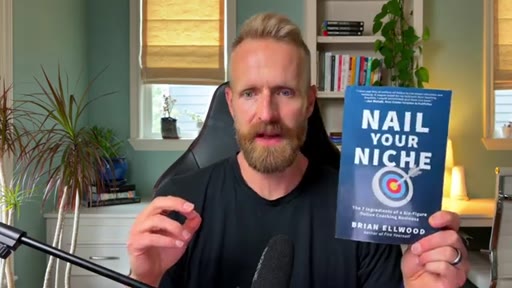
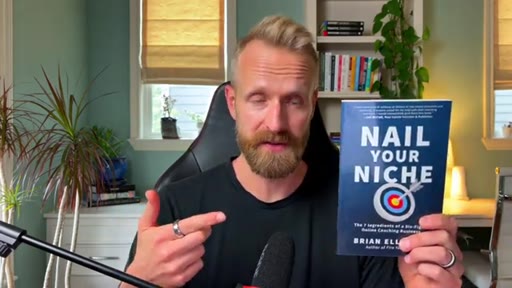
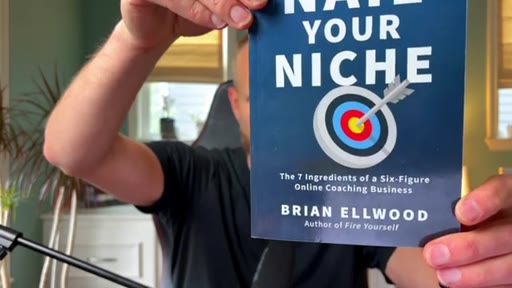
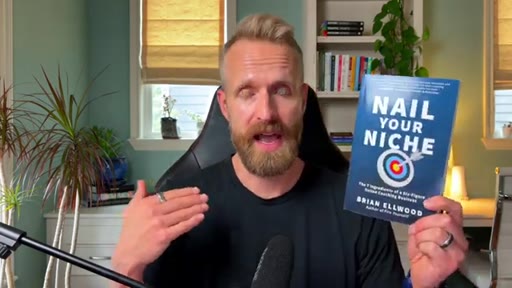
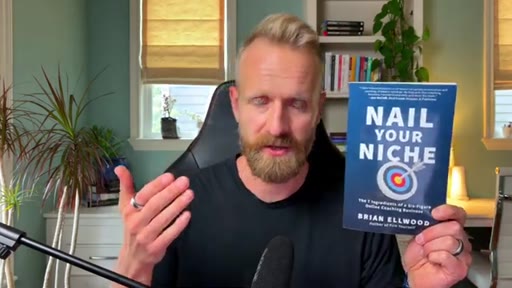
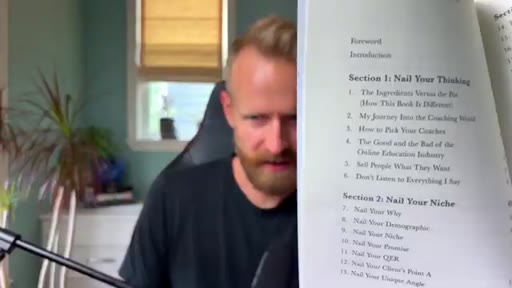
03 · Live autopsy: Nail Your Niche
Uses the host's own second book as a negative example — shows how the title, subtitle, and chapter selection all stray from a central argument. Points out specific chapters that should have been deleted. Personal, self-deprecating, concrete.

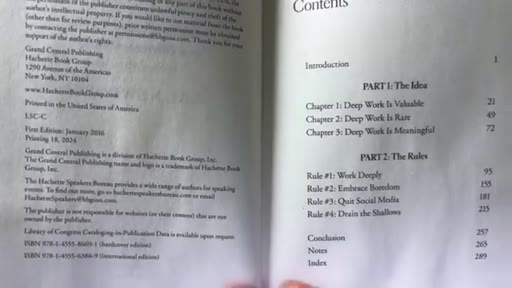
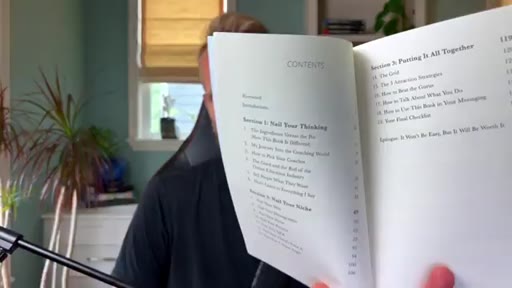
04 · Best-practice example: Deep Work
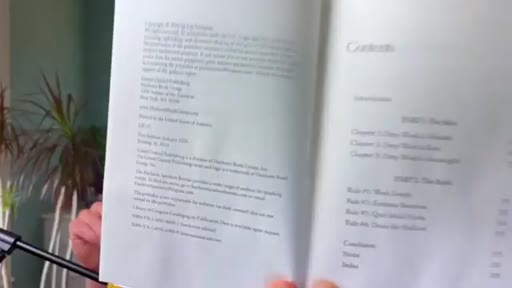
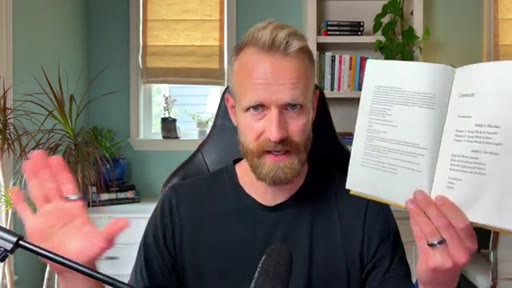
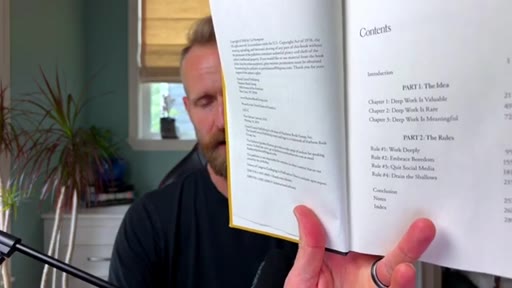
Holds up Cal Newport's Deep Work as a through-line masterclass. Walks through the table of contents to show every chapter serving one argument. Introduces the principles/practices structure as a reusable framework.

05 · The green smoothie analogy
Uses a personal green smoothie recipe to show how any expert topic can be stripped to a single audience-targeted argument. Demonstrates the golden thread test: state the book's idea in one sentence a non-expert understands.

06 · Agora data + one-idea-per-chapter rule + final CTA
Cites Agora's finding that single-idea content consistently outperforms multi-idea content, extends the rule to individual chapters, delivers the final call to action to watch the full Claude book-writing tutorial.
Visual structure at a glance.



Named ideas worth stealing.
The Golden Thread (Through Line)
Every chapter in a great book maps back to a single declarative argument — the golden thread. Missing it produces a manuscript that confuses readers and fails commercially.
Principles/Practices Book Structure
- Part 1: How to think (principles)
- Part 2: What to do (practices)
A two-part structure that forces the author to separate concept from execution, naturally reinforcing the through-line because both halves serve the same thesis.
Agora One Big Idea Rule
Agora studied millions of newsletter and blog pieces and found that content centered on one idea outperforms content mixing two or more ideas. Extended here to books: one idea per book, one idea per chapter.
Lines you could clip.
"Writing the book with or without Claude is really just one piece of a much larger ecosystem."
"When I rewrite this one day, I'm just gonna delete that chapter entirely."
"Take the time to get clear on the big idea for your book, which will act as that golden thread that passes through it."
Things they pointed at.
How they asked for the click.
"You can grab my book, the author operating system. The link is in the description in the pinned comment. It costs less than a cup of coffee."
Early mid-video CTA at ~2:28, before the main teaching even begins — inserted after the stakes setup but before the framework. Classic funnel-in-a-video structure. Second CTA at 13:57 pointing to a next-video tutorial.
Word for word.
The golden thread is a positioning decision, not a prompt.
Claude will generate as many chapters as you ask for — but it has no way to know if they all serve the same argument unless you've already decided what that argument is.
- Before writing a single chapter with AI, write one sentence that states your book's central argument — if you can't, the manuscript will sprawl regardless of how good the prompts are.
- The traditional publishing industry enforces the 'through line' via editors and proposal gatekeepers; self-publishing with AI removes that filter entirely, making it your job.
- A mismatched title and subtitle is a reliable early signal that the golden thread is broken — fix the concept, not the wording.
- Deletion is the right edit for a chapter that doesn't serve the central argument — not revision, not repositioning, deletion.
- Each chapter should carry exactly one sub-idea of the book's central thesis; when a chapter has two ideas, split it or cut one.
- Agora's large-scale newsletter data confirms what great books demonstrate: content built around one idea outperforms content mixing two or more — every time.
- The principles/practices split (how to think, then what to do) is a reliable structure that naturally enforces a through-line because both halves must serve the same thesis.
- The simplest test for a working golden thread: state the book's argument in one sentence a non-expert would immediately understand — if you need qualifiers or conjunctions, the idea isn't singular yet.