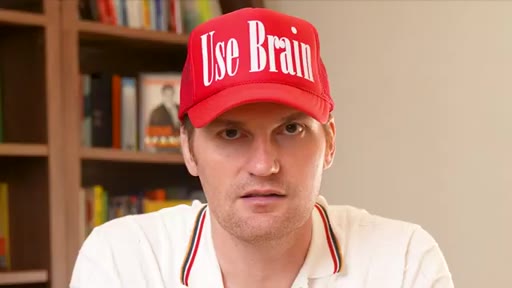

The bait, then the rug-pull.
Eleven principles. Nineteen years. A quarter billion dollars in digital product sales. The host opens with a credential so large it either stops you cold or sends you straight to the comments, and then delivers on it, numbered tip by numbered tip, for the next fifteen minutes.
Where the time goes.
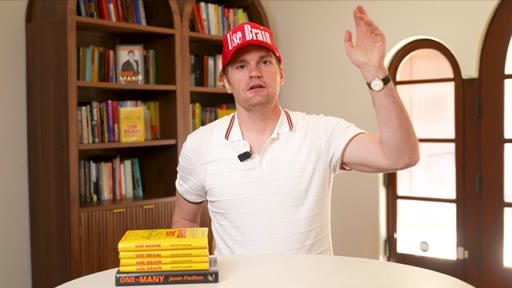
01 · Sell instant gratification
Find a solution people already pay for and deliver it in half the time. The microwave potato analogy. AI prompt template: how to get a specific result in a specific time frame with specific conditions.

02 · Engineer the quick win
Products must deliver a win within the first ten minutes. Four win types: speed, clarity, relief, confidence. Skip warmup and history; lead with the best secret on page one.

03 · Narrow your focus
Specificity makes quick wins possible and makes AI output useful. Real estate agents plus Instagram listing templates beats going viral on Instagram. Broad topics cannot be templatized.
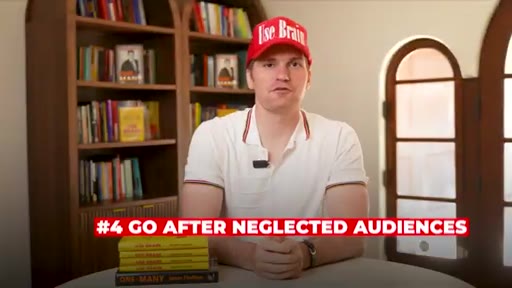
04 · Go after neglected audiences
Three conditions: they have money, the problem is urgent, their options are bad. Use AI to mine Amazon reviews and Reddit for frustrated buyer signals.
05 · Outcomes over information
Information gets in the way of outcomes. Fasting works not because of science but because it removes friction. Teach less, simplify further. Five Love Languages as the benchmark.
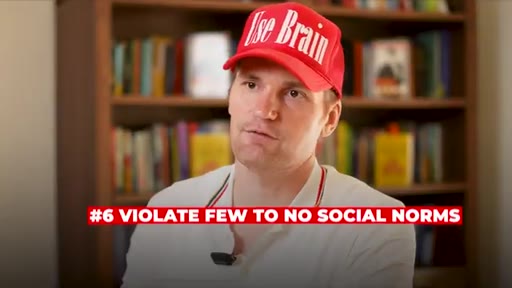
06 · Violate few to no social norms
Buyers will not use tactics that feel wrong even if they work. David DeAngelo beat the PUA niche by teaching socially acceptable dating. AI can execute uncomfortable tasks on the buyer's behalf.

07 · Easy to explain, easy to accept
10,000 steps beats insulin sensitivity cycles. Find the round-number emotionally accessible concept in your niche. Use AI for explain-it-like-five rewrites.

08 · Use Parkinson's Law
Products expand to fill creation time. Extreme deadlines force outcome focus. AI speeds creation; you write the 20% that matters, AI fills the rest.

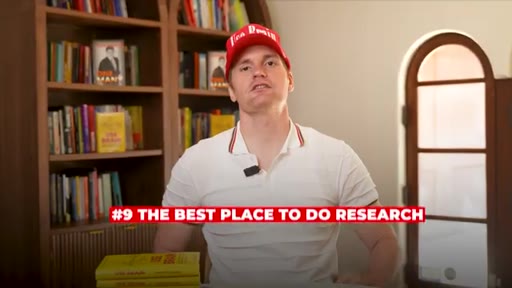
09 · Research competitor products
Long-form sales letters, webinars, and challenges are goldmines. Use AI to analyze competitor promises and deliverables, then combine the best elements.

10 · World-class experts are cheap
Mr. Olympia: $100/hr. Emmy-winning scriptwriters: $80/hr. Studio musicians: $50/hr. Interview five experts, have AI synthesize the best. Total cost under $1,000.

11 · Crawl, walk, run
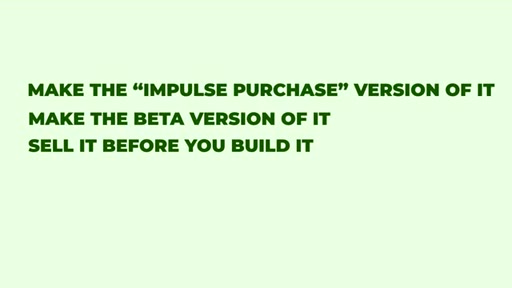
Three launch modes: impulse-purchase version, beta version, full production. The $9.8M affiliate launch was the fifth iteration. Validate market fit fast before gold-plating.
Visual structure at a glance.
Named ideas worth stealing.
Instant Gratification Formula
- How to [specific result]
- in [specific time frame]
- without/with [specific conditions]
A positioning template for generating digital product ideas that lead with speed. Forces the creator to define the exact outcome, timeframe, and constraints before building.
Four Types of Quick Wins
- Speed win: I did this faster than usual
- Clarity win: I now know exactly what to do
- Relief win: I no longer have to worry about this
- Confidence win: I can actually do this
A taxonomy for identifying what kind of early result your product should engineer. Any of these four counts as a win within the first ten minutes of consumption.
Neglected Audience Filter
- They have money
- Their problem is urgent
- Their options are bad
Three-condition filter for identifying underserved buyer segments with real purchase intent. Find niches where existing products aim at the wrong persona.
Crawl-Walk-Run Launch Sequence
- Crawl: impulse-purchase version, cheap, fast, validates demand
- Walk: beta version, no polish, just the core solution
- Run: full production version added only after market fit is confirmed
A three-stage product launch model that prioritizes validation speed over production quality. Value compounds across iterations.
Lines you could clip.
"Any win will feel huge to someone who just paid you money for a digital product."
"If you make AI do all the generic stuff like write me a book, it sucks. But if you niche down to a super duper specific task and have the AI do it, it does it amazingly well."
"World class expertise in most fields is comically cheap."
"The information often gets in the way of the outcome because you get into the nuance and the exceptions and all of the details."
Things they pointed at.
How they asked for the click.
"the fancy digital product strategies that I teach all my consulting clients and that I teach inside of my product eClass program"
Soft close framed as scratching the surface, pointing to a paid program for deeper strategies. No hard pitch, no price mentioned.
Word for word.
Eleven rules for building products people actually finish.
Most digital products fail at the moment of first use, and the fix is not better information but a faster, more specific win engineered into the first ten minutes.
- Products succeed or fail at first use. A buyer who gets a small win on the first attempt becomes a testimonial; one who gets nothing becomes a refund.
- The fastest path to a quick win is a narrow problem. Specific audiences with specific problems can be given templates; broad audiences need niche selection coaching before any real help begins.
- Information density is inversely correlated with results. The more exceptions and nuances in a product, the harder it is to follow, regardless of how accurate the content is.
- AI produces excellent output on hyper-specific tasks and mediocre output on broad ones. Narrowing the scope of a prompt mirrors narrowing the scope of a product.
- Audiences with money, an urgent problem, and bad current options are systematically underserved because most creators aim at the largest visible audience rather than the most frustrated one.
- Tactics that violate social norms will not be implemented even when they work objectively. Products that require uncomfortable behavior need either a socially acceptable alternative or an AI proxy to do the uncomfortable part.
- The round-number, easy-to-explain version of a concept outperforms the technically correct version in behavior change because acceptability determines whether anyone tries it at all.
- Validating product-market fit in a single low-effort launch costs almost nothing; building the polished version before validating costs weeks and often the entire business case.
- World-class domain expertise is available for interview rates under $150 per hour in most fields. A $1,000 research budget spent on five expert interviews, synthesized with AI, produces more credible content than months of solo research.
- Setting an extreme creation deadline forces the creator to strip the product to its essential 20%, which is often where all the value was anyway.