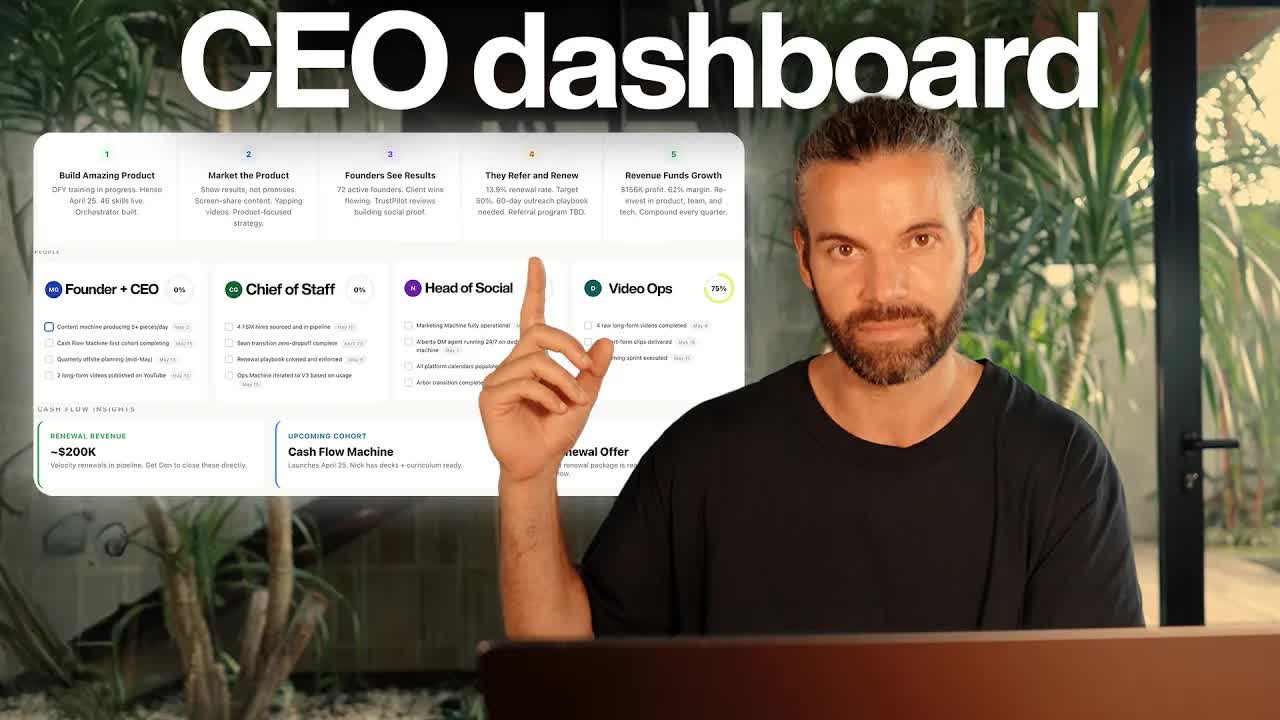
Matt Gray · Youtube · 19:01

I Built a Complete Business Operating System Using Claude Code

A live walkthrough of the AI-built internal dashboard running a 17-person, $700K/month company.

Posted
May 29th 2026
3 days ago
Duration
19:01
Format
Tutorial
educational
Channel
MG
Matt Gray
§ 01 · The Hook

The bait, then the rug-pull.

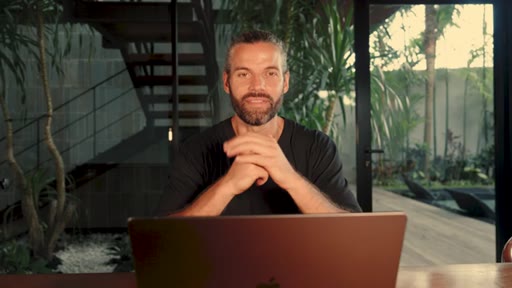
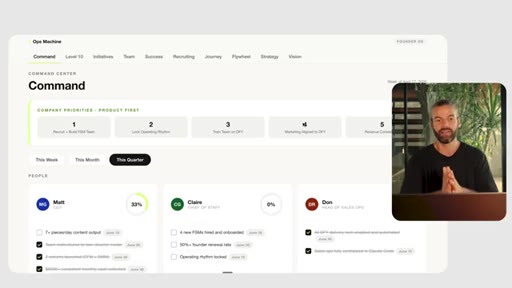
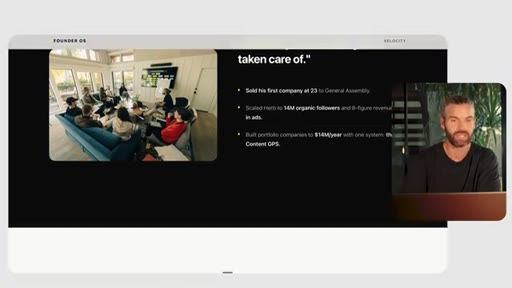
Before the title card clears, the dashboard is already on screen. No cold open, no teaser montage — just the claim, stated flat: a 17-person, $700K/month company running in real time through a single tab. What follows is a 19-minute screen tour of what it actually looks like to stop holding your company in your head.

§ · Chapters

Where the time goes.

00:00 – 00:53

01 · Hook and Problem Frame

Dashboard intro, promise stated. Founder exhaustion diagnosed as trying to hold the company in your head. Three pillars every core team needs: dashboard, meeting rhythm, clear OKRs.
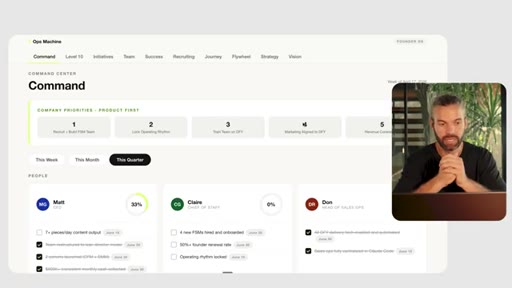
00:53 – 06:17

02 · Command Center

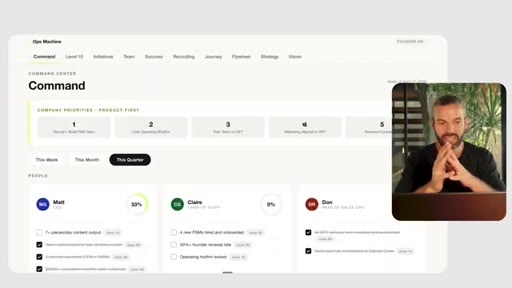
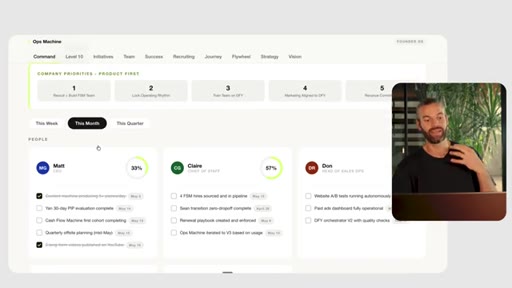
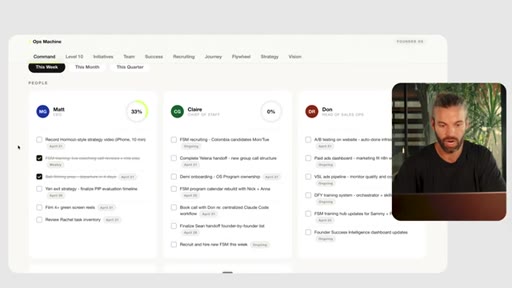
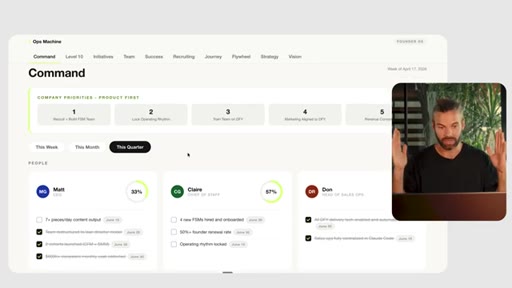
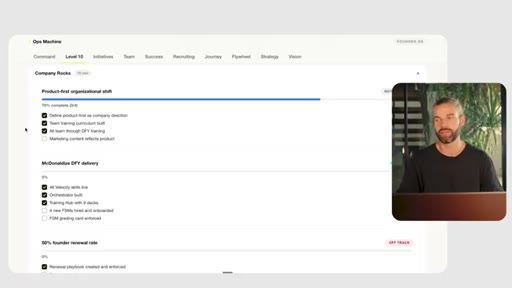
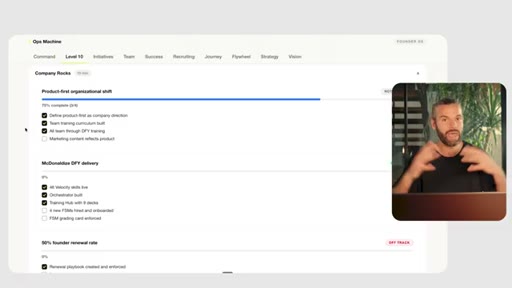
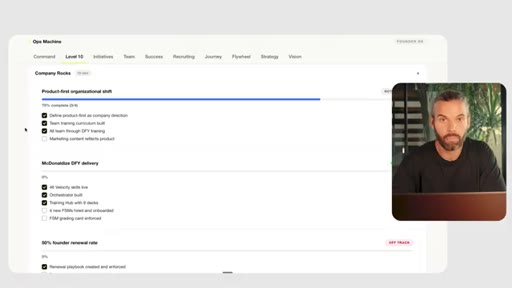
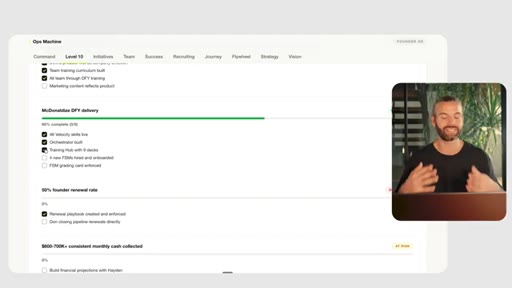
Quarterly rocks with subtasks, people scorecards with completion percentages, week/month/quarter task drill-down. Demonstrates shared goal visibility as the driver of urgency.
06:17 – 08:06

03 · Level 10 Meeting

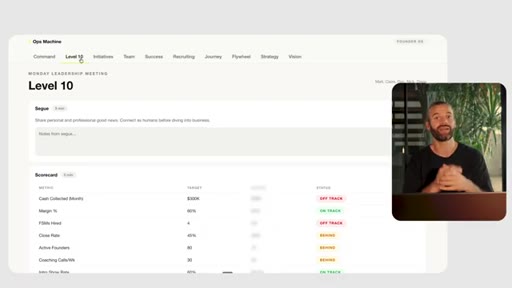
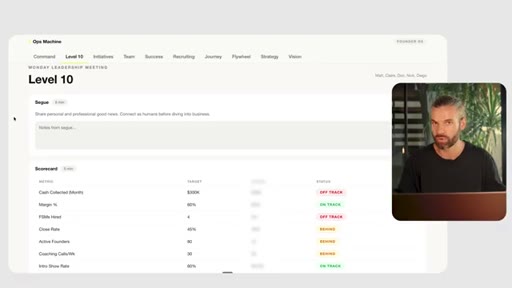
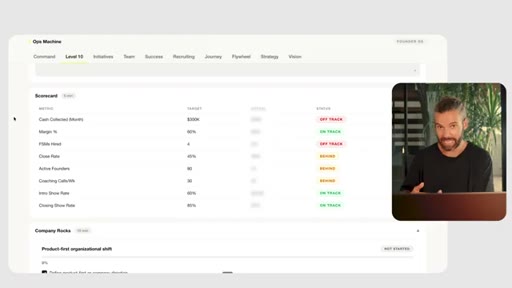
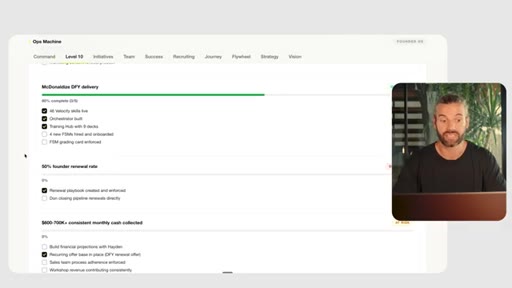
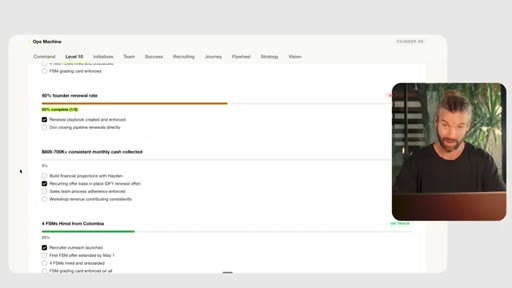
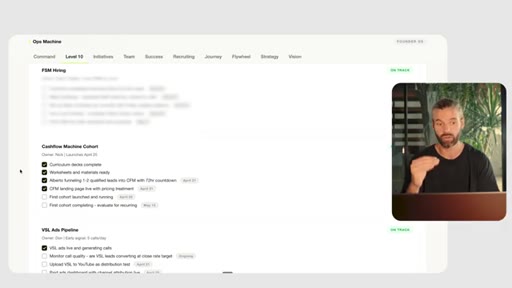
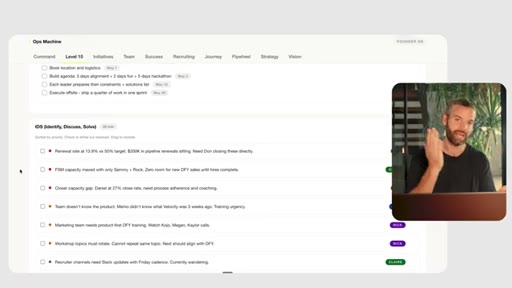
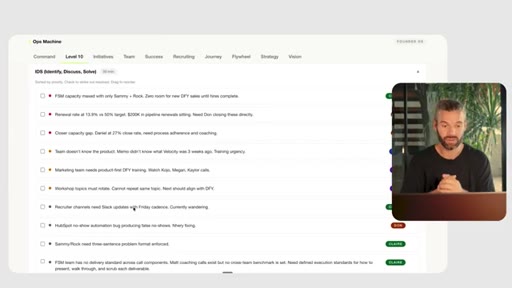
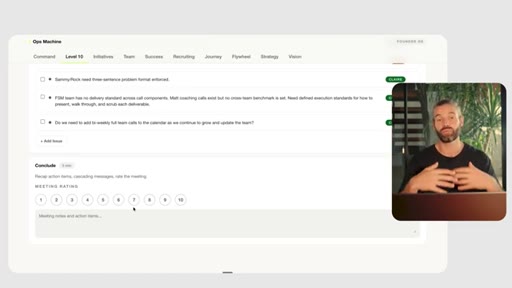
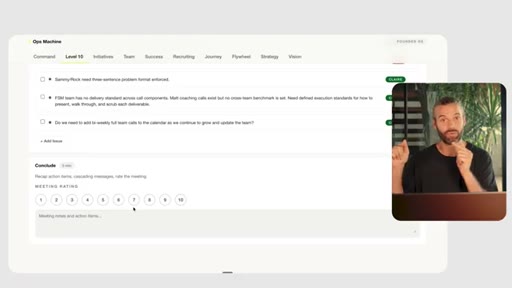
Traction-based meeting structure: wins, scorecard with ON TRACK / OFF TRACK / BEHIND KPIs, IDS issues section, meeting rating. Fathom-to-Claude auto-update pipeline introduced.
08:06 – 10:11

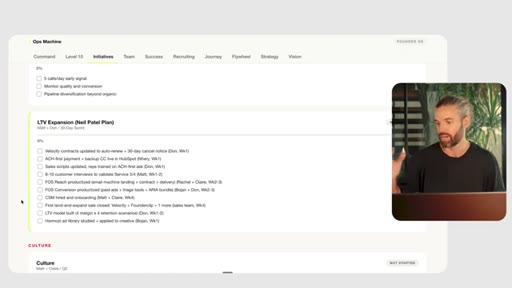
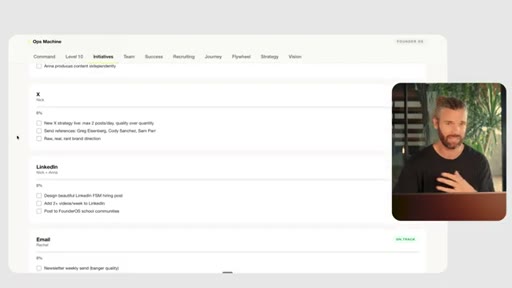
04 · Initiatives Tab

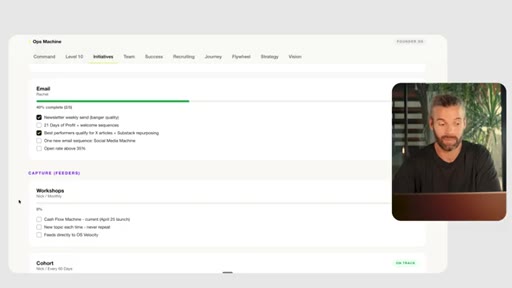
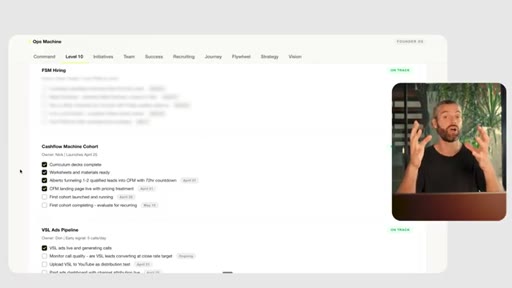
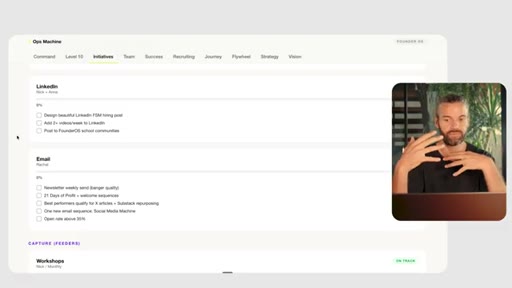
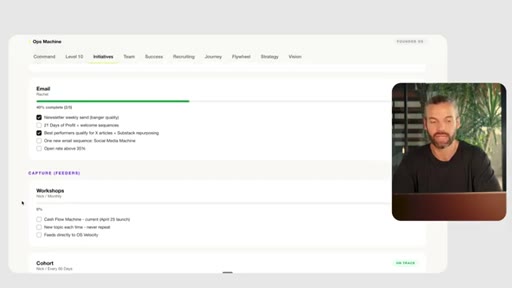
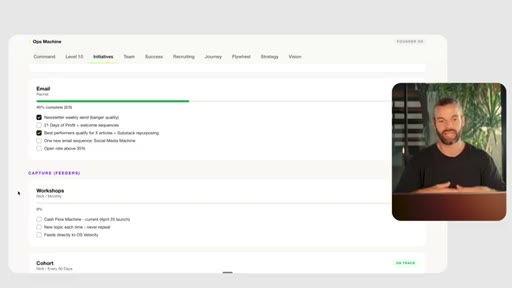
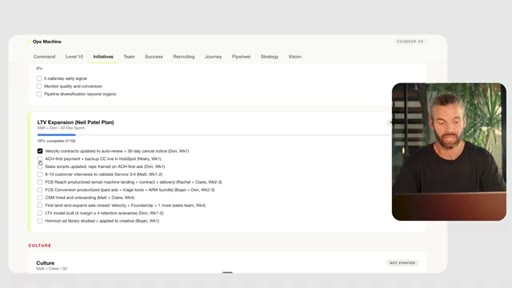
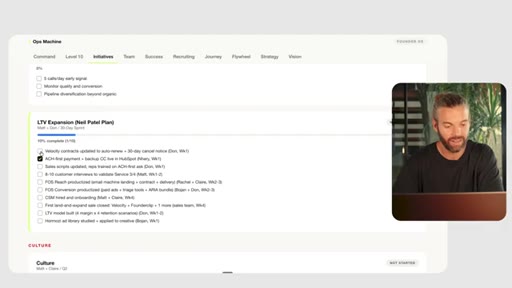
Media platform, email, workshops, cohort — all with completion bars and due dates. Advisor call action plans auto-pushed by Claude into relevant initiatives after Fathom recording.
10:11 – 12:03

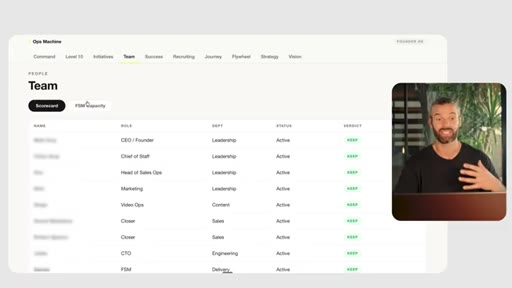
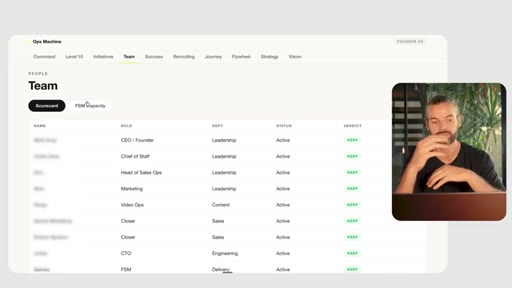
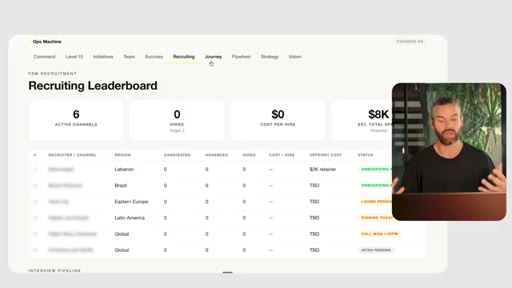
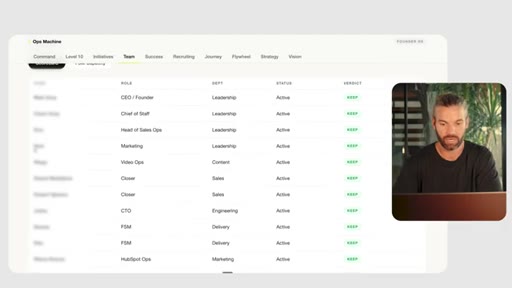
05 · Team and Recruiting

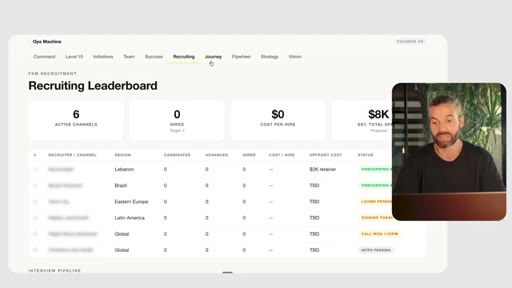
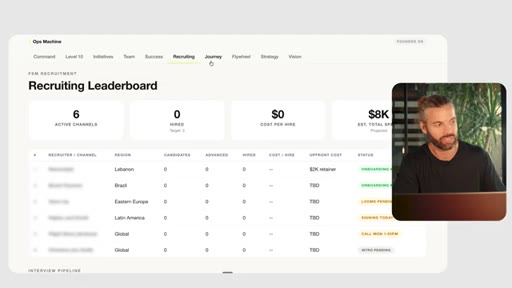
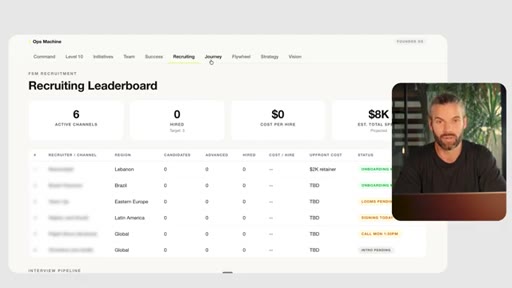
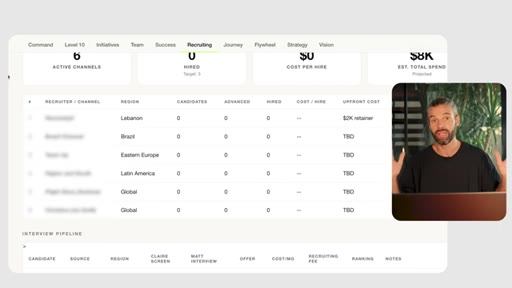
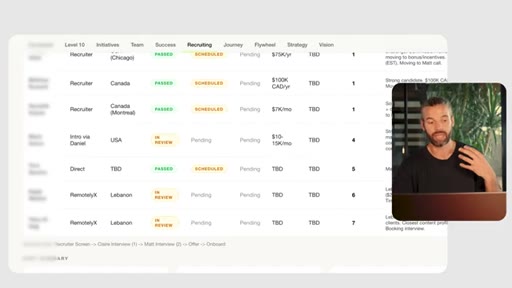
Team roster with KEEP verdicts. Recruiting leaderboard: 6 active channels across Lebanon, Brazil, Eastern Europe, Latin America. Elon Musk exceptional interview question. Careers plug.
12:03 – 14:42

06 · Journey and Flywheel

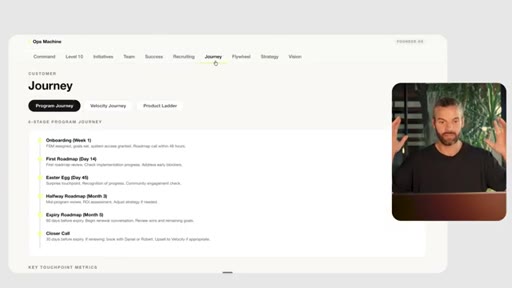
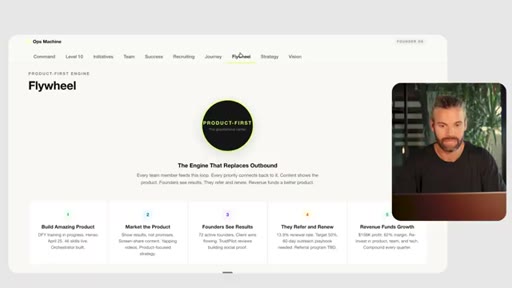
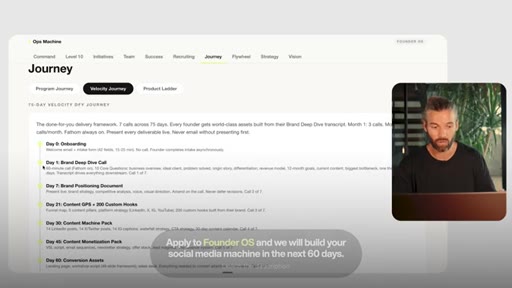
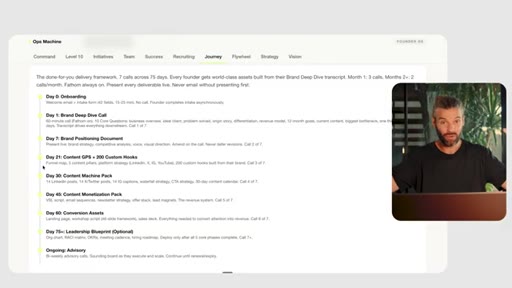
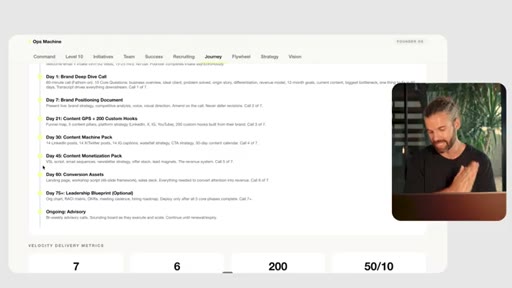
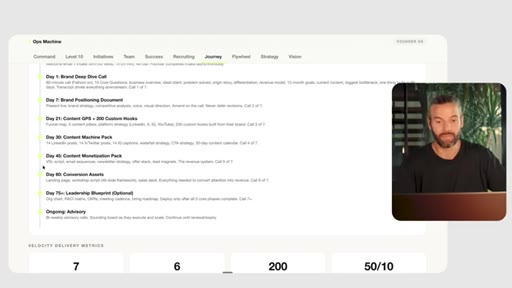
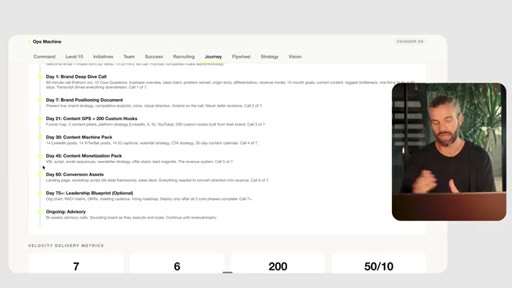
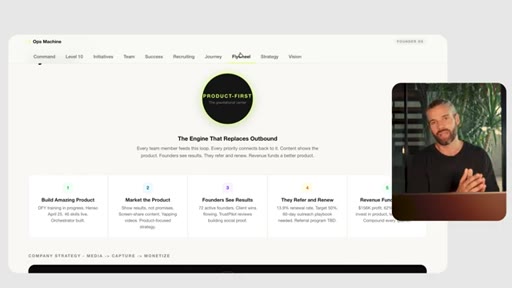
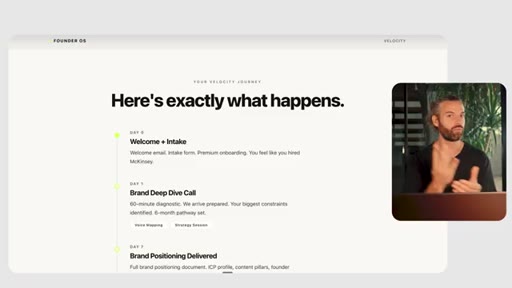
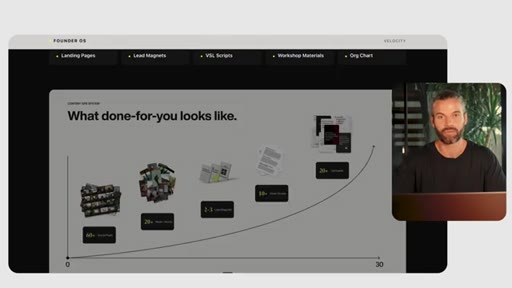
75-day Velocity DFY journey: 7 calls, 60-plus deliverables, delivery metrics. Flywheel model: product obsession drives results, results drive word of mouth, word of mouth drives growth.
14:42 – 17:00

07 · Strategy Tab

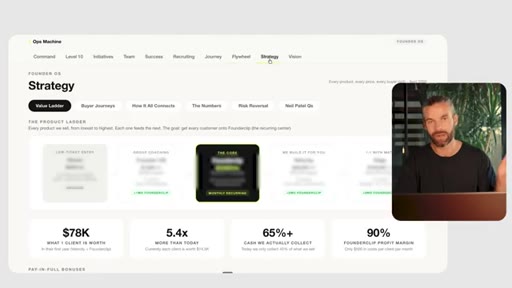
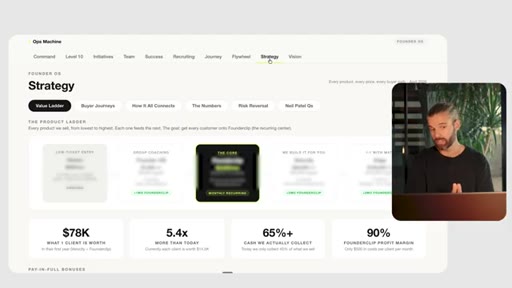
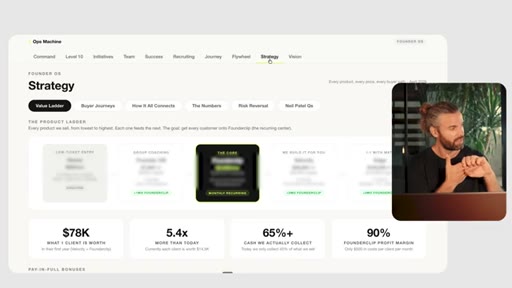
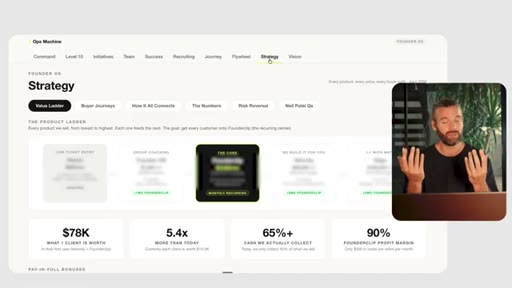
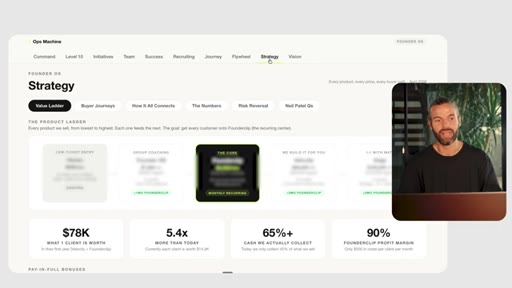
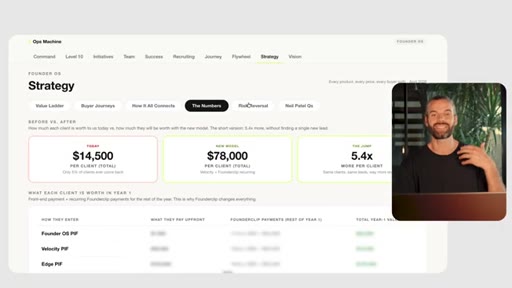
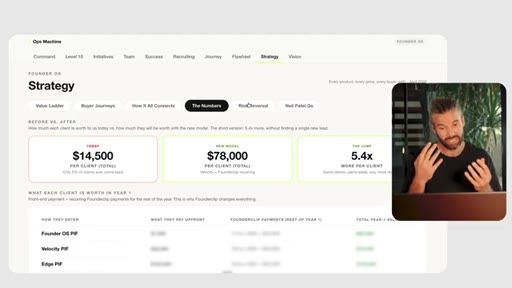
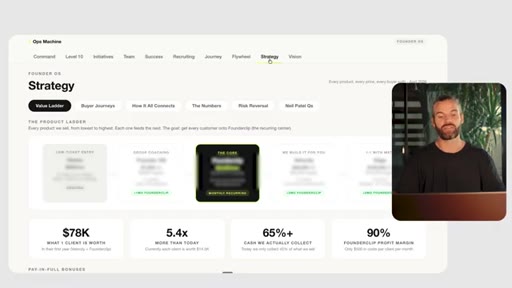
Value ladder, key metrics: $78K LTV/client, 5.4x more than average, 65% cash collected, 90% profit margin. Weekly advisor call rhythm with Claude-generated action plans auto-loaded.
17:00 – 18:28

08 · Vision Tab

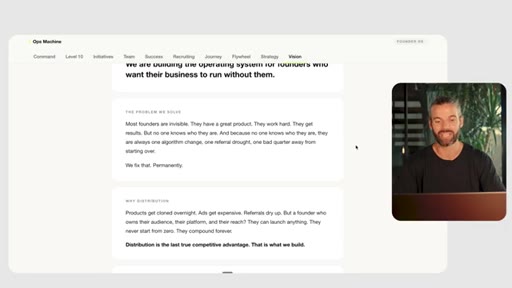
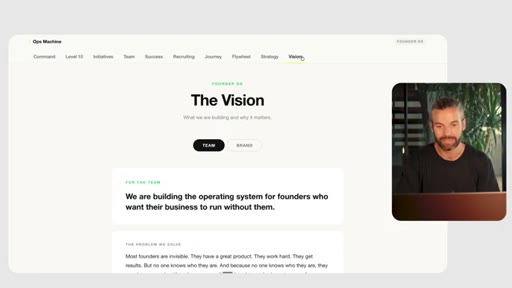
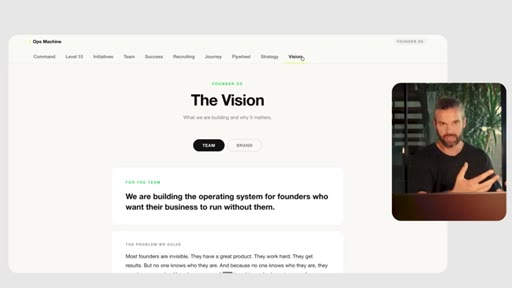
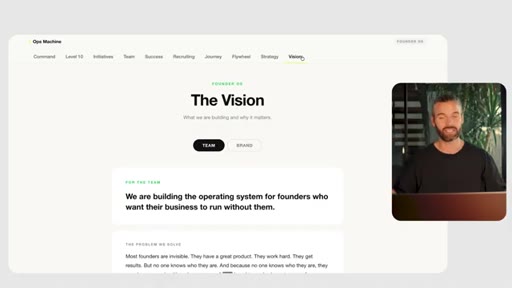
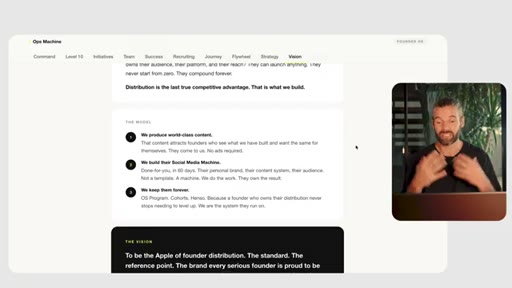
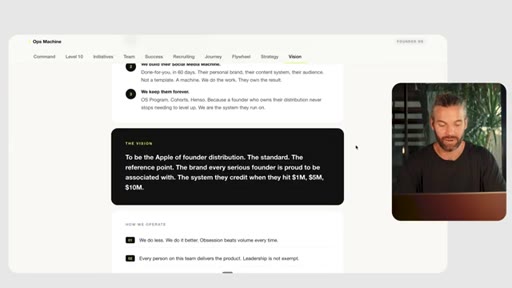
Mission: operating system for founders who want their business to run without them. Apple of founder distribution aspiration. Marc Benioff vision card reference.
18:28 – 19:01

09 · CTA and Close

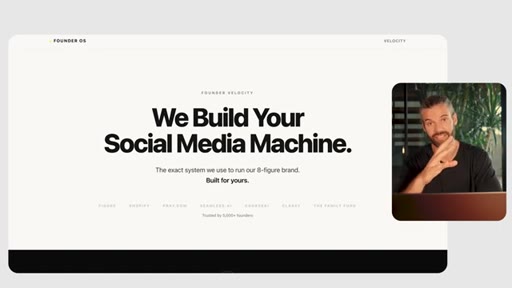
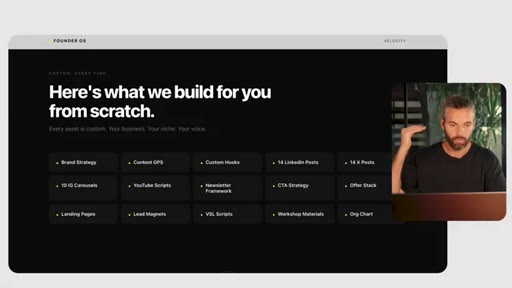
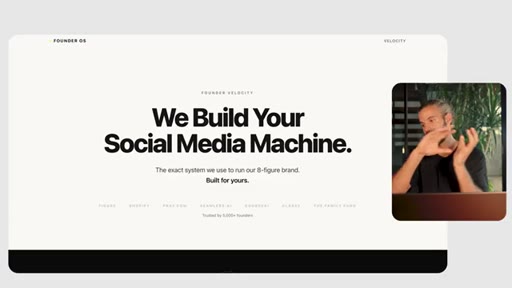
FounderOS Velocity done-for-you pitch: intake form, brand deep dive, social media machine, access to named team members. Link in description. Outro points to next video.

§ · Storyboard

Visual structure at a glance.

open
dashboard
level 10
initiatives
team
journey
strategy
vision
cta
§ · Frameworks

Named ideas worth stealing.

01:37 model

Level 10 Meeting

  1. Wins and segue
  2. Scorecard review
  3. Issues and opportunities IDS
  4. Conclude and meeting rating

Weekly leadership meeting structure from Traction by Gino Wickman. Fixed agenda, scored 1-10, forces all off-track metrics into a solvable issues list.

Steal for Any team running recurring leadership standups that drift into status updates instead of decisions
00:53 concept

Company Rocks

  1. 5 quarterly priorities
  2. Subtasks per rock
  3. Week and month and quarter drill-down

90-day top priorities with subtasks that ladder up to monthly and quarterly goals. Creates shared urgency and a shared scoreboard.

Steal for Quarterly planning cycles for teams of 3 or more
03:48 concept

McDonaldizing Delivery

Systematizing every client deliverable so any team member in any city produces identical output quality. Enables scaling from 5 to 12 CSMs without founder bottleneck.

Steal for Any service business preparing to hand off delivery from founder to team
07:33 model

Fathom to Claude Auto-Update Loop

Record every advisor call on Fathom, pipe transcript into Claude Code, Claude pushes action items directly into the relevant dashboard initiative. Company brain that writes itself.

Steal for Any founder who takes advisor calls and loses the insight to their notes app
12:29 concept

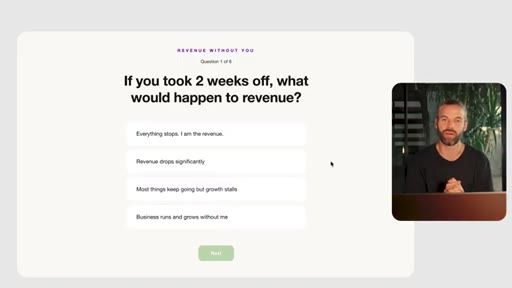
Founder Freedom Score

Four-minute diagnostic quiz identifying which business constraint traps the founder: priorities, leadership, customers, or strategy. Free lead magnet with workshop CTA on completion.

Steal for Lead magnet design for B2B founders — diagnostic quizzes outperform ebooks because they personalize the follow-up pitch
§ · Quotables

Lines you could clip.

00:35
"Your head is not a system."
Six words. No setup needed. Diagnosis and punchline in one. → TikTok hook
00:40
"Founders who run one are leading their businesses while everyone else is being run by theirs."
Tight contrast, quotable framing, positions the product without naming it. → IG reel cold open
02:17
"To me, fun is winning."
Punchy reversal. Reframes company culture in four words. → Newsletter pull-quote
08:49
"Make sure that any meeting that you are on inside of your company, you have got that shit recorded — and that it is being fed into Claude so that you build this kind of company brain."
Concrete, actionable, memorable in a how-to context. → TikTok hook
16:57
"Systems have become skills. My brain can be poured into an orchestrator."
Dense insight, AI-native framing, stops the scroll for any builder audience. → IG reel cold open
§ · Resources Mentioned

Things they pointed at.

01:37bookTraction by Gino Wickman
07:33toolFathom ↗
00:39toolHubSpot ↗
17:33bookInto the Cloud by Marc Benioff
§ · CTA Breakdown

How they asked for the click.

12:29 link
"It takes about four minutes. Link is in the description, so go do that right now, then come back."

Mid-video quiz CTA is well-placed and low-friction. Second CTA at 18:30 is a direct sales ask framed as a free diagnostic call, reducing perceived commitment.

§ 04 · The Script

Word for word.

HOOK opening / re-engagementCTA the pitch metaphor analogy
00:00HOOKThis is the actual dashboard running my 17 person, $700,000 a month company in real time. Not me solo, not Slack, not a spreadsheet, this.
00:09HOOKOkay? And the sad reality is that behind most businesses making 30 k a month or even 1,000,000 a month, it's the founder who is starting to feel a specific kind of exhaustion that they just can't explain. The problem is they're trying to hold the entire company in their head, and your head is not a system.
00:24HOOKWhat you're going to see is exactly how I use this real operating system to go and run my company, and why founders who run one are leading their businesses while everyone else is being run by theirs. This is my ops machine. I've used Cloud Code mixed with Vercel,
00:39HOOKcombining it with a lot of the data that I store in HubSpot to go and create this one stop dashboard for everything I need to run my core team. There are three things that I think every core team needs.
00:52HOOKDashboard, an amazing meeting rhythm, and you need make sure that your team has clear objectives and key results. And so gonna get into every one of those pieces here.
01:01So starting out with the command center. Right? This is like the cockpit of the company.
01:05Right? We're able to see the core company priorities here, things like going and recruiting and building a badass founder success team. So what I can do here with all of these goals, right, is go and see all of our goals across our week, you know, across the core leadership team.
01:21Right? And as we go and check these off, right, they gradually go and just kind of show that progress bar, which is pretty cool.
01:28So we're able to, every single week, just chip away at the core task we need to get done every single week, then how that ladders up to our given month and what we're working towards. Right? And then similarly, how that goes and ladders up to what we need to get done in a given quarter.
01:41This is the big thing that I'm, you know, huge on in my business. Right? It's creating, like, this maniacal sense of urgency.
01:45Right? And so if we all have a clear direction, clear goals for the week, for the month, for the quarter, we are all rowing at the same rhythm. This next piece is the level 10 meeting.
01:55Okay? This comes from a book called Traction by Gina Wickman. This book really talks about the importance of running level 10 meetings inside of your company.
02:03Now, the structure for the level 10 is a game changer. You start off with wins. Right?
02:07So what are people on the team going and accomplishing? Let's share those. Get the energy going.
02:11Right? The more, you know, energized the team is, you know, the more that that just flows through to results, momentum, all that good stuff.
02:18Right? To me, having fun in a business is about ping pong tables and some bullshit culture initiatives. Right?
02:24To me, fun is winning. Right? I view building a business like a sports team, and that's why just like in a sports game, right, you've got some sort of scoreboard.
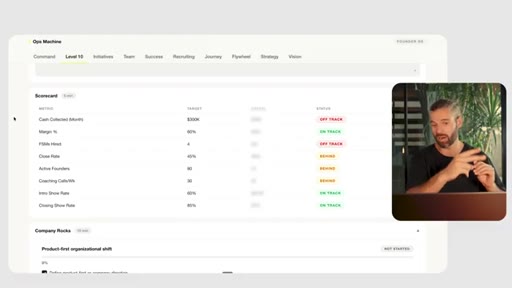
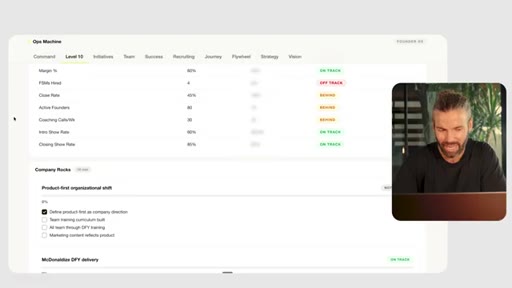
02:31Well, we've got a scoreboard inside of our company as well, showing things like cash collected, our margin, the FSMs that have been hired, our close rate, show rate, all that good stuff. Right? So that we know across the core business what we're on track, off track, and what we may need to get, you know, kind of grooving on.
02:47Why this is important is that on these leadership meetings each week, what we're aiming to do is understand what's off track because then we bring that down to something called the issues and opportunity section, which I'll get to here in one minute. Okay?
02:59Now, across the company, I think the core job of the CEO, right, is to set the company goals.
03:06Everything inside of FounderOS, giving founders their founder operating system, and really helping, you know, eliminate the use of, like, a 100 different spreadsheets, hundreds of different Google Docs, different teams running off of Notion, one person on Google Workspace, another person on ClickUp, you know, another person on HubSpot, and your business just becomes this, like, mess.
03:27Right? And to me, that's what leads to founder chaos. My theme this year in really helping founders is helping turn them into architects
03:34versus just the pure operator in their business. And, you know, things like the ops machine are my, you know, products that I'm trying to birth and help founders go and implement in their businesses. In addition to that, right, I'm really big on kind of McDonaldizing
03:48our delivery. Right? I want, you know, almost like when you go to McDonald's in Tokyo or Paris or New York, you're getting that same kind of product.
03:55Well, that's exactly what we're doing in Founder West, to really systemize every single part of it, make it insanely scalable, scaling our team from five customer success managers to about 12 over the next four months. So things are growing at a good clip and just need to obviously make sure that as we grow, those systems get sustained.
04:13From there, you know, it's a lot of, like, focusing on retention at a business our size, trying to get to a $2,000,000 a month. It's a game of just retention, retention, retention. And so the best way to do that, right, is just to be product obsessed, deliver an amazing product for founders, really embed the infrastructure that we've made into their businesses, making their lives easier, getting their team more aligned, helping reduce the confusion inside of their business, and really, you know, helping founders across all the different departments.
04:41Right? And from there, if we're doing our job, founders are sticking with us for years to come. What I want you just to gather from this is less like the details of my business, although, you know, happy for you to see it and be transparent.
04:50But is this this idea of, like, imagine your own business. Right? If you had every core initiative, every company goal, all listed, and all the subtasks around there, imagine how much tighter your business would be.
05:01HOOKThis is what it's all about. Right? It's about knowing the details and having every single task laid out across all core niches so that nothing slips
05:09HOOKbetween the cracks. That, to me, builds a formidable empire. This is what we do.
05:14HOOKWe just go from top to bottom through this, making sure that every single project is on track. If anything's missing, we talk about it, and we move it down to the identify, discuss, and solve section here.
05:23HOOKYou can see that we can go and move these areas around. You know, we can move different aspects up if we think it's a higher priority, and what this allows us to do is just make sure that as a leadership team, we're addressing the biggest issues that may come up. We're solving those first and working our way down this list.
05:37You can imagine this whole meeting, we're doing it on Zoom. My team's all over the world, and all these meetings are recorded on Fathom. From there, we're able to go and automatically pipe that Fathom recording into Cloud Code, and this whole ops machine and this meeting rhythm is automatically updated.
05:53No more going in, you know, what did we say last week, or what happened four weeks ago that we committed to? No more of that stuff. Right?
06:00Make sure that any meeting that you're on inside of your company, you've got that shit recorded, right, and that that's being fed into Claude, right, so that you build this kind of company brain. Now from there, we've got the initiatives tab. Right?
06:12So this just really measures all the core aspects of our company. Right? We've got our media platform across YouTube, Instagram, LinkedIn x, right, and bunch of initiatives going on there.
06:21Things like, you know, new styles of infographics. We're doing more raw, real rant type content just like this right now on YouTube and on Instagram. Hope you like it.
06:30With all that, right, just involves, like, different stuff going on across the team. Right? Different things that we wanna keep track of.
06:36And this is how we kind of make sure that, you know, all the core initiatives are moving forward in a nice way. We're able to track progress, see when things are behind, and basically just make sure that we're all moving forward in one organized way. Know, on the front end, right, you guys see my brand.
06:49You know, a lot of you guys have said, you know, it looks really tight. We seem to have everything together. It's really polished.
06:54Well, the way that all happens in the background, right, we're just running a seriously tight operation. And too many founders I see, you know, that come to us in FounderOS. Right?
07:02They, you know, feel like they're just operating some house of cards, that everything at any moment could just fall apart. You know? The same systems that work for you at a million dollars a year start to break at $5,000,000 a year.
07:13And so that's why this kind of dashboard, right, a good meeting structure, and clear goals and rhythm across your team are so imperative. The cool thing about this as well is that, you know, in any given week, right, I'm talking to different advisers of mine, and I'm constantly learning.
07:26Right? So folks like Dan Bolton, you know, Neil Patel, have a conversation today with Ryan Claude. And after those conversations,
07:34Claude is going and then pushing in different recommendations and action plans that need to get done. So this morning, had a call with Neil Patel. Now I can see this whole LTV expansion plan has all been added into
07:46our actual initiatives here. Right? So things like getting clients on ACH first payments and having a backup credit card there, something that he's seen work in the companies he runs, which he's been cranking it for twenty plus years now.
07:59And then some recommendations on where we can find CSMs, different kind of ways of building out our conversion infrastructure. So lots of cool stuff there.
08:07When we get to the team, right, it's also a bit of a team scorecard. Right? Being able to see kinda scorecards across the team, who are the active members of the squad,
08:15which is a nice place for us just to have, like, that one stop shop view of everyone on the team right now, and as well as look at things like our capacity on our team. When you're building a team, I see it almost like a sports team.
08:27Right? And you're building your own fantasy roster. Right?
08:29So this is my fantasy roster. I think building a business is kind of like, you know, a video game, and this lets me see the squad that we've got today. Right?
08:37And understand just, you know, where we can improve, where we're maybe seeing some gaps,
08:43areas we can automate. You know, just nice to have that one stop view. Any business is only as strong as its recruitment.
08:50Okay? And so about 30% of my job at least is recruiting. You know, I was just on an interview before filming this video.
08:57This quick side note, my favorite interview question to ask, and I learned this from Elon Musk, is tell me about something that you've done that is exceptional. Why I think this is an interesting question, right, is that you end up hearing responses, anything from stuff that's actually exceptional. Like, this last guy had built his organic audience on Instagram to over a 180,000 followers all the way through to things that are not all that exceptional.
09:19Someone I talked to a few days ago had helped a high school person go and win, like, a little science experiment, and I just was like, alright.
09:29Like, interesting, but not quite, like, exceptional in terms of the level of caliber we're we're looking to bring people on. Right? So good test to try to really understand what people are capable of, what they've actually done in their life.
09:40And if it's mind blowing and truly exceptional, those are the kind of people we wanna hire. Inside of a recruiting leaderboard, we're recruiting people from all over the world. Right?
09:47We've got recruiters in Lebanon, Brazil, Eastern Europe, Latin America, you name it. If you're interested, by the way, in joining Founder OS, we're currently hiring folks like salespeople, customer success people. You can go and check out Founder OS and apply at founderos.com/careers.
10:03Okay? And so inside of this, then we're just constantly going and monitoring our pipeline, keeping our eye out for quality people.
10:10And, you know, when we find great people, bringing them on board and running them through the systems that we have for onboarding. I think what's most important is as you're building a team, right, everyone understands the journey that your customer goes through.
10:22Right? Everyone in your company must be product obsessed, and they must understand the strategy. So here, we have the founder journey.
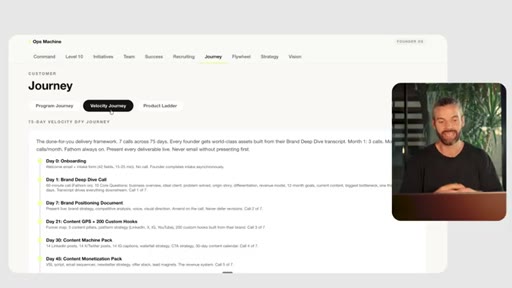
10:29Okay? When someone joins Velocity, as an example, which is our core product here at FounderOS, we go and build their entire social media machine for them. Across seventy five days, there's seven calls, and we deliver around 60 different assets for them, helping them go and scale up their, like, organic content machine.
10:46Okay? So it includes things like an onboarding call right away. We then do a bit of a brand deep dive, understanding their brand.
10:52Six days later, then we deliver their brand positioning document, build out their content GPS, you know, their content pillars, their different conversion assets, and then we end up kinda building out their content machine, their revenue, and monetization pack,
11:05and then really help them go and scale out things like workshops, email sequences, and newsletters. Okay? And everything that we do at FoundRust is really just reinforcing that journey.
11:14Right? The automations we build, the different products we're launching. We eat, sleep, breathe, really building a really delightful
11:22constant process here that, ideally, every single email we send, every asset we deliver for founders is an moment. Right? That's the bar that we have.
11:31I like to think that we're trying to build this Apple for founders. Right? Just like Apple, when you open an iPhone, has this gorgeous unboxing experience, and you can just tell every single piece of, the product that they're showcasing for you has a degree of intention involved in it, we wanna make our process feel the same way when we're working with founders on their social media and helping them with their their organic content.
11:54We built a free tool called the Founder Freedom Score. You answer a short set of questions about where your time goes, what you control, and what controls you, and then you're gonna get a score. Okay?
12:04And the score is gonna tell you exactly which part of your business is trapping you right now, whether it's your priorities, your leadership team, your customers, or some other strategic gap. Okay? It takes about four minutes.
12:15CTALink is in the description, so go do that right now, then come back because we are about to go and see is the answer to wherever your score flags. Now, every business, right, that's really trying to grow to levels we're trying to grow to needs a flywheel. Okay?
12:29CTAAnd for us, again, it all comes down to building an amazing product, right, then marketing the results of that product, showing the kind of founders that we help, and then those founders spread the message, right? There's that belief that people don't buy what you sell, they buy what other people wanna buy. And so by us just doing great work by founders, we're able to just, yeah, attract more amazing founders of that caliber,
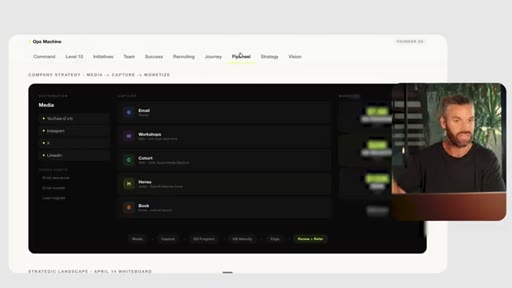
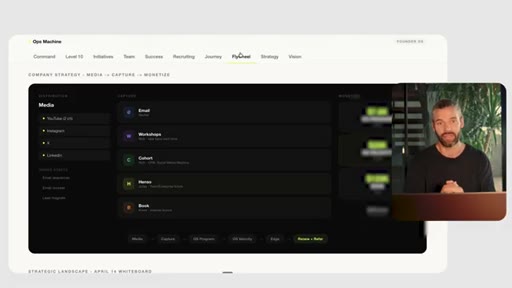
12:51CTAand the machine just keeps on growing. And so this is kind of a one page company strategy. Okay?
12:57CTAOn the left here, you can see the different media platforms we have. We then capture
13:03CTAthat audience inside of things like our email list, which we've grown to a quarter million people all organically. We drive people through workshops every single month that then get people interested in the kind of things we got going on. We run cohort based programs every three months, the next one being something called Cash Flow Machine.
13:21And then, you know, I've even got some software products, and I got a book coming out soon. And then that brings people then to typically our core opera, which is FounderOS Velocity, right, which I already spoke about. So we'll move past that.
13:34Now, the strategy side of things. Right? Why I most like this tab is actually because every single week, I aim to talk to about five different mentors or advisers.
13:44Right? So like I had mentioned, I was actually just at lunch with William Brown. I talked tonight to Ryan Clog.
13:49This morning was Neil Patel. I talked yesterday to Dan Bolton. You know, that's just an average week, and what I typically will do is show those guys this strategy tab, right, so that I'm able to get feedback on how I'm thinking about things like our value ladder, how I'm progressing,
14:06you know, on the product side because inevitably, just to be honest, right, there's a ton of stuff I do not know. Right?
14:12I've built media companies in, you know, different industries. I've built education companies before, But inevitably, like, we're all kind of on this, like, new frontier here with AI and how fast things are progressing. And so one of the number one ways that I think that you can really stay ahead is by finding a tribe, right, a community and mentors and advisers, and that's what we do in FounderOS, but I also honestly live and breathe out myself, right, having my own tribe of mentors that are constantly helping me.
14:38And so this just is an example of how I'm kind of currently looking at things. We've got some insane offers that we're constantly launching to keep things fresh and fun. I'm going and just constantly refining my business by talking to folks.
14:52You know, Paul Graham says that as you're building a business, it's important to get outside the building. Right? So I'm getting outside, talking to folks, I'm learning.
15:00It's not that I from every one of these conversations, I'm getting, like, 20 insights that I'm implementing. Sometimes it's just like a couple epiphanies, or often what I find is it's like one person says something over here, and then you connect that with what someone else is saying, and you kind of then come up with some other crazy idea off that.
15:16So that's currently, you know, what I'm up to and how I'm building. Lastly here is the vision. Okay?
15:23My vision with FounderOS, right, is to build the operating system for founders who want their business to run without them. I talk a lot about how, you know, I see myself as more of an artist than an entrepreneur. Right?
15:35And I think that as you're building, you kinda wanna be this artist who's able to be creative and then have this autonomous engine running behind you. Those two things combined allowed me to make insane content and basically have my business all run off a series of automations,
15:51all visible in dashboards with a key meeting rhythm and a team that's aligned around the same kind of goals. It's important to have your vision in one spot.
15:59I learned this from Marc Benioff in his book Into the Cloud. He always had this card that he'd show every single person in his company the mission, the vision, and their core goals.
16:08And so I think it's important that you have things centralized. Right? Producing world class content,
16:13building folks' social media machine, and then really just keeping them on board forever because the product's just so damn good. Right? We wanna be the apple of founder distribution, the standard, the reference point, the brand every serious founder is proud to be associated with, the system they credit with helping them make a million, 5,000,000, even $10,000,000.
16:31Right? That's what I'm after. And so when we look at the kind of stuff we're building, right, I'd mentioned it's all around building your social media machine.
16:40Right? And for me, the genesis of FounderOS, which OS stands for operating system, it also stands for open source.
16:47Right? And the, really, origin of FounderOS was giving away all these systems that I had used over the previous 18 of building companies.
16:56Now these days, I think that systems have become skills. Right?
17:01And I believe that my brain can be poured into an orchestrator. And so when folks join Founder OS, we're giving them essentially my brain and all the skills I use to run my autonomous business. Okay?
17:12And so that's what this is all about inside of Founderrest Velocity. If you're interested, what happens when you join is that we do an intake form, learn every single piece of your business. You're uploading all your core documents, things like your brand positioning,
17:26your content, your platforms, your website, your offer, your pricing. So we learn everything about it. From there, we do a brand deep dive call, and then we deliver your brand positioning.
17:36Right? So you have content pillars, your founder narrative. You really know how to go and own your own corner of your market.
17:43One core tenant we have internally is always going the extra mile for founders. Right? And we wanna have that, like, four seasons,
17:50like, Ritz Carlton level of, like, luxury founder experience in what we do. And so, you know, it's giving people things like their content waterfall and not just getting access to me.
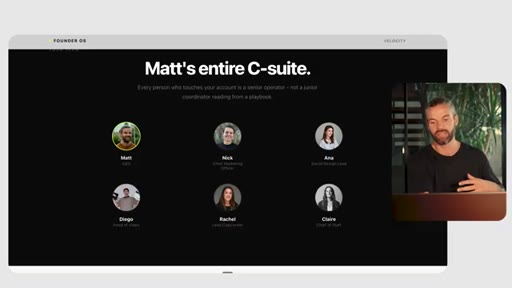
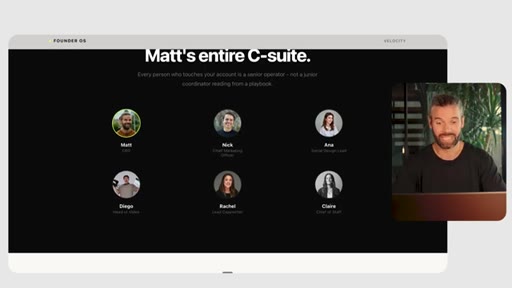
18:00What typically happens is founders are gonna go work directly with me, and then they go and get access to my team. Folks like Nick to help their marketing team, Diego to help people like their video strategists. We have Claire to help them on the ops side, really making sure that we're building leverage around the founder, right, so that they truly do get to remove themselves from operations and have their whole
18:24CTAreal leadership team get up leveled inside of FounderOS. And so, you know, a dedicated advisor, their social media machine, and their entire team getting trained. If that's interesting to you, you can go and check out FounderOS Velocity and go and join via the link in the description.
18:39CTAWe'll get on a brief call, learn what your business is all about, maybe what's constraining you right now, and see how we can help. So that is how to go and run your ops machine to scale. Hope this has been helpful.
18:50CTAIf you're interested in learning how to build a business that runs itself, you should go and check out this next video. I'll see you over there. Thanks so much for watching.
18:58CTABe sure to like and subscribe, and let's win together.
— full transcript
§ 05 · For Joe

Build the system before the system breaks you.

WHAT TO LEARN

When a founder is the operating system, every scaling decision costs more than it should — and a single AI-built dashboard can change that math faster than any SaaS stack.

  • The bottleneck past $30K/month is rarely the product — it is the absence of a shared system that lets a team act without the founder in the room.
  • A Level 10 meeting turns a weekly status update into a decision engine: wins set momentum, the scorecard surfaces what is off track, and the issues list forces resolution before problems compound.
  • Routing advisor call recordings through an AI transcription tool and into a project dashboard converts one-off conversations into permanent company memory — no follow-up doc required.
  • A recruiting leaderboard that tracks cost per hire, active channels, and pipeline stage turns hiring from a reactive scramble into a measurable, improvable system.
  • Standardizing every deliverable so any team member produces the same output is what makes a 5-to-12 person scaling move without quality degradation.
  • Treating a company value ladder, flywheel, and vision as live documents updated after every advisor call keeps strategy from becoming a PDF no one reads after the offsite.
  • A done-for-you service with a mapped 75-day journey, defined calls, and counted deliverables is a productized system — not a bespoke engagement — and that distinction is what makes it scalable.
§ 06 · Frame Gallery

Visual moments.