Marcus Stadon · Youtube · 61:31

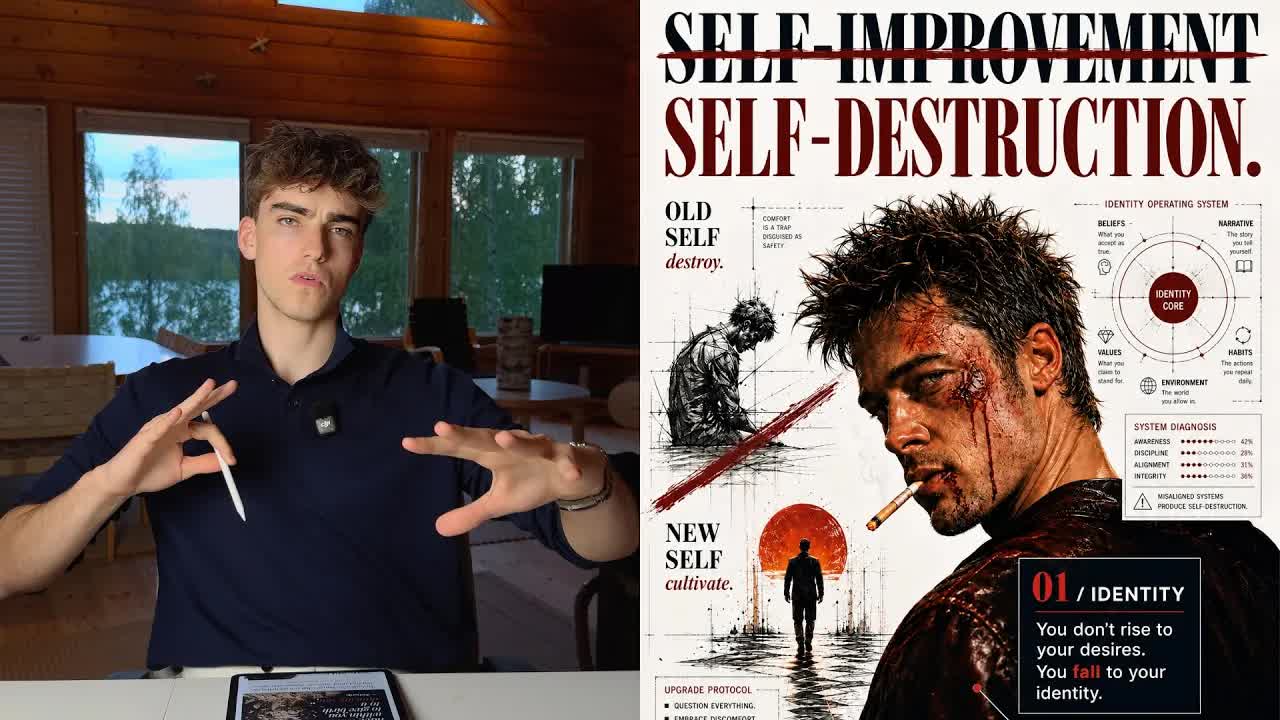
"Self Destruction" is how you actually get rich (but it's brutal)

A 61-minute identity-engineering protocol that argues self-improvement is the trap, and total psychological reconstruction is the only path that sticks.

Posted
May 27th 2026
5 days ago
Duration
61:31
Format
Essay
educational
Channel
MS
Marcus Stadon
§ 01 · The Hook

The bait, then the rug-pull.

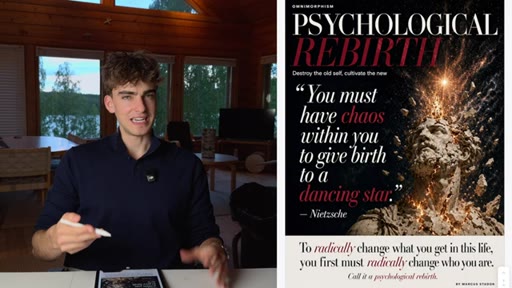
A Nietzsche quote about chaos and dancing stars is an unusual cold open for a wealth video — but the provocation lands: self-destruction precedes creation. In the 61 minutes that follow, Marcus Stadon does not talk about habits, systems, or hustle. He makes a case that the identity running your behavior right now is the only thing between you and the outcomes you want, and that changing it requires total obliteration of every dimension of the self — simultaneously.

§ · Chapters

Where the time goes.

00:00 – 00:42

01 · Why radical change requires self-destruction

Nietzsche cold open, thesis stated: self-destruction precedes creation, psychological rebirth is the mechanism.
00:42 – 02:23

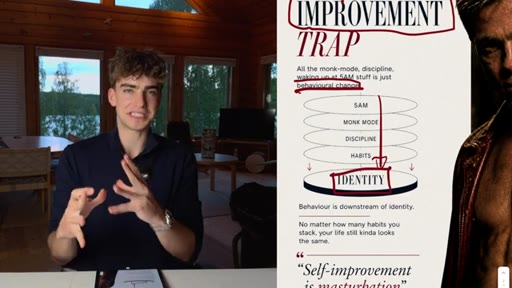
02 · The self-improvement trap

Self-improvement is band-aid on bullet wound. Behavior is downstream of identity. Tyler Durden: self-improvement is masturbation.

02:23 – 04:21

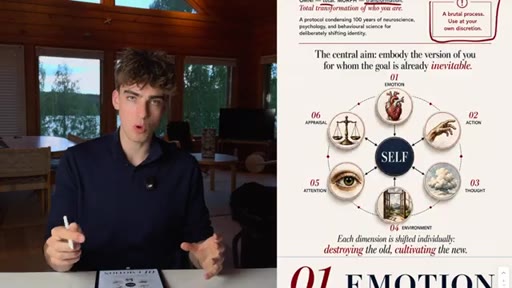
03 · Omnimorphic protocol introduced

Framework named and defined. Six dimensions: emotion, action, thought, environment, attention, appraisal. Central aim: embody the version of you for whom the goal is inevitable.
04:21 – 13:43

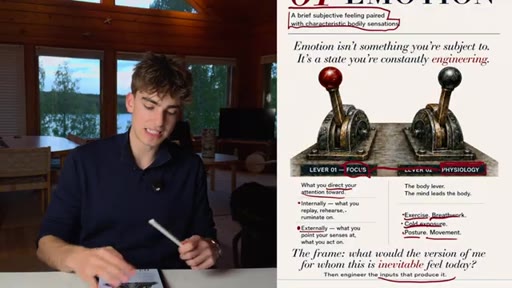
04 · Stage 1: Emotion

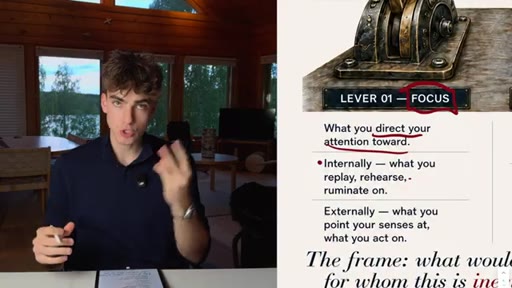
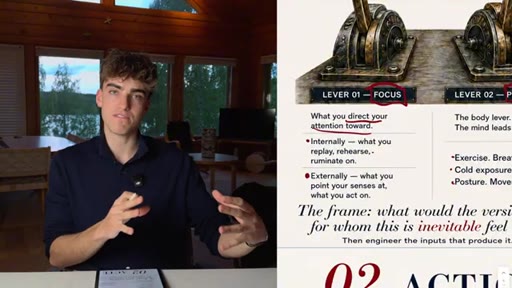
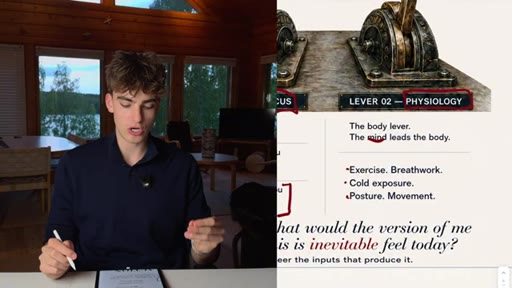
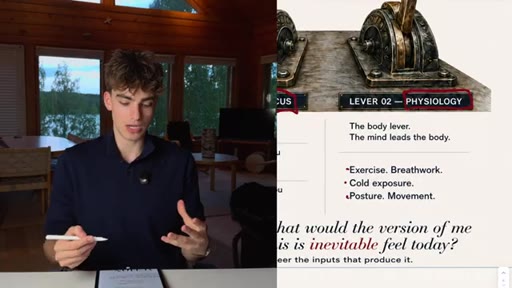
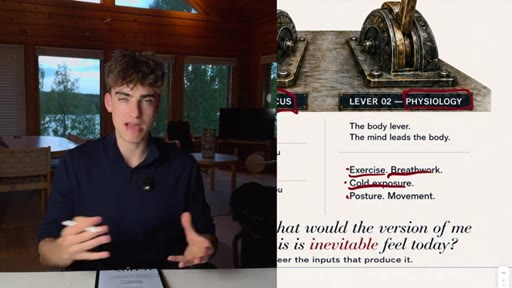
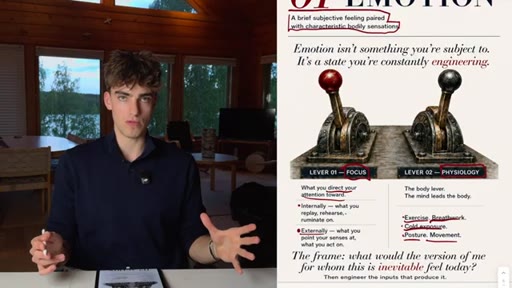
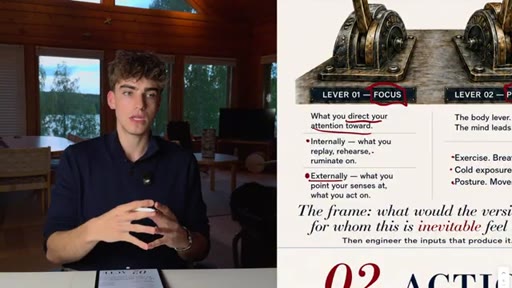
Emotion is engineered, not received. Two levers: focus (internal/external) and physiology. Frame: what would the inevitable self feel today?
13:43 – 20:24

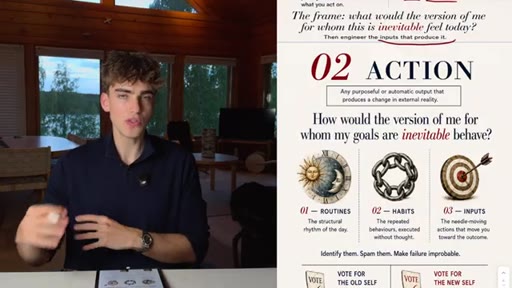
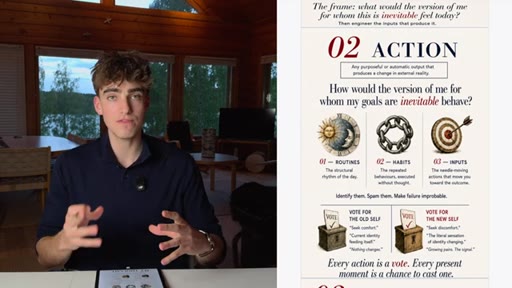
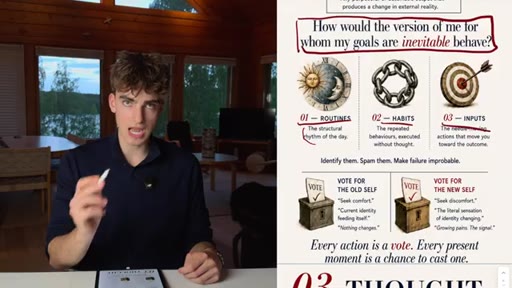
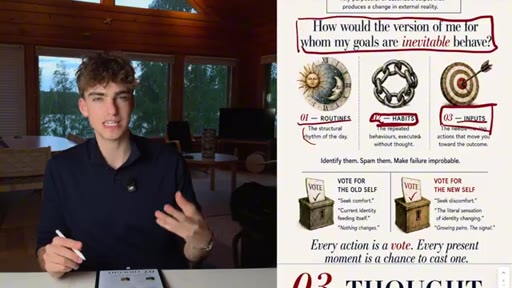
05 · Stage 2: Action

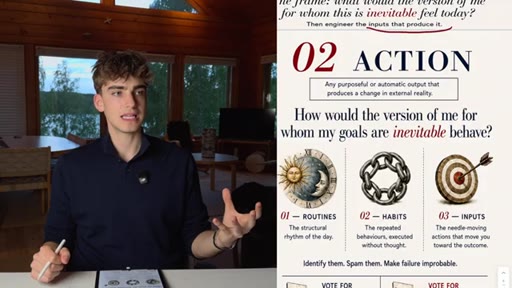
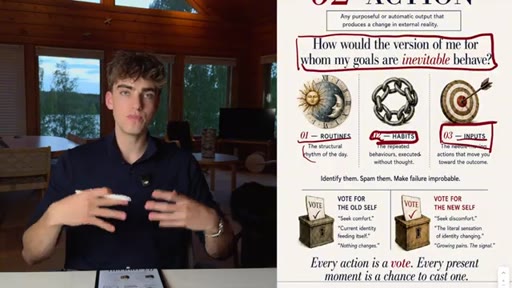
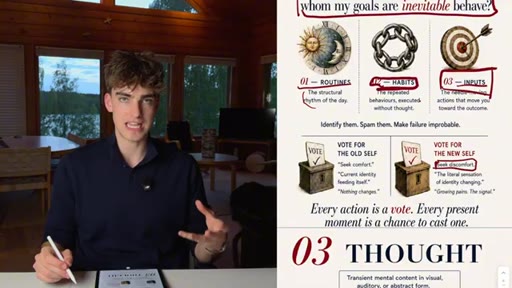
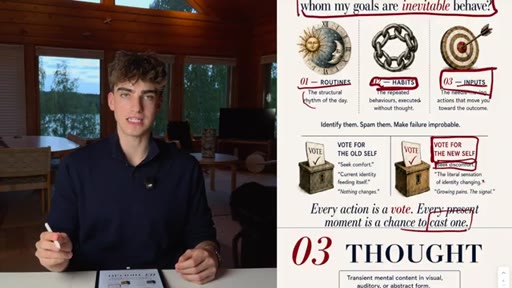
Action is the only way to change external reality. Three elements: routines, habits, inputs. Every action is a vote for old or new self. Seek discomfort.
20:24 – 27:55

06 · Stage 3: Thought

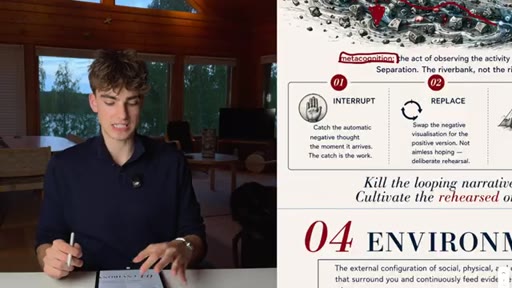
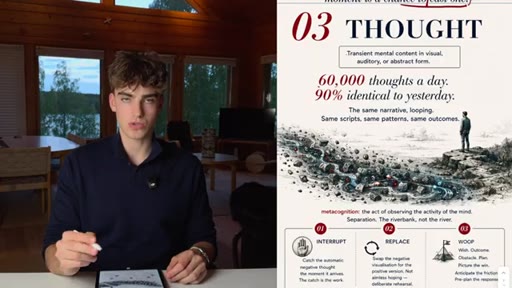
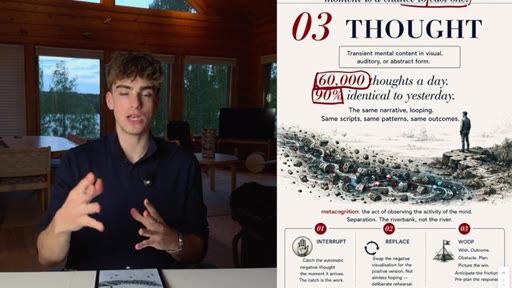
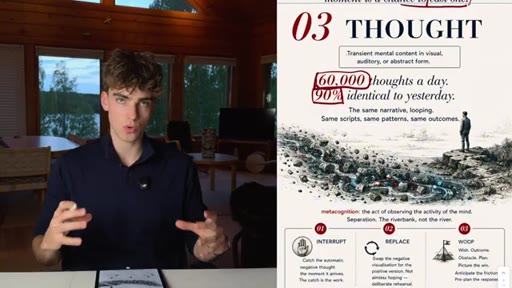
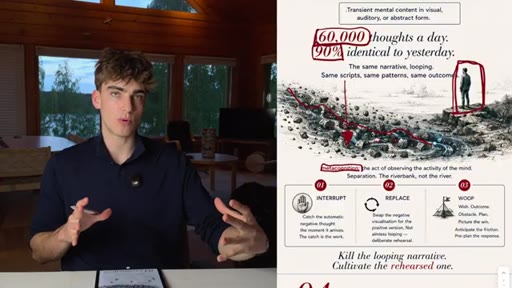
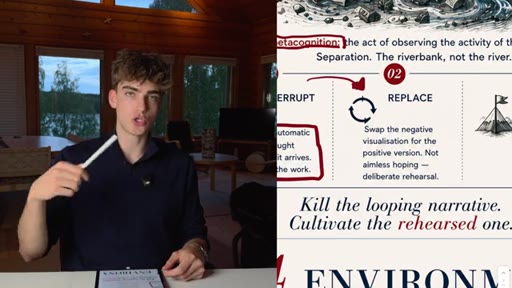
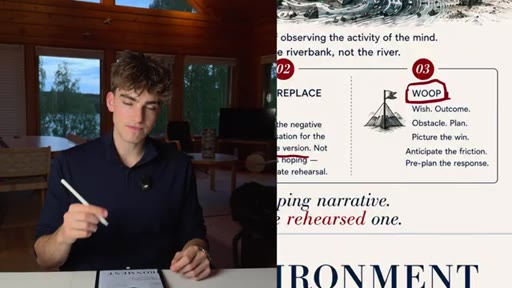
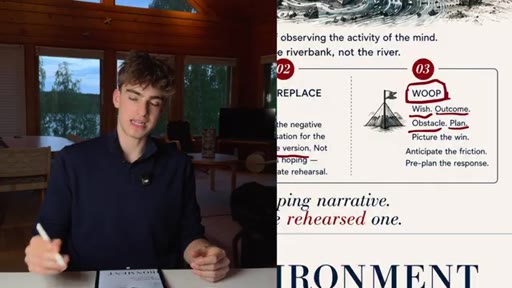
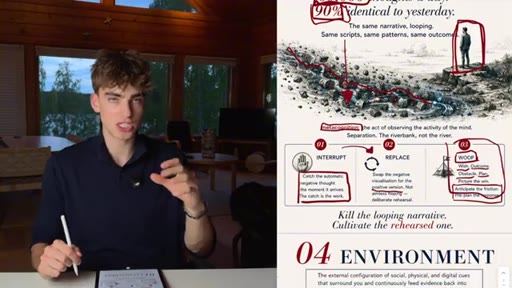
60,000 thoughts/day, 90% identical to yesterday. Metacognition creates separation. Interrupt-replace protocol. WHOOP visualization.
27:55 – 32:11

07 · Stage 4: Environment

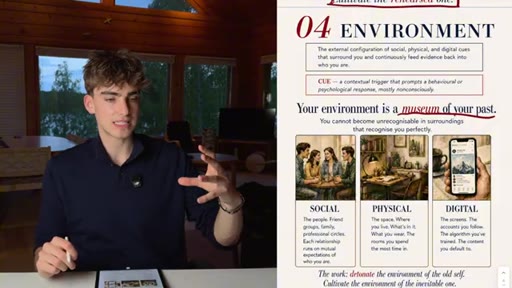
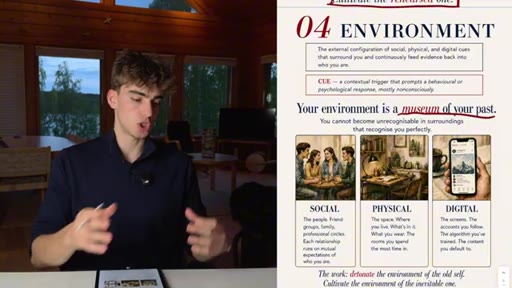
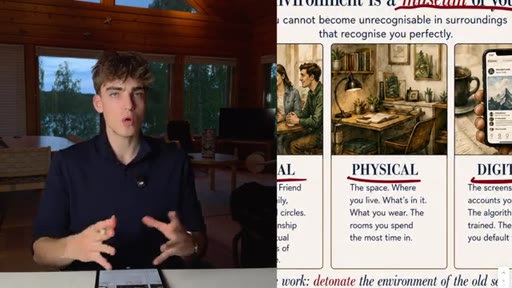
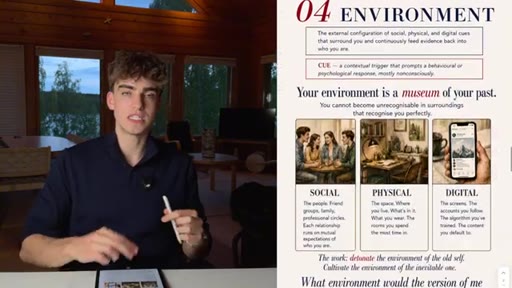
Environment is a museum of your past. Social, physical, digital cues constantly re-encode old identity. Detonate it.

32:11 – 37:02

08 · Stage 5: Attention

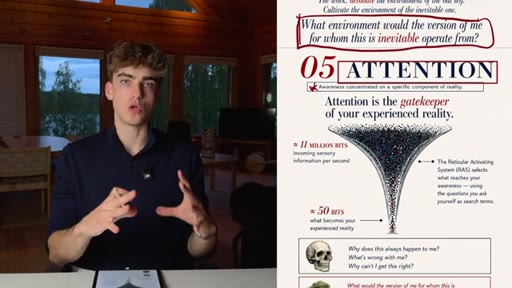
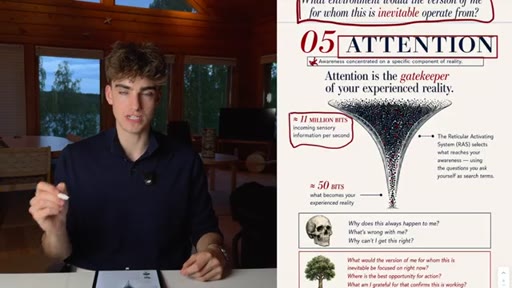
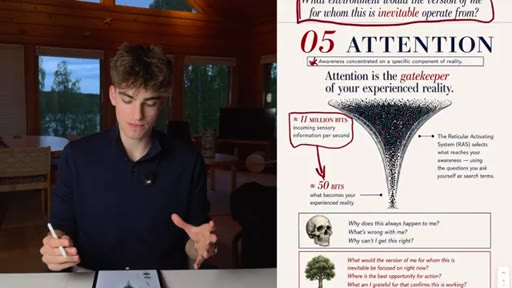
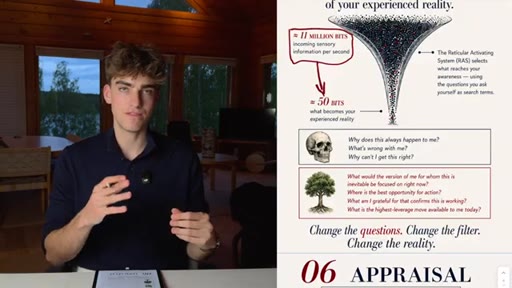
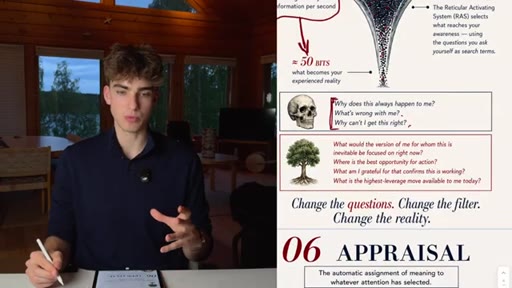
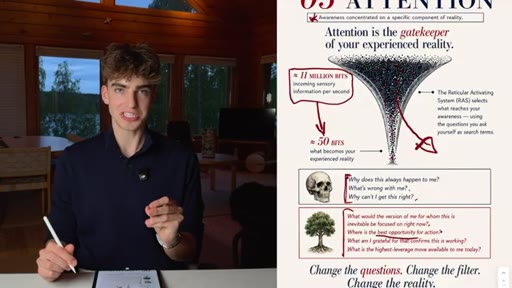
RAS filters 11M bits to 50 conscious. What you ask yourself determines what you notice. Change the questions, change the filter.
37:02 – 41:55

09 · Stage 6: Appraisal

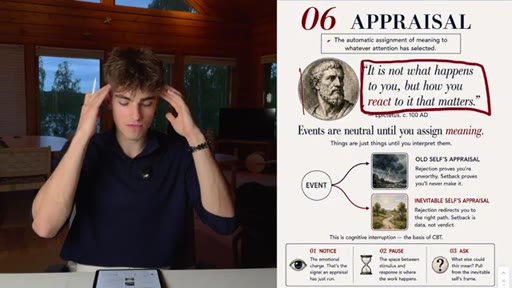
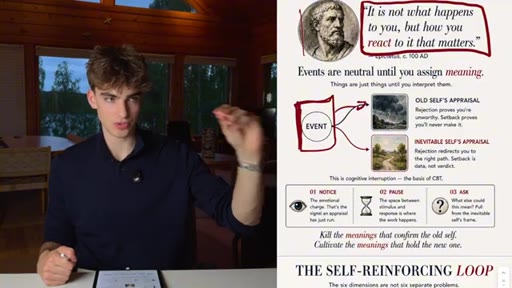
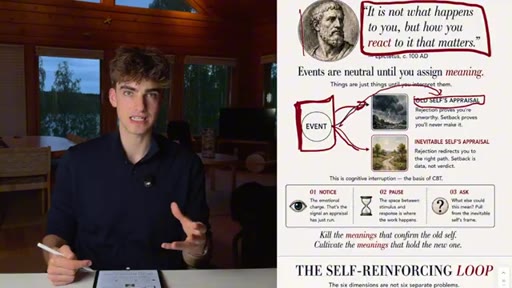
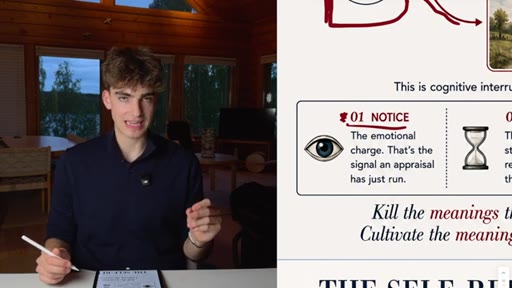
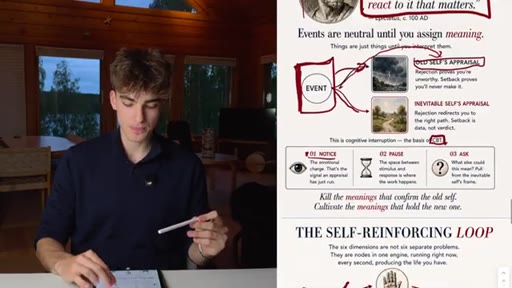
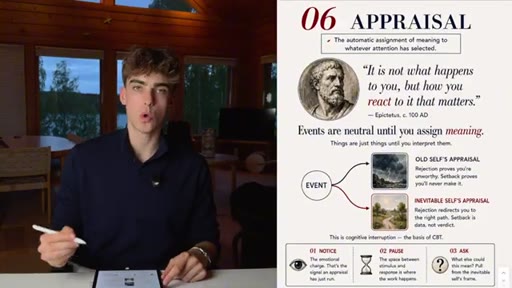
Appraisal is the active layer of belief. Epictetus: it's not what happens, it's how you react. Cognitive reappraisal via CBT: notice, pause, ask what else this could mean.
41:55 – 47:55

10 · How the six stages form one engine

The six dimensions are nodes in a self-reinforcing loop. Change all simultaneously or the untouched nodes drag you back. Omnimorphic: no failure point.
47:55 – 52:37

11 · Identity and the Ship of Theseus

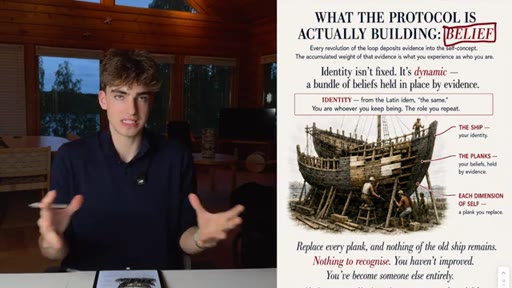
Belief is the atomic unit of identity. Identity is a dynamic cluster of beliefs held by evidence. Ship of Theseus: replace every plank, a new ship emerges.
52:37 – 54:55

12 · Method acting your inevitable self

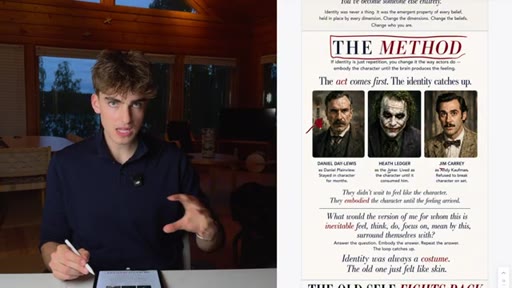
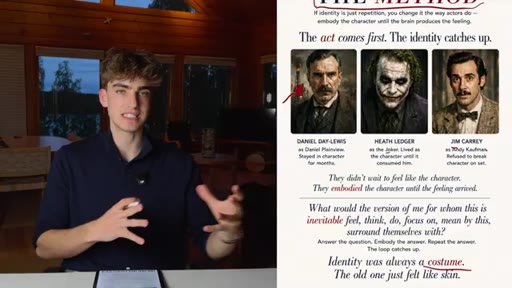
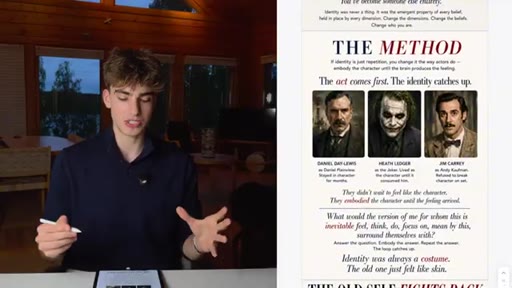
Method acting as the operating metaphor: embody the character until the feeling arrives. Daniel Day Lewis, Heath Ledger, Jim Carrey. The art comes first; the identity catches up.
54:55 – 59:40

13 · The old self fights back

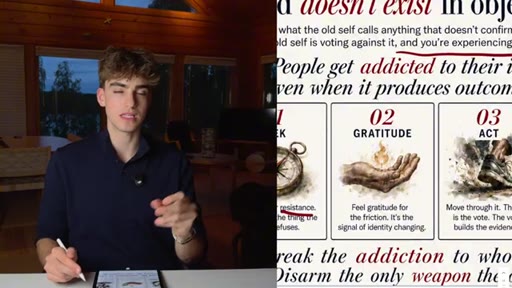
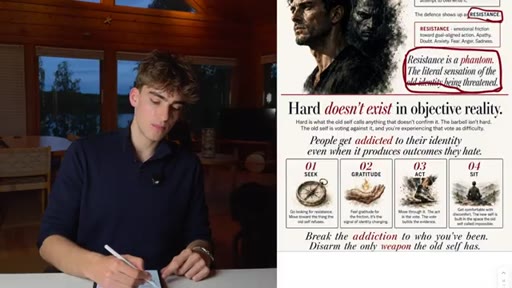
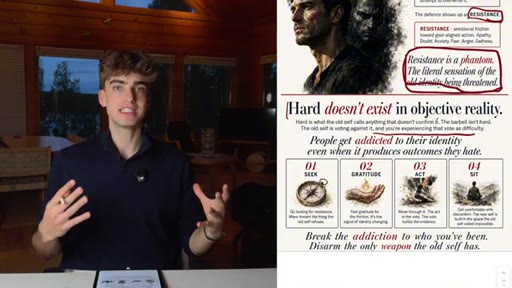
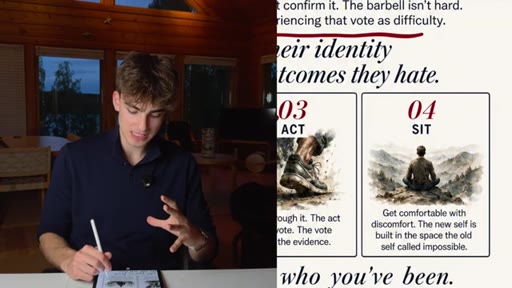
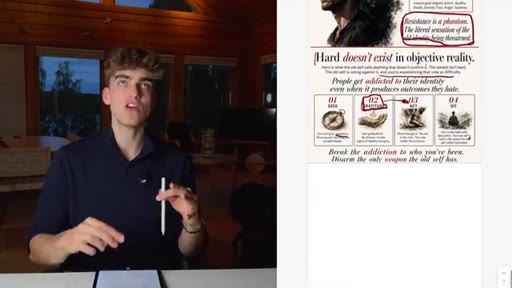
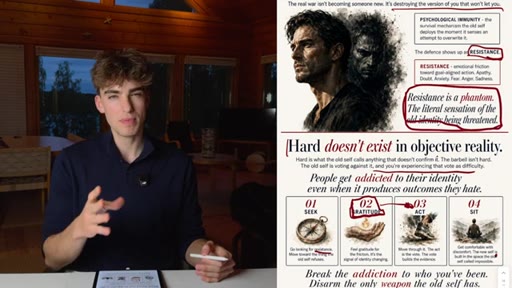
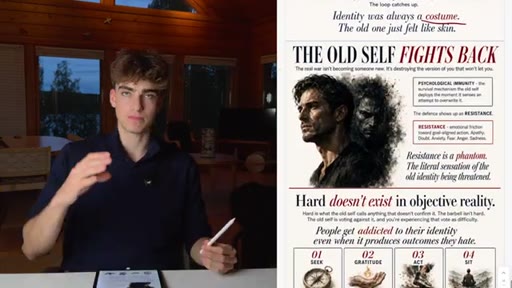
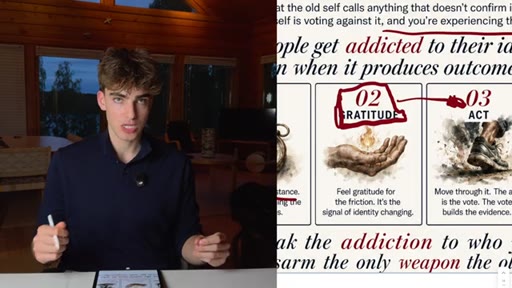
Psychological immunity: the old self deploys resistance when threatened. Resistance is a phantom. Four steps: seek, feel gratitude, act, sit.
59:40 – 61:31

14 · Destruction and creation as one move

Two sides of the coin: offense (becoming new) and defense (destroying old). Break the addiction to who you have been.

§ · Storyboard

Visual structure at a glance.

open
self-improvement trap
protocol intro
emotion lever
action as vote
thought protocol
detonate environment
attention filter
appraisal
identity loop
ship of theseus
method acting
resistance
CTA
§ · Frameworks

Named ideas worth stealing.

02:23 model

Omnimorphic Embodiment

  1. Emotion
  2. Action
  3. Thought
  4. Environment
  5. Attention
  6. Appraisal

Total simultaneous transformation of all six dimensions of self. Each dimension is both a lever to pull and a node in the identity loop. Neglect any one and it feeds the old self.

Steal for Any coaching or transformation offer where habit-based approaches have failed the client
25:45 acronym

WHOOP Visualization

  1. Wish
  2. Outcome
  3. Obstacle
  4. Plan

From researcher Gabriele Oettingen. Visualize the goal, then specifically visualize the obstacles and your planned response. Outcome-only visualization reduces motivation by lowering allostatic load.

Steal for Goal-setting exercises, sales objection prep, any performance context requiring mental rehearsal of friction
43:00 model

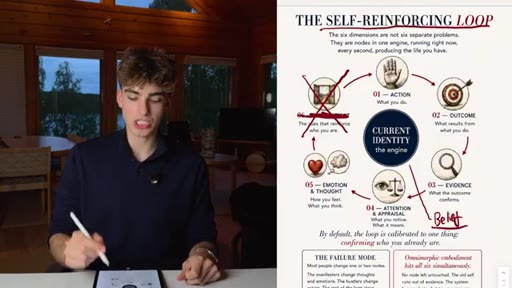
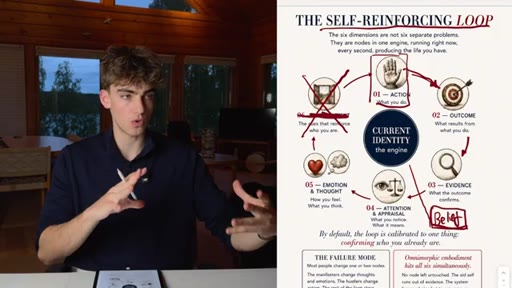
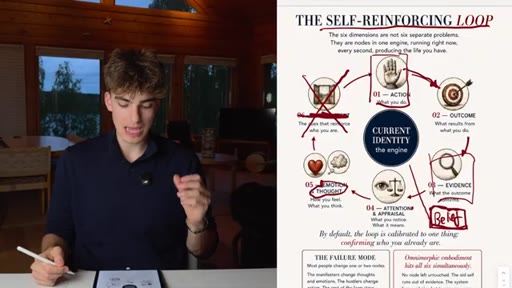
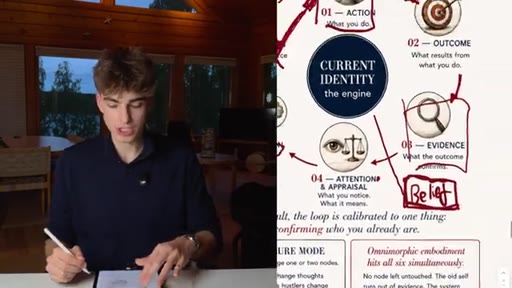
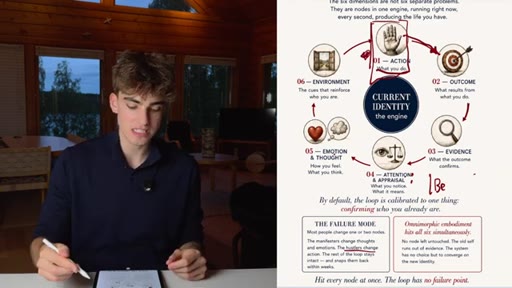
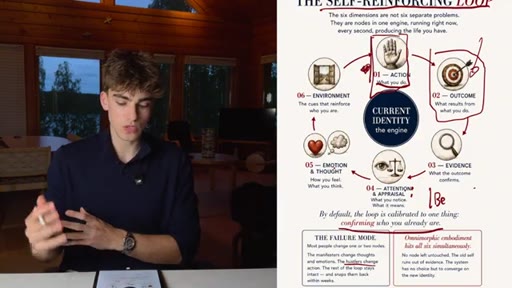
The Identity Loop

  1. Action
  2. Outcome
  3. Evidence
  4. Belief
  5. Attention/Appraisal
  6. Emotion/Thought
  7. back to Action

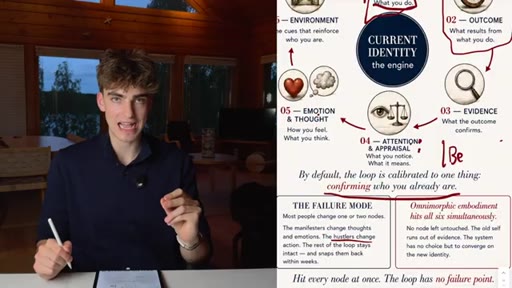
The self-reinforcing engine running on autopilot every second. Each node feeds the next. By default it confirms existing identity. Omnimorphic change hijacks all six nodes simultaneously.

Steal for Explaining why clients relapse; showing why piecemeal change fails; framing total-system interventions
57:58 list

Resistance Protocol

  1. Seek the resistance
  2. Feel gratitude for it
  3. Take imperfect action
  4. Sit in the discomfort

Four-step protocol for overcoming psychological immunity. Resistance is reframed as confirmation of forward motion rather than a stop signal.

Steal for Procrastination coaching, any high-friction behavior-change context
§ · Quotables

Lines you could clip.

00:14
"Self destruction precedes creation."
Five-word thesis that stands alone → TikTok hook
02:07
"Self improvement is masturbation — it's stimulation without creation."
Provocative Tyler Durden quote, no setup needed → IG reel cold open
02:31
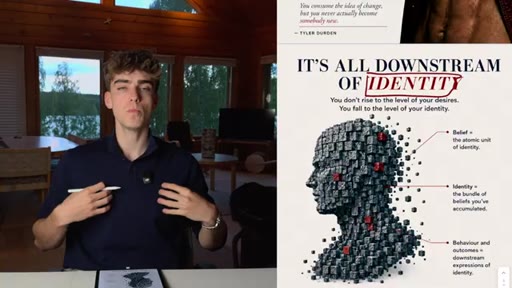
"You do not rise to the level of your desires. You fall to the level of your identity."
Quotable standalone insight, high shareability → newsletter pull-quote
11:58
"Responsibility is the prerequisite of control."
Clean aphorism, zero context needed → TikTok hook
56:38
"The most addictive drug in the universe is your current self."
Counterintuitive hook, punchy → TikTok hook
54:00
"The identity was always a costume. The old one just felt like the skin."
Poetic reframe, strong standalone → newsletter pull-quote
§ · Resources Mentioned

Things they pointed at.

09:40channelLisa Feldman Barrett (neuroscientist)
24:26bookGabriele Oettingen / WHOOP visualization research
24:12bookViktor Frankl quote (Between stimulus and response lies your power)
30:37bookAtomic Habits by James Clear
37:20bookEpictetus — The Enchiridion
40:46productVipassana meditation
§ · CTA Breakdown

How they asked for the click.

61:20 next-video
"I've got a full master class on discipline. It's a game changer and not many people have seen it so you can get a competitive advantage on that one."

Low-pressure, value-framed redirect. The description also links to a free PDF, an Instagram follow, and a related video. No product pitch anywhere in the video.

§ 04 · The Script

Word for word.

HOOK opening / re-engagementCTA the pitch metaphor analogy story
00:00HOOKNietzsche said it best man, you must have chaos within to give birth to a dancing star and that line it just gives me shivers every time because he's stating the only fact you need to get rich.
00:14HOOKSelf destruction precedes creation.
00:19HOOKTo radically change what you get in this life you first must radically change who you fundamentally are. Call it a psychological rebirth.
00:28HOOKNow to understand how to actually execute that change it's imperative we debunk a vicious trap which blocks most people from this radical transformation
00:39HOOKwhich is self improvement. Self improvement
00:43HOOKis like applying a band aid to a bullet wound, painting over the cracks of a crumbling building, the monk mode discipline, wake up at 5AM stuff. It feels productive but it's surface level.
00:56HOOKIt operates at the level of behavioral change which of course action or behavior doesn't happen in isolation, it's a downstream effect of your identity which is why no matter how many habits you stack into your day
01:12HOOKnothing seems to radically change. Maybe there's just a new coat of paint but nothing radically has changed
01:19HOOKin your life. Tyler Durden from Fight Club, excellent movie,
01:24HOOKsaid it best, self improvement is masturbation, it's stimulation without creation.
01:30HOOKPeople love to consume the idea of change without ever actually becoming somebody new and that's the problem. Self improvement is not the move my friend. It's all all of the leverage is found in identity.
01:43HOOKIt's not self improvement, it's self destruction because you do not rise to the level of your desires or your short term behaviors. You fall to the level of your identity which is just who you believe yourself to be.
01:57HOOKAnd so the crucial reframe here is your identity is not who you are, it's not a truth, it's a tool that you use to manipulate your outcomes
02:08HOOKand so you destroy the old self that is holding you back from your goals and you cultivate a new one that supports those goals. But this identity shift is not something you can just do.
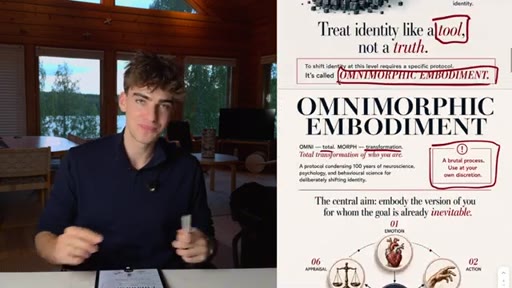
02:21HOOKRight? Self destruction and transformation requires a very specific protocol known as omnimorphic embodiment.
02:29Omni meaning total, morph meaning transformation,
02:33total transformation of who you fundamentally are. Now this may disappoint some people but this isn't some sort of woo woo manifestation
02:41technique. What we're doing here is consolidating
02:45the relevant insights from the last hundred years of neuroscience, psychology, behavioral science
02:52and much more into a repeatable, reliable
02:57protocol for intentionally shifting identity to achieve certain desired outcomes.
03:05Now let me be very clear before we go into this protocol which is you will be radically changing the fabric of who you are.
03:14I'm giving you the bullets, I'm giving you the tools, use it at your own discretion in whatever direction you want. I'm not telling you where to shoot. That is the disclaimer.
03:24I'm now legally protected. I'm not a lawyer. The central thesis,
03:30the central aim of this protocol is very simple, to embody the version of you for whom your goal is inevitable.
03:39The wording there is crucial. It's a version of you right now for whom the goal would be unavoidable. It would be improbable
03:45for you not to achieve it and we approach that frame across the six and that is six. Six components
03:54or dimensions that create yourself or identity. The first is emotion, then action, thought,
04:01environment, attention, and appraisal. These six are interconnected
04:06into this web that create your identity in a very interesting and fascinating way in which we'll zoom in on later, but the crucial point here is omnimorphic, is total transformation of
04:17each and every six of these components all together all at once because if you neglect any
04:25they will come back to bite you which explains why most people snap back to their old life like an elastic band. And so we'll go through each individual components and how to
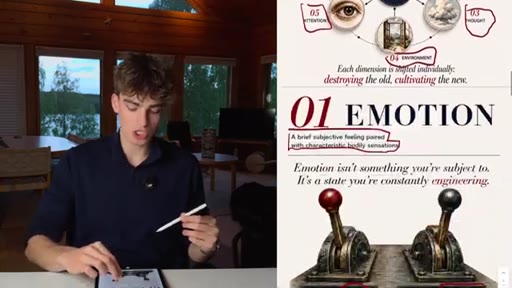
04:35take control of them and align them with your goals, and then we'll zoom out to see how they all connect with each other in this interesting system that creates your reality. The first component is emotion. Emotion at first principles
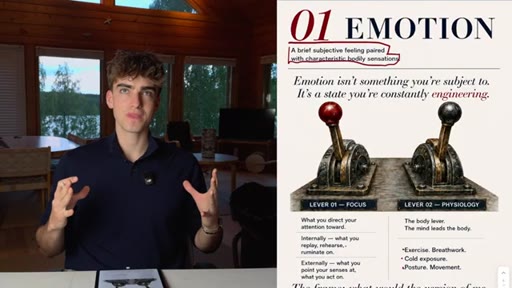
04:50refers to a brief subjective feeling paired with a characteristic bodily
04:57sensation. Now the big insight that I've come to this year and it was a tough pill for me to swallow, the brutal truth to accept
05:08was that emotion isn't something you're just subjected to. It is a state that you're constantly engineering whether you realize it or not.
05:18Most people believe that emotion is like the weather. If it's raining, it's raining, there's nothing I can do about that.
05:24If it's sunny, great. And they think their emotions are just happening to them. They're like a paper airplane in a storm and wherever that airplane goes
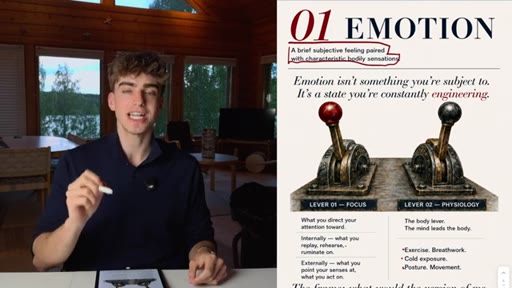
05:33they're along for the ride, there's nothing they can do about it, but this fundamentally isn't the case and this is a belief that I had to change which is you can take radical responsibility for your emotions because you are engineering them whether you realize it or not and you are engineering and modulating your emotions through two specific levers.
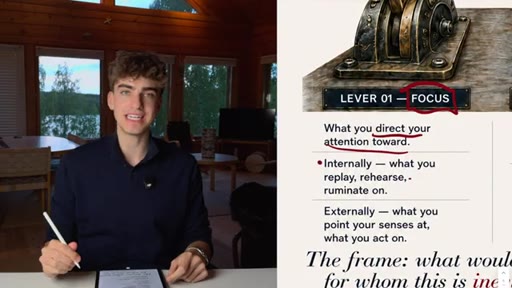
05:54The first is focus and the second is physiology. And so let's dive through both and I'll show you how to modulate your emotions by using these levers. Focus
06:08refers to what you direct your attention toward right? We have consciousness and that is what your that is the component of reality which your attention has landed on.
06:21And so we can modulate emotion by modulating focus specifically
06:27both internally and externally. Right?
06:30So you're always focusing on something internally, the thoughts that are arising in this passing moment, what you're replaying,
06:38simulating, fantasizing, ruminating,
06:43catastrophizing, and everything in between. The different scenarios which you're running through on your mind to a large degree are determining how you feel.
06:53The thoughts you think and the emotions you feel are inextricably linked in this this self reinforcing
07:00loop. What you focus on within your mind I. E.
07:04What you think about is to a large degree going to determine how you feel. Now you have the ability to engineer your thoughts,
07:11you also have the ability to choose which thoughts you entertain with and which thoughts you just let pass. Using those two capabilities,
07:21those two unlocks, you can choose which thoughts influence your emotions through modulating your internal focus
07:29you can modulate how you feel. The second dimension of focus is external. This is everything that's going on outside of your mind.
07:38Well, nothing is really going on outside your mind this is all mind but you know what I mean. What you point your senses at and what you act on.
07:48So this is in the realm of action but also just what you're observing and what you're paying attention to in your environment. You know we'll explore this later with the fifth component attention but we absorb 50,000,000 bits of sensory data every single second
08:03and yet out of that 50,000,000 we are only consciously sorry it's 11,000,000 I'm getting mixed because it's out of those 11,000,000 bits we are only conscious consciously aware of 50
08:16and so you are consciously aware of about 0.0001% of your total sensory data that is coming in. And so to a large degree what you externally focus on is
08:30what you're experiencing, but that isn't what is actually going on. Two people can go through the exact same circumstance and walk away with entirely different conclusions
08:39depending on what those 50 bits landed on. And so what you want to do is modulate your focus externally on the things that serve you rather than them serving
08:51whatever negative emotional spiral you're in. We can look into this more in the fifth component when it comes to modulating attention, but it's worthwhile knowing
09:02that partially your emotions are an emergent property of what you're focusing on. They really are if you break them down at first principles, emotions are your body's reaction
09:11to what is going on in your mind and in reality at large. So that's the first lever we have. The second is physiology.
09:21Your that's wrong. Your body leads your mind. Your mind does not lead your body.
09:25Your body leads your mind. Now this is the cutting edge of
09:32neuroscience on emotions. There's a neuroscientist called Lisa Feldman Barrett who's done a lot of studies on this which is the relationship between your mind, body, and your emotions.
09:43We're not gonna get into the technical nitty gritty here because it's actually not too relevant to the the protocol, but
09:51the headline is your body budget, your energy levels, how you feel
09:56in your body to a large degree determines your emotional state and there's this bidirectional relationship which is constantly feeding back and forth. This is all under the the guise of predictive processing in neuroscience.
10:08Super interesting stuff if you want to look into it I highly suggest you look at Lisa Feldman Barrett. Very knowledgeable. And so the the body leads the mind in the way that you feel.
10:18If you energize the body the mind will follow. And so we can energize or we can change our physiology which is the state of our physical body through different protocols you know exercise,
10:30breath work, Wim Hof, cyclic hyperventilation, different types of breath work can change your your nervous system from parasympathetic to sympathetic.
10:41If you're apathetic you wanna psych yourself up, you may wanna do some hyperventilation. If you're feeling nervous you may want to calm down a little bit and that's a different breath work protocols.
10:52There's different stuff for different emotional states. You've got cold exposure that doesn't just mean cold plunging that could be splashing water on directly onto your face, uh, activates the the dive reflex which is again going to activate a parasympathetic
11:07state, spike norepinephrine or adrenaline.
11:10You can change your physiology again through posture. Something as basic as making yourself sit
11:18sitting with a better posture or doing certain physical movements change your emotional state. There's a lot of scientific evidence around this. Just movement in general, going for a walk, being outdoors
11:30is calming. And so depending on the emotional state that you have, we have two levers that we can use to modulate and change it. What we focus on internally,
11:40externally, and what we do with our physiology. And so taking the frame of I am responsible for my emotions
11:48is one of the most liberating things you can do Because if you do not take responsibility for your emotions, you're not in control of them. Responsibility is the prerequisite of control.
11:59And so taking responsibility and at least trying your best to try modulate your emotions when they're not serving your goals with focus, with physiology is incredibly liberating.
12:10Now the frame in which you approach this is very simple. You ask yourself the question, what would the version of me for whom my goal is inevitable
12:20feel today? What emotional states would they be running through in this specific context or this event or this action or this opportunity? Right?
12:29This all comes back to this inevitable self. This question will be asked on every single component of the dimensions of self because ultimately that is the version of you who achieves the goal.
12:43And so what does that individual feel? Understand those emotional states and then modulate these inputs what you're focusing on in your mind corresponding thoughts, confident thoughts to breed a confident emotion for example. Change your physiology.
13:00Energy you know, energize your body and the mind will follow. You can use these tools to modulate your emotional state which is an incredibly
13:08powerful tool, but you need to have this belief that you can change the way you feel. Do not just think it's like weather. You are in control of it whether you realize it or not.
13:17You can engineer it and so engineer the inputs that produce those emotional states that you recognize in that inevitable identity and that is the first component that you need to change.
13:30Ultimately if you don't change the way you feel not much else is really going to change because to a large degree how you feel determines what you do, what you think, and all the rest of it. As I said they're interconnected we'll get into that.
13:42The second component is action. Now action at first principles refers to any purposeful or automatic output that produces a change in external reality no matter how small. Now there's a ongoing fierce debate
13:58on the role that action plays in the achievement of your goals. We can simplify this into two camps.
14:03You have a manifestation camp who just to to quite a large extent,
14:12guess, dismiss the impact that action has in terms of achieving your goals.
14:19Some people will go as far to say that action is relevant and you can sort of operate on the quantum field or the spiritual plane or the mental plane or some variation of this. It will differ depending on what guru you're listening to and what esoteric framing they put on it. As you can probably tell I'm not too keen on that philosophy.
14:37And then you have the other camp which are kind of like a hustle bro or these like productivity gurus who are super focused on action and will neglect any other aspect beyond that. These two camps have fallen into the tribalistic trap. They're they're lost in binary thinking.
14:54Ultimately the nuance is this, action is the only way we can interact with the world around us and we can make change. I don't care how good of a manifesto you are.
15:04If I put you in a dark cave and you're not allowed to leave that cave, don't care how good you are at changing your frequency, your vibration, or visualizations,
15:13or your affirmations, you're not changing anything outside of that cave. And anyone who tries to convince you that you are and explaining that through some sort of quantum method
15:22or spiritual esoteric you have to ask yourself why is it being framed in this really complicated convoluted way
15:31when it could all just be explained through psychology and neuroscience? That's a question you need to ask these individuals. But also
15:39okay action is the only way we interact with the world around us and make change but it also doesn't happen in isolation. It's not the only thing going on and so focusing on it entirely which is what these productivity bros are doing is a mistake. You see most people know what they need to do they just don't do enough of it because they are not in in control of their emotions, their thoughts, the other components which create their actions, their beliefs, their identity.
16:06And so you know if action were just something you could just do, well then people would do it. It's not that simple.
16:13And so the nuance is that action doesn't happen in isolation. Yes. There are other things influencing it, but it's also incredibly important if you don't take action nothing will change.
16:23And so what we do is we change everything all at once. Why just change action alone when you need when you can change the things that influence it as well?
16:33And that's the philosophy of omnimorphism total transformation of everything. Now the frame in which we approach action is again very simple.
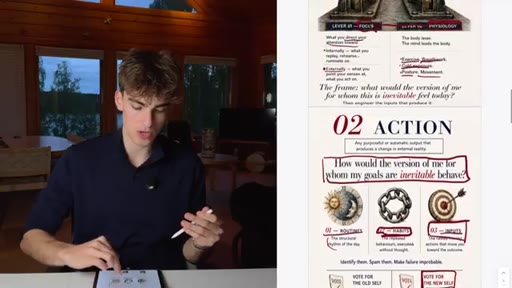
16:42You ask yourself the leading question, how would the version of me for whom my goal is inevitable behave in whatever context you're trying to discover behavior in? And you need to identify three things from this inevitable self, Their routines,
16:57their habits, and their inputs. Now the routine is the structure and rhythm of their day.
17:03Their morning routine, you know, how much they work on, you know, do they work on Sundays, these these like these different questions you need to ask yourself. You know, when are they going to the gym?
17:12What are they doing? Structure and routine is your best friend. Stick to it.
17:16Identify what your inevitable version of you does and stick and go and do that routine. Habits.
17:23Identify all of the unlocking habits. Not just the random habits that feel good like
17:29probably waking up at 5AM has got nothing to do with your goal. It doesn't have a direct impact. Figure out the habits which genuinely
17:36move the needle in your goal. The repeated behaviors that are executed without thought.
17:43Write down the habits that this individual has. And then crucially
17:48write down the inputs that the inevitable self executes on. These are the needle moving actions that move you toward the outcome.
17:56You're gonna have one or two inputs and in a business context this is the thing that actually moves the cash. The first action you need to take typically it's gonna be sales or marketing related.
18:07The thing that actually moves the needle. Identify your inputs and spam them.
18:13Spam the inputs. You know the line from Humosey, do so much volume it would be unreasonable for you not to succeed.
18:20That is the perfect frame to approach this from. Do not neglect action. I don't care how much work you do with your thoughts or emotions if you do not change your actions nothing will change.
18:32You need to look at action as a vote. Right?
18:36We're undergoing this process of identity destruction and then creation, but to do this you need to look at and reframe
18:45action as a vote for the new or old identity. Every present moment that passes you are offered an opportunity
18:54to take action and you can either take action in alignment with the old self which means you're voting for it or you can take action in alignment with the new self which means you're also voting for it. You can cast a vote for one or the other.
19:09There is no other way. And so how do you know which self you're casting the vote for? It's very simple.
19:15The actions you take under comfort are most likely casting the vote for the old self and the actions taken under pain are casting votes for the new self and this is all in the context and pursuit of your goal. And so really the frame that you need to look at this is seeking
19:30discomfort. Discomfort meeting resistance and taking action anyway through the fear, the apathy,
19:37the anger, the guilt, the shame, the doubt, dread. Those are the growing pains. That is the actual signal
19:46that you are moving closer towards your identity. You're going through this process of metamorphosis and you are shifting, you're destroying the old self.
19:54Every vote is an arrow that you know a bullet that you can shoot at that old identity. It is the literal sensation of changing who you are and so you need to go out and seek that sensation of discomfort
20:08and vote for the new self. Action is incredibly important tool. You need to recognize it, it's important.
20:15Use every single present moment that you can to take relentless action and cast a vote for this new identity to destroy the old one. Now the third dimension
20:28of self is thought. Thought at first principles refers to the transient mental content. In visual, auditory, or abstract
20:37form. Now most people are lost in this unmitigated
20:44rushing river of mental noise and chatter. It's this churning of catastrophization, fantasization
20:53and daydreaming and and living in this simulation that's not real, this rushing river of thought and narrative. And the stats here are pretty potent and pretty
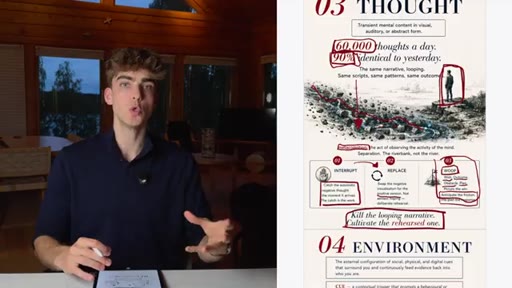
21:04sobering. The average person thinks 60 to 70,000 thoughts per day. 90%
21:10of those thoughts are identical to the ones they had the day before. They're running the same narrative,
21:17the same scripts, the same patterns and therefore they achieve the same outcomes. Now out of those thoughts 60 to 70,000 that they're having they're having most of them lean completely negative and so it's this cycle of automatic negative thoughts that are running the exact you know throughout
21:35every single day of your life and most of them are the exact same. Now most people recognize these thoughts as themselves. They think that they are the thinker.
21:46That's who they are and therefore they follow it. They treat it as if it's part of them and therefore they act in alignment with that individual.
21:56But of course the thinker isn't who you are and we can debunk this very easily by doing a very simple thought experiment or try not to think experiment. I'm gonna ask you not to think of a certain thing
22:11and if you were truly the thinker behind your thoughts you'd be in perfect control of that. Do not think of a green apple.
22:20Don't think of a green apple right now. You see? What was that?
22:24I mean you're not in control of your thoughts. The thinking is a process of the mind in the same way beating is a process of the heart.
22:33It happens to you not from you and that's the crucial point you need to understand. And so we can break identification with thought but you can only do this when you observe your thoughts.
22:45You cannot be the thinker if you're both observing the thoughts at the same time
22:51and so we achieve this state of observation through a skill known as metacognition. Metacognition
23:00refers to the act of observing the activities of your mind
23:04and it's metacognition which creates separation from this rushing river of mental noise.
23:11Instead of being the thinker that is lost inside it and therefore being influenced by your thoughts, you are now standing on the riverbed or the riverbank and you're now watching your thoughts go past.
23:24And as you become the observer of your thoughts you create separation from them. There's this quote from Viktor Frankl between stimulus and response
23:32lies your power. It's your power to choose how you want to respond. When you're the thinker identified with your thoughts you don't have a choice.
23:39If you think something that's what's happening and that's that you know that's that's that's what you think and so you behave in alignment with that thought. But with metacognition you create separation from this rushing river and therefore you regain the ability
23:56to choose how you want to respond and the types of actions that you want to take, liberating your ability to create new outcomes, escape this loop of 90% of the same thoughts. And the process here is simple, so we've got a protocol we can run through here in terms of how to interrupt and replace your thoughts.
24:13And again, you need to ask yourself what would the version of me for whom the goal is inevitable, what would they think on a daily basis? How would they speak to themselves?
24:22And that's the way we wanna interrupt. So the first stage is interruption. You need to catch yourself in this automatic negative thought spiral the moment it occurs.
24:32Right? What you'll notice is how often you're distracted by your own thoughts and you'll get better and better
24:38at catching them the more metacognitive you are. And metacognition
24:43is something you train through Vipassana meditation. It's it's something I've spoken about at length in other lessons if you want to seek that out and learn a bit more about that. The second step is replacement.
24:55Now once you've interrupted the thought we do have the ability to conjure up unique thoughts. So we don't have the ability to control our thoughts, they're just coming at us, but we can add a couple of new thoughts into that river.
25:08And so you swap whatever negative catastrophization or visualization you are running for a positive version. This is not aimless sort of positive thinking.
25:17We go through a very specific protocol here. It's called WHOOP and this is from a scientist called Gabrielle Uttagen.
25:25I don't know if I mispronounced the name there, but she's done a lot of research on visualization and there's a really good insight here not exactly relevant to this but I think you should know which is anybody who's talking about visualizing the outcome assuming that you've already achieved the goal and feeling the goal as if it's already been achieved,
25:45there is very compelling scientific evidence to suggest that that sort of visualization of the outcome reduces your allostatic load which reduces your motivation to take action.
25:57And so that type of visualization alone is fairly ineffective. The type of visualization you want to follow follows the structure of wish, outcome,
26:08obstacle, plan. Okay.
26:10So the wish and outcome is visualizing the outcome and then you achieving it, but the crucial point here is you need to visualize the process,
26:21the actions that get you there, and you don't want to visualize it all going well and and picture everything going swimmingly because of course it won't. It's not going to be a walk in the park.
26:31And so the crucial point here is anticipating friction and based on that friction setting an implementation intention.
26:39An implementation intention is a fancy psychological word for if x happens then I will do y. If this thing that will probably go wrong, if it does go wrong, I will do this thing. And you visualize these intentions.
26:54You overcoming the adversity, the resistance, and you do this on a loop.
27:00You keep going through different bouts of adversity and this doesn't necessarily have to be a formal practice that you do every single day. You can just notice yourself
27:10getting lost in your own mind throughout the day and you interrupt it and you replace it with a form of positive visualization where you actually out you go through the outcome that you want, you create a positive expectation effect, a positive placebo effect, you you you but you don't just fantasize
27:29about it you actually visualize and picture the plan and something going wrong and overcoming it. That's the idea.
27:38And what we're doing here is killing the looping narrative that your old self is clinging onto and it's running these scripts on repeat in these patterns which are holding you back and you cultivate a new rehearsed
27:51narrative, the way that you think to yourself and at the very least you are not reacting to your old thoughts anymore in a way that controls your behaviors.
28:01Now that brings us on to the fourth component which is environment. At first principles your environment refers to external configuration of your social, physical, and digital cues
28:13that surround you and continually continuously feed evidence back into who you are.
28:20A cue in this context refers to a contextual trigger
28:26that prompts behavioral or psychological response. Mostly this is happening non consciously but behind the curtain of your conscious awareness.
28:35You need to understand your environment that you exist in, the physical, social, and digital environment that you operate in in a daily on a daily basis is a museum
28:46of your past. It is littered with cues
28:50that are constantly encoding an old outdated identity that no longer serves you.
28:57And so your old identity, doesn't matter how much behavior you try and change, is constantly encoding itself through your environment,
29:05through these hidden cues, and so you need to go through a process of destruction and cultivation.
29:13You know there's a scene from Fight Club and I guess this whole video is Fight Club Coded because they do talk about this idea of self destruction and transformation where he detonates his apartment. The first stage to changing
29:26as a man is destroying your apartment. Now I don't reckon recommend you detonate your apartment, but you do want to radically change
29:33your surroundings to a large degree destroying the cues that hold together your old self and cultivating new cues that support your new self. So through your social,
29:45physical, and digital environments ask yourself the question,
29:50what would the version of me for whom my goals are inevitable, what environment would they exist in? And social is the people, the friends, the family,
30:00circles, the types of relationships you have and most likely the version of you for whom your goal is inevitable, you're surrounding yourself around different people or at least you're exposing yourselves to new people for whom the the behaviors which you need to do are normalized and the minimum expectation.
30:19Physical environment this is simple. This is your where you're working, where you operate and it has to be conducive. It has to make the actions easy and obvious and these this is basically the whole book of Atomic Habits is engineering your physical environment.
30:33Next is your digital environment which to a large degree people spend most of their day on. You need to engineer your digital environment in a way that doesn't
30:42bring back all the old habits that represent your old self and cultivate new cues. Perhaps you put your phone on grayscale or you permanently do do not disturb or whatever you want to do to reinforce a new version of yourself that represents this inevitable identity. Ultimately,
30:59the reframe here is detonation. The as much change you can make as possible
31:06is the move. Right? Even if that change isn't necessarily relevant to adding new cues, just reorganize your environment in a very radical way.
31:14That is the best approach here because you just want to change things up because that forces your brain to move that that forces your brain to shift from system
31:25two which is this sort of automatic primal limbic system which is just operating on these patterns
31:31into system one which is more forebrain focused. You activate your PFC or prefrontal cortex and it forces you to think. When you change your environment it forces you to think about the environment and therefore the behaviors that you want to take instead of running on these automatic grooves and loops which you've programmed in.
31:50And so again operate from this question and spend a long time designing your environment your social, physical, and your digital environment.
32:00Do it once and it will serve you for the rest of your life because your identity is constantly being encoded in the background whether you realize it or not. And so that now brings us on to the fifth dimension of your identity which we need to shift to undergo this process
32:17of self destruction following the omnimorphic
32:21protocol and that is your attention.
32:26Attention is the gatekeeper of your experienced reality. Attention at first principles
32:32refers to awareness concentrated on a specific component of reality. Right.
32:38We have a reality as a whole and you have consciousness. You can look at your consciousness like the spotlight and wherever that spotlight lands on that is your attention.
32:48And so as I mentioned earlier, every single second you are unconsciously, your sensory channels are receiving
32:57about 11,000,000 bits of information every single second through your eyes, vision, hearing, everything altogether. And there's a part of your brain called the reticular activating system which I'm sure you've heard of before and that is what is selecting
33:12what and you actually notice. What actually reaches conscious awareness.
33:18Now what's so remarkable here is how radical the filtering actually is. Out of those 11,000,000 bits
33:25of information that you receive, you are only consciously aware of 50.
33:3250. You are experiencing maybe 0.0001%
33:38of the total sensory data that's coming in. You are experiencing a tiny sliver of what is actually going on in your reality. To a large degree,
33:49what you pay attention to is determining your subjective reality. Now of course, what you subjectively
33:57experience determines what you subjectively feel. Therefore what you think about, what you do, and then ultimately your results to a large degree.
34:07It is your attention that determines much of everything else that happens in your life through your RAS.
34:15And so the direction in which this filtering goes is incredibly important because if we're filtering out every single opportunity,
34:24if we're not noticing the opportunities to take action or if we're constantly filtering things
34:31the things that are going wrong or that represent our old life and that old identity, we're gonna struggle.
34:38And so we need to modulate your attention if you wanna stand any chance at changing your circumstances and your behavior. And we do this through questions. You see
34:50questions are this incredibly useful tool that we can use to modulate attention. Giving a tactically
35:00phrased question and having a question that already has presupposed conclusions
35:06within them forces your brain to search for the answer. This is very important because most people ask themselves questions that presuppose
35:17a negative Why does this always happen to me? What's wrong with me?
35:22Why can't I get this right? They're trying to find the answer for the mistake for something that's holding them back that represents that old self. But the moment you start asking yourself questions that presupposes
35:34change, that presupposes your ability to overcome adversity, you change your attention.
35:40Ask yourself the question, what would the version of me for whom this is inevitable be focused on right now? What would they be doing? How would they be feeling?
35:50What would they be thinking? Where is the best opportunity for action? You see this presupposes
35:57there is a best opportunity and so your brain forces the look function. Let me find that opportunity
36:03and you're going to find the best move on the chessboard by asking yourself these questions with tactical presuppositions. What am I grateful for that confirms this is working? What is the highest leverage move available to me today?
36:18Asking yourself these questions forces your
36:22filtering mechanism to go in a different direction and find information
36:28that gives you an answer to this question. Now this question is worded in a way that presupposes information that will support
36:38your current identity oh, sorry, your your desired or your new identity. And so what we're doing here is modulating attention
36:47by changing the questions that you ask yourself. Change the questions, you change the filter. So those 11 those 50 bits now shift into something that actually serves you rather than just running the same subjective reality which is keeping you chained to where you're currently at.
37:04The sixth and final dimension of self.
37:08I know we've been through a lot. This is dense, but I promise you this is all gonna interconnect in a very powerful way is appraisal. Appraisal at first principles refers to the automatic assignment of meaning
37:20to whatever attention has selected. There's this quote from Epictetus who is a very good stoic philosopher.
37:28I highly recommend his book. It is not what happens to you but how you react to it that matters. He said this over two thousand years ago and it still holds up today.
37:40Ultimately, things are things. Events are neutral and this may not immediately
37:47seem obvious, but hard
37:52does not exist in objective reality. Big does not exist. These describers,
37:58these adjectives that we add to reality are subjective. They originate from our own mind.
38:06Things are just things until you add interpretation to them, and appraisal is that layer of interpretation.
38:14You can look at appraisal like the active layer of your beliefs. Right?
38:19Your beliefs refer to held conclusions your mind holds as true. Appraisal are those conclusions in action.
38:28Appraisal is those the the meaning that you hold in your belief being moved into its active form. Right?
38:36So this is why two people can go through the exact same event and walk away with entirely different conclusions. You see this a lot with politics.
38:45This is the easiest way to see it. You watch a political debate and you look at the comments section, one person says another thing, the other the other person saw a completely different thing. The event itself is the same objectively.
38:57The subjective experience of it is different. Now most people are subjectively experiencing their old self's appraisal system based on their old self's beliefs.
39:08Rejection proves you're unworthy. Setback, uh, proves you'll never make it.
39:14Whereas, we need to modulate our appraisal in a way that rejection redirects you to the right path. Setback is data not a verdict.
39:21So this would be a big example for sales for example. People who look at sales rejection as sort of a blotch on their self worth versus someone who sees a sales rejection
39:32as data for their next call and as a positive rather than a negative. The same event, two entirely different appraisals of what that actually means.
39:42And so what we need to do is use cognition or thought to interrupt appraisal and this is the basis of CBT Cognitive
39:52Behavioral Therapy. Now we don't need to do therapy to gain insights from this so let's quickly run through this. The first step is noticing.
40:01Appraisal usually comes with emotional charge. That's the signal of appraisal running. That that's your mind has assigned meaning to something and the emotion is the reaction to that meaning.
40:11And so just notice that your mind has appraised a certain situation and especially when you feel negative emotion that should be a punctate, that should be a
40:19clear indicator that you are running a negative
40:25appraisal and this should be interrupted. So the first stage is noticing. The second stage is pausing.
40:31The space between stimulus and response is where the work happens here. You pause before your response and in that pause you just ask yourself the question, what else could this mean?
40:44Pull from the inevitable self's frame. What would they interpret this event as? Look at different perspectives of viewing the situation,
40:52viewing the the event or the context or the opportunity. And just ask yourself, how else could I look at this? In what way is this thing good?
41:02Is a very powerful question. Again that presupposes good linking back to that fifth component attention. And so by going through this process which they use in CBT which is cognitive reappraisal,
41:14asking yourself what does this actually mean? Looking at it from a different angle, you kill the meaning that confirms the old self and you cultivate meanings that hold together a new one.
41:24You know, throughout every single component that we've gone through here, I'm talking about destroying and cultivation. Destroy the old self, self destruction, but identity
41:35can never it doesn't leave a vacuum. You're always gonna believe in something, and so at the same time you're destroying your your old actions, old environment, your old thoughts, your emotions,
41:45you need to cultivate something new that represents this inevitable identity, and that's the importance of approaching it from that frame throughout every single component. But now we've gone through the six dimensions that create a self.
42:00Right? The the emotions they feel, the actions they take, the thoughts they think, the environment in which they operate in,
42:10the attend what they focus on, the where their attention lands, and ultimately the appraisal, the meaning that they assign their reality determines who you are. That that that is your identity in action.
42:23And so these all interrelate into this self reinforcing loop. Now as I was walking through this, I'm sure you could hear me referencing different and other components and how they interrelate with each other, but these six dimensions are not six separate problems.
42:39They are nodes in one engine that work together. Every second of your life, you are producing
42:46this loop. There is a loop, this self reinforcing loop that is happening on autopilot every single day of your life.
42:54And so let me run you through this loop of how every node interacts with each other. So let's let's first start off with action which is what you actually do, the behavior. The actions you take determine the outcomes that you get.
43:07Right? We can agree on that. If I'm in a cave I'm not changing anything outside of that cave.
43:11I've got to leave the cave and take actions with my body to change external reality. Now the outcomes that you get serve as evidence for the type of person that you are. That evidence supports beliefs that you hold.
43:25Those beliefs hold together your identity. Right? Belief is the atomic structure of identity.
43:30You can look at identity like a brick wall. Beliefs are the bricks that hold together that wall. Now the beliefs that you hold
43:39to a large degree determine what you pay attention to, what's important to you, and what that means. Remember appraisal
43:47is the active layer of belief.
43:51Appraisal is just the meaning that you assign something and that meaning comes from the preconceived notions you had about it stored
43:59in your beliefs based on the evidence that you create. Now what you pay attention to and what that means to you to a large degree determines your emotions and your thoughts.
44:10How you think and how you feel. How you think and how you feel, you've got to ignore this this was a mistake, determines your actions. And then again your actions determine your outcomes which produces more evidence, reinforces the same beliefs,
44:25which creates the same attention and appraisal systems running the same automatic negative thoughts, running the same automatic negative emotions, which were reinforced the same automatic negative action.
44:37Now most individuals are running on this automatic loop every single second of their life and the beliefs that they already hold that form through childhood through random experiences
44:48are controlling every single aspect of their life and therefore their outcomes which is why you know the people who just try to change with their behavior
44:58you know they just try and intervene at the level of behavior get wiped out. Most people snap back like an elastic band. They don't create lasting change because the emotions and the thoughts and the attention and the appraisal and beliefs are still running in the background that eventually control their actions.
45:15The vast majority of the action you take is happening below the conscious curtain of awareness and so there's only so much you can do with conscious will.
45:24There's only so much discipline that you can allocate. This is the power of omnimorphic change. Now of course also on the other side of the coin if you just try and change your thoughts and emotions, your attention and appraisal,
45:35nothing will change because you're not changing your actions which create your outcomes. And so you cannot be binary here. You need to change everything all at once.
45:44If you neglect one of these nodes, they're gonna create a feedback system. Right? So if if we neglect our
45:50environment or what our outcomes for example, our outcomes are still going to reinforce our old self.
45:58It's going to act as feedback for our old identity. And so even if we get everything else right, there's a good chance that our environment pulls us back because there's such overwhelming data
46:09in that section of ourself. Our environment, it may seem like it's out there, it's all going on in here and the cues assigned to it is very much a large degree a part of who you are. By default, the loop is calibrated to one thing which is confirming
46:24who you are already, magnifying magnifying and maintaining
46:29the existing beliefs that you already have, creating the existing outcomes through the habits and the existing behaviors which you take.
46:38And so omnimorphic embodiment, it's all six simultaneously.
46:43This is what I call holistic change. No node is left untouched. The old self runs out of evidence.
46:50The system has no choice but to converge on new identity. What you're doing is providing such overwhelming evidence
46:59in such a short period of time that your old identity has no choice but to die. It just doesn't have any evidence. Nothing feeding it anymore.
47:07You can look at each component, each dimension as oxygen for an identity.
47:12It can either be feeding the fire of your old identity or the new one and so you it cannot be it cannot be either way.
47:21You you have to choose the old or the new and if you neglect one of them the fire of the old self is still gonna be burning bright which is why people fail to create lasting change. And that is where omnimorphic reality
47:32plugs into. It removes any failure point from the equation.
47:38It is this reliable simple but repeatable pro protocol you can follow to reliably shift your identity, fundamentally change who you are,
47:48and this change is happening all through the layer of belief. Now
47:55belief is not something we can just switch on and off like a light switch. I cannot just say I believe in
48:02some I cannot just say I believe that the sky is red when I know it's blue. Right?
48:08You cannot just change your beliefs in the same way you can change your thoughts or your emotions or your actions. And so we change our beliefs by changing the evidence of those beliefs. Right?
48:20We change our actions first. We change our thoughts and our emotions and what we pay attention to and what that means to us. We change these first
48:28and then the belief takes that feedback and there's new evidence that supports these new empowering beliefs. But the process of change is happening through belief.
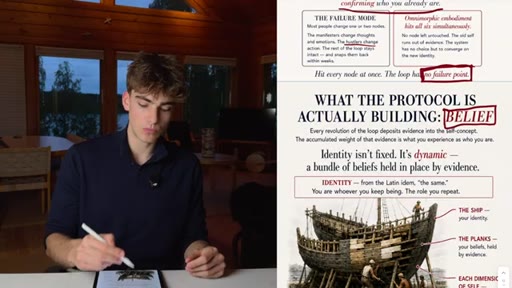
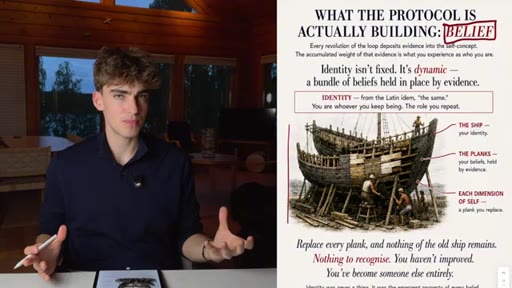
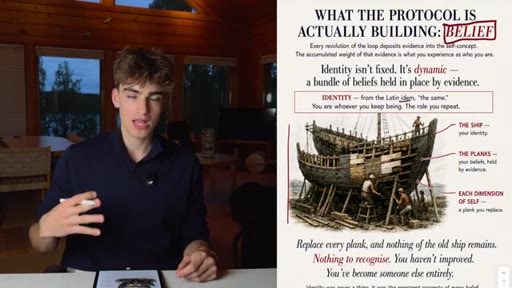
48:38Your identity is just who you believe yourself to be, it's a construct. And so every revolution of the loop deposits evidence into your self-concept or your identity. That accumulated weight of evidence is what you experience as who you are.
48:53Who you are is just this cluster of random beliefs that you have. Your identity is not this permanent structure and we can explain this through the I think it's a parable or a fable of Theseus' ship.
49:05I'm not gonna explain the full story but there was this famous man called Theseus and he went on a big mission on this ship. And this ship was saved in ancient Greece for a very long time and the ship got very old.
49:18And so over time they had to replace the the wooden planks that made up this ship. But eventually they get they got to a point where the original ship was no more.
49:28Every single plank from that old ship had been replaced. And so by this point, is that still the same ship? All of the planks of wood are the exact same, but everything has been replaced over time.
49:40At what point does that become a new ship? Identity is the exact same. Each plank is just a reference or a belief.
49:48References are just the evidence which hold together certain beliefs. Change one belief at a time and the identity is shifting, it's dynamic, but there is no solid identity which you can touch. It's this dynamic moving cluster
50:02that is an emergent property of the beliefs that you hold about yourself. You see the etymology of identity or just the the origin of the word identity
50:13comes from the Latin idem meaning the same. Identity literally means the person you are being, the role that you are playing. You can think of identity like the character that you're just repeating.
50:27Identity is just who you repeat and the role that that is. And so what we're doing with omnomorphic embodiment is changing the person that we repeat.
50:37We are changing the planks of wood on this boat that creates your identity. And by changing all of the planks of wood, by changing the references and therefore the beliefs,
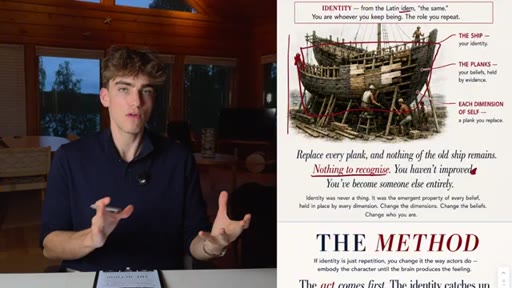
50:47we fundamentally change who you are. You change the entire boat and that's the process of destruction into creation. Replace every plank and nothing of the old ship remains,
50:57nothing to recognize. You haven't improved. Now this is the problem with self improvement optimization.
51:03Most people are trying to improve the old ship. They're trying to optimize the the self that is keeping them the same, which is why they see marginal gains,
51:12but nothing really exiting the comfort zone. They're not radically changing who they are, and so they're not radically changing what they get. Identity was never really a thing in the first place.
51:21It's not this solid thing that you can touch. It was an emergent property of every belief that held in place by every dimension of the self. Okay.
51:30So the the it's important to understand it. Belief creates your identity. Okay?
51:36Your identity is just a cluster of beliefs you hold about yourself. What we can call a self-concept. But your beliefs are formed
51:45through the dimensions of yourself. Those are the six things that we went through here because this is where your beliefs find evidence. What you think is evidence.
51:54What you do is evidence. How you feel is evidence. What you pay attention to is evidence.
51:58You get the idea. And so we can use these six dimensions of self that we ran through as nodes, as as tools that we can use to engineer evidence for a new identity. It's nuanced.
52:11I get there's a lot of density of information here, but this is the cutting edge of how you actually change who you are and therefore your results. And this could be related to business, making money, but you know anything in human endeavor.
52:25I mean this could be any goal health, wealth, relationships, you name it. You identify the version of you for whom that goal is inevitable and you engineer them across these six components of self. Now the big way that you approach this, the frame in which you need to approach this is the method.
52:43The method is a I'm I'm not an acting specialist, but it's essentially when you absorb yourself with your character behind the camera and out you know, when you're not behind the camera or when you're in front of the camera and when you're behind the camera.
52:58You act as this individual throughout your entire day or at least during the shoot. And there are some famous examples of this. Daniel Day Lewis in
53:07Daniel Plainview in the I think the movie is There Will Be Blood. Great movie. Famously, Heath Ledger playing the Joker lived as the character until it consumed him.
53:16Perhaps it probably killed him, many would argue. Jim Carrey playing Andy Kaufman refused to break set character on set. These people are method acting.
53:26They're absorbing themselves with the character, and still it just becomes a part of who they are. The crucial point here is you method act this inevitable identity. You identify who they are across these six components
53:38and you stick to that. Now at first it's going to feel alien. At first it will feel foreign,
53:44but remember identity is just the role that you're repeating. All that you're doing through omnimorphic
53:49embodiment is changing that role, changing the character that you're playing. And so after a long enough time the cost the identity was always a costume.
54:00The old one just felt like the skin. It's it's not
54:05permanent. And so by repeating something else for a long enough period of time, that can feel just as normal. And you just need to go through this transition period of it going from alien to normal, which all of these actors have famously done
54:18and to a large degree changed who they fundamentally are through this process of just absorbing yourself with this character,
54:26with this individual. Now this is a version of who you are.
54:31You can become intimately familiar with this individual. It's a version of who you are and in fact sometimes
54:38you are probably being this person when you are at your very best. What you wanna do is cultivate this as a minimum standard, as something you you know you won't drop below as a minimum tolerance
54:49and that's the person you become. You commit to it. You method act
54:54and you go no matter what. Now what you must understand is this is not as easy as just becoming a new person. That's an oversimplification
55:01because the old self will always fight back. The real war isn't becoming someone new, it's destroying the version of you that won't let you become someone new. Right?
55:11Your old self has something known as psychological immunity. It's the survival mechanism that the old self deploys the moment it senses an attempt to override it.
55:21Right? Every living organism on this planet has a survival bias.
55:27It biases survival or it wouldn't be around. It's an evolutionary trait.
55:31You need you need to bias survival, and your old self, your old identity, the beliefs that hold it together is no different. When it feels threatened it uses
55:42its defense mechanism and that defense mechanism is resistance. Resistance at first principles can be defined as emotional friction toward goal aligned action. The usual suspects are the same perhaps it's apathy, doubt, anxiety, fear, anger, sadness, guilt, shame, whatever it may be.
55:58People have different flavors of resistance, but it's all emotional in nature. Resistance is a phantom, a literal sensation
56:05of an old identity being threatened. Whenever you feel negative emotion, you know that you're sitting outside of your current comfort zone.
56:13Comfort zone is just what you deem is familiar, and so you know for a fact that your old self feels threatened and therefore you're going in the right direction.
56:22Remember we were talking about seeking discomfort in the second component that is action. Now as I've said
56:31previously in this lesson, hard does not exist in objective reality. The resistance that you feel, the obstacles that you feel are not going on out there. It's all going on within the mind.
56:41Hard is what the old self calls anything that doesn't confirm it, that threatens its existence. Right? The barbell isn't hard, it's not heavy, it just is what it is.
56:51There is no description. That that's all subjective. The old self is voting against it and you're experiencing that vote as difficulty.
56:59And so you're in a perpetual war with your old self. You need to destroy it. You see, most people are addicted to their old self.
57:06You know, the most addictive drug in the universe is not sold in a blacked out BMW by a sketchy man. No.
57:12The most addictive drug in the universe is your current self. You know, people are addicted to their to familiarity
57:20despite familiarity creating outcomes that they hate and they fear. That is the crucial point.
57:26It doesn't matter how much you hate the life. You are still addicted to the familiarity of it.
57:32And so the way that we overcome and destroy this old self is through four steps. Firstly,
57:38seek out the resistance. Resistance is a is an indicator that you're going in the right direction, that your old self is threatened and therefore when you take action through it it will degrade.
57:49Every action you take in the face of discomfort is a vote for that new self and therefore degrading the old self. They exist on a polarity. Seek out the resistance.
57:58Secondly feel gratitude for it. This is a reframe. This is a cognitive reframe following the the lessons from CBT Cognitive Behavioral Therapy.
58:07If we can cognitively reappraise what resistance means as something that is good, it's a green light, it's petrol for progress rather than something that holds you back, feel gratitude for it, it flips the entire equation on its head. Resistance now becomes something you want rather than something you avoid.
58:24The third is of course take action. Once you have found the resistance you feel gratitude and then you instantly beeline toward taking imperfect action. You move through it, you cast the vote for your new self.
58:38And then fourthly you sit in the pain. You need to become comfortable
58:43with discomfort. This is a really good skill to master. The new self is built in the space
58:50of discomfort. It's what the old self deemed as deemed as something that's a threat, and you need to identify those threats as opportunities and something that you can be comfortable with.
59:03Most people fear fear itself, and if you can become comfortable with the feeling of fear, with the feeling of doubt or anxiety or sadness or guilt and just be okay with it. Not necessarily love it, but just be comfortable
59:17with the feeling of discomfort. You become unstoppable. You become an antifragile
59:22system which is essentially what doesn't kill you makes you stronger. The resistance can't hurt you because you feel gruff you want it. You feel grateful for it.
59:30CTAYou flip the entire equation on its head. The old self weapon has now become your weapon to degrade and destroy it. That's the process of self destruction.
59:40CTABecause all of these tools that we we named up here in terms of embodying the new self, this is offense, this is becoming the new version of us. It doesn't matter how good we are at becoming
59:51CTAif the old self can just drag us back through that negative resistance. And so you need to be good at offense and defense,
59:59CTAdefending yourself against this resistance and taking action through it. And so there's two sides of the coin, self destruction and self creation. Killing
60:10CTAand cultivation. It's always they exist on a polarity, the old self and the new self, and so you need to be doing both and that's the crucial point here.
60:20CTAYou need to approach every component, every dimension of the self from a pros from a perspective of where can I destroy the old?
60:28CTAWhere can I cultivate and grow the new? You know, this exists everywhere in nature. You cannot plant
60:35CTAsomething new without unrooting the old, and that's the exact same process we're going through here. It's all about breaking the addiction to who you have been.
60:45CTADisarm the only weapon the old self has and it has no more influence over your outcomes
60:53CTAand your behaviors. And that's the entire protocol. That is everything
60:58CTAthat you need to know about shifting your identity. It is your identity above all else which determines your outcomes.
61:05CTAIf you're not able to modulate it, you won't be in full control of your behaviors.
61:12CTANow this is a system that plugs in to my broader mindset system
61:18CTAthat you should definitely check out. I've got a full master class on discipline. It's a game changer and not many people have seen it so you can get a competitive advantage in on that one.
61:27CTAI'll see you in there. Thanks for watching. Godspeed.
— full transcript
§ 05 · For Joe

Identity is an engineerable construct, not a fixed trait.

WHAT TO LEARN

Most change attempts fail not from lack of effort but from operating on behavior while leaving the identity that generates behavior untouched.

  • Self-improvement targets behavior, but behavior is a downstream output of identity — which is why habits installed without identity change tend to collapse under pressure or boredom.
  • Emotion is not weather. It is an engineerable state with two accessible inputs: what you focus on internally and externally, and what you do with your physiology. Taking responsibility for your emotional state is the prerequisite for controlling it.
  • The average person runs 60,000 thoughts per day, 90 percent identical to the day before. Breaking out of that loop requires metacognition — the ability to observe thoughts from a position of separation rather than being swept along by them.
  • Your physical, social, and digital environment is a museum of your past self, continually feeding evidence back into the identity you are trying to leave. Redesigning the environment is not cosmetic — it removes a continuous source of identity-confirming data.
  • The Reticular Activating System filters 11 million bits of sensory data per second down to 50 bits of conscious awareness. The questions you habitually ask yourself determine what those 50 bits contain — which means question design is attention design.
  • Appraisal — the automatic assignment of meaning to events — is the active layer of belief. The same event produces different emotional and behavioral outcomes depending on what frame it is evaluated through, and that frame can be deliberately interrupted and replaced.
  • Belief cannot be switched on directly, but it can be changed indirectly by generating new evidence through behavior, environment, thought, and attention. Identity shifts as the weight of evidence accumulates, not through an act of will.
  • Resistance to goal-aligned action is not a signal to stop. It is the survival mechanism of the old identity — which means feeling resistance while moving forward is confirmation of progress, not a warning.
  • People are addicted to their current identity not because it produces outcomes they want, but because it is familiar. The familiarity itself is the draw, independent of the results it generates.
  • Method acting an identity — acting as the person you intend to become before it feels authentic — works because identity is not a fixed object but the role you keep repeating. Change the repetition and the identity follows.
§ 06 · Frame Gallery

Visual moments.