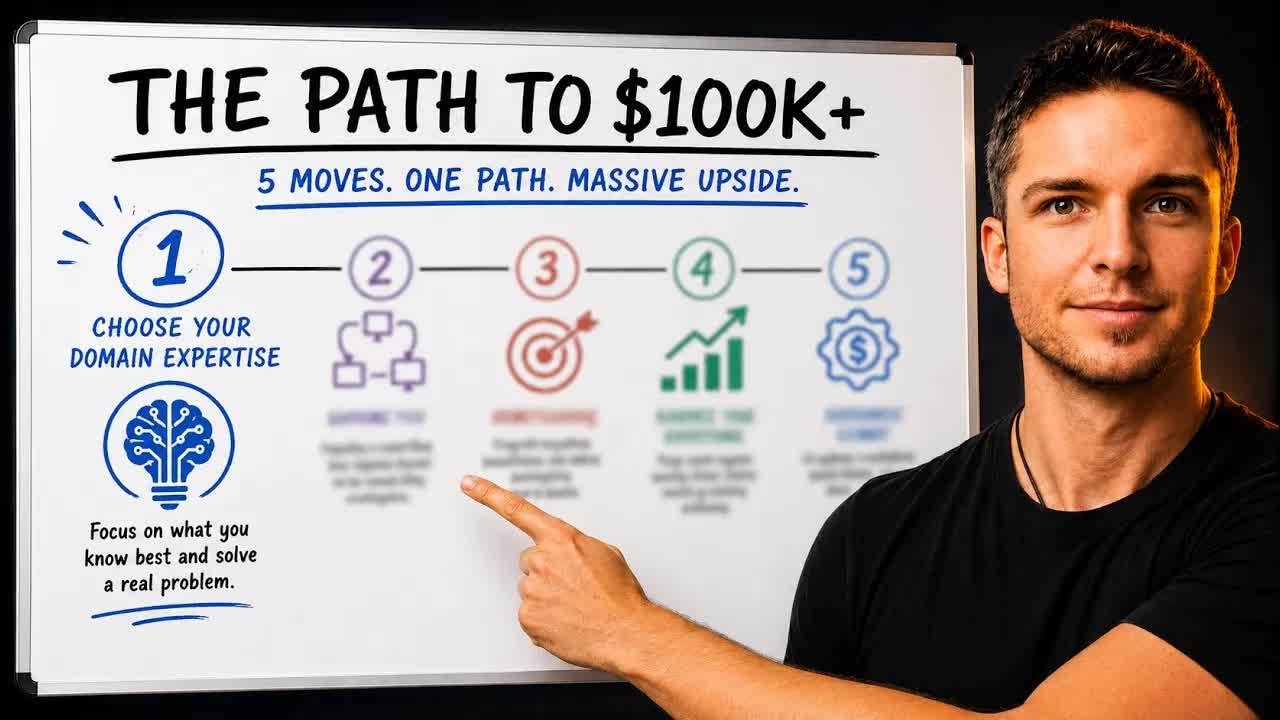
Mansel Scheffel · Youtube · 17:02

Claude Code + Live Workshops = $100K Consulting Playbook

A 17-minute blueprint for building a six-figure AI consulting funnel starting with a single in-person event.

Posted
May 27th 2026
8 days ago
Duration
17:02
Format
Tutorial
educational
Channel
MS
Mansel Scheffel
§ 01 · The Hook

The bait, then the rug-pull.

The demand for AI education is real, but almost nobody is teaching the monetisation side. This breakdown maps the complete five-stage funnel, from a single in-person event to a 176K-per-client retainer, built on one principle: the work is the pitch.

§ · Chapters

Where the time goes.

00:00 – 01:15

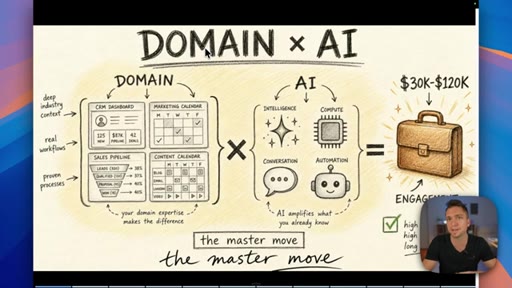
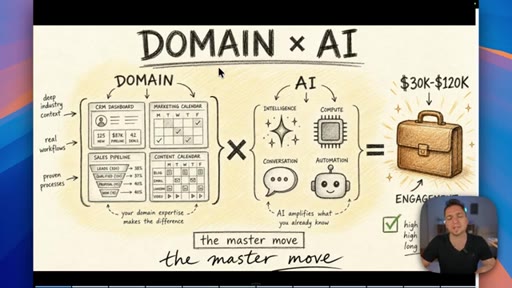
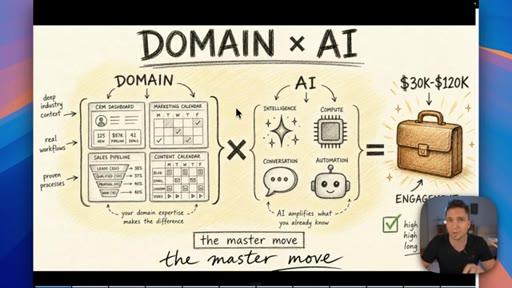
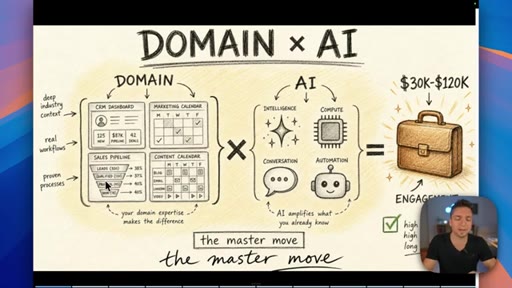
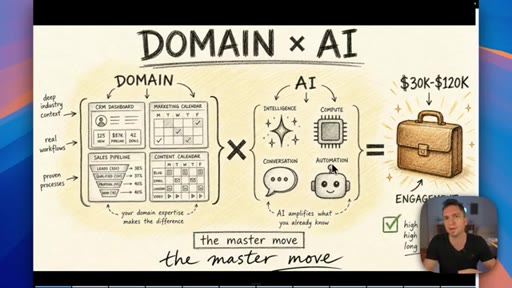
01 · Domain x AI: The Starting Theory

Distinguishes domain expertise from work experience; frames AI as an amplifier that turns proven processes into repeatable, reliable, faster-to-deliver workflows.
01:15 – 03:32

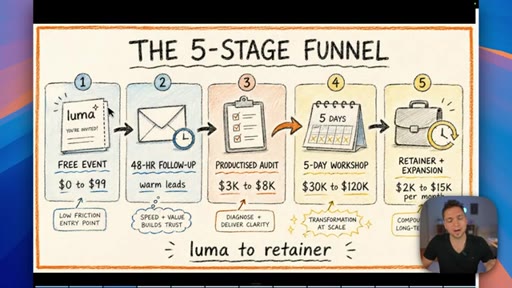
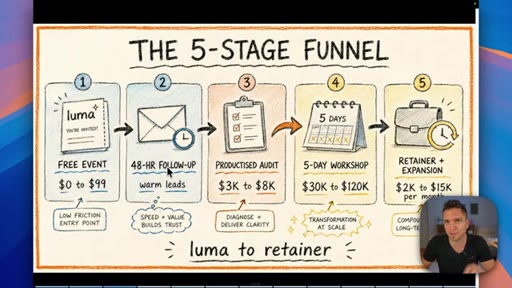
02 · The 5-Stage Funnel Overview

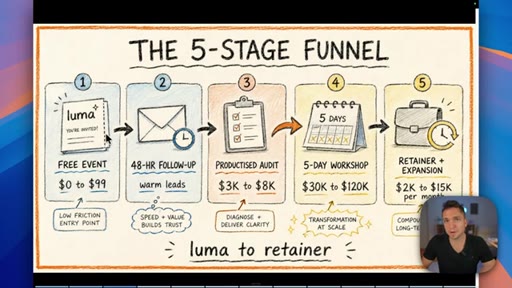
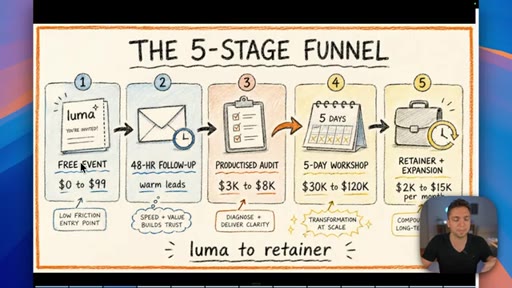
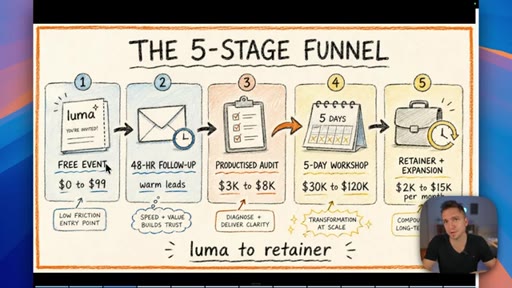
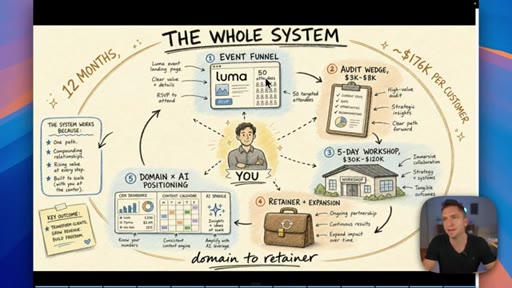
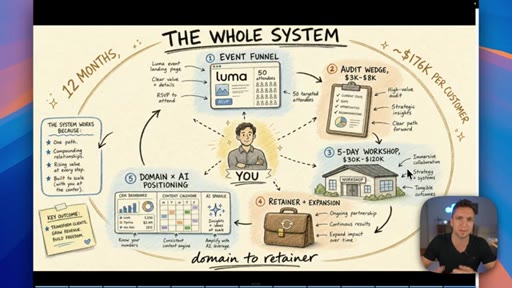
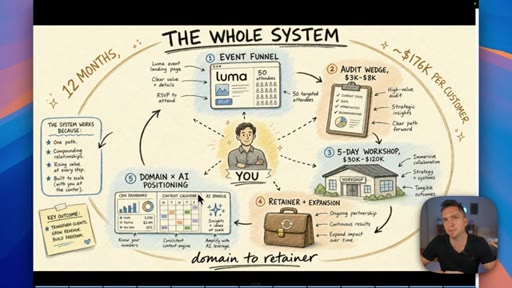
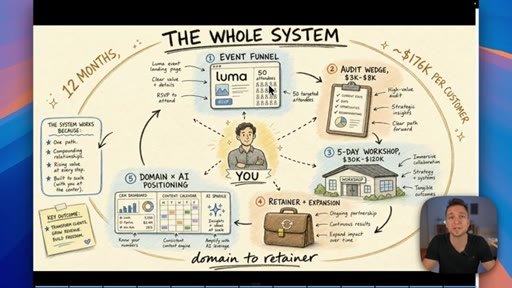
Introduces the full progression: Free Event, 48-HR Follow-Up, Productised Audit, 5-Day Workshop, and Retainer plus Expansion with pricing at each stage on a hand-drawn diagram.
03:32 – 05:02

03 · The Live Event Blueprint

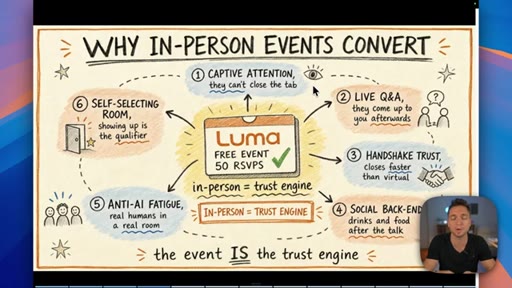
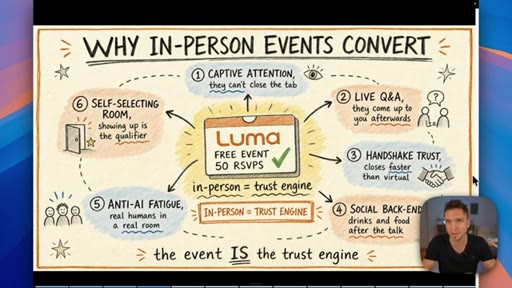
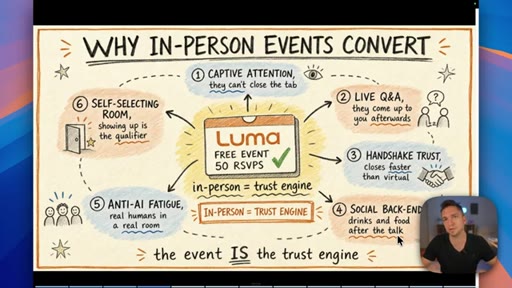
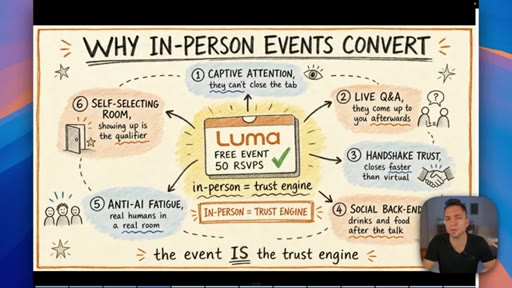
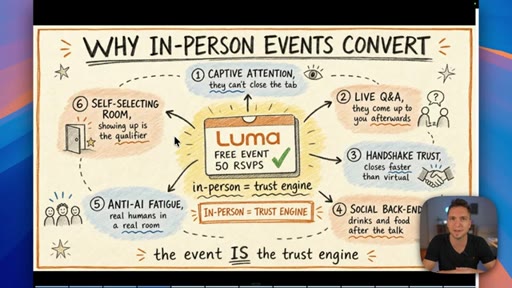
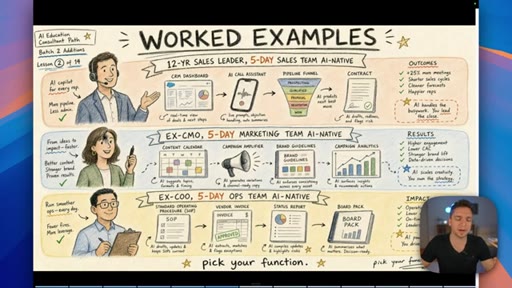
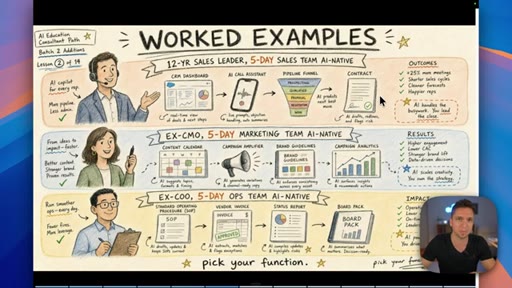
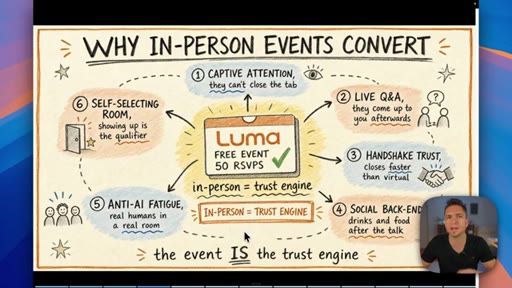
How to structure a 90-minute in-person workshop; worked example with a 12-year sales leader choosing 1-3 workflow items to teach; why in-person events convert: captive attention, live Q&A, handshake trust, anti-AI-fatigue, self-selecting room.
05:02 – 07:19

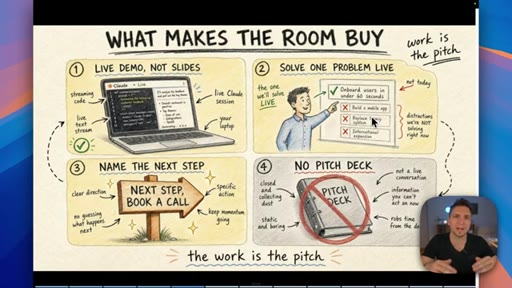
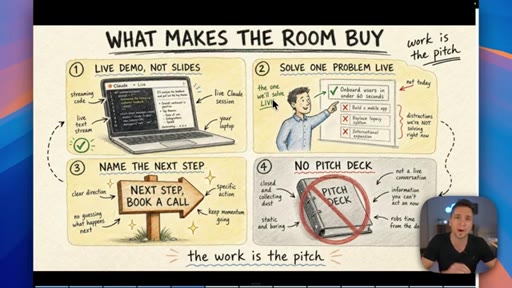
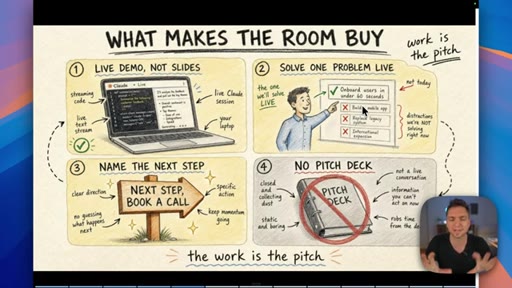
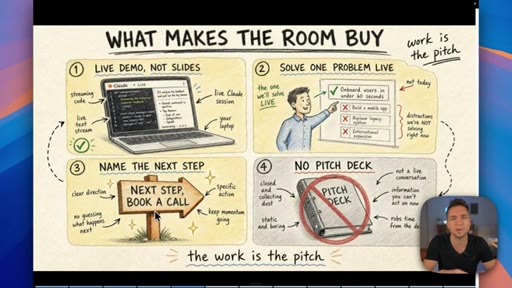
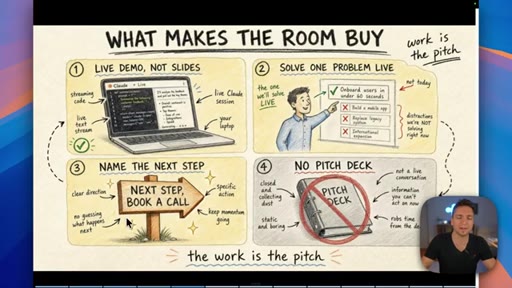
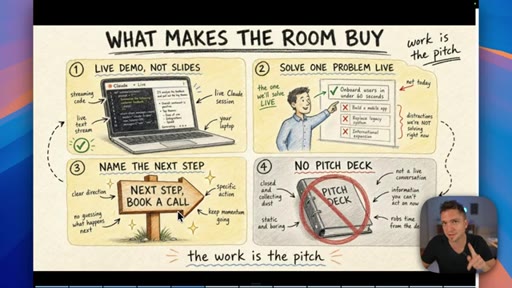
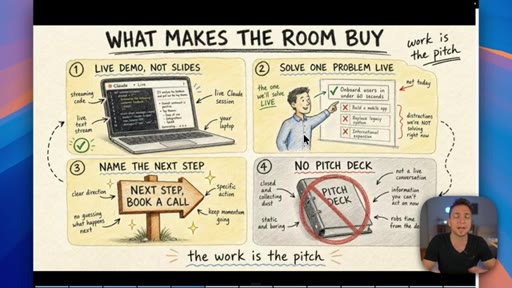
04 · What Makes the Room Buy

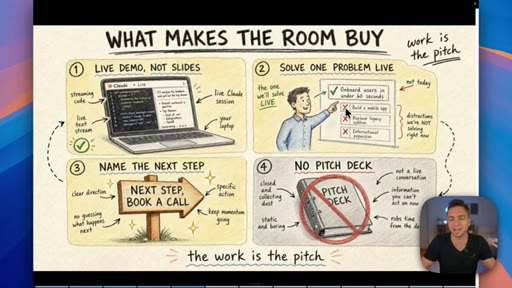
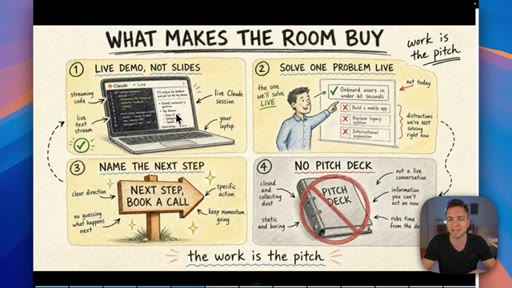
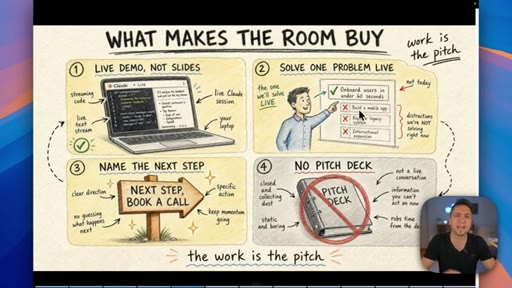
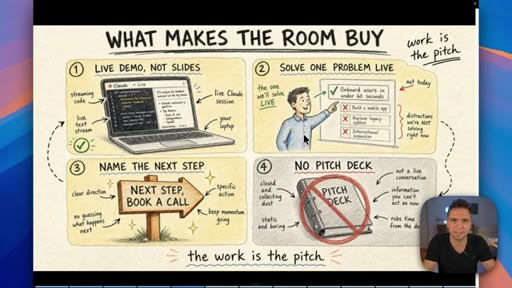
Four rules: live demo not slides, solve one problem live, name the next step, no pitch deck. The event is a lead magnet not a sales floor. Value given freely forces the conversion privately.
07:19 – 09:45

05 · The 48-Hour Follow-Up

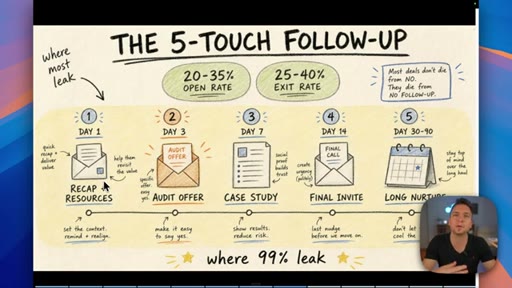
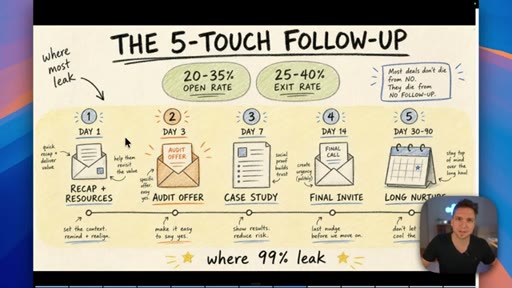
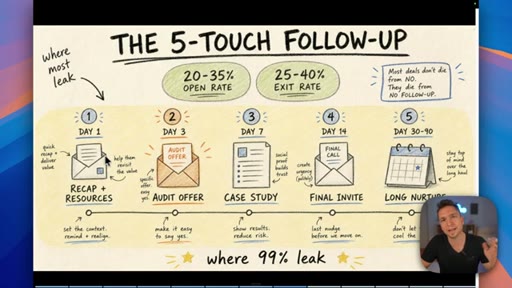
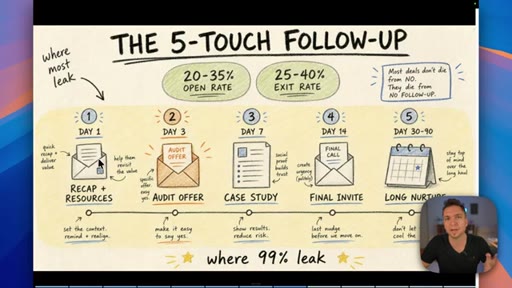
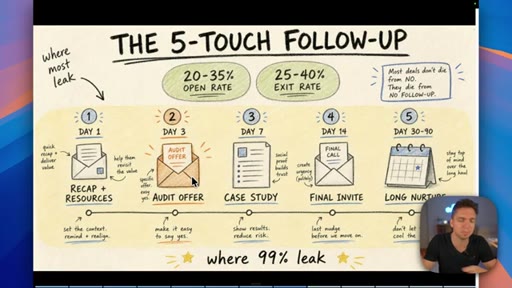
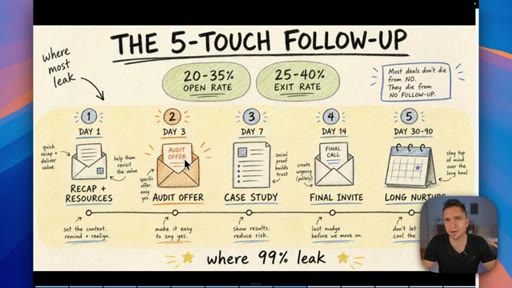
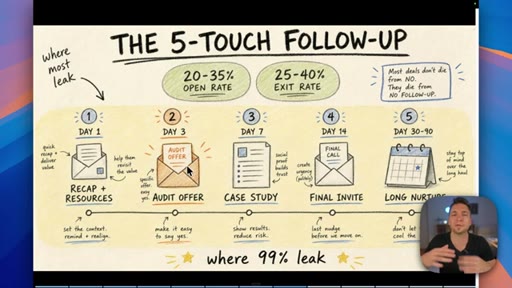
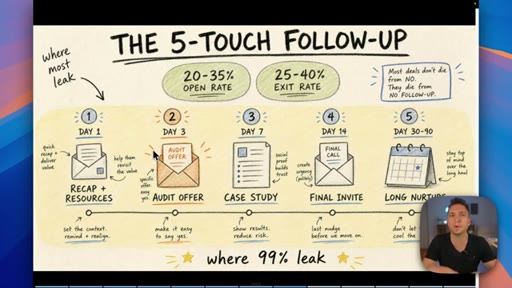
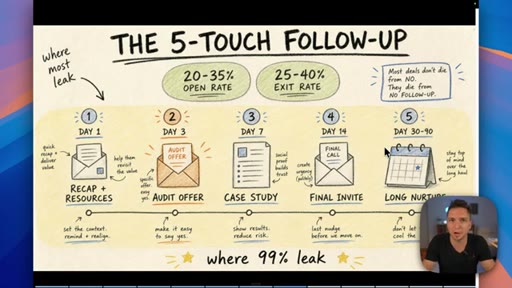
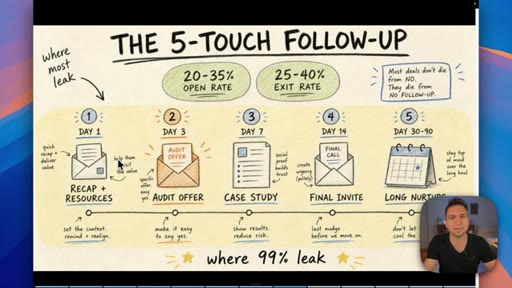
Day-one recap with no upsell, 5-touch email sequence, where 99 percent of consultants leak leads, and how to introduce a free audit offer rather than a paid pitch on day two.
09:45 – 11:46

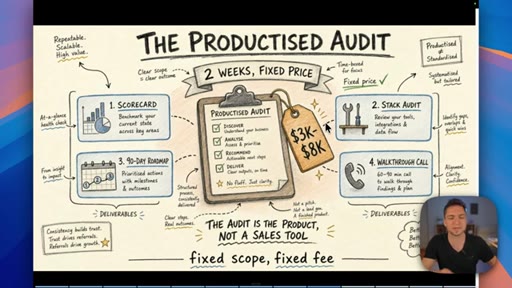
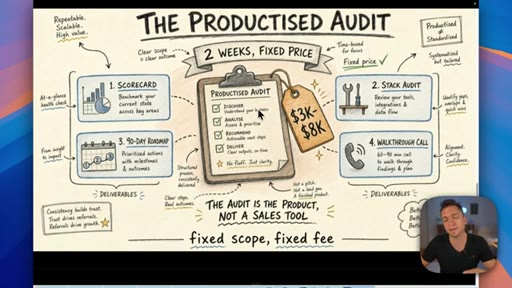
06 · The Productised Audit

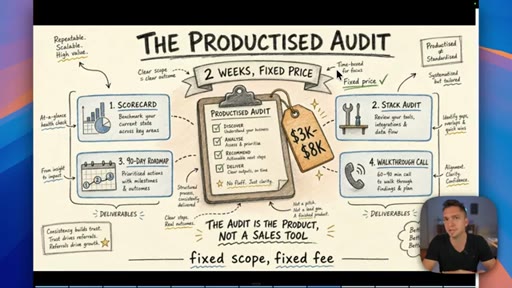
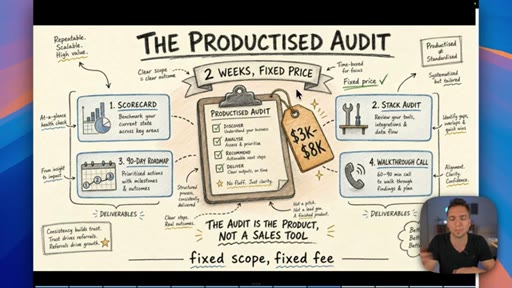
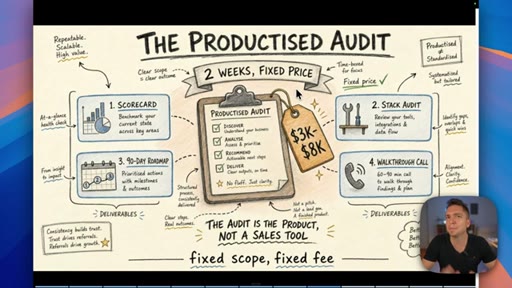
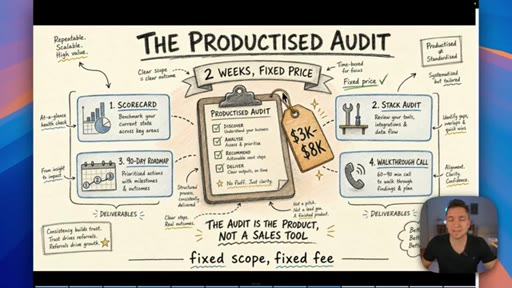
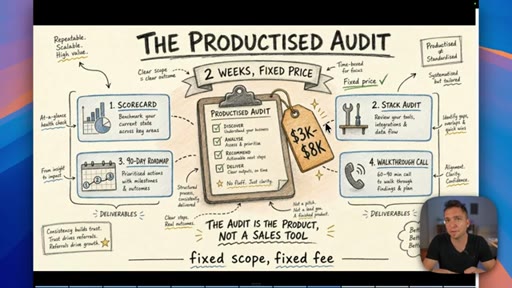
Fixed-scope, fixed-fee AI audit priced 3K to 8K over 2 weeks: Scorecard, Stack Audit, 90-Day Roadmap, and Walkthrough Call. The audit is the product not a sales tool and maps where AI should actually go in a business.
11:46 – 13:28

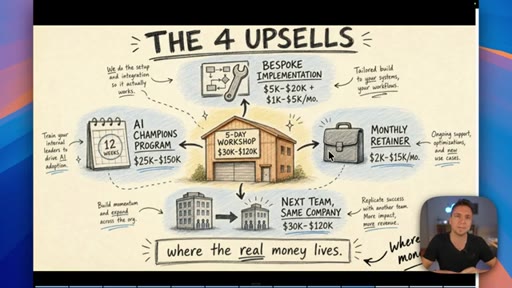
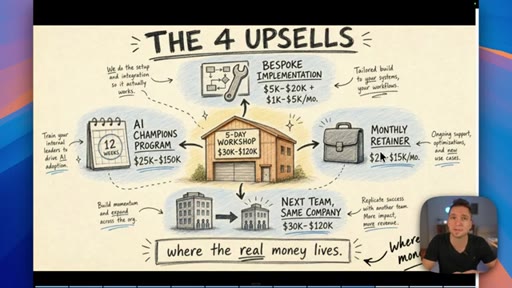
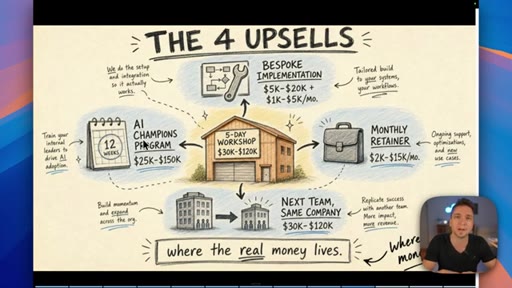
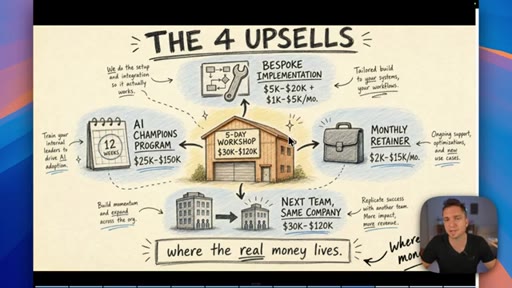
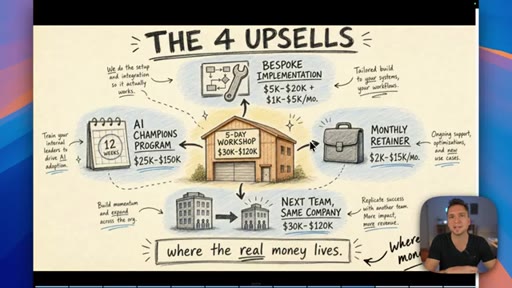
07 · The 4 Upsells

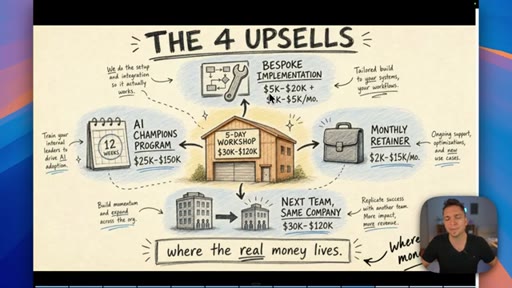
Bespoke implementation, AI Champions Program, 5-Day Workshop, and Next Team Same Company. All referral-based with no cold outreach. Together these represent where the real money lives.
13:28 – 15:13

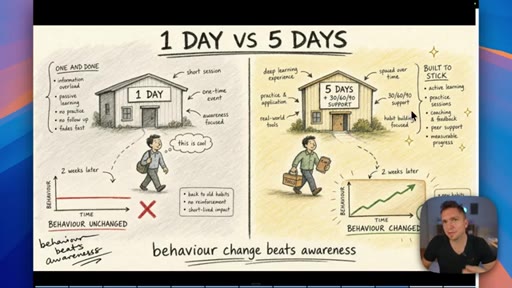
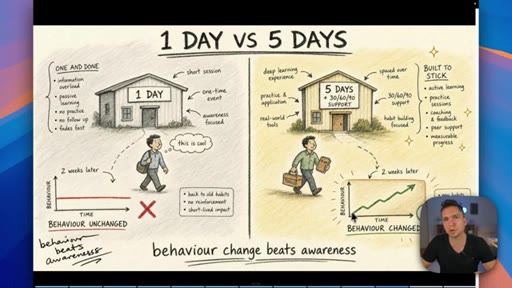
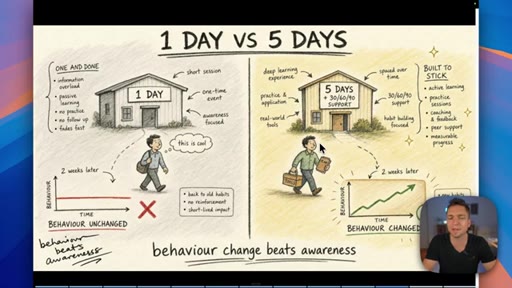
08 · 1 Day vs. 5 Days

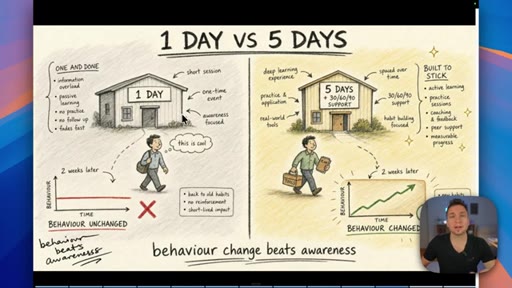
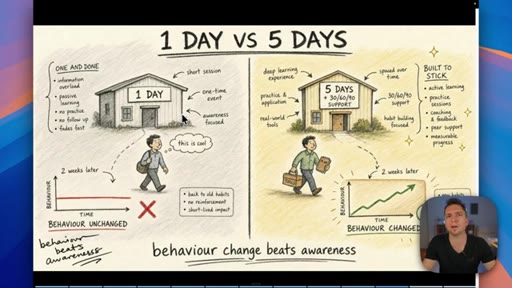
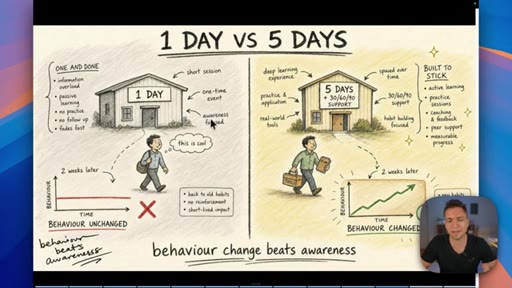
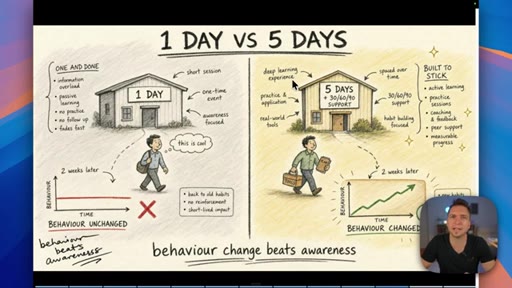
One-day events create awareness that fades; five-day immersives with 30/60/90-day support create behaviour change. The 5-day format lets you charge more and actually automate workflows inside the client business during the engagement.
15:13 – 17:02

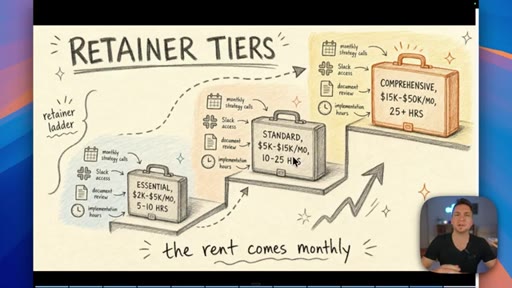
09 · Retainer Tiers and the Whole System

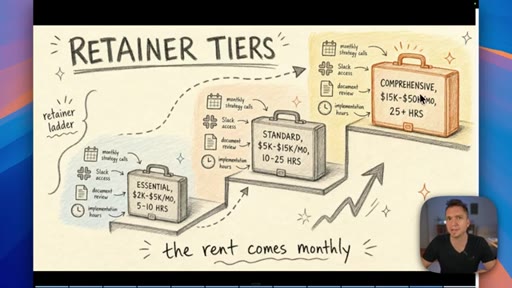
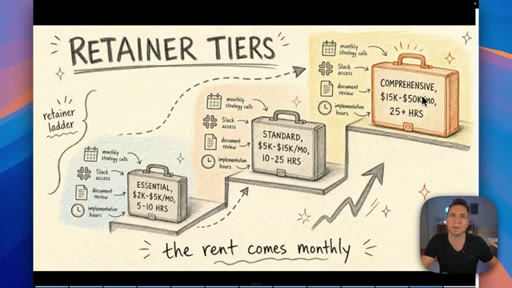
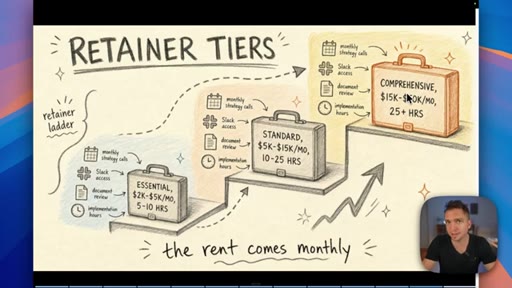
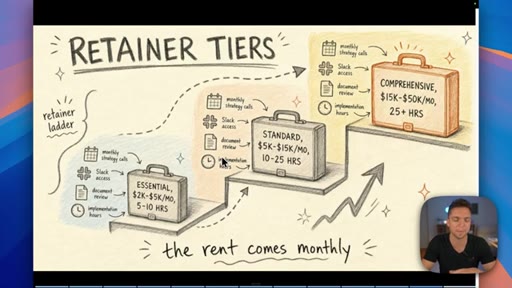
Three retainer tiers: Essential (2K-5K per month), Standard (5K-15K per month), Comprehensive (15K-50K per month). Full 12-month per-client value diagram showing approximately 176K. Whole funnel summarised as domain to retainer.

§ · Frameworks

Named ideas worth stealing.

01:15 model

The 5-Stage Funnel

  1. Free Event (0-99 dollars)
  2. 48-HR Follow-Up
  3. Productised Audit (3K-8K)
  4. 5-Day Workshop (30K-120K)
  5. Retainer plus Expansion (2K-50K per month)

The complete progression from low-friction in-person event to long-term monthly retainer, all driven by referrals.

Steal for any service business needing a trust-first lead gen system
00:00 concept

Domain x AI Formula

Deep industry context plus real workflow experience plus proven processes, amplified by AI, produces a repeatable, reliable, scalable offer that is faster to deliver than domain expertise alone.

Steal for positioning any consulting or coaching offer in the AI era
09:45 model

The Productised Audit

  1. Scorecard: benchmark key areas
  2. Stack Audit: review tools and data flow
  3. 90-Day Roadmap: prioritised actions with milestones
  4. Walkthrough Call: 60-90 min findings and plan debrief

Fixed scope, fixed fee, 2-week engagement priced 3K-8K. Sold as a product not a sales discovery call, which removes objections because the client knows exactly what they are buying.

Steal for converting event attendees into paying clients without a lengthy proposal process
05:02 list

What Makes the Room Buy

  1. Live demo, not slides
  2. Solve one problem live
  3. Name the next step
  4. No pitch deck: the work is the pitch

Four rules for structuring a workshop so the room converts without a sales conversation.

Steal for any live educational event designed to generate downstream clients
13:28 concept

1 Day vs. 5 Days

One-day events max out at awareness; five-day immersives with 30/60/90-day support produce behaviour change. The difference is active learning with coach-led feedback versus passive information delivery.

Steal for pricing and structuring multi-day workshops or bootcamps
15:13 model

Retainer Ladder

  1. Essential: 2K-5K per month, 5-10 hrs, async-heavy
  2. Standard: 5K-15K per month, 15 hrs, direct support
  3. Comprehensive: 15K-50K per month, 25+ hrs, fractional embedded

Three tiers differentiated by hours of access, not deliverables. Clients self-select based on how much change they actually want.

Steal for structuring ongoing consulting engagements after an initial project
§ · Quotables

Lines you could clip.

02:45
"Trust is the only thing that is ever going to close a sale."
short, universal, no setup needed → TikTok hook
05:12
"The work is the pitch."
five words, punchy, runs against every sales instinct → IG reel cold open
05:38
"Do not feel like you need to gatekeep anything from anyone and put it behind some stupid paywall."
contrarian to most creator monetisation advice, emotionally charged → newsletter pull-quote
16:50
"If you got 20 people in a room, that is 2000 dollars for ninety minutes of your time."
concrete number that reframes the value of in-person teaching immediately → TikTok hook
§ · Resources Mentioned

Things they pointed at.

04:21toolClaude Cowork
04:21toolClaude Code Skills
10:35toolLuma ↗
09:48linkPricing video linked in description
§ 04 · The Script

Word for word.

00:00Right now, is a massive demand for AI education, yet so few channels out there are actually teaching you how you can sell this to people out there who want to learn more about AI. In this video, I'm gonna show you how to take your domain expertise, mix it with AI, and turn it into an offer that scales ridiculously fast. Let's get into it.
00:15So straight out the doors here, when I talk about domain expertise, I don't want you to think that I'm talking about work experience. Those are two very different things. What domain expertise means is that you're an expert within that domain.
00:25Could be content creation, it could be sales, whatever that is. The difference between domain expertise and work experience is that, obviously, you have taken your domain expertise and applied it to work. So all you're getting from that is some form of credibility from an established business.
00:39Obviously, that would increase your value, but don't worry for those of you that don't have any of that work experience yet, this exact model still works for you. So the starting theory here is quite simple. We take our domain expertise, which is our deep industry context,
00:50our real workflow experience or building specific things within this domain, and taking all of our knowledge and our proven processes that we have either done for ourselves or for businesses historically to make them more money or achieve a specific goal within this domain. We then take all of that and we bundle it up with AI, so we're essentially amplifying our own intelligence and our own experience to the point where we can get a repeatable workflow that is reliable for a business but a lot faster.
01:13So we're augmenting domain expertise. To me, this is the highest leverage thing you can do right now and it forms the backbone of everything we're about to talk about in this video. And this brings us neatly into the five stage funnel.
01:22Now, after points one and two, what you do is entirely up to you. I'll give you some ideas of what you can do, but this isn't some static thing that you rigidly need to follow except for points one and two because those are the obvious entry points and how we get through to the rest of the funnel. The first thing over here being an event.
01:37Now depending on your experience level, that would depend on whether you're giving this thing away for free or whether you're gonna be charging for it. For me, after twelve years working in some of the biggest companies in the world, I would never ever do a free event anymore. Those days are past me.
01:48But if you're just starting out and you have the domain expertise like I mentioned, but you don't have any of that credibility behind you, doing this for free is really a no brainer because it automatically establishes credibility for you. By default, humans already trust people in person more than they would online, with everybody claiming that everyone on YouTube is a guru.
02:05But there are several other reasons we want to do this kind of thing in person and that is because we captivate their attention. They can't just close a browser tab. It's not like it's a YouTube livestream where they get bored and just go back to looking the latest Lububu collection.
02:17They're in the room with you over here. They're gonna sit till the end of the ninety minutes to see what all of this is about because they also came all the way there. So as long as you make it engaging and valuable,
02:26then you will keep them in the room. Second point here, this is a live q and a. They can ask you questions in real time, human to human, and get that feedback that they need.
02:34This increases your trust along with everything else that we're doing in here, which if you know for sales, trust is the only thing that is ever going to close a sale. That is what we are trying to convert over here, their attention to trust to a sale. And that brings us into our third point, having a real life handshake, seeing someone in the room, that increases trust automatically like I mentioned earlier as opposed to somebody who's online.
02:52The fourth and best part of this is that you can build actual relationships with these people, which not only increases that trust, but it also disarms them more. The more that they learn about you, the more that they find they might have in common with you, that increases your trust, which increases your leverage. But it's also a great way to make new friends, and friends make the world go around because these guys are in places that you might want to be in.
03:12But the benefit is obvious beyond working here and trying to sell something, building genuine relationships will really help you in this space and in your personal life. So there's a lot of benefit for actually doing it from that perspective. Point five, like I said, people are tired of the AI slop, the AI fatigue, running around everywhere, giving them advice when they would rather have somebody lead the way for them, especially in person.
03:32And then finally, the benefit of this is that your room is self selecting. If they've chosen to be in the room, whether it's for free or whether they paid for this thing, they're taking the time to leave their little room and come to wherever you're hosting this event. So that's already a good sign that these people are more than just curious.
03:46Because if someone takes the time to come all of the way to see you, they're going to be far more engaged. Cool. So we know we need to host a live event, but how the hell do we do that and what's involved in it?
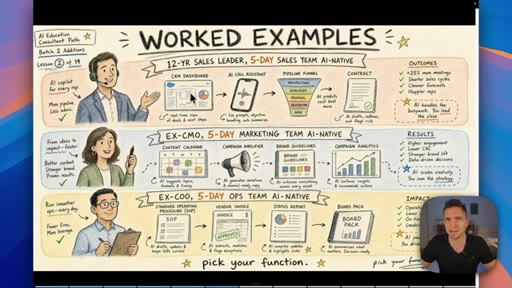
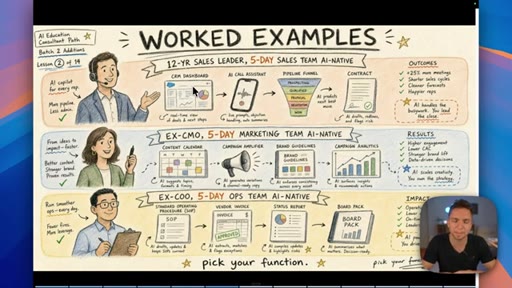
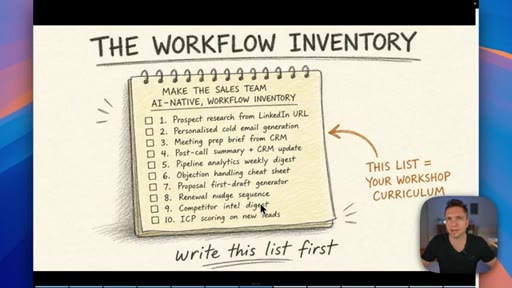
03:54I think for the rest of this video, we need to anchor ourselves in one of our experts over here. Let's just go with this twelve year sales leader at the top over here who's going to be hosting a live event as part of his lead magnet to get into a much larger organization later on and do an AI native transformation project for them.
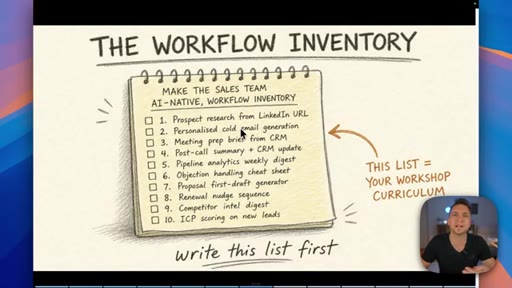
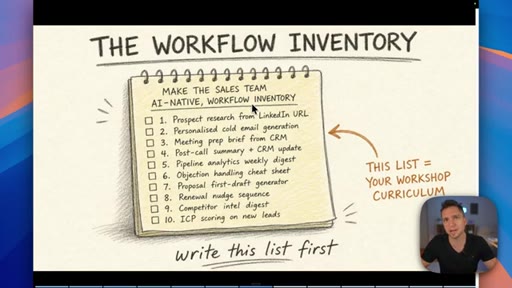
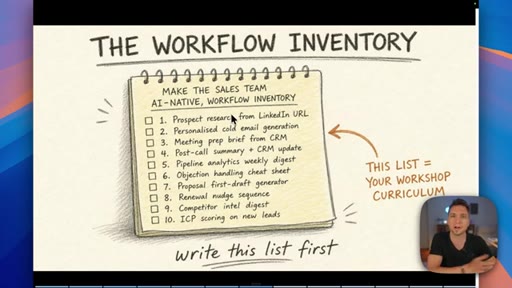
04:09So before his workshop, he would create an inventory of whatever it is that he needed to do. He might have 10 steps in here, and at the first live event that is either free or costs maybe a $100 or more, he would choose one, two, or three things that he might want to take these people through as a part of their local transformation.
04:26So generally, that could be something like teaching them how to use Claude Cowork because it's more user friendly. Then as a part of learning Claude Cowork, he might teach them how to use skills because those are the fundamentals for automating any workflows or processes that businesses actually need nowadays. Then the most common one for salespeople is that they want automated lead gen and prospecting and things like that.
04:44So he might say, cool. In those ninety minutes or two hours, we're going to cover all of that. And by the time you leave this place, not only will you know exactly how to do that, but you'll walk away with a workflow that you can use in your business today.
04:54And it obviously doesn't have to be that. That's just a really good starting point on this list that you make of everything that would generally have been done as part of a sales transformation. You can pick and choose what you want, which brings us into the next slide of what actually makes the room buy.
05:07We've got them in the room now. We know exactly what we're going to be giving them in this mini transformation, which in this case is that sales and lead gen workflow plus the knowledge of co work and skills.
05:16So you wanna make sure that you are not doing a slide deck here. Of course, slides will form a part of it here and there, but the more live you can make this thing, the more tangible that you can make it and people getting their hands dirty, the better it is for you because then it becomes an experience and not just a presentation.
05:29Like I mentioned, the second point here is to make sure that they leave with a problem solved, not just the education piece because people can find that stuff online. They need to leave with something they can take back to a larger group of people, some of their friends, maybe a business that they're working in to show them, oh my god, I went to this presentation, this guy's awesome.
05:46Look at what we did in ninety minutes. Again, this whole thing is just a lead magnet. It's a way to boost your trust, your leverage, and to gain traction into the companies that you would otherwise never get into.
05:55Something to note here that's extremely important, don't feel like you need to gatekeep anything from anyone and put it behind some stupid paywall. This event, especially if you do not have experience, is your one way into those companies. So give as much value as you possibly can in that time frame.
06:09And like I said, if you can back that up with a cool experience afterwards like drinks, getting to know one another, maybe playing table tennis or whatever it is that people do nowadays, that's a really good way to enforce everything that they've learned and build a more personal relationship. Once we've done that, we need to make sure that we have named the next step.
06:25When people leave this event, they should know exactly what is gonna happen next, where they can find you, do you have a community, is there a way that they can engage with you beyond whatever just happened inside this group meeting. Give them a clear direction, and the easier it is for them to do that, the better it is for you.
06:38Usually, going to be with a QR code that takes them to a landing page or to a community, whatever. They scan it, they have it forever, they have all of your details, and it also signs them up to a newsletter or an email list, whatever you've got going for yourself so that you can keep them informed after the event.
06:51You obviously also want to make sure that you are following up after the event. We'll get into that in just a second. But make sure you absolutely do not try and sell a single thing to anyone in this room.
07:00The goal here is not to sell. All of this stuff that you are doing between building relationships, giving them massive value, and actually solving problems for them, that builds the trust. That builds everything we need to make a sale.
07:11Think about it. When you see somebody doing something that you wish you knew how to do, doing it very well, and then giving it away for free, those are all the principles that convert automatically. So if these people see that, they don't need to be sold to.
07:22They are already sold. They want more if you've given them an amazing event and solve their problems. Your only job now is step three, to make it very clear how they can get more out of you.
07:30And that brings us on to step two, is the forty eight hour follower. So day one, the first thing that you wanna do after your event is make sure that you send them a recap of everything that happened. Maybe even send them a recording.
07:41Side note here, really good to record this kind of thing because it improves your online credibility when you're doing public speaking events in the real world. You can also use it for all forms of content. So you can put it on YouTube, you could cut it onto Shorts, put it on Instagram, YouTube Shorts, whatever.
07:54It gives you a lot of content that you can piggyback off of. Hey, I taught all of these people in person. Come on around to the next one.
07:59It serves a dual marketing purpose between the people that you just taught and the people that you will teach one day. But back to this, like I said, you need to make sure that you're sending them everything they need, not just where to find you but how they can progress through the pipeline and get more things out of you in the future.
08:12That all happens here. But on day one, you never wanna upsell them anything, don't offer them anything else. Just keep giving them reinforced value, any guides that you might have promised throughout the talk that you just did, skills, whatever that they might find valuable goes into your day one recap.
08:26Now, whatever happens from day three afterwards is entirely to your own custom pipeline, whatever it is that you've got going on. If your entire goal was just to get them into a higher ticket community or something like that, where they pay you a yearly fee of like $2 or whatever it is, your offer would obviously change over here.
08:41I'm just using the audit offer as an example. It's interchangeable. Point being over here though is not to sell them something.
08:46Don't say pay me 5 k for this audit. I'm gonna audit your business. Again, will just burn all the credibility that you just built.
08:52You again offer them something free over here. An audit is a really good way to get this done because it is another foot into a door, perhaps a door inside the business that they work in. So one thing you could do is a thirty minute discovery call where you go through an audit of a specific pod within their business.
09:06It could be the acquisition part aka how do they get clients, and you would go through there and talk about some aspects or challenges that they're facing within their business on how to get clients at the moment. You can find automation opportunities in there where AI would help them solve that problem, and again, them free value on that that call.
09:21It costs you absolutely nothing and it builds you a ton of more goodwill because now you've done that live event. That same person will be on this call along with whoever else they invited to this call to see how awesome you are from that live event. Once you've done that, you now have two forms of trust and credibility,
09:35plus you're giving them more value upfront, and then you take them further in this five touch follow-up to the point where you show them what a full audit would look like and then perhaps into transformation or education, whatever it is we wanna do, we're gonna look at that now. So for me, the audit is the best place to start, particularly because it explains everything about the business, the problems that they're facing, the opportunities that there might be for automation and placing AI within the business, where it actually makes sense.
09:59So if you lead with this, not only do you have the strategy that you need to see these are the things I should solve, but you also have something to show the client where their problems actually are because sometimes they think it's over there when really it's down there. So by spreading all of this out on an actual canvas that people can see their problems in front of them with numbers attached to it, return on investment, how much time they're wasting, all of the information they need, stashed there in a simple order that you can either, again, based on your experience, offer for free or as a paid for opportunity.
10:26As a side note, I've got a whole video on pricing and how to price yourself in the description below if you're struggling to understand how to do that. But another reason that we do this audit is because in discovering all this information that you can see on the screen now, we walk away with a road map of where we should actually be applying AI.
10:40For some businesses, that might be blatantly technical. You might need to come in there, rip out a bunch of stuff, go through their business processes, and do something technical. But it might also just mean education, and that was the whole purpose of this video is how to lead with AI education.
10:54So I wanna frame particularly what we're gonna be doing after our audit and focus on how we can mix the education with any of the domain expertise and perhaps some of the technical nature behind it because then you really have a solid offer to sell to a company.
11:07So let's come back to our little worker diagram over here and take our sales guy as an example again. He's got twelve years as a sales leader. So now, long before AI came along, he was the best salesman in his class.
11:17He was cutting deals every single day. But then AI made him 10 times better and 10 times faster, so he merged the two together. And now his sole purpose is to out there and take all of that and put it in a business.
11:27But how the hell does he do that? And more importantly, how does he turn it into an offer? Off the back end of this audit that he just did where he recognized all of the problems the business is facing, not just from a technical perspective,
11:37but also a team perspective, he knows the best thing that he could do for his upsell is to not only look at tailoring specific solutions using AI to make the team faster, he knows before he even touches that, he needs to get the team trained specifically in sales so that they can hit their goals without AI.
11:54If their baseline sucks, no matter what AI you throw on top of that, it's never gonna be any better than where it currently is. So his first goal is to educate them on sales, how to be better salespeople, increase their close rates, get them on cold calls, get their cold calls closing better, whatever goes into that. Once he's brought their baseline up, that's when he starts doing the bespoke implementation for any AI workflows that need to take part.
12:16He might do AI education for the team as a whole, how to actually use it every day in a sales team per sales member. You can do group classes within the business, teaching various aspects around how to do this as an AI enabled salesperson. So we've got the bespoke implementation.
12:30We've got the AI champions program, bringing however many people in their team into there. Then we also have the monthly retainer because remember, AI changes all the time. So you're not just gonna go in there and then leave the business forever.
12:40You would wanna stick around, and more importantly, they would want you to stay there because the landscape always changes. So after you've done these two things, there's still maintenance because these people might have been champions when you were there, but their call rates might start dropping again. They might not have adopted some of the tools that you brought into the business.
12:55So you need to watch for change management. You need to make sure the things that you have done actually stick. Otherwise, everything you've built is completely pointless.
13:01And that's why change management and adoption psychology is so important as a part of this process. I have a video coming out on that very soon. Point is, there are many different angles that you can take in here and they all feed off of one another just by you being the domain expert and attaching AI to it.
13:14The great thing about this, as you can see, is that this entire funnel that we've built is entirely referral based, completely open without you needing any credibility or stamp of approval from a much larger business. Obviously, terms of timings and pricing for this, it would depend on the size of the organization. But something to note over here is that for our AI champions program, this does not have to be something overly long.
13:33In fact, if you didn't want to do any of the technical implementation and you only wanted to focus on education, something you could do is like a five day workshop. If we look at the one day versus five day, on one day, you can certainly give away value.
13:45But as it gets to about the two or three hour limit, that is the cap for something that is actually meaningful where people are gonna take something home on that day. Those boot camps where they try and get nine hours of work done and you complete a whole course, it's less realistic.
13:58People cannot learn that fast. Not everyone has your brain. And they certainly can't pick up some of the things in AI right now because they're not only having to learn a little bit about the domain expertise itself, but then also how AI works.
14:08So realistically, one day is good for those shorter term things. I would say up to three, maybe four hours absolute max depending how technical you're going. But five days is more valuable not just for them but for you because you can obviously charge a ton of more money for this because you're charging for a deep learning experience plus a lot more that you can actually automate in that time for them.
14:27So they would be working with you to automate their own processes. They're doing the technical implementation while you're teaching them how to do it live. In a nutshell, it's an active learning session with coach led feedback
14:37within the business itself, which is extremely valuable for them. More importantly, the team members and the business are going to get outcomes based on this, which is all you ever wanted. Right?
14:46We want to have behavioral change. We don't just want to have awareness and hey, AI exists. We want to see it running in our company.
14:52And if you can get their employees to do it instead of you having to do it or instead of their management actually having to think about how do we get this done, you're solving so many problems in one day, which again just increases your value. And then finally on this, I just want to talk a little bit about the retainer model here.
15:05I think it's really good to have a tiered approach because it depends on how much you want to give to a specific business versus another one or how many you want to juggle at the same time. So an essential package might be something that has more async support than it does direct support. You certainly would need to offer at least one hour a week where you're talking to these people face to face to answer any direct questions.
15:24As we climb up this ladder, that's when you start giving more of your time week or per month. You might offer them some more build help, helping some of their team build out skills and things like that that they need. And as we get into comprehensive, that's where, obviously, where they're paying a lot more for your time, and it's essentially fractional at this point.
15:39You would be more embedded in the business. You would understand their processes almost as well as they do, you and would be helping them achieve a specific goal. It's probably going to be measurable over three to twelve months and you would help them achieve specific milestones so that they can measure your quality, but also that you can ensure that they're getting the value that they need over that time period.
15:56The great thing about this approach apart from the money is that if you can show them that they are getting actionable value every single quarter or month, however you're measuring this thing, it means they're way more likely to keep you around much longer, which is what we want and why we have retainers. And so that's it in a nutshell, guys.
16:10It starts with the event. That is the most important thing for you to nail even if you're just starting out and you're charging a $100 for this event. If you got 20 people in a room, that's $2,000 for ninety minutes of your time.
16:21So it's really lucrative even if you have nothing right now. Once we've done that, we have the audits or the wedge, whatever it is that we're going to put in between this and the larger offer that we get them into, whether it's a community, whether it's going into the business. The whole point is just using this as leverage to build trust, to get them into this wheel, finally, into our retainer model.
16:38And out of this retainer model, you become that domain expert because now you will have more stamps of approval of this person helping specific businesses or being an amazing public speaker and showcasing these live events. However you wanna frame this thing, I just wanted to give you guys a vehicle to get you there. So I hope this video was helpful.
16:53If it was, leave some comments down below. Otherwise, check out the videos on the screen now. They'll definitely help you on your journey.
16:58Or you can check out my community where we're doing things like this every single day. See you
— full transcript
§ 05 · For Joe

The room that trusts you already bought from you.

WHAT TO LEARN

Every stage of this funnel is designed to make the sale feel inevitable rather than persuasive, and it starts with giving everything away in person.

  • Domain expertise is the raw material and AI is the amplifier. Either one alone commoditises quickly, but the combination creates an offer that is both faster to deliver and harder to replicate.
  • In-person workshops convert better than webinars not because of the content but because of the commitment required to attend. People who travel to see you are already halfway sold.
  • Giving everything away for free at an event is a deliberate strategy, not generosity. The trust it builds is worth more than the ticket revenue you forgo.
  • A productised audit removes the longest objection in consulting, which is uncertainty about what you are actually paying for. Fixed scope and fixed fee let a prospect say yes without negotiation.
  • Behaviour change requires multi-day immersion with structured follow-up. One-day events produce awareness that fades within two weeks because there is no reinforcement loop.
  • The retainer is the goal of the whole funnel, not an upsell. It converts a project-based relationship into a recurring one and keeps the expert close as the AI landscape shifts.
  • Recording every live event is a compounding asset. It provides social proof for future attendees and gives past attendees content to share, making the event self-marketing.
  • The 48-hour follow-up sequence is where most consulting relationships are lost. The recap email on day one with no upsell keeps the trust intact long enough to introduce the next step naturally.
§ 06 · Frame Gallery

Visual moments.