The bait, then the rug-pull.
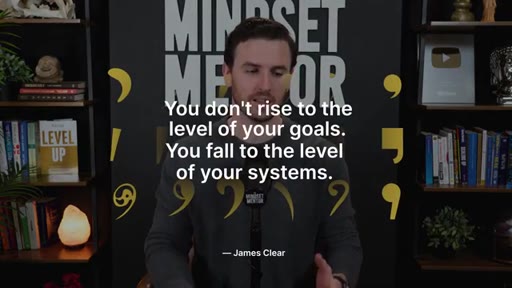
The hook is a credibility setup, 17 years of goal obsession, before the rug pull: most people fail not at setting goals but at achieving them. The James Clear quote that follows at 00:43 is the real thesis card.
Where the time goes.

01 · Why goal setting changed my life
Personal origin story (age 19, 2006) plus problem statement: people struggle to achieve, not just set, goals.

02 · James Clear systems vs goals
Core quote: you do not rise to the level of your goals, you fall to the level of your systems.

03 · The hidden problems with goal setting
Goals are outcome-oriented and binary. Two big problems: they focus only on the end result, and they do not address long-term behavior change.

04 · Why goals can destroy your confidence
Not hitting a goal breaks trust with yourself. Marathon example: you only succeed when you cross the finish line.

05 · Why most people gain the weight back
80% who lose 20+ pounds regain it within two years. Hitting the goal triggers a reversion to old habits.
06 · Reason 1 -- Focus on what you control
You cannot control outcomes. You can control daily actions. 500 words every morning is controllable; finishing a book is not.

07 · Reason 2 -- Sustainable actions
Small consistent daily actions become second nature and part of identity. Meal prep and carrying a water bottle as habit infrastructure.
08 · Reason 3 -- Reduce decision fatigue
Every decision costs mental energy. Systems automate recurring choices. Jeff Bezos three-decisions-per-day example.

09 · Reason 4 -- Celebrate progress
Systems create continuous small wins. Each win releases dopamine which motivates the next rep.
10 · Real-life examples
Seven practical systems vs goals contrasts: mindfulness, fitness, writing, language, diet, relationships.

11 · How to build your systems -- 5 steps
Identify outcome. Break into daily habits. Make specific and realistic. Track. Refine without shame.

12 · Success as a byproduct
When you focus on the process, results take care of themselves. Just show up today.
Visual structure at a glance.
Named ideas worth stealing.
Five Reasons Systems Beat Goals
- Focus on what you can control
- Build sustainable actions
- Reduce decision fatigue
- Celebrate progress
- Enable long-term change
Five reasons why daily systems outperform outcome-focused goals for producing lasting behavioral change.
Five-Step System Builder
- Identify the desired outcome
- Break into small daily habits
- Make it specific and realistic
- Track your progress
- Refine without shame
A practical framework for designing a personal system around any goal.
Lines you could clip.
"You do not rise to the level of your goals. You fall to the level of your systems."
"The man who loves walking will go further than the man who is running to hit a goal."
"When it does not work, do not be an asshole to yourself. Just say I learned something that does not work for me."
"Success becomes a byproduct of your actions. When you focus on the process, the results tend to take care of themselves."
Things they pointed at.
How they asked for the click.
"scan this QR code -- theperfectmorningroutine.com"
Mid-video sponsor break (~3:44-4:05) for his own product. QR code on screen, link in description. Soft integration, returns to content immediately after.
Word for word.
Your system is the habit. The goal is just the address.
Outcome-focused goals fail not because you lack discipline, but because binary pass/fail structures kill motivation before change can compound -- systems fix this by turning daily actions into the win.
- Goals tell you where to go; systems determine whether you ever move. Direction and motion are separate problems that need separate designs.
- Every time you frame success as crossing a single finish line, you rob yourself of the hundreds of wins that happen on the way there.
- 80% of people who hit a weight loss goal regain it within two years -- not from weakness, but from having no system in place once the goal was achieved.
- Reducing the number of daily decisions you have to make is itself a performance strategy. A system automates the trivial so you can spend real energy on what matters.
- Shame and guilt after missing a target make the next rep less likely, not more likely. Negative self-talk after failure degrades future performance.
- Starting smaller than feels right is not laziness, it is calibration. Two minutes of meditation after brushing your teeth will outlast a rigid 30-minute daily requirement in almost every case.
- Dopamine releases on wins, not on effort. Designing your system so every completed rep feels like a win is working with the brain's actual motivation architecture, not around it.
- Refining a system when it stops working is part of the system. The first version is never the final version -- building in adjustment is what separates durable habits from January resolutions.