The bait, then the rug-pull.
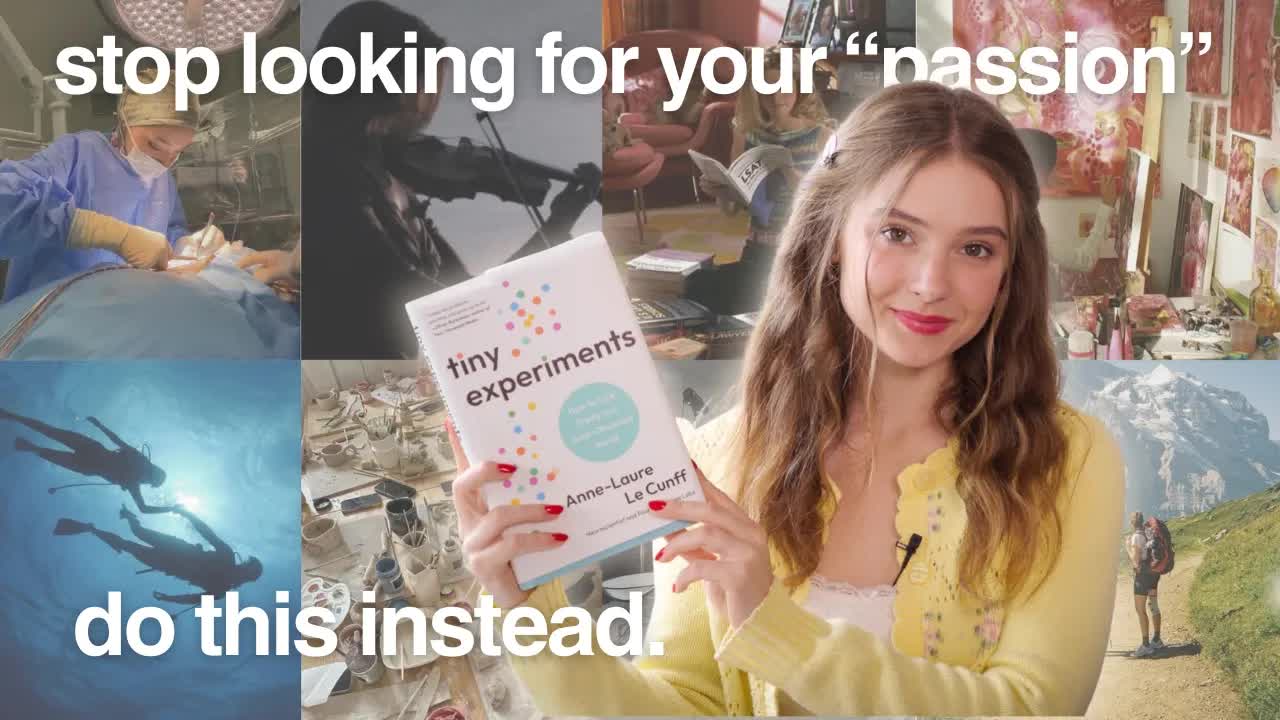
Most passion advice tells you to look inward until the right feeling arrives. This video opens by dismissing that advice as simply wrong — and backs it up with a Stanford study.
Where the time goes.

01 · If you do not know what your passion is
Hook and personal backstory: searching through writing, painting, psychology without the obsessive certainty others seemed to have. Sets up the Stanford research as the pivot.
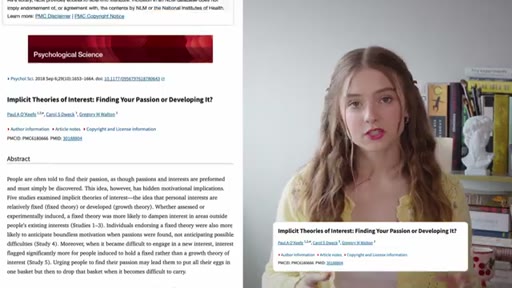
02 · The Stanford study that explains everything
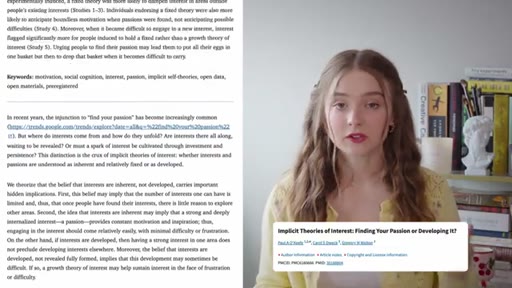
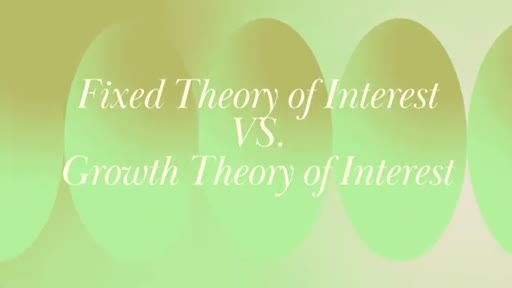
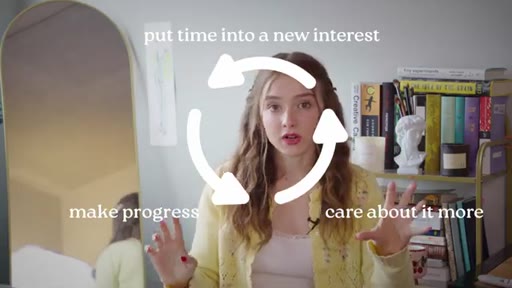
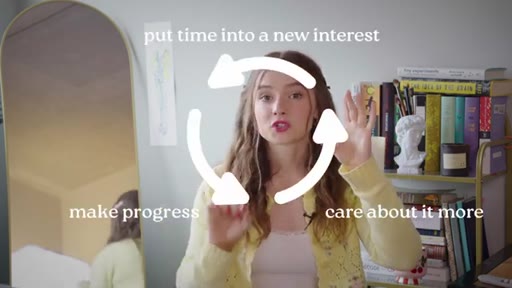
Fixed vs. growth theory of interest (Dweck, Walton, O'Keefe 2018). Boundless-motivation trap explained. Passion loop animated diagram: time in to progress to care to more time in.
03 · Step 1: Figure out what to explore
Write 20 interests. Filter with two questions: what would you do with no external reward, and what do you envy in others? Pick the strongest candidate and begin experimenting.

04 · Step 2: Run a tiny experiment
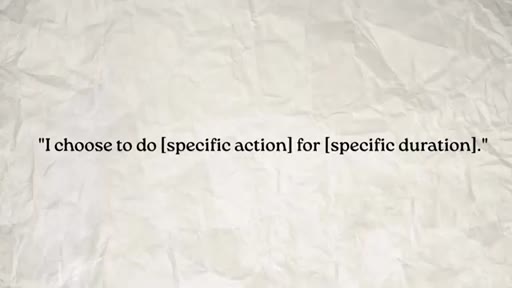
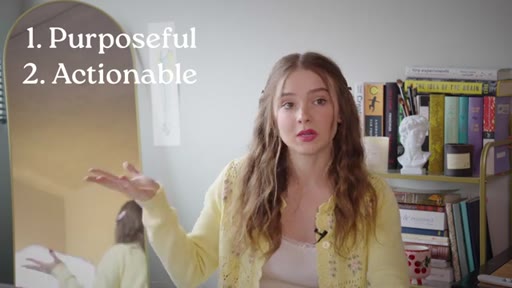
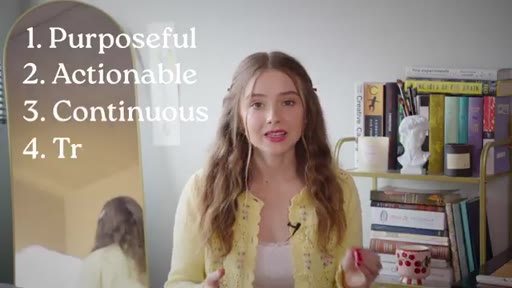
Identity statements freeze action; pacts unfreeze it. A pact is specific, time-bound, action-only. Four rules: purposeful, actionable (only what you control), continuous, trackable.

05 · Step 3: Read the data
Three end-of-pact questions: did you keep returning despite difficulty, did you improve, do you want to extend? Closing reframe: multiple passions across a lifetime is normal, not failure.
Visual structure at a glance.

Named ideas worth stealing.
Fixed vs. Growth Theory of Interest
- Fixed: passion is innate, awaiting discovery
- Growth: passion is built through time and effort
Stanford 2018 study showing that your belief about the nature of passion predicts whether you ever develop one.
The Passion Loop
- Put time into a new interest
- Make progress
- Care about it more
- Repeat
Reinforcing cycle showing how passion compounds rather than pre-existing. Rendered as an animated circular diagram in the video.
The Pact Framework
- Purposeful
- Actionable
- Continuous
- Trackable
From Tiny Experiments. A pact is a specific-action commitment for a fixed duration — contrasted with identity statements that paralyze rather than activate.
Lines you could clip.
"Passions are not found. They are built."
"Finding your passion is not a discovery problem. It is a mindset problem."
"If this were really my passion, it would not be so difficult."
"You are not actually bad at finding your passion. You have just been told to find something that does not exist."
"You are going to learn more about whether something is your passion in just four weeks of doing a pact than in four years of thinking about potentially doing it."
"This whole pressure to have to find that one thing — it is mostly fiction."
Things they pointed at.
How they asked for the click.
"Subscribe if this video helped, and let me know in the comments what your first pact is going to be."
Soft and genuine; also invites viewers with existing passions to share. Channel vision stated clearly (cognitive science + personal growth library). No aggressive overlay or countdown timer.
Word for word.
Build the loop instead of searching for the signal.
Passion does not arrive as a revelation — it accumulates through a compounding cycle of time, progress, and care that you have to start before the feeling is there.
- People who expect passion to feel effortless quit at the first difficulty — not because they picked wrong, but because difficulty is normal in anything worth caring about.
- The belief that your passion is hidden inside you waiting to be discovered is the primary reason most people never develop one.
- Envy cuts through social pressure more reliably than enthusiasm: the life you wish you had is a cleaner signal of desire than the life that sounds most impressive.
- Identity statements are too large to act on; pacts remove hesitation because they are bounded, binary, and only require actions you control.
- A pact must only include actions you control — outputs like follower count or income are invalid targets because they depend on others.
- The end-of-pact diagnostic matters more than the pact itself: did you keep returning when it was hard, did you improve, do you want more?
- Expecting one life-defining obsession is statistically rare — most people will have several genuine interests across their lifetime, and that is not a failure of self-knowledge.
- Four weeks of consistent action produces more honest data about fit than years of research, reflection, or personality assessments.