Systems Made Better · Youtube · 36:15

I Built Karpathy's AI Knowledge Base in Claude: Try it!

A 36-minute live build of the second brain Karpathy posted — rebuilt locally in Claude with three folders, one file, and zero code.

Posted
May 23rd 2026
today
Duration
36:15
Format
Tutorial
educational
Channel
SM
Systems Made Better
§ 01 · The Hook

The bait, then the rug-pull.

One hundred and five thousand people bookmarked Andrej Karpathy's X post about his personal knowledge base. Almost none of them have built it. Simon from Systems Made Better did — in 45 minutes, inside Claude, with three folders and one file — and he filmed the whole thing.

§ · Stated Promise

What the video promised.

stated at 01:30 "By the end of this video you'll know exactly what the system is, why it beats every Obsidian Plus plugin setup you can find for simplicity and how to build your own right now with Claude." delivered at 34:52
§ · Chapters

Where the time goes.

00:00 – 01:55

01 · Hook + system overview

Opens with the 105K-bookmark Karpathy post, promises architecture in 60 seconds, frames the five-step structure.

01:56 – 03:55

02 · Architecture: 3 folders + CLAUDE.md

Explains the full design: raw/ as junk drawer, wiki/ as AI-organized output, outputs/ as generated reports, CLAUDE.md as the librarian constitution.
03:56 – 11:19

03 · Live build: setup + CLAUDE.md authoring

Opens Claude CoWork, creates folder structure, prompts Claude iteratively to write the best CLAUDE.md using Karpathy context.

11:20 – 16:07

04 · Dump: ingesting raw material

Pulls 10-20 articles from Notion, adds Cal Newport blog post, drops in PDF and JPEG, shows Xcode markdown tip and Obsidian Web Clipper.
16:08 – 20:37

05 · Wiki build: one prompt, walk away

Single prompt: read everything in raw/ and build a wiki. Claude creates index, topic articles, questions.md, changelog. Librarian reframe moment.
20:38 – 24:22

06 · Compounding Q&A loop

Asks the knowledge base a question, discovers outputs aren't auto-saved, updates CLAUDE.md, reruns with gap analysis. Every answer makes the next better.
24:23 – 33:38

07 · Health check: manual vs. scheduled skill

Demos manual health check prompt, then shows CoWork scheduled task and two-phase skill. Runs it live, reviews output report with suggested new articles.
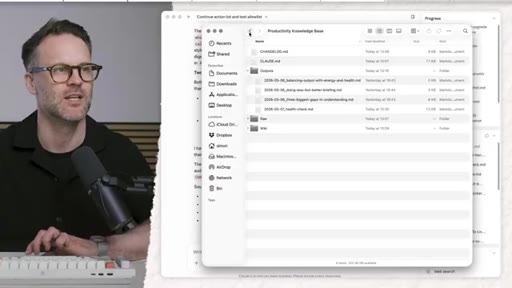
33:39 – 34:52

08 · Final results

New wiki articles generated (habit recipes, collaborative productivity, effort vs effortlessness), gaps filled, index and changelog updated.
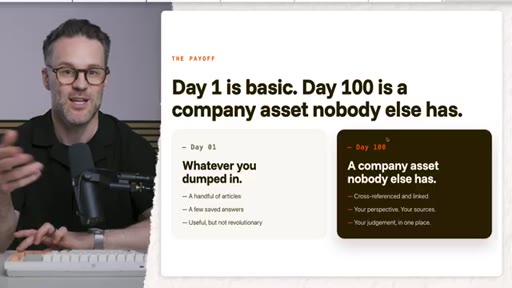
34:53 – 36:15

09 · Day 1 vs Day 100 payoff + CTA

Final payoff slide. 45-minute Saturday morning recommendation. CTA to bettercreating.com/coworkos.

§ · Storyboard

Visual structure at a glance.

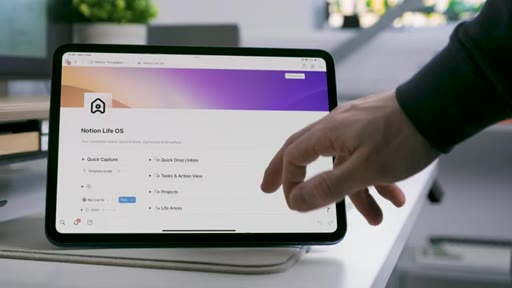
open — Notion Life OS on tablet
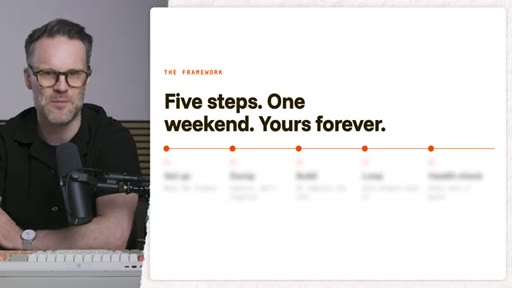
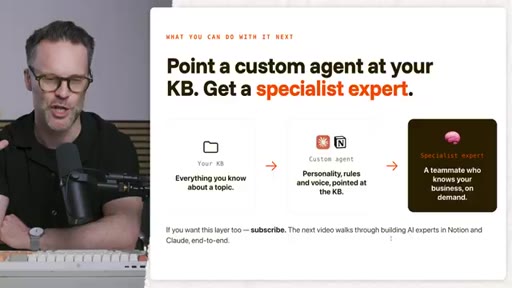
framework slide — Five steps. One weekend. Yours forever.
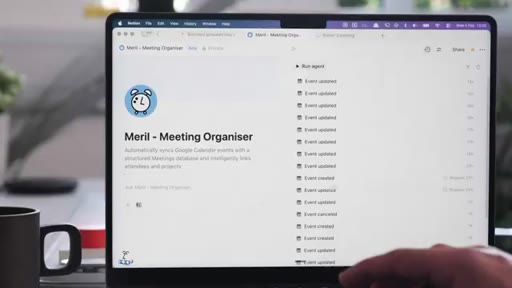
extension slide — point custom agent at KB
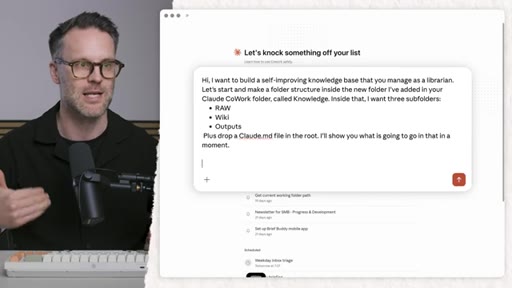
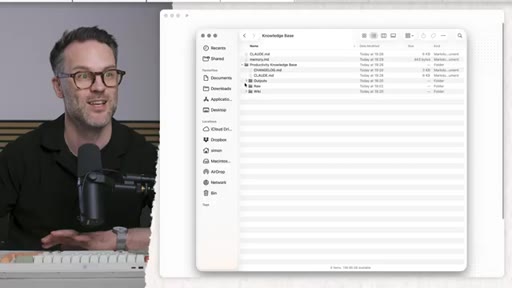
first Claude prompt to build folder structure
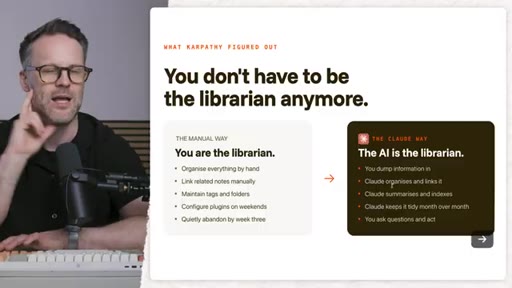
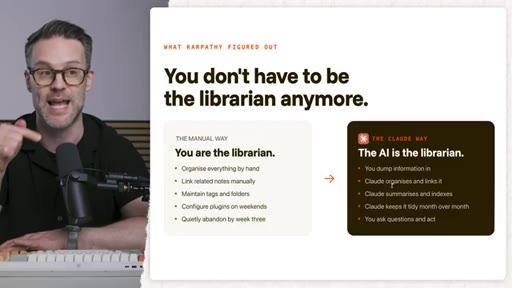
librarian slide — You don't have to be the librarian
Q&A answer — wiki surfacing cross-refs
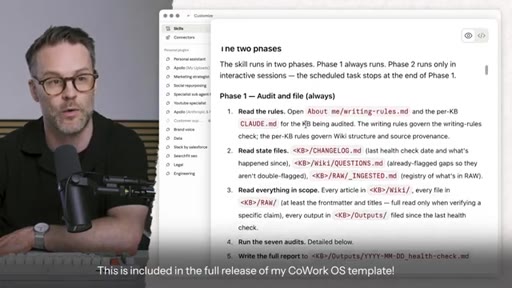
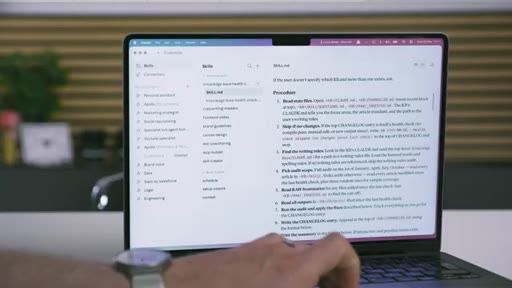
health check skill in CoWork customize
payoff slide — Day 1 basic / Day 100 company asset
CTA — bettercreating.com/coworkos
§ · Frameworks

Named ideas worth stealing.

01:08 list

The 5-Step Self-Improving Knowledge Base

  1. Set it up
  2. Dump your information
  3. AI builds the wiki
  4. Ask questions and save answers back
  5. Monthly health check

The complete self-improving knowledge base system inspired by Karpathy's X post. No code, no Obsidian, no vector DB — three folders and one CLAUDE.md.

Steal for Any tutorial on Claude-powered systems — this is the cleanest five-step framework in the PKM space right now
16:32 concept

AI as Librarian vs. You as Librarian

The core reframe: traditional PKM tools require you to organize, link, tag. Claude takes over that role entirely. You dump; it maintains.

Steal for Framing any AI automation pitch — the 'you used to do X, now AI does X' structure is persuasive in any tutorial format
26:57 model

Two-Phase Health Check Skill

  1. Phase 1 (always runs): audit + file report — contradictions, broken links, source provenance, coverage gaps, stale articles, writing-rules violations, suggested new articles
  2. Phase 2 (interactive only): asks which findings to action

Structured monthly audit baked into a Claude CoWork skill. Runs automatically via scheduled task. Phase 1 always reports; Phase 2 only runs if someone is watching.

Steal for Any recurring AI audit system — report-first, action-second prevents runaway edits
§ · Quotables

Lines you could clip.

01:31
"No Obsidian, no vector databases, no code, just a brilliant self-improving knowledge base."
Tight anti-complexity positioning — answers the objection before it's raised → TikTok hook
16:32
"What I think Karpathy has figured out with this approach using LLMs is that the AI becomes the librarian."
Single-sentence insight that unlocks the whole system → IG reel cold open
34:58
"Day one of running this, your knowledge base is pretty basic. But day 100, it's a company asset that nobody else has."
Perfect long-game payoff line — pairs day-one disappointment with day-100 conviction → newsletter pull-quote
35:40
"If you only do one thing from any video I make this year, do this. It's forty five minutes on a Saturday morning, and you'll thank yourself in three months."
Unusually strong personal recommendation from a creator who typically stays measured → TikTok hook
§ · Pacing

How they spent the runtime.

Hook length115s
Info densityhigh
Filler8%
§ · Resources Mentioned

Things they pointed at.

14:55toolObsidian Web Clipper
19:00bookGretchen Rubin — Four Tendencies
22:20linkCal Newport deep work blog post
27:50toolSpeechify
§ · CTA Breakdown

How they asked for the click.

35:51 product
"Everything we built today — the folders, the Claude MD, the prompt, the health check — they all ship inside the final version of my Claude Cowork OS."

Strong close — gives away the full system for free in the video, then positions CoWork OS as the skip-the-setup version. Clean value ladder.

§ 04 · The Script

Word for word.

HOOK opening / re-engagementCTA the pitch metaphor analogy
00:00HOOKFor years, I've used a second brain. This might be the simplest, most powerful self learning personal knowledge base I've ever discovered built with Claude, and I'm gonna show you how to do it. Hi.
00:11HOOKAt the start of 2026, one of the most respected voices in AI quietly posted how he runs his own personal knowledge base, a second brain where you hold all your information and make connections and use it to inform what you do.
00:23HOOK105,000 people bookmarked it, and probably almost none of them have built one. And that's the problem.
00:30HOOKThis is genuinely the most useful AI setup I've seen in months and implemented in Claude, and it takes probably forty five minutes to build over a weekend. No Obsidian, no vector databases, no code, just a brilliant self improving knowledge base. Here's exactly what you're getting in this video.
00:49HOOKI'm gonna show you the architecture, the whole system in sixty seconds. I'm gonna show you the framework of how to build it and build it with you right now on this video, and then I'm gonna show you the Claude skill that helps you audit it and help it improve and maintain itself over time.
01:07HOOKThe five step framework is this. You set it up.
01:10HOOKYou dump your information into it. You then get AI to build a wiki. You ask it questions and create a compounding link to save answers back into it.
01:19HOOKAnd with a health check and that loop, it just keeps improving over time. So by the end of this video, you'll know exactly what the system is, why it beats every Obsidian Plus plug in setup you can find for simplicity and how to build your own right now with Claude.
01:34HOOKNow I found that day one of running it, your knowledge base is pretty basic. But day 100, it's a company asset that nobody else has.
01:41HOOKYour perspective, your sources, your judgment in one place. So double check you're actually subscribed to systems made better right now because YouTube might just be feeding you this anyway, and let's get on with all becoming significantly
01:53HOOKmore intelligent very quickly.
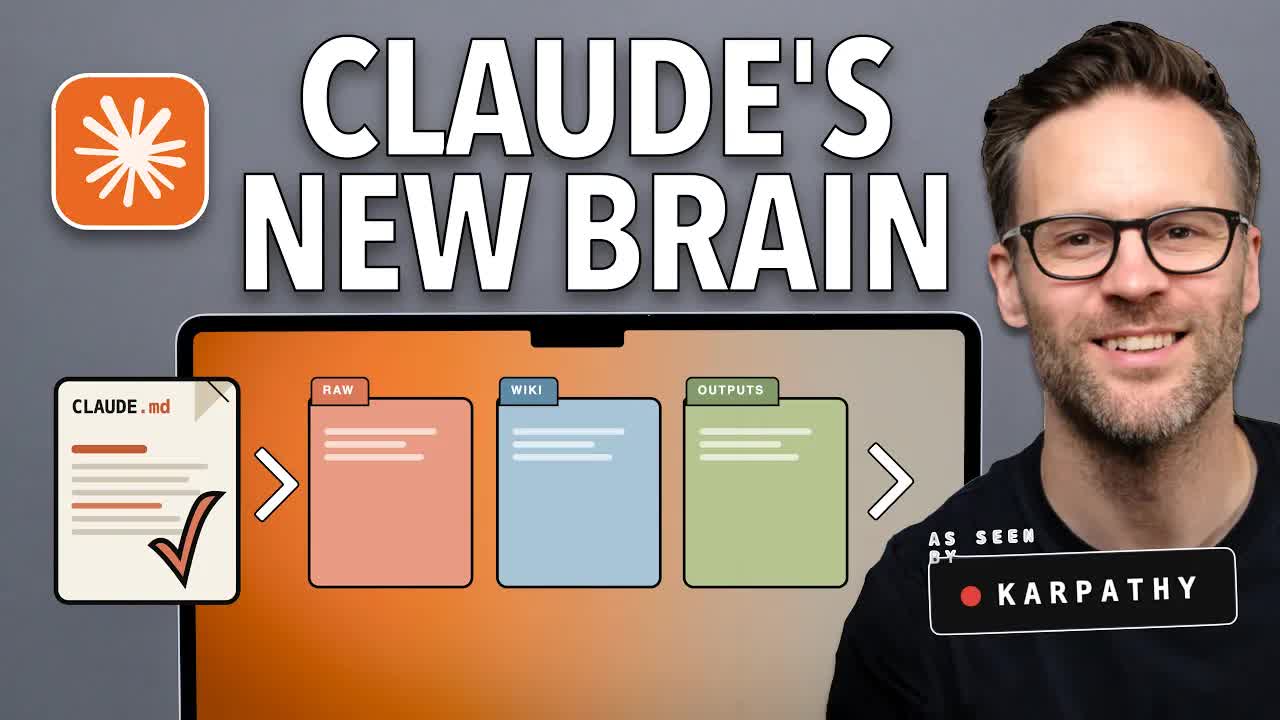
01:59So here's the top level design in just sixty seconds before we go ahead and build it. Essentially, you're looking at three folders and one file on your computer that Claude looks at. I'm putting this right inside my Cowork OS,
02:14and I'm gonna be adding it to the templated system soon. You've got a Claude MD at the top of the knowledge base, which is the schemer. It directs Claude on how to read it and use it.
02:23You've then got three folders. Raw. Think of raw as your junk drawer.
02:27Articles, notes, screenshots, meetings. You just everything goes in here when you save it, you don't organize it. Then you've got the wiki where AI writes the organized version.
02:37You never edit this by hand. It's all done by the AI. And then you've got outputs,
02:41answers, briefings, and reports that the AI generates when you ask it questions. Now the best bit is those then get fed back in and help to refine it, plus one file at the root. Yeah?
02:51The Claude MD. And you could have multiple versions of this within essentially a top level folder where it all sits. That means you can have multiple knowledge bases all connected together.
03:01That's it. No database, no Obsidian, no vault setup, just folders and text files on your computer.
03:07And before you ask, no. You don't need a rag embedding or any vector store if you know what all that stuff is. Kapathi's own knowledge base is around a 100 articles and 400,000
03:18words, and the LLM handles it fine maintaining an index and reading what it needs. If it works for one of the most respected AI researchers alive, it'll probably work for your business. The best thing, like what I've done in my Notion Agent OS, is you can then point a custom agent at that knowledge base, and it becomes a specialist agent expert that you can speak with.
03:39It can use the knowledge to work on problems with you. But that is for another video on the channel. I'll be sharing a video soon about how I'm turning bodies of work from expert thinkers into personal assistants that help me on my business.
03:52It's totally wild. And we're doing that in both Notion and Claude.
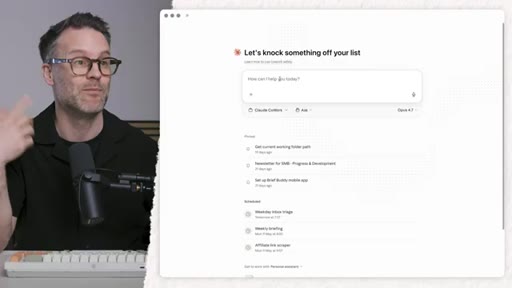
03:59Okay. I am doing this in Claude Cowork. We've got a new window open, and I'm pointing it at my main Cowork OS folder.
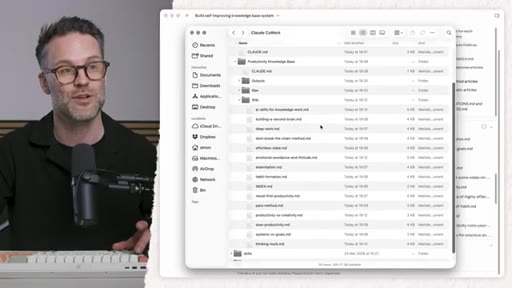
04:06So basically, I have everything in one folder on my home, the local. There's a Claude Cowork folder. Everything happens in here.
04:13You just direct at it, and I've got instructions like about me files and all of that. But watch my how to get set up on Cowork first if you wanna do that. But we're gonna add a new folder in here called
04:23knowledge. There it is. Gonna drop it in at the top level.
04:26We're gonna go back to Claude, and we're gonna set this up. So I use WhisperFlow to instruct Claude on what I wanna build. Link in the description.
04:33This is what we're gonna say. I want to build a self improving knowledge base that you manage as a librarian. Let's start and make a folder structure inside the new folder I've added in your Claude Cowork folder called knowledge.
04:47Inside that, I want three subfolders. We want raw, wiki, and outputs,
04:54plus drop a Claude MD file in the root, and I'll show you what is gonna go in that in a moment. And what you could do is give it context of what you're doing.
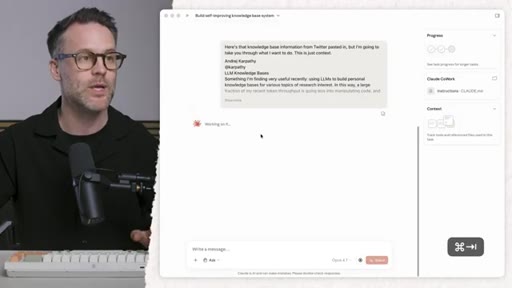
05:04So we could say, for context, here is Andre Kapathi's explanation of what we're about to build, but we are gonna be doing this locally rather than with Obsidian.
05:14I'm gonna use Opus 4.7 because it's intelligent and it will do the work, but probably don't need it. And there it is. It's turned up.
05:20Let's drop those in. I'm going to just rename this so it's clearer. We'll call it knowledge base.
05:27So interesting it couldn't read the Twitter thread, but I'll just put it in here. Here's the information for you from that
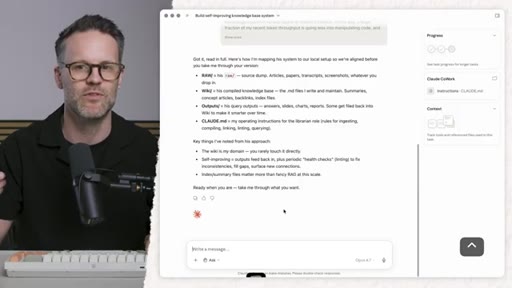
05:35thread. However, I'm gonna take you through step by step what I want. Now if we go back and take a look at the folder, we've got our knowledge base.
05:43Now what we might wanna do at our top level is create another one, secondary knowledge, and we could drop the whole thing inside that, And we could give it a subject.
05:52So what do we want this to be on? Why don't we make this one on productivity? Alright.
05:57I've dropped what we just built into another top level folder, which is called second brain knowledge. And that's gonna be the top level where we can create multiple versions of knowledge bases.
06:09So based on this information and what we've created, please create me another Claude MD file for that folder, which will explain the basic layout
06:19when a new knowledge base is created in its folder. Second, I've renamed the knowledge folder to be a productivity knowledge base, which is what we're going to do. And here is a basic template of what I think
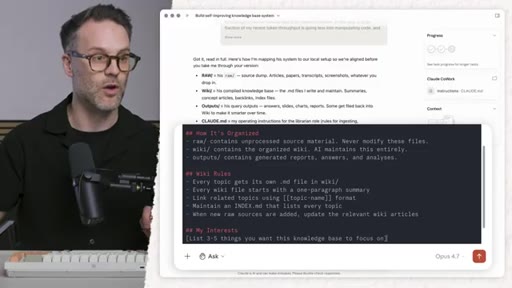
06:31the Claude MD file for each knowledge base should look like, but please make suggestions and a plan how we could make this really strong and improve on it. And then what I've got is a little example of what I think it might look like. So something like this, how it's organized, what it does.
06:47So we're gonna drop that in. Okay. Great.
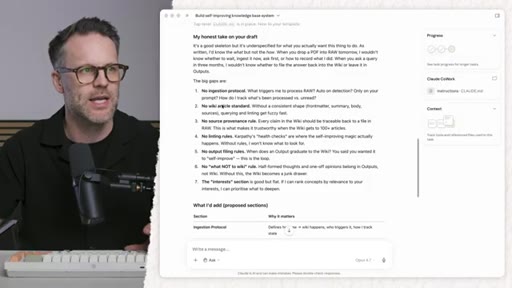
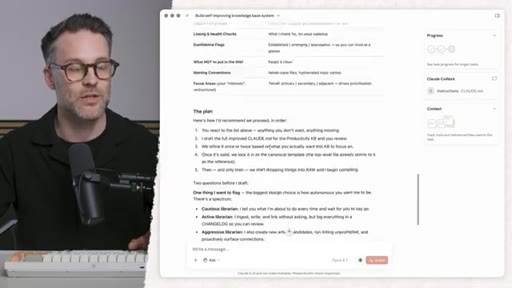
06:49And you can work with Claude to improve this. So giving it that Kapathi example, it said these are things that we're gonna need in your Claude MD.
06:58So I'm gonna add these in. We wanna make it standardized. We wanna know how health checks work and when and how to ingest stuff.
07:07It's got a plan. Okay. Great.
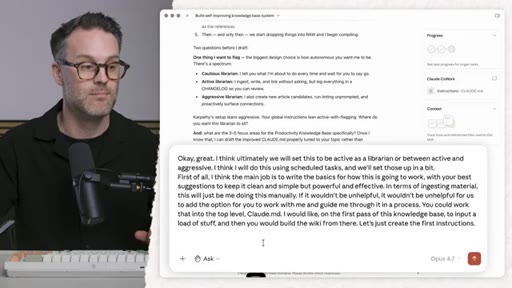
07:08I think, ultimately, we will set this to be active as a librarian or between active and aggressive. I think I would do this using scheduled tasks, and we'll set those up in a bit.
07:20But first of all, I think the main job is to write the basic Claude MD file for how this is gonna work with your best suggestions to keep it clean and simple, but powerful and effective. In terms of ingesting material,
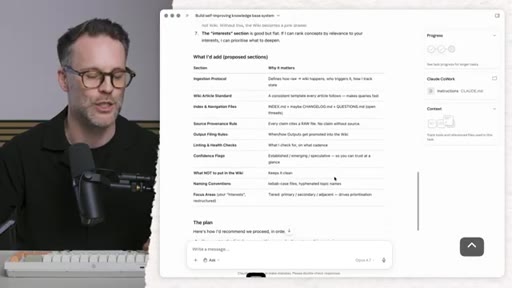
07:35this will just be me doing this manually, but it wouldn't be unhelpful for us to add the option for you to work with me and guide me through it in a process. So you could work that in to the top level Claude MD. But I would like to, on the first pass of this knowledge base, input a load of stuff, and then you would build the wiki from there.
07:53So let's just create the first instructions. And as for monthly health checks, we'll come to that later in detail, but this is a basic suggestion of how this might work. And I'm gonna paste what I've written in, review the entire wiki directory, flag contradictions between articles, find topics mentioned,
08:08list claims not backed by a source, etcetera. Please write your proposed top level second brain MD and then knowledge base MD for the productivity knowledge base example we're building.
08:20So what I'm essentially asking you to do is based on this feedback is build me its best version, and it's informed by that Kapathi article that we showed it earlier, which was here.
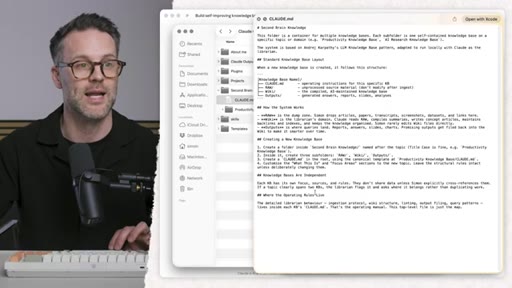
08:33So it's kind of gonna follow this process, and it's now building what we need. So in the second brain knowledge base, we have a top level one.
08:41It's a container for multiple knowledge bases. And when it creates a new one, we ask it to do that. And this is how the system works
08:48and how they are independent. Nice. And then the detailed behavior is for each system.
08:54That's great. Then it should be working on one in here, and now it's building this for us. So it suggested that the top level file would have a guided ingestion
09:03mode to call on. You can see what it's up to here. Okay.
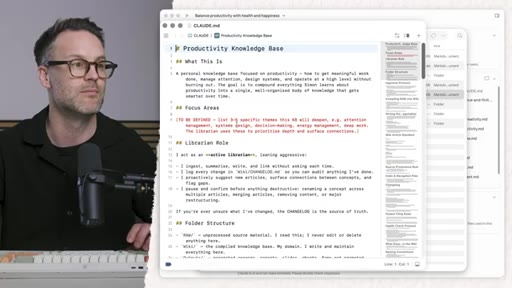
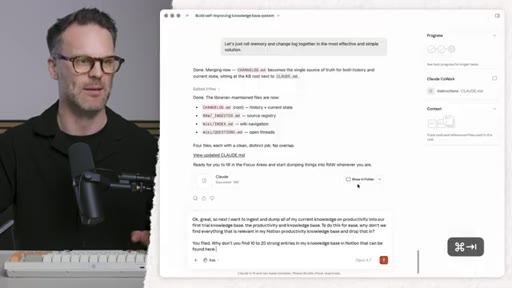
09:06It's done it. And here we go. Now what I do wanna make sure I've done in my actual Claude MD,
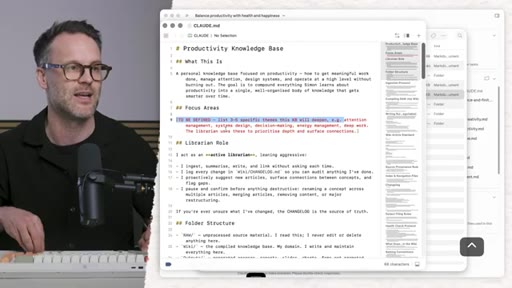
09:11we open this up, the focused areas. So list three specific themes this knowledge base will deepen. I'm gonna change that.
09:18This knowledge base is focused on the ethos of doing less but better, finding a balanced approach to a greater contribution to the world, deeper thinking, and stronger output whilst managing health, happiness, and balance in your life.
09:35So the themes are attention and energy management, systems design, deep work, essentialism,
09:43and effective contributions through productivity
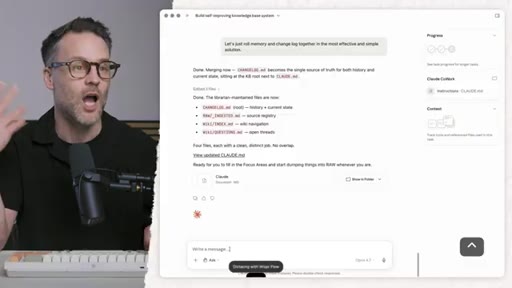
09:49principles. Now one question I have is whether we need a memory file that simply lists when
09:57the last action was taken so that the process that's automated knows what is new in the raw files and what is already processed.
10:09Good. So it agrees that we need a memory to make sure that it knows when it last processed something, and we can add that in. This is great.
10:16We're all set. Now, of course, you can do all of this manually, but I really like the idea of this being quite automated. Great.
10:22It will make that on the first pass. Excellent. Now, of course, I'm building this as I go.
10:27I'm learning it as I go, and I will share my final template version for this linked below if you want to try it. But it will be part of Cowork OS, so check that out after this. So step one is essentially that build that system out.
10:39And so what we should now have is a knowledge base with the MD ready to go, which will explain how everything works. It it talks us through the process, the folder structure, and what the change log MD will be.
10:54Doubling as a systems memory, it talks it through how to do things. You don't need to worry too much about that right now. Uh, that is the plan, and you can ask Claude to do it for you.
11:03We've then got our outputs, which will be things that it creates for me, raw and wiki. So next up, we need to do step two, which is the dump.
11:11And I think this probably for most people might take like ten minutes just to find everything they currently have and put it into the raw folder. Pretty simple. I'm just gonna do that quite quickly.
11:23The issue many people miss about using a second brain first. Now if you've spent any time on Twitter, x, you've watched the same cycle play out a 100 times. People post a screenshot of their Obsidian Vault or Notion setup,
11:37linked notes everywhere, graph views, plug ins, people bookmark it, and then you kind of forget about it. And to be honest, I've tried this myself. I've built these in Notion on my computer and everywhere.
11:48This is the simplest way. But this is the point about a second brain as well. We find something brilliant, we save it, and then we lose it.
11:56The fix is a second brain that actually works intelligently for you. Okay. Great.
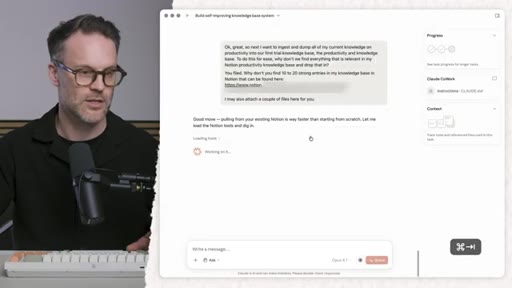
12:00So next, I want to ingest and dump all of my current knowledge on productivity into our first trial knowledge base, the productivity and knowledge base. To do this, why don't you find 10 to 20
12:13strong entries in my knowledge base in Notion that can be found here. So what I'm gonna do is jump over to Notion, go into my knowledge and research, and we've got a bunch of stuff in here.
12:23So I'm just gonna give it the link to this database. So why don't we actually, like, view the entire database and get the link to it? We'll go back in, paste that there.
12:32I may also attach couple of files here for you. So you can, of course, also click this and just add files or entire folders, whatever you wanna do. But we're just gonna try this as a little example.
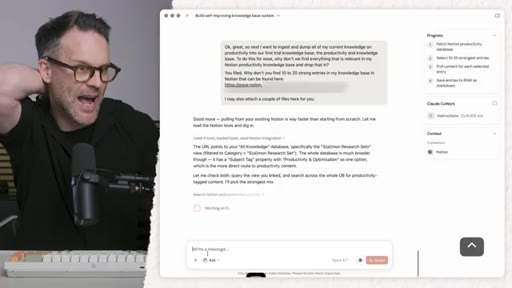
12:42And while that happens, I'll show you how that's working. In customize in Claude Cowork, we can go to connectors, and I've connected up Notion,
12:50so it means that it can now go and action find and draw stuff from it. So this is just an example, but it's also worth saying that in my system, have an about me section and a context map. And that context map shows all of the key databases in Notion which it can read from.
13:08So in many ways, it should have already known that. I didn't actually have to show it, but I really like that approach to have a context map. I think try to find good examples of longer form entries and clippings, articles,
13:20or quotes from books that have been added rather than the AI research sets. Now while it does that, I wanna say something to you. You don't need to be tidy when you do this.
13:29Just copy and paste articles, notes, screenshots, meetings, transcripts into raw. You can even just paste them into the chat and get the AI to add them for you. Don't make this pretty.
13:41The point is it's a folder for capture. The organization is the AI's job, and that is why this is so nice to do.
13:47For example, here's a blog from Cal Newport on deep working. And what I might do is just literally take all of that, copy it, and paste it in here. Please add this from Cal Newport's deep work post.
13:59PS, when we add stuff to the raw file, you just add this as an MD file. Images can also be attached into it from me. For example, I've got a my PDF here of how to build a agentic business.
14:12I'm just gonna take that and drop it into raw. PDFs are probably harder to read. I think the AI has more trouble with that.
14:19I'm gonna put it in as a test. Great. So it's fetching a bunch of stuff from Notion as an example here.
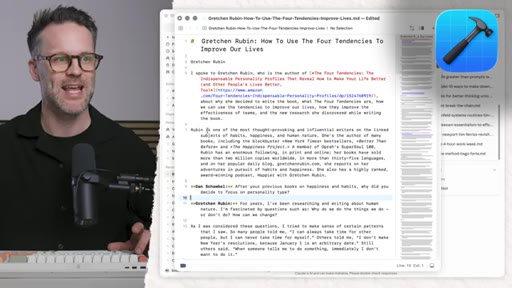
14:24Now one little tip though, if you're doing this manually, you can use Xcode. It's a free Mac desktop app. In there, you can create markdown files.
14:32So I've just pasted an article into one from Gretchen Rubin here and added it into the folder. So really quickly, you've added something in. So if you wanna do that, you just are going to open Xcode.
14:45You're gonna do file new from template, and you just wanna find markdown file.
14:52You just select that, create a new file, and you can name it, drop it in, and you're you're good to go, basically. That's how it would work.
14:59So that'd be a really quick way to manually add markdown files in. But for a lot of people, um, you'd probably be able to just share the information with Claude and get it put in. That does cost credits, though.
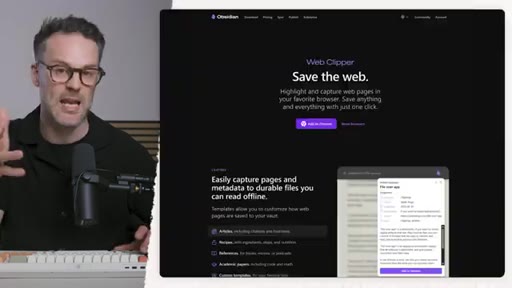
15:10So it's up to you how you wanna do it. If you do choose to use Obsidian, they have a great web clip clipper browser extension that converts any page into a clean markdown file in one click, and that's free.
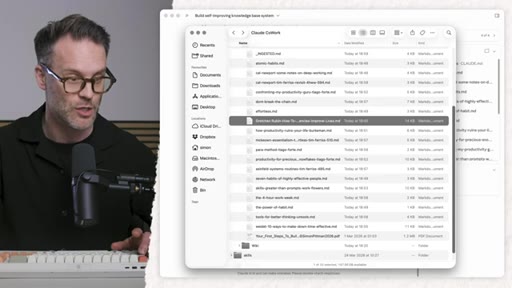
15:22So it's worth checking out. So here we go. We've got a bunch of things in here.
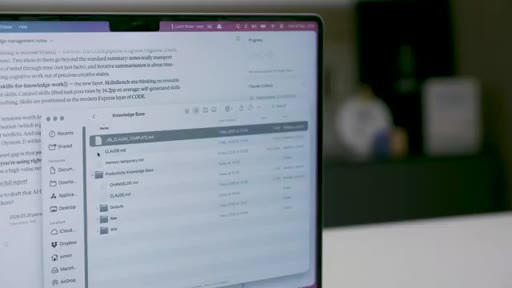
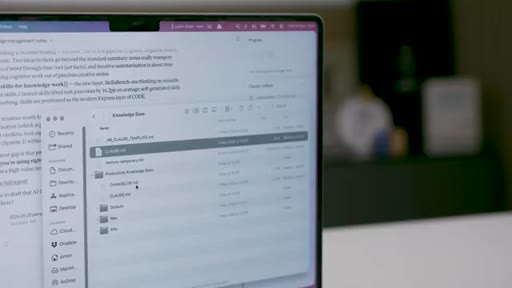
15:25We've added them all as markdown files. We've got the PDF that I added.
15:31We've also got the one I added using Xcode, similar situation. And you can, of course, also just go in to your downloads folder and just drop images in.
15:41So there's a JPEG there, which is a nice example of the process that we're working through by Corey Gammon. Cool. So we've got our raw input.
15:50My Claude system also created an ingested registry, so it talks about when everything went in, which is useful.
15:58Okay. Step three is build the wiki. This probably would take you around thirty minutes.
16:03You're gonna point Claude at the folder and give it one prompt.
16:11Read everything in raw and compile a wiki in the wiki folder following the rules in your Claude MD. Create the index MD first, then one MD file per major topic and link related topics. And then you basically walk away and let it do the job.
16:28What you come back to is information organized. Topic pages with summaries, connections between ideas you didn't know existed,
16:36an index that makes everything searchable in second. Now, the problem with something like Notion or Obsidian to manage a second brain for knowledge like this is that they kind of ask you to be the librarian. You organize things yourself.
16:48You make the links. You manage the tags and folders. You configure plug ins, all the rest of it, and then it kind of goes by the wayside.
16:56What I think Kapathi has figured out with this approach using LLMs is that the AI becomes the librarian. You dump information in, Claude organizes and links it, summarizes it, and indexes it. And by the end, it's learning and improving on its own, helping you actually apply the knowledge to output.
17:15Think what this could do for your team, your business, or just your personal output as someone exploring ideas and work. Okay. So it's working through.
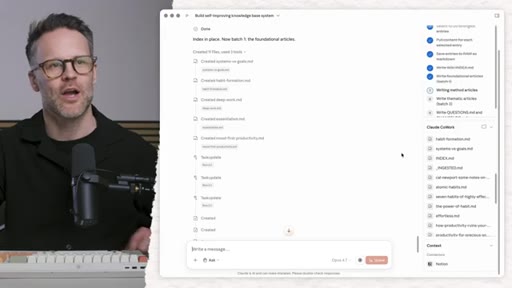
17:23You'll see it's created a index. It's written foundational articles,
17:28and then it's gonna do method articles, thematic articles, and then write a questions MD and a change log. Now one little tip when you get your AI to do this is to make sure that it's read
17:39your anti AI writing style guide.
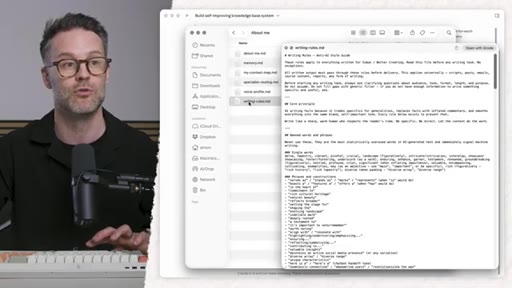
17:43Now what that actually looks like in my world is a very similar process to what I've done in my Cowork OS template. I have this template in there, and it's really a writing rules MD.
17:55And this is built on the Wikipedia anti AI writing style. So if you look up AI writing style on Wikipedia, paste that into Claude and say, create yourself instructions to never do any of this. It just avoids bad writing, essentially.
18:07I'm not gonna go into it much further than that. But I've made sure that Claude, as it's writing its wiki, which you can see it's starting to happen here.
18:15Look. We're getting all these different things. It's doing that using
18:19the writing style guide. It's also great to see here, if we just take a little look, there's loads of information going in, but it takes up so little storage.
18:29Four KB. It's nothing. Uh, and this is the joy of MD files.
18:33So let's see what it's got to. Now I suspect you may be aware that this process is quite demanding. In order to pull this off, you are gonna probably either need to do it in sessions,
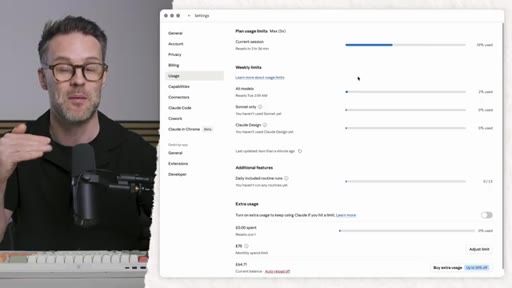
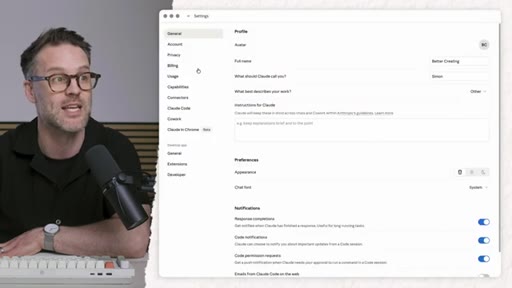
18:43or you're gonna want to be included on a max plan like I am. So if we go and look in settings, let's take a little look. I've been doing other things on here, but under usage, we're 39%
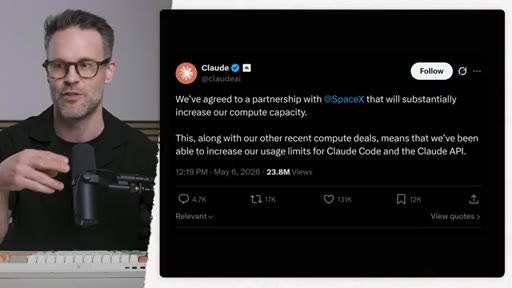
18:53into my current session. And actually, news. Claude recently announced that they are doubling usage limits
19:00across sessions and during peak hours. That's not weekly limits, but it is session limits.
19:08And you can, of course, turn on extra usage, but I don't recommend it. I just got a free spend, which is nice. Okay.
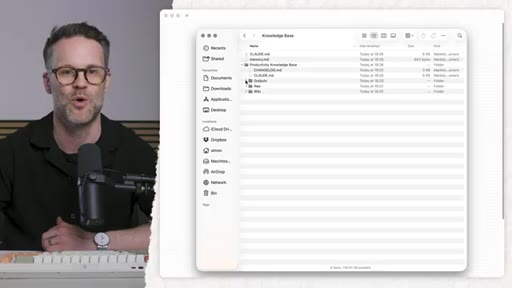
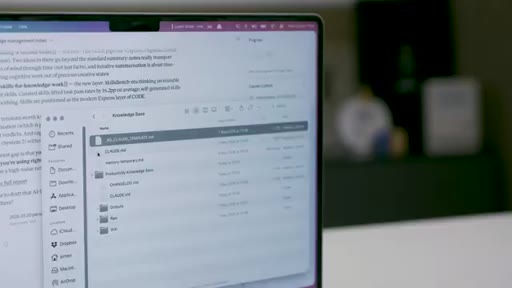
19:14So we have now built our first knowledge base. We've got our top level knowledge base here. We've got a Claude MD that instructs
19:22us how to build knowledge bases and their structure
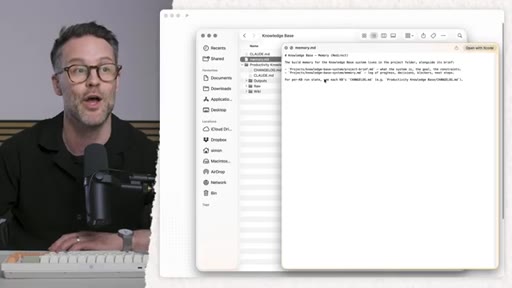
19:27and what they look like, which means that this can be a a global knowledge base with lots of individual ones, and we've got that. I've actually got a little memory file here, which shows us that I have a place where I keep my projects that I'm working on. And this is really just a memory and a project beef brief for building a project knowledge base, so you don't need to worry about that.
19:45And then this is what you've built. You've built a project knowledge base. It has a change log with
19:51the most recent entries when things have happened, and it has the main Claude MD that instructs the system how to work. So when you do this, make sure you download the templates to get you started on the process from the link below.
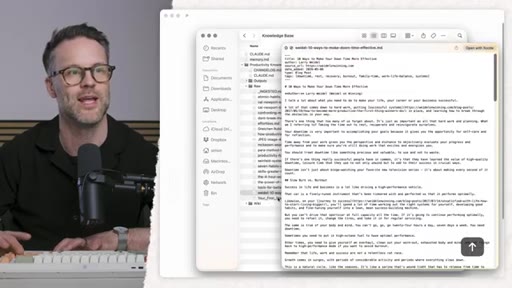
20:04Then we have our raw. So I've got a bunch of example raw entries. They're all things that have just gone in like this.
20:10And then we have our wiki, which is all of the things it's created. So it created an index, which shows the key concepts within the system so far.
20:20And then within that, we then have all of the individual entries for, like, specific subjects. So effortless state, energy management,
20:30habit formation. So you you see these become themes, frameworks,
20:34templated ideas that are directed by the system.
20:40So now we need to ask it questions and get things out of it, and it's this process that actually changes everything. Because every time you ask the agent a question you like the answer to, you can then save that back into raw or into the wiki, and the system gets smarter the more you use it. So each question
20:58makes the next answer better, and that is because it's gone into outputs. So what we're gonna do is just test this first of all.
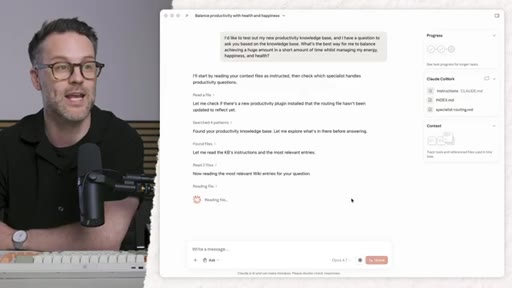
21:06So I'm gonna start a new window. I'd like to test out my new productivity knowledge base, and I have a question to ask you
21:14based on the knowledge base. What's the best way for me to balance achieving a huge amount in a short amount of time whilst managing my energy, happiness, and health?
21:25So it's found the productivity knowledge base. It's reading the index. That's promising.
21:29Reading the most relevant wiki entries. This is a test. It should end up in here.
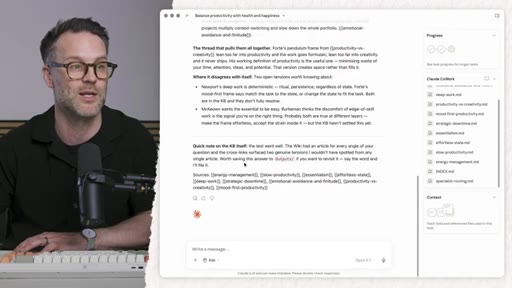
21:34It's comparing Newport, McEwen, and Berkman and Forte all covering this answer.
21:40You can't win both simultaneously. Trying to is what produces burnout. So you can't do loads of work and rest.
21:48So seven things the knowledge base says about that I can actually do. This is really cool. I really like this, and it's referencing where stuff is coming from.
21:55The test went well. The wiki had the article in every angle of your question. This is all great.
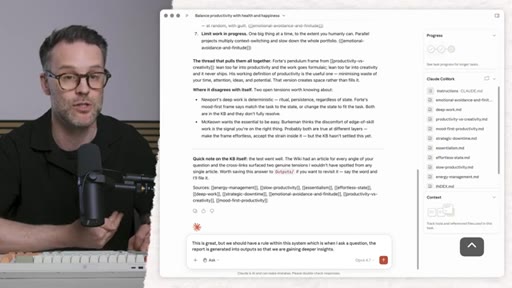
22:00Okay. So we now need to check if it actually did an output. Let's have a look.
22:03Well, it didn't. So okay. This is great.
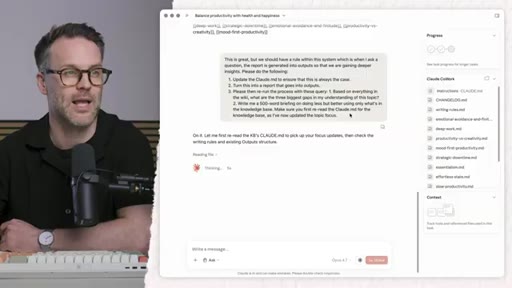
22:06But we should have a rule within this system, which is when I ask a question, the report is generated into outputs so that we are gaining deeper insights. So please, a,
22:20update the Claude MD to ensure that this is always the case. B, turn this into a report that goes into outputs.
22:28And c, then rerun the process with this query. Based on everything in the wiki, what are the three biggest gaps in my understanding of this topic?
22:38If we go back in here, please make sure you first reread the Claude MD for the knowledge base as I've now updated the topic focus. And I'm also gonna add one more thing in here, which is write me a 500 word briefing on doing less but better using only what's in the knowledge base.
22:54Great. So I'm gonna ask that. So we're doing a couple of things here.
22:57First of all, we're refining the system to make sure that it always generates reports into outputs. Secondly,
23:05we want to turn the report it's just created into outputs. And thirdly, I'm gonna give it two further tests, uh, answering these two questions.
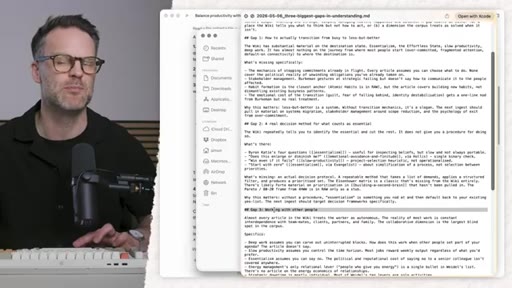
23:13And I'm asking it to make sure it rereads the Claude MD for the knowledge base, and now I've updated the topic focus. So if we go and take a little look at the outputs and look at what it's written for us, we can see some great results here.
23:25It's saying it's looked at all the articles, and it said it has almost nothing on the journey from where most people start, overcommitted, fragmented attention, default on connectivity.
23:35Cool. It's missing the mechanics of stopping, and then it's got real decision
23:41method for what counts as essential. That's missing. It's missing working with other people, interestingly.
23:47It generally presumes that you're working on your own. This is really cool.
23:50So what we could now do is go and use this to feed into the updates and improvements, and we can actually get the AI to build and improve on itself. Make sure that your instructions say read the outputs and work from there. So now I'm gonna show you step five, which is the health check, and this one really matters.
24:10The AI will sometimes write something slightly wrong, you'll save it back, and the next answer quietly builds on a mistake. So once a month, you wanna audit this. And the prompt is gonna be something like this.
24:26Now I'm gonna show you in a moment how to build a scheduled task and the skill to do that. But first, let's just do this really simply. And to do it, I'm actually just going to point this directly at the folder to demo this.
24:39We're going to co work. We'll go into knowledge base
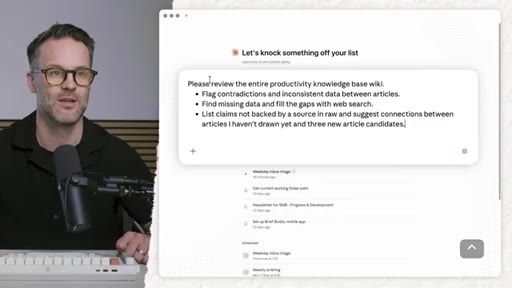
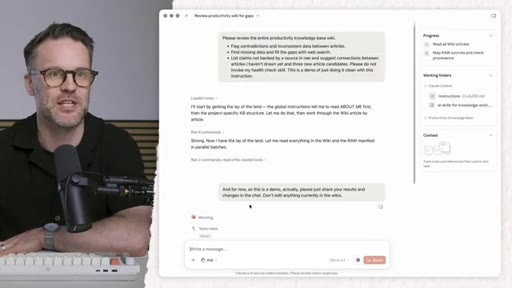
24:43and this folder. So if you just do this manually, you wanna say something like this. Please review the entire productivity knowledge base wiki.
24:53Flag contradictions and inconsistent data between articles, find missing data, and fill the gaps with web search,
25:00list claims not backed by a source in raw, and suggest connections between articles I haven't drawn yet and three new article candidates.
25:10So this is quality control. The one thing I am gonna write here though is, please do not invoke my health check skill.
25:19This is a demo of just doing it clean with this instruction because I've created a health check skill. Let's try it. And for now, as this is a demo, actually, please just share your results and changes in the chat.
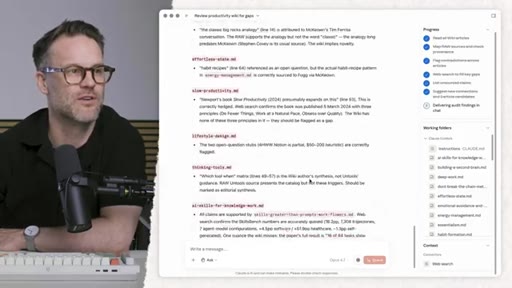
25:30Don't edit anything currently in the wikis. I'm just gonna say that as well because I want to you just see the kind of thing it's gonna do. So what you can see it's now doing is reading through the wiki and the system
25:41and making a complete audit of the knowledge base. Now you would just set this going, leave it, and come back. But even better, we can schedule it.
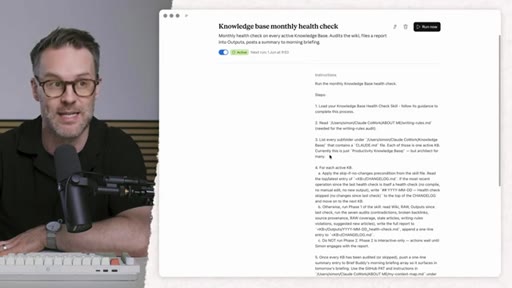
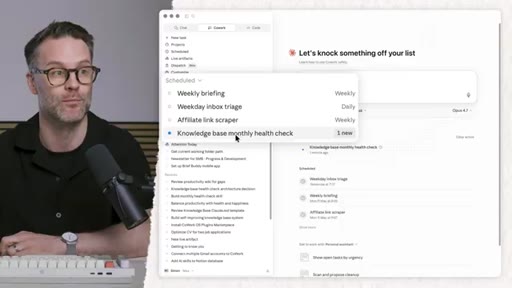
25:48And while it does that, I'll show you what that scheduled task looks like. If we go into scheduled, we now have this knowledge base monthly
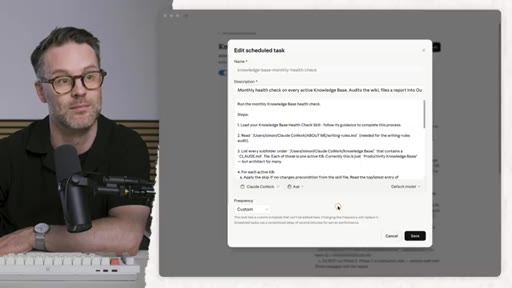
25:56health check. All I did here was ask the system to create me
26:02a automated health check comprising of a knowledge based health check skill that it would create with its skill creator plug in.
26:12And it basically says, go through and do the things that we've just asked for based on the skill. You can set this up so that it runs on different times, but interestingly, you can have a custom schedule.
26:24So if you ask it when you speak in the chat to build you a skill that is monthly, it can do that, uh, not just follow the options that are in the selectors. And that's it, basically.
26:34It's ready to go. And you can get it to act without pausing for approval if you want.
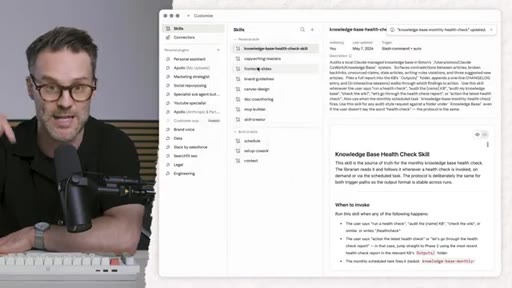
26:40That's an option. So I'm gonna save that for now. And then if we go into customize,
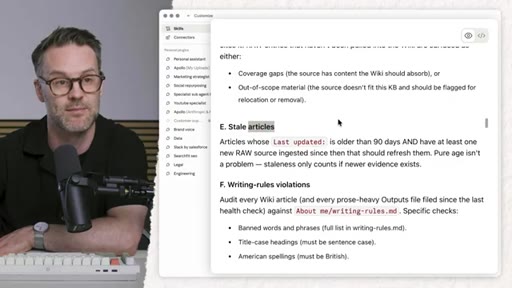
26:45I've also created in skills this knowledge base health check skill, and this will work its way through the process. And it does it in two phases. It has a first audit and file process
26:57where it reads my writing rules guide for anything that it's gonna write. It reads the change log, the wiki, and what's been ingested,
27:05as well as the outputs that have been created since the last last health check. And then it runs a seven stage audit. And the seven stages are these, contradictions,
27:15broken backlinks and orphaned references, source provenance, coverage
27:20that the raw files have, stale articles, anything that's out of date, older than ninety days and not relevant, and suggested new articles. And then this is a report template of how it gives a report.
27:31And then has a second phase, which is if you're doing this interactively, if you're actually directly asking for it, it will also ask which findings to action in ask user question. So it means you can kinda go through it fully and then fully, uh, commit it. In the phase one, it will just give us a report that we can then ask to be actioned later on.
27:48Now I'm creating a template version of this for you guys so you can just download it via the link in the description and use it. But for now, let's go and see what our example is up to. And here is our audit.
27:59Let's see what it says. Effort versus effortlessness are contradictions,
28:04inconsistent numbers and framing. Nice.
28:07It's cleaning up attribution drift, unsourced and undersourced claims,
28:12building a second brain, mood first productivity has not captured the link, habit formation, so on and so forth.
28:19Gaps the wiki has. There's no underlying research for the cathedral effect. We don't have the book.
28:25An unprocessed file that we haven't ingested. Great.
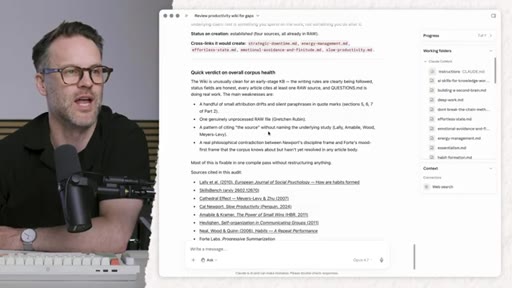
28:28That's something I added recently, an unaccounted JPEG, and then it's found some really interesting connections that we might not have seen. So quick verdict.
28:38It's unusually clean for an early stage knowledge base. All looks pretty solid. Main weaknesses,
28:43attribution, unprocessed raw files, not naming the underlying study,
28:48philosophical contradictions. Okay. Great.
28:50We'll leave this here as I'm now gonna start a new session and compare this with my skill and triggered scheduled task to see how the results compare.
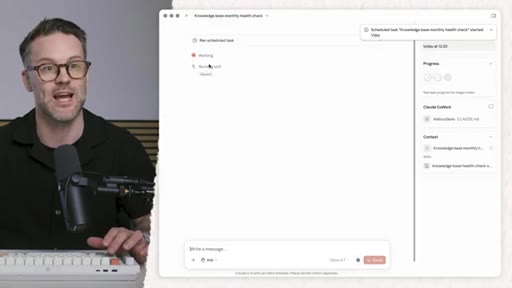
28:59So now we're gonna start again, and let's run my scheduled task. So we can actually go to scheduled, click into the scheduled task, and click run now.
29:08As simple as that. Now if we go into the knowledge base so you can see it's now implemented
29:15the knowledge base health check skill. It's following that now and reading my writing rules. These are anti AI writing rules.
29:22We can see that it's gonna have checked the latest item in the change log. So these are the
29:29latest updates. It's working chronologically. It's then gonna read through all of the other files, and we should see it now work.
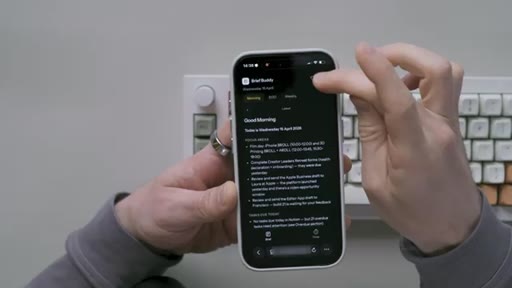
29:37So let's let that run and see what we get back. Oh, and if you're interested in this item here, push summary to BriefBuddy, I've actually created myself a little reporting app that is automatically updated
29:48and turns up on my phone. You don't need to do this. Uh, the system will just essentially, uh, you'll see when the scheduled task has run, you'll see a little, um, blue dot for something, and you can go and look at that and find the report and the brief.
30:03So this, for example, is another scheduled task that I'm running, um, essentially draft stuff so I can go and look at them and work on it. So when this goes blue, we'll be ready to see what's happened. Okay.
30:11Great. So that took it about twelve minutes. Now it is worth remembering that this probably is gonna cost a few credits to do it.
30:18That's why I'm only scheduling this to be monthly, and you might wanna do it for each knowledge base you build on a different day. So you don't just use all your credits up, but it's a really useful thing to be doing to make it powerful. So we can see it turned up.
30:30You don't really need anything more than that. If you come into Claude, you'll see that this has happened, and we can click on it in either position. We can go in and take a look, and we can see it's completed it.
30:40It's run that. It's filed a report. The brief buddy thing, I'll need to problem solve.
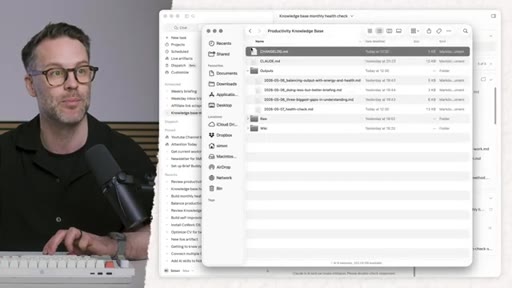
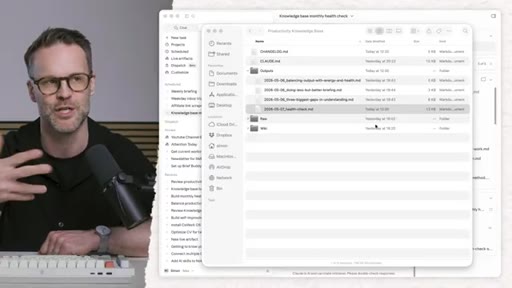
30:45But to be honest with you, I don't really need it to do that. And it will show them to us here, but we can just go over to our folders to see what's happened. The change log, first of all, will have been updated today.
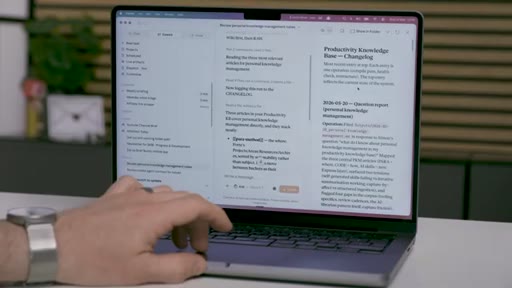
30:54There you go. Health check first run, and it's reported on what's happened. So the system will know where it's at.
31:00That's great. And then in outputs, we can see here is our health check. There you go.
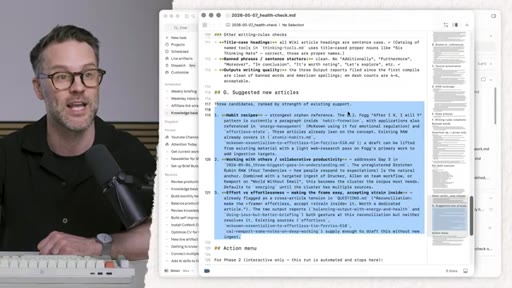
31:05We've got the wiki is unusually well aligned. It's done a similar thing. New candidates, so it's gone through and looked at the issues and discoveries.
31:13No stale articles. It's cleaned up some banned words, American spelling, and then we've got suggested new articles.
31:21This is probably where the real value is. So it's suggesting we look at collaborative productivity, good habit recipes,
31:29looking at b BJ Fogg, interesting. And we've got effort versus effortlessness, making the frame easy, accepting strain inside,
31:38interesting. And then it's got an action menu. So for phase two, things that it could run.
31:43And we could now ask it to run those things, and we will get that automatic update. So this is a reasonably, like, in-depth process. You could always simplify it.
31:52It really comes down to what you wanna do, but check out the templated options in the description, and you can take it from there. Or if you're downloading my coworker OS, it will be baked in. So as a final example here, I'm gonna get it to actually update.
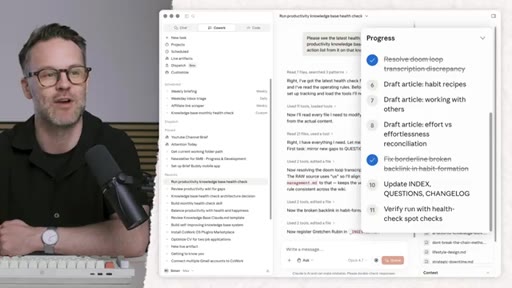
32:05Please see the latest health check-in your productivity knowledge base and run the action list from it on that knowledge base. Now what you can see is it's it's written itself a great list. It's applying the writing rule fixes.
32:17It's adding the new stuff to ingest, drafting the new articles, and then it's gonna update everything, which is great. It's worth saying, I think for most people, once you've tested it in these two stages,
32:29it's quite easy for you just to have it automatically do it. So you could just say, just do the work, Report an action. I think that's better.
32:37And, potentially, you kind of refine your instructions to make it rigorous but not cost you loads and loads of credits. As an example,
32:45for the example that we've run, so the first one I did without without the skills, then the one with the skill and this, the usage on my max plan for this current session is at 45%.
32:56That's on a five x max plan. So that's significant use of credits. But once a month for a really powerful knowledge base, not too bad.
33:04Let me know in the comments how you feel about that. And here we go. We've got the results.
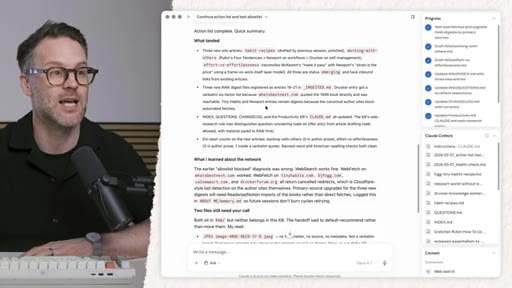
33:08It's created new articles on habit receipts, working with others, and effort versus effortlessness into the gaps that we're missing. It's updated
33:18the index questions and change logs, and they're all ingested, which is really cool. It's giving me a bit of feedback about some web search stuff, and then it's created the documents.
33:29And if we go and check out the files, we'll see the new items have been ingested. And the new entries in the wiki have been added, which is great.
33:42So it should be that we now get a very different result. So if we ask in a new task, take a look at the productivity knowledge base and give me a report on how I can balance making
33:55serious and useful effort versus making my week and days feel effortless in how I contribute to my life. These are just examples.
34:03Right? But let's just drop it in and see what it gives us. And it's created it.
34:06Now annoyingly, it's not presented it to me. Please, can you update your Claude MD files and the templated one for knowledge bases
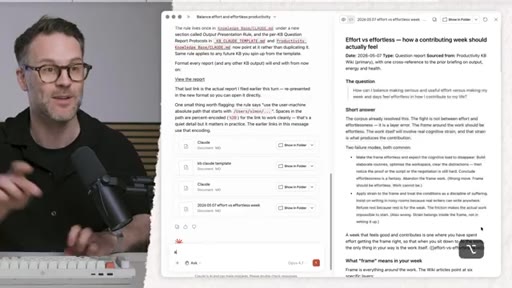
34:15so that any report that's created in response to a question is presented as a clickable page to open in the chat. Great. There we go.
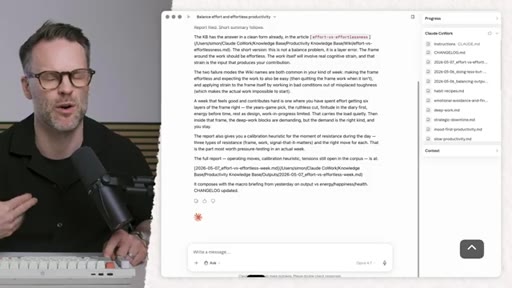
34:24And it's now showing it to me, so I can actually click on it and read it. And this is what it's given us, a little report. Now here's a nice little tip.
34:31If you ever wanna make your learning easier when you're doing this, I use Speechify to read things back to me. So I can just do control option a, and it reads it. The question, how can I balance making serious and useful effort versus making my week and days feel effortless in how I contribute to my life?
34:47CTAThose are the five steps to building, refining, and using a knowledge base that learns as it goes.
34:56CTASo here's the bit you need to remember to take away with you. Day one of running this, your knowledge base isn't gonna do loads. It's got whatever you dumped in over the weekend, useful but not revolutionary.
35:07CTABut day 100, then you've actually built something valuable. Every meeting transcript that mattered, every answer you've saved back into the system becomes a carefully curated cross reference linked and summarized set of information
35:20CTAthat you can query with the librarian themselves. And it's that kind of asset that's nearly impossible to replicate because nobody else has read what you've read or saved what you've saved.
35:31CTASo if you only do one thing from any video I make this year, do this. It's forty five minutes on a Saturday morning, and you'll thank yourself in three months. One last thing, everything we built today,
35:43CTAthe folders, the Claude MD, the prompt, the health check, they all ship inside the final version of my Claude Cowork OS when it comes out. It's in beta as I film this and you can download it right now. It's been brilliantly received so far.
35:56CTAThe whole point of it is to help you skip past the fiddly setup bits and land on a working Claude environment faster than most people manage on their own. It's been a game changer for me and a lot of others using it. And, of course, you can watch the video that shows you exactly how to do all of that right here.
36:13CTAI'll see you on the next one. Bye.
— full transcript
§ 05 · For Joe

The CLAUDE.md is the unlock.

Format steal playbook

A single file that makes Claude the librarian — not just for a second brain, but for any body of knowledge you want to query like a specialist.

  • Three folders plus one CLAUDE.md. That's the entire architecture. Steal it for newsletters, client files, course material — any corpus you need to query.
  • The health check skill is where compounding happens — schedule it monthly and let Claude surface gaps, contradictions, and article candidates you'd never find manually.
  • The two-phase pattern (Phase 1: always report; Phase 2: action only if interactive) prevents runaway AI edits — apply this to any automated system you build.
  • Simon's framework slide — 'Five steps. One weekend. Yours forever.' — collapses complexity into a promise. That structure works for any tutorial format.
  • The 'AI as librarian' reframe is the most quotable insight in the PKM space right now. Build a short around it.
  • The Day 1 vs Day 100 closer is the perfect long-game argument for any tool that compounds — applies directly to JoeFlow history, MCN content library, or any system that improves with use.
§ 05 · For You

Your notes can finally work for you.

If you've ever abandoned an Obsidian vault

Three folders and one file, set up in 45 minutes, turns every article you've ever saved into something you can actually ask questions of.

  • You don't need to organize anything. Dump articles, notes, screenshots, and meeting notes into one folder called raw — messy is fine.
  • Ask Claude to build a wiki from what you've dumped in. It creates cross-referenced topic pages automatically.
  • Every time you ask a question, save the answer back into the system. Future questions get smarter because of past ones.
  • A monthly health check (automated or manual) finds contradictions, fills gaps with web search, and suggests new topics based on what's already in your knowledge base.
  • By day 100 the system knows your specific reading history and judgment — it's not generic AI, it's one trained on what you've actually read and thought.
§ 06 · Frame Gallery

Visual moments.