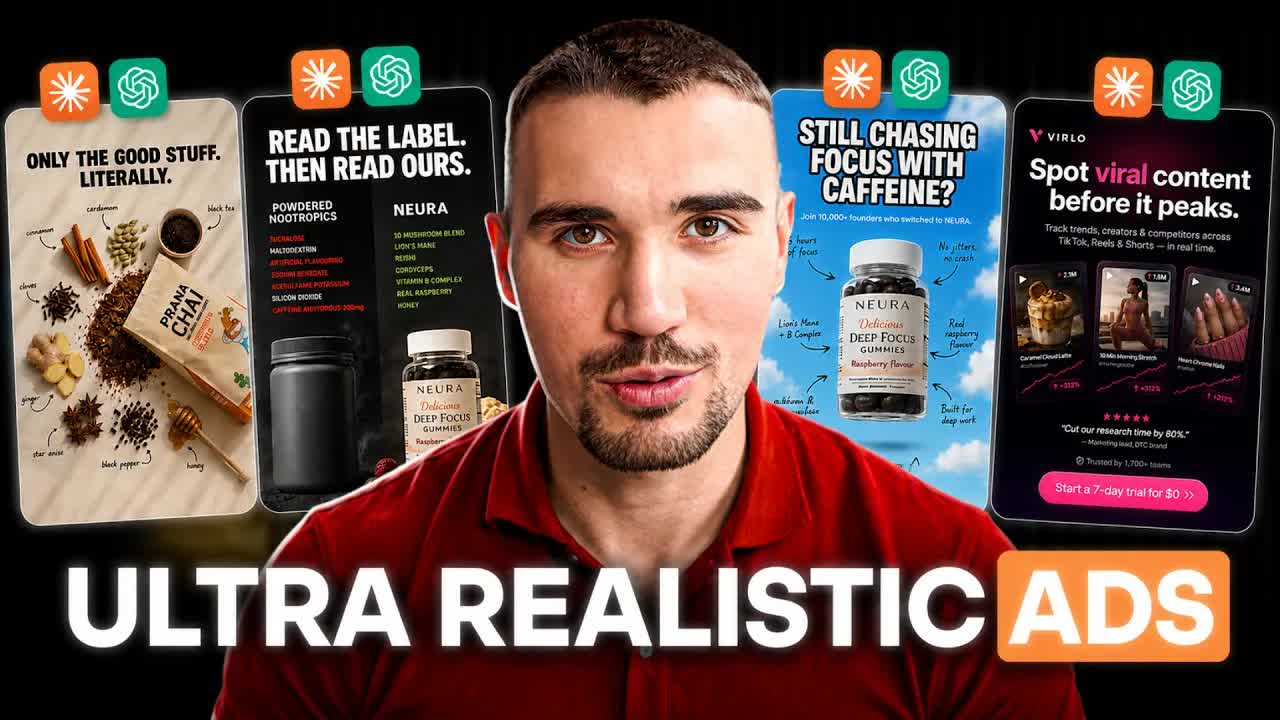
The bait, then the rug-pull.
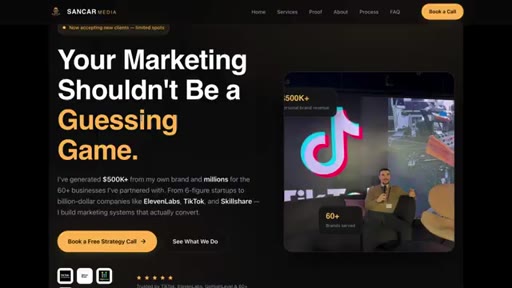
Static ads were never supposed to be the underdog format. Yet in 2026, with video ads demanding five to ten seconds of viewer commitment before landing a single point, the humble static image has quietly become the fastest, cheapest way to find out what messaging actually works.
Where the time goes.
01 · Hook and why static ads still win
Pattern-interrupt hook, agency backstory, core claim that static outperforms video for cold traffic because of one-second skim time.
02 · Three-part winning static formula
Skimmable, objection/desire-led, social proof present. Sets the framework before the how-to begins.
03 · Claude Code brief workflow
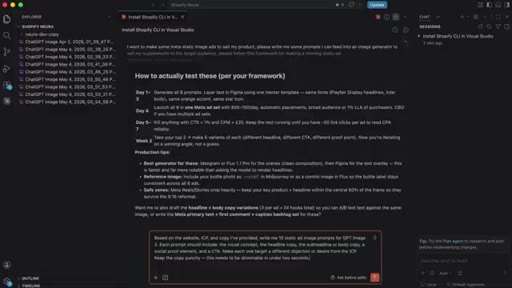
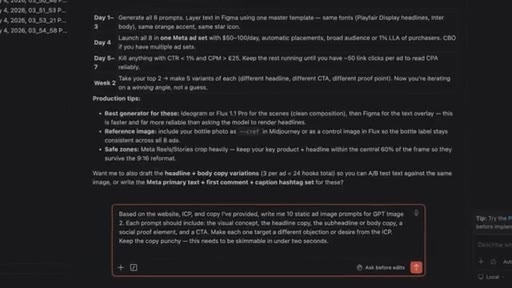
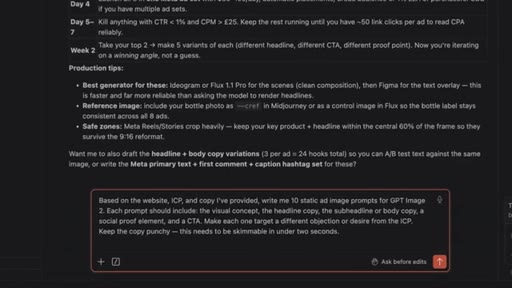
Feed website URL, ICP document, existing copy. Master prompt: ten image prompts each targeting a different objection or desire, skimmable in under two seconds.
04 · Live Claude Code demo
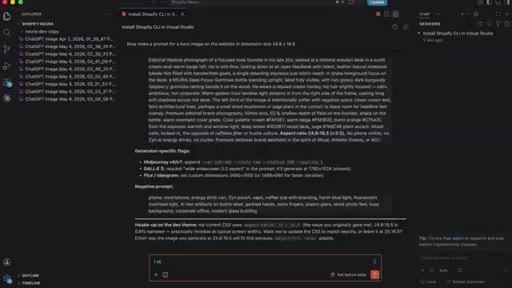
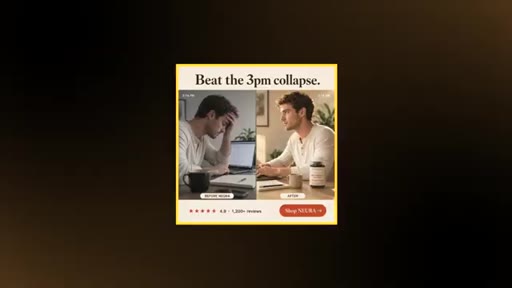
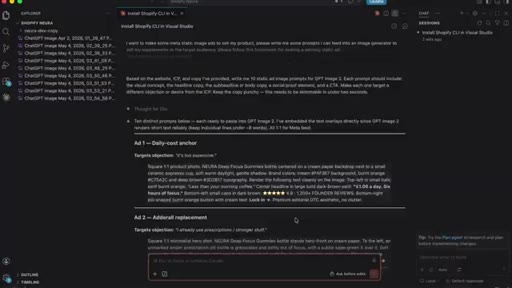
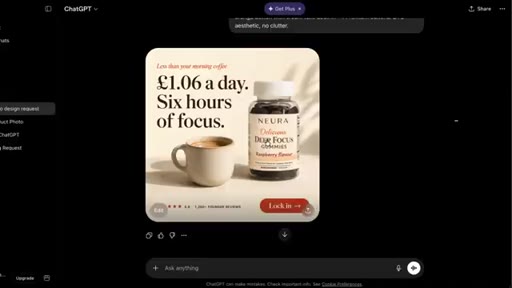
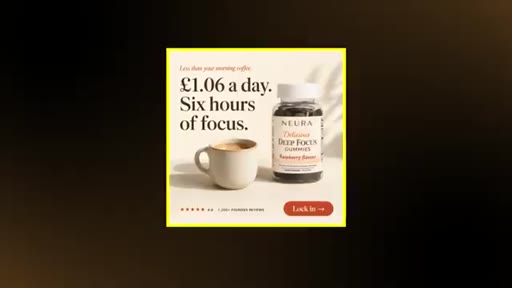
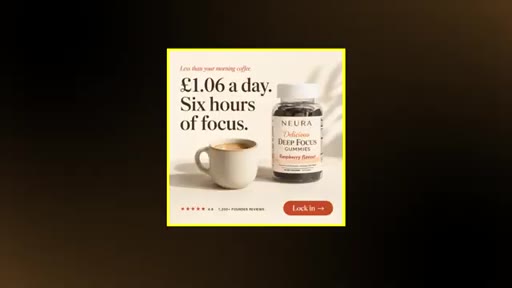
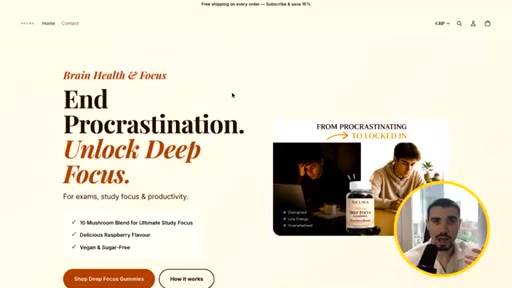
Screen recording: Claude Code inside VS Code generating ten ad prompts for NEURA supplement brand, formatted with visual concept, headline, body, social proof, and CTA.
05 · Sponsor: TeamDrop
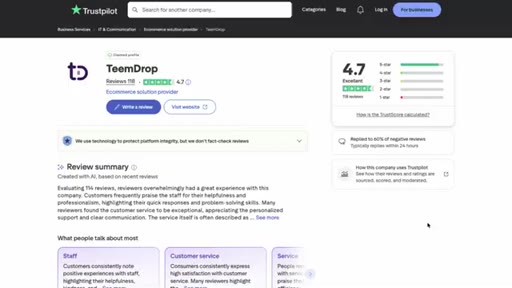
Sponsored segment for TeamDrop dropshipping supplier.
06 · GPT Image 2 generation
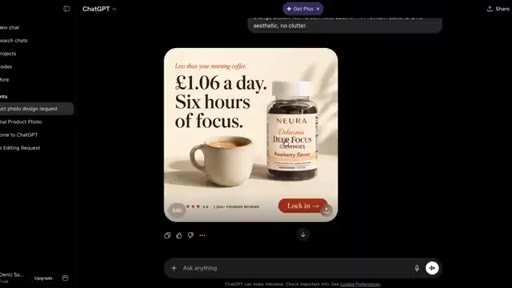
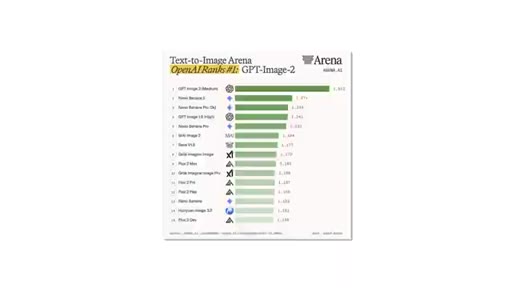
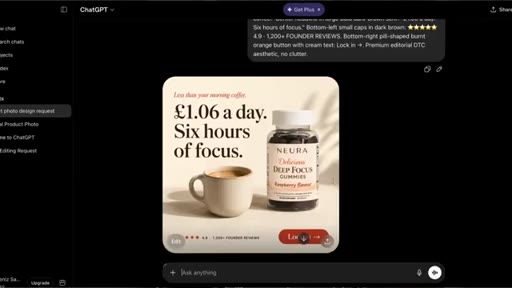
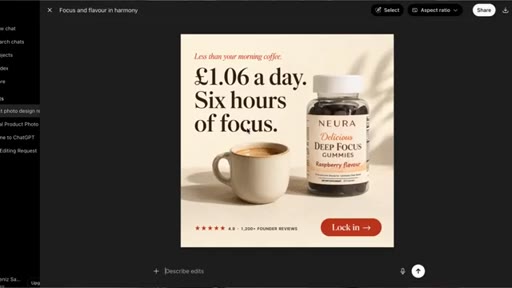
Why GPT Image 2: number one on Arena leaderboard, clean text rendering. Workflow: paste Claude prompt, attach product photo as reference, generate.
07 · Batch complete
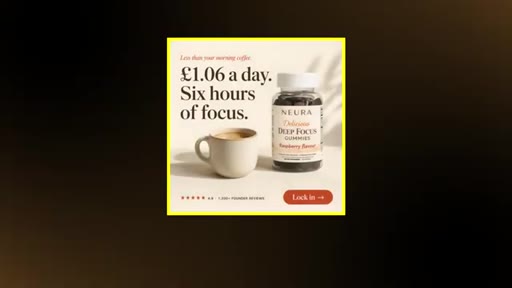
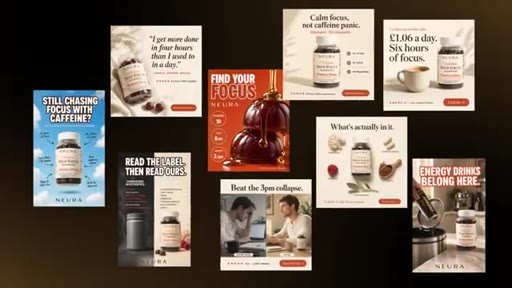
Ten statics generated in 20-30 minutes. Full grid shown on screen. Equivalent to a week of creative testing.
08 · Five-point conversion framework
What actually makes a static convert: (1) instantly skimmable, (2) lead with objection or desire, (3) social proof nonnegotiable, (4) design for the scroll with visual hierarchy, (5) test fast and messy over perfection.

09 · CTA and close
Binary CTA: apply yourself or book his agency. Cross-promotion to prior 24-hour dropshipping challenge video.
Visual structure at a glance.
Named ideas worth stealing.
Three-Part Static Ad Foundation
- Instantly skimmable (the blink test)
- Addresses a specific objection or desire
- Social proof visible somewhere on the ad
The minimum viable criteria before testing any static; if an ad fails any of these three, it should be reworked before spend.
Five Things the Best Static Ads Have
- Instantly skimmable headline
- Lead with objection or desire
- Nonnegotiable social proof
- Design for the scroll (visual hierarchy)
- Test fast and messy, not perfect and slow
Expanded framework taught at the end of the video as context for evaluating the AI-generated batch. The fifth item (test volume over perfection) is the strategic lens; the first four are executional.
Claude Code Ad Brief Prompt Structure
- Website URL as context
- ICP document
- Existing copy and past ads
- Master prompt: 10 prompts, each targeting a different objection/desire, with visual concept + headline + body + social proof + CTA
- Optional: attach competitor ad examples for style reference
The exact three-input, one-prompt workflow used to generate brand-specific (not generic) ad creative briefs.
Lines you could clip.
"What used to take days and cost hundreds if not thousands, now can be done in under an hour for a fraction of the cost."
"A static on the other hand, they can skim in literally one second, which means if you can nail the image and the copy, you can stop the scroll better than any other format."
"The goal is not to make one perfect ad. The goal is to make 15 ads, find two that work, and scale them."
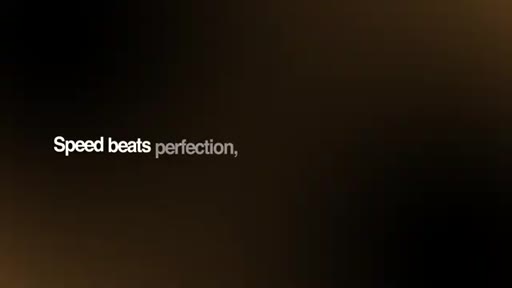
"Speed beats perfection especially when starting out."
Things they pointed at.
How they asked for the click.
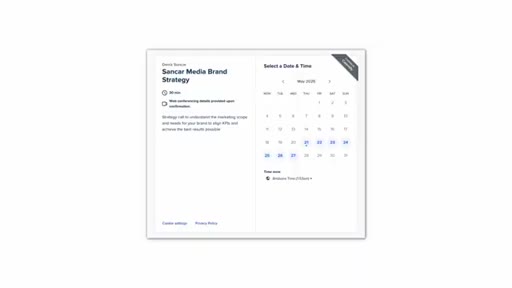
"Click the link down below and book in a call with my team, and we can help you scale your business through these AI ads."
Binary framing (do it yourself or hire us) presented cleanly without pressure. Agency URL shown on screen. Also plugs a related video as content CTA.
Word for word.
Volume and context are the two levers in AI ad production.
AI image generation is only as good as the brief behind it, and a brief is only as good as the brand context you feed it.
- Static ads communicate in one second; video ads need five to ten before the viewer understands the offer, making statics faster for cold-traffic testing.
- Feeding Claude your website URL, ICP document, and proven copy produces brand-specific prompts rather than generic ones that look like they were made for someone else's business.
- Asking for ten prompts in a single generation, each targeting a different objection or desire from the ICP, produces a full week of creative testing in one sitting.
- Attaching a product photo to each GPT Image 2 generation keeps output on-brand without writing a longer or more complex prompt.
- The blink test is the right filter: if the core message cannot be retained in one glance, the headline is too complex or the visual hierarchy is wrong.
- Social proof does not need to be elaborate: a star rating, a review quote, or a number like 2,005 five-star reviews gives strangers permission to stop scrolling.
- The five conversion criteria (skimmable, objection-led, social proof, scroll design, and test volume) apply equally to human-made and AI-made ads; AI speeds up production but does not change what makes an ad convert.
- The goal is fifteen ads, two winners, and scaling those two; perfecting one ad before testing it is the most common and most costly mistake in early paid ad campaigns.