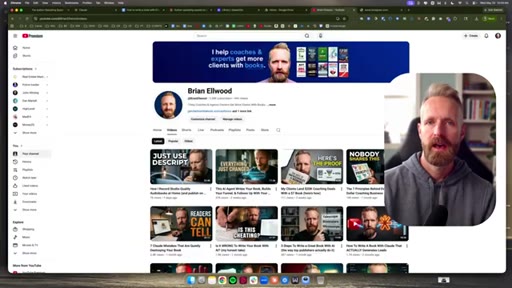

Brian Ellwood · Youtube · 25:22

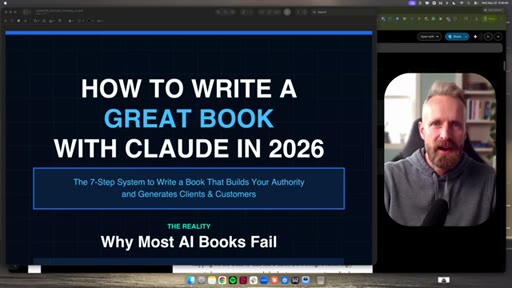
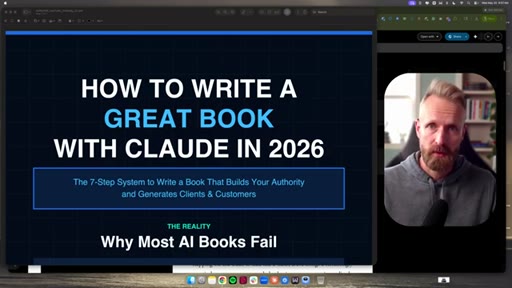
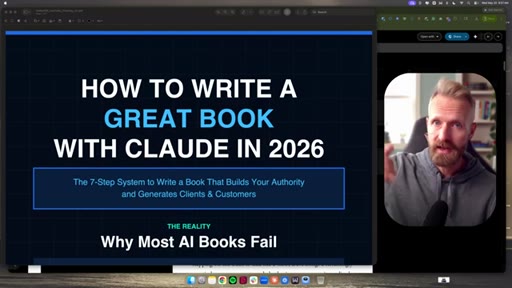
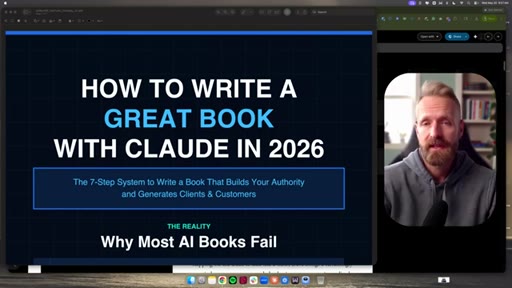
How to Write a GREAT Book With Claude in 2026

A 25-minute tutorial on the 7-step system for writing an AI-assisted book that builds authority and generates clients, not just words between pages.

Posted
May 21st 2026
today
Duration
25:22
Format
Tutorial
educational
Channel
BE
Brian Ellwood
§ 01 · The Hook

The bait, then the rug-pull.

Books are cheap now. That is the uncomfortable premise Brian Ellwood opens with: AI has handed everyone the tools to publish, which means a book alone is no longer a differentiator. What follows is a 25-minute systems breakdown of how to produce one that still matters.

§ · Stated Promise

What the video promised.

stated at 00:11 "Once you learn the seven steps, it is gonna be quite straightforward for you to produce something that builds your authority, creates trust with your readers, and turns those readers into clients and customers." delivered at 23:15
§ · Chapters

Where the time goes.

00:00 – 00:47

01 · Cold open + problem frame

The commoditization thesis: AI made it trivially easy to publish, so most AI books are worthless. Only books with bigger strategy around them work.
00:47 – 02:10

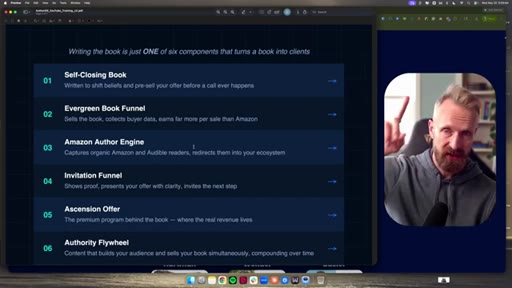
02 · The 6-component book engine

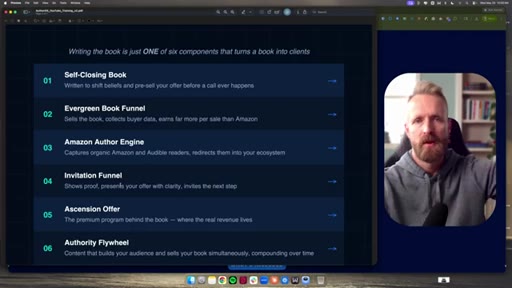
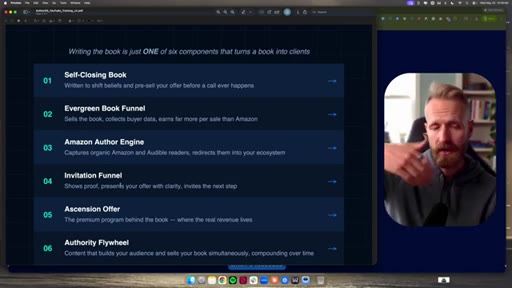
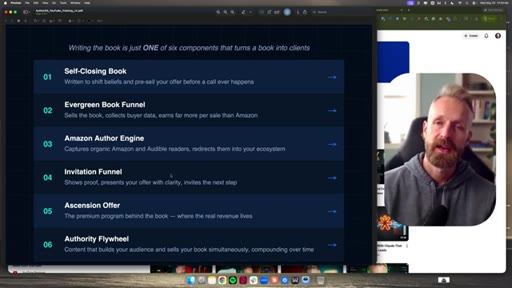
Writing is step 1 of 6: self-closing book, evergreen book funnel, Amazon/Audible, invitation funnel, ascension offer, authority flywheel.
02:10 – 04:10

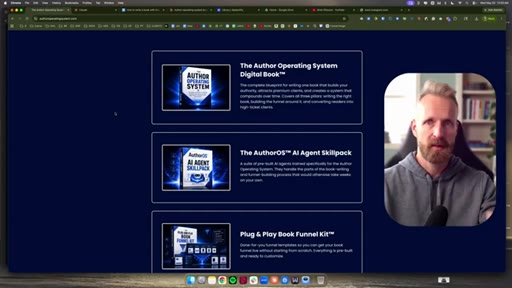
03 · Author Operating System offer pitch

Pitches his book and AI agent skill pack at 3:49 before pivoting to the tutorial.
04:10 – 06:10

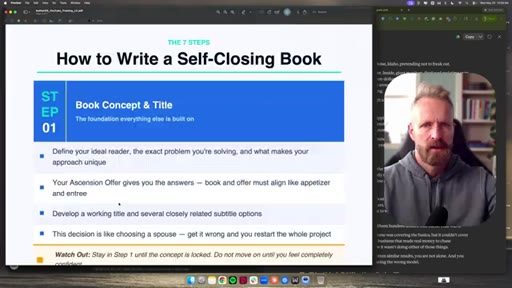
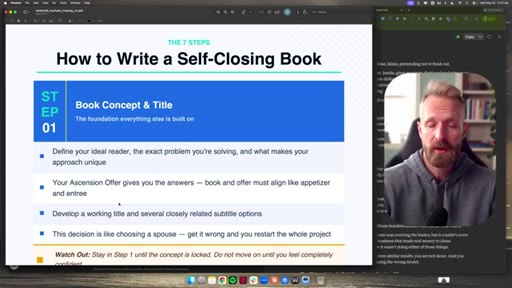
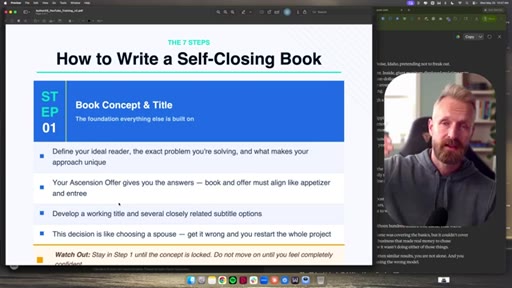
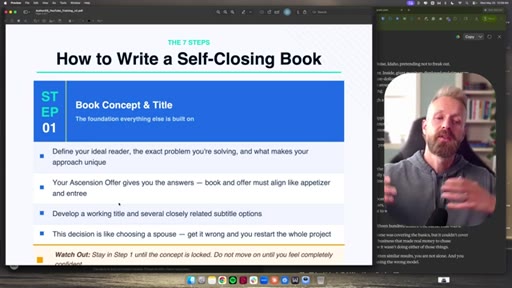
04 · Step 1 - Book Concept and Title

Define ideal reader, outcome, and unique method. Ascension offer gives the clues. Lock the concept before moving forward.
06:10 – 11:05

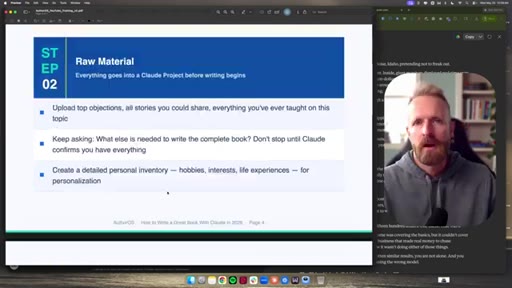
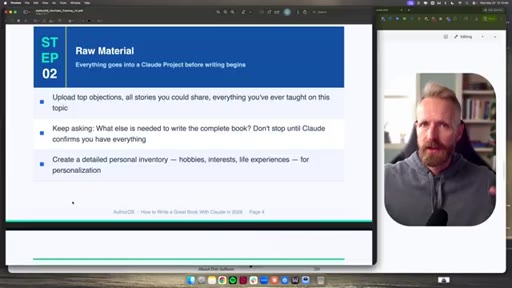
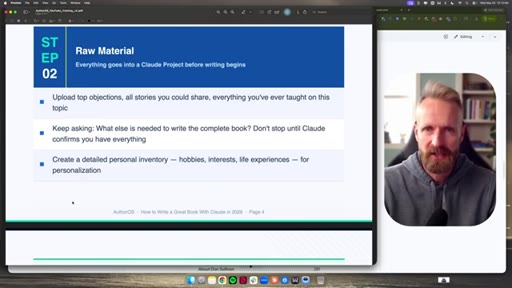
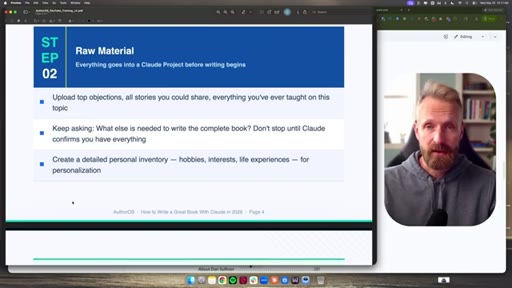
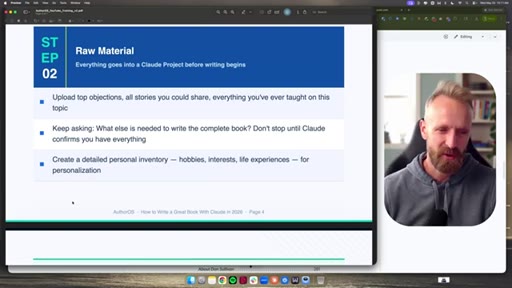
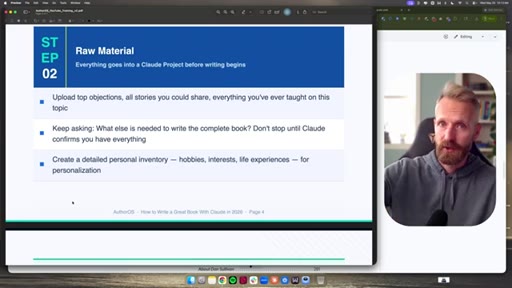
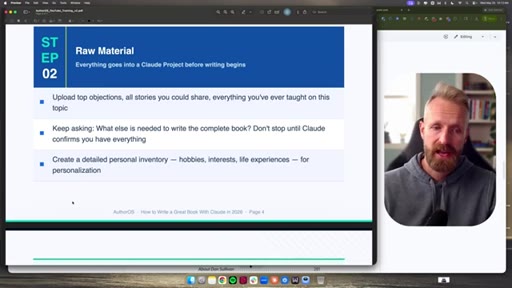
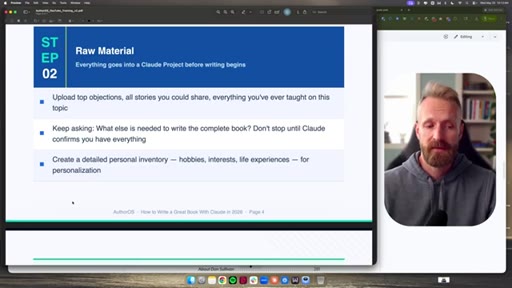
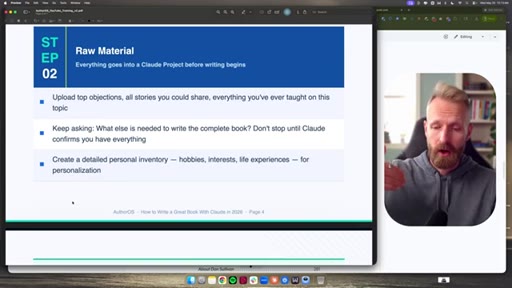
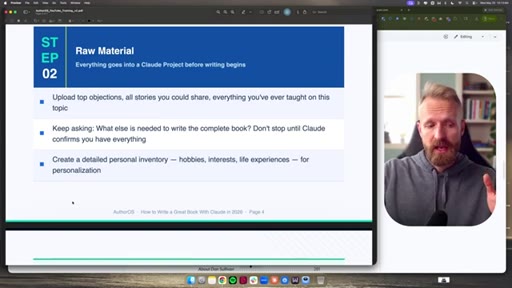
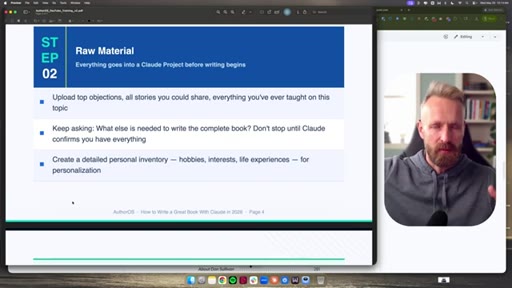
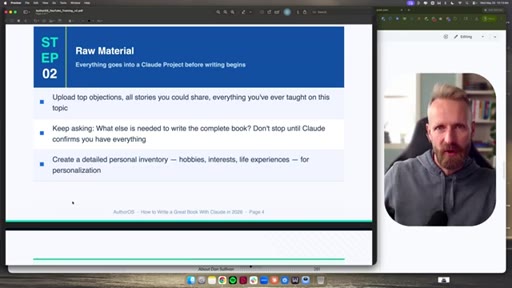
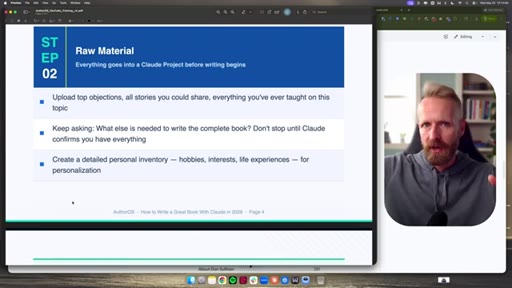
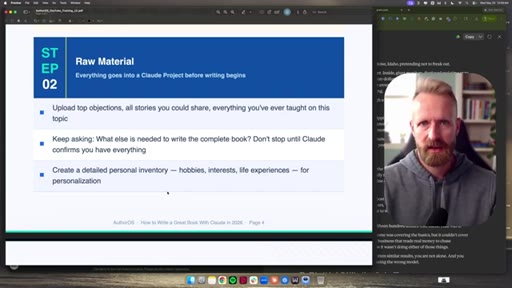
05 · Step 2 - Raw Material

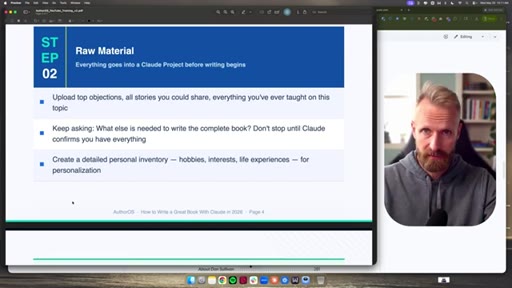
Stuff a Claude Project with all your content: transcripts, newsletters, courses, stories, objections. Add a personal inventory of hobbies and quirks. Keep asking Claude what is missing until it says nothing.
11:05 – 13:50

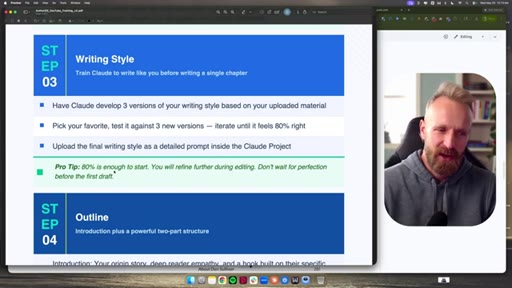
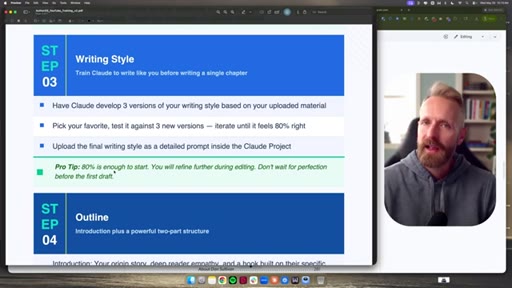
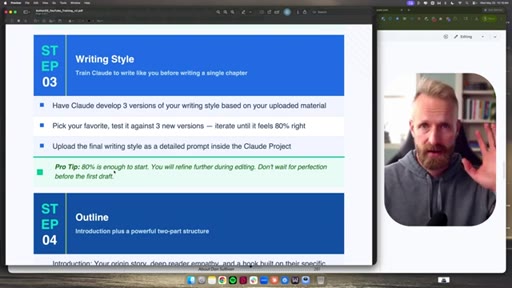
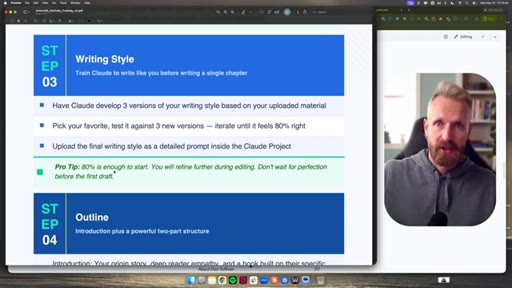
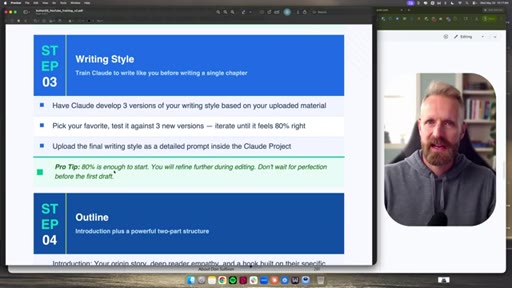
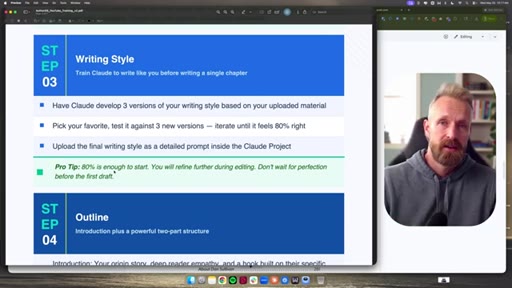
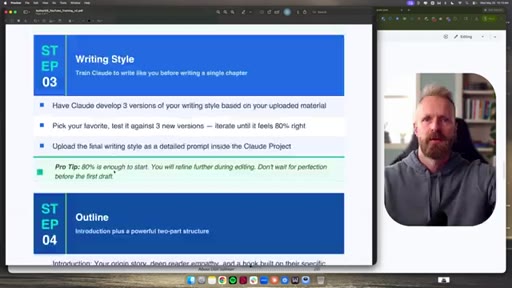
06 · Step 3 - Writing Style

Have Claude generate 3 style versions from speech and writing samples. Iterate challenger vs. champion until 80% right. Save the winning style as a prompt file in the Claude Project.
13:50 – 16:05

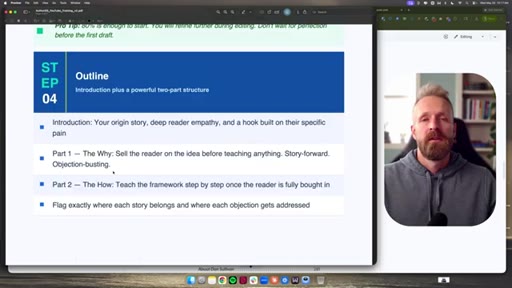
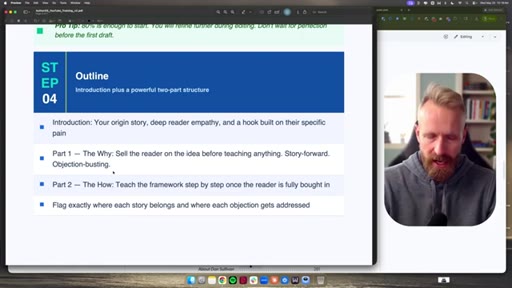
07 · Step 4 - Outline

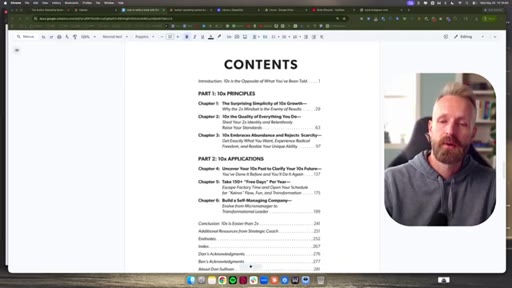
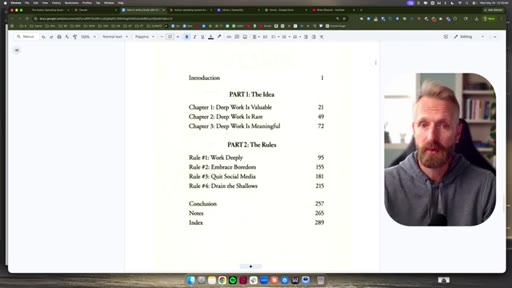
Intro + two-part structure (principles then applications). References 10x Is Easier Than 2x and Deep Work as templates. 6-8 chapters; simpler wins.
16:05 – 19:00

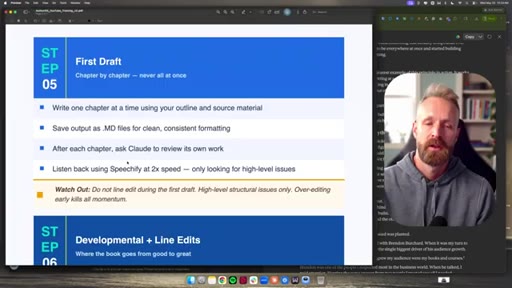
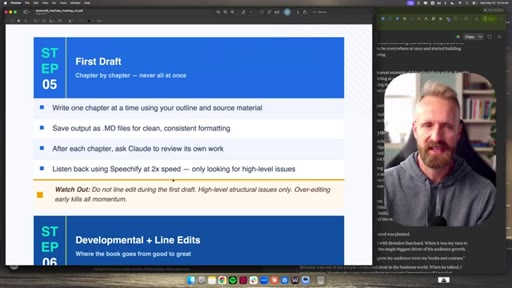
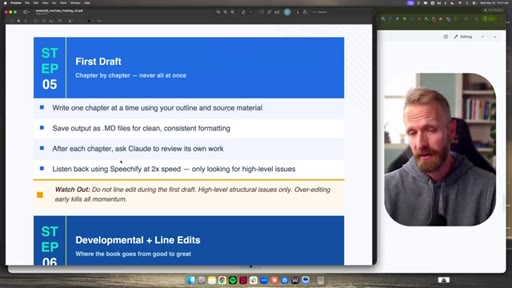
08 · Step 5 - First Draft

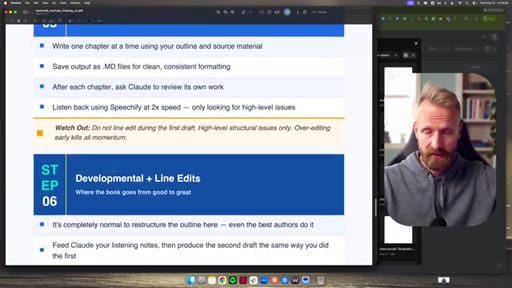
Write chapter by chapter saving as MD files in the Claude chat thread. After each chapter ask Claude to review its own work. Speechify trick: listen at 1.5x while walking, voice-note feedback.
19:00 – 23:15

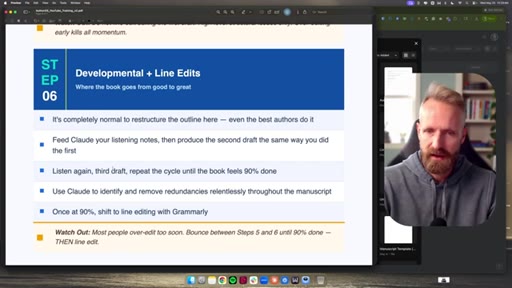
09 · Step 6 - Developmental and Line Edits

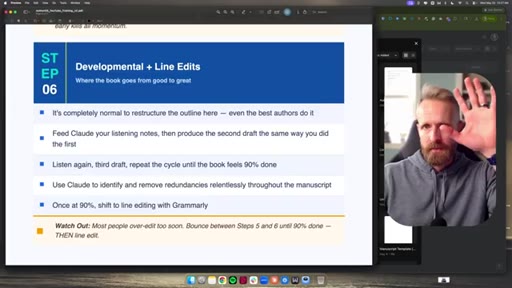
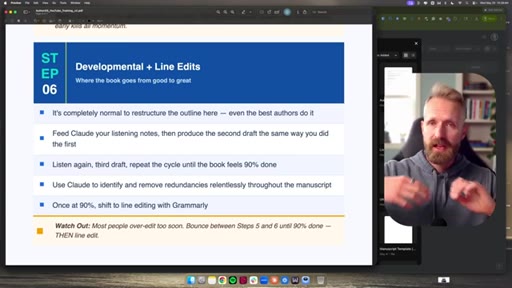
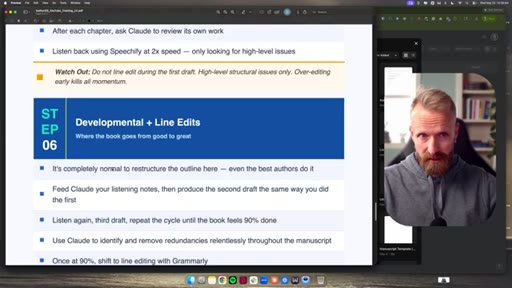
Bounce between steps 5 and 6 until 90% done. Do not line-edit too early. Restructuring the outline here is normal. Grammarly for the final pass.
23:15 – 25:22

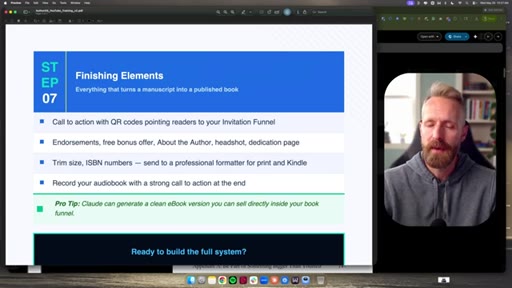
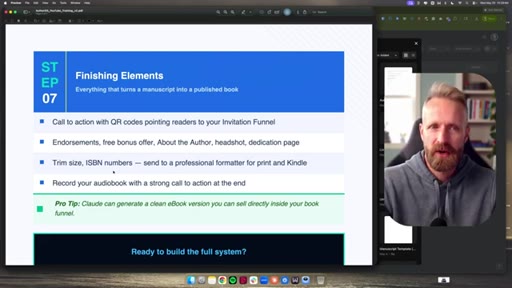
10 · Step 7 - Finishing Elements

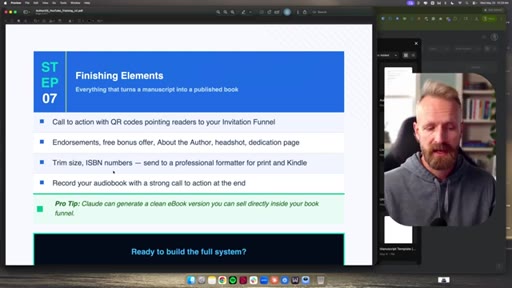
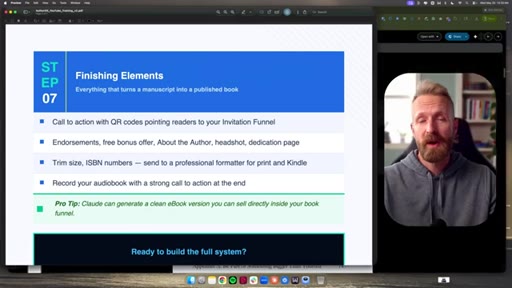
CTA with QR codes at front, middle, and back. Free bonus to capture Amazon buyers. About the Author, endorsements, headshot, dedication. Pick trim size, buy ISBNs, send to professional formatter, record audiobook.

§ · Storyboard

Visual structure at a glance.

open
6-component system
step 1
step 3
step 5
step 6
step 7
CTA
§ · Frameworks

Named ideas worth stealing.

04:10 list

7-Step Self-Closing Book System

  1. Book Concept and Title
  2. Raw Material
  3. Writing Style
  4. Outline
  5. First Draft
  6. Developmental and Line Edits
  7. Finishing Elements

End-to-end workflow for producing a Claude-assisted book that generates clients.

Steal for Any AI-assisted long-form content workflow
02:02 list

6-Component Book Engine

  1. Self-closing book
  2. Evergreen book funnel
  3. Amazon and Audible
  4. Invitation funnel
  5. Ascension offer
  6. Authority flywheel

The full system around the book that turns readers into clients. Writing the book is step 1 of 6.

Steal for Positioning any product as a client-acquisition engine
17:10 concept

Claude Self-Review Prompt

After Claude writes a chapter, prompt it to review its own work against all project prompts and uploaded material. It finds fabrications, em-dashes, style violations, and redundancies.

Steal for Any multi-chapter or multi-section Claude writing workflow
19:00 concept

Speechify Audio Editing Loop

Paste the draft into Speechify, listen at 1.5x while walking, voice-note all high-level feedback to Claude. Only go granular once the book is 90% done structurally.

Steal for Developmental editing any long-form content without getting stuck in line-edit hell
§ · Quotables

Lines you could clip.

00:51
"Even a child could write a book with AI in a couple of days. So books have essentially become commoditized."
Punchy thesis, no setup needed → TikTok hook
10:20
"Claude is an absolute machine when it comes to building that mansion, but it cannot do it without the materials that you give it."
Memorable analogy that reframes the human role → IG reel cold open
05:46
"Stay on step one until you really lock in the concept. This is kinda like choosing a spouse."
Unexpected analogy with stakes-raising punchline → Newsletter pull-quote
20:32
"Ask Claude to review its work. It will find seven mistakes. Redundancies. Fabricated material. Em dashes."
Actionable tip most creators do not know → TikTok hook
21:45
"Most people over-edit too soon."
Tight one-liner, no setup needed → IG reel cold open
§ · Pacing

How they spent the runtime.

Hook length47s
Info densityhigh
Filler8%
Sponsor blocks
  • 03:49 – 04:12 · Author Operating System (own product)
§ · Resources Mentioned

Things they pointed at.

20:55toolSpeechify ↗
22:13toolGrammarly ↗
14:15book10x Is Easier Than 2x
14:50bookDeep Work
03:49productAuthor Operating System
§ · CTA Breakdown

How they asked for the click.

23:15 next-video
"I made a whole video on exactly how I record audiobooks, which you can check out right here."

End-screen card. Clean, non-pushy. Product CTA was front-loaded at 3:49 rather than saved for the end.

§ 04 · The Script

Word for word.

HOOK opening / re-engagementCTA the pitch analogy
00:00HOOKIn this video, we are going to go over the exact process so that you can write a great book with Claude
00:07HOOKright now in 2026 using the best practices.
00:11HOOKOnce you learn the seven steps that we're gonna go over in this video, it's actually gonna be quite straightforward for you to produce something that you're truly proud of, builds your authority, creates trust with your readers, and actually turns those readers into clients and customers and income for your business. The reality right now is that most people are doing the exact opposite.
00:33HOOKThey're using Claude to just print out crappy books that sell no copies and basically make no noticeable difference in their lives or their businesses. And that's because AI has basically given everyone the tools to write a book. That is if you just consider a book to be words between pages.
00:51However, even a child could write a book with AI in a couple of days. So books have essentially become commoditized, and now the competition
01:01is much greater for your book to actually be great, to actually stand out, to actually shift the beliefs of the readers, and to make a meaningful difference in your business,
01:15you've gotta have a bigger strategy and even a system that lives around the book that actually can turn that book into an engine. And this is not easy. Otherwise, everyone would do it.
01:26Right? But that's what we talk about here on this channel. That's what I do and what I help my clients do.
01:31My name is Brian O'Hud. I help coaches, experts, agency owners publish books and use those books to get more clients for their business. I've worked with lots of $6.07, and even 8 figure coaches and experts, and I wanna share with you what I'm learning from working in the trenches with these very seasoned marketers
01:49to use Claw to develop their books, create their books, and then ultimately build that system around it so that they can actually make money. Because writing the book is really just one of six components that turns a book into clients. The first thing is you do need that self closing book that shifts their beliefs,
02:06presales your offer before a call ever happens. You're also gonna wanna sell it in what I call an evergreen book funnel, and what you're seeing right now is an example of a funnel.
02:17I'm going to share more about this in a moment. What the funnel does is it allows you to make a lot more money per book sale and then capture their information so you can follow-up with them more effective than Amazon. The third step is to also put it on Amazon and Audible.
02:32Most people are very comfortable buying books there. And then you want to funnel those people back into the same sequence so that they can land in what I call your invitation
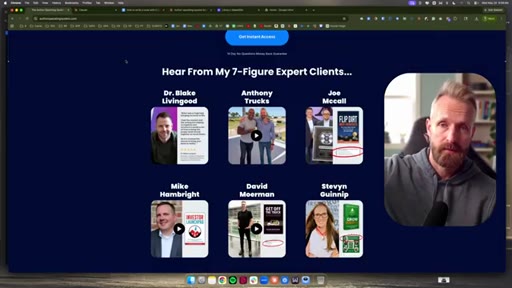
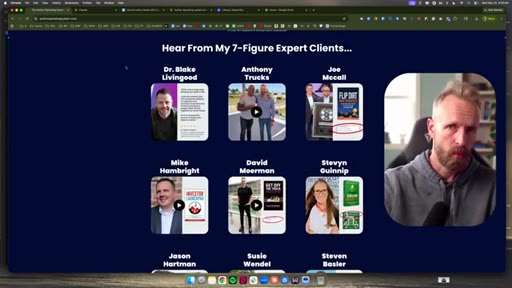
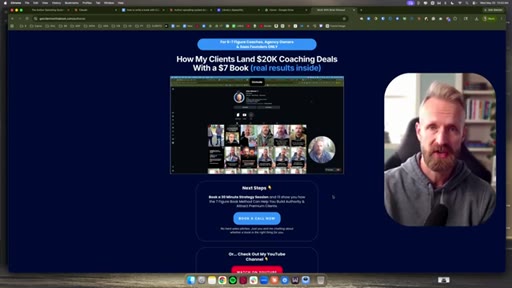
02:42funnel. And that's simply a page that looks like this where you tell people about the high ticket offer that you sell. You show some testimonials,
02:51and you allow them to book a call, fill out an application, whatever that may be. Most authors don't even have a page like this, so they really don't have any chance of selling the thing that is actually gonna make them the money.
03:05And that thing is actually step five of this framework. You wanna have an Ascension offer, the premium program that lives behind the book where the real revenue lies.
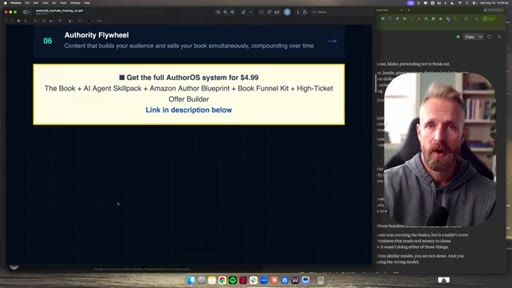
03:15And the final step, number six, is you wanna have what I call an authority flywheel. You wanna have content that both builds your audience and sells your book simultaneously.
03:25You can expect to get 2% of book readers to convert to clients or customers for your higher ticket stuff. And so if you want two customers, you gotta sell a 100 books.
03:36CTAI do that with content on YouTube and Instagram, paid ads, and this is what puts a bow around the whole thing. By the way, if you want this entire system, I just launched my new book called the author operating
03:49CTAsystem. You can get the book that walks you through this entire process as well as an AI agent skill pack that's pre trained with all of my book writing prompts.
04:00CTAYou're gonna get my exact book funnel templates and training on how to build one of these for yourself, how to build your high ticket offer, how to get your book on Amazon.
04:10CTAAll of these bonuses are included when you grab a copy of the book. I'll put the link in the description in case you wanna check it out. And in this video, we're talking about this first step, writing your self closing book.
04:22And so without further ado, let's get into step one on how to do that. The first step is to define the book concept. You must be crystal clear on who your book is for,
04:33the outcome that the book produces, and what makes your approach or method unique and different from everything else that is out there. And just as a hint, that ascension offer that you sell behind your book will give you the clues on how to do that.
04:49For example, if you wanna help lawyers to get more clients with YouTube, then your book should also help lawyers get more clients with YouTube.
04:59And the book would be like the appetizer version, and then hiring you would be the entree. The only way an ascension offer makes sense is if it matches what is in the book so that the reader can naturally ascend
05:14to the more white glove version of what you do. At this phase, I also have a working book title and a handful of book subtitles that are essentially interchangeable,
05:24just saying the same thing in different ways. I usually kinda wait towards the end to pick the final book subtitle, but I wanna have some
05:33idea of the title before I go any further because I'm probably gonna be referencing that title or concept throughout the book. And I recommend that you stay on step one until you really lock in the concept. This is kinda like choosing a spouse.
05:49You wanna go slowly and make sure you nail this because if you don't, you basically will end up having to restart this whole thing and write a whole new book down the road. Alright.
05:59Once you've nailed step one, step number two is to assemble all of the raw material for your book. It's kind of like building a house. You bring all of the construction
06:11materials to the site so that you can build a beautiful mansion. Claude's an absolute machine when it comes to building that mansion,
06:20but it can't do it without the materials that you give it. You are still the architect
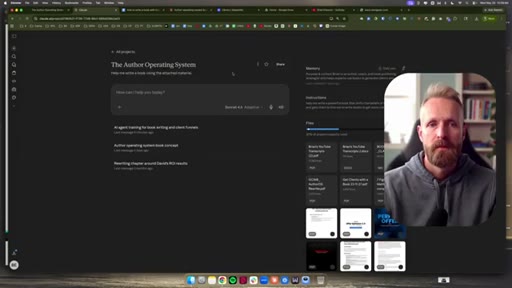
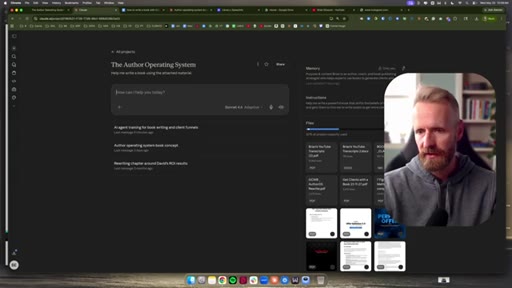
06:26or whoever creates that blueprint for the house, and you're gonna tell it to design it exactly how you want it. And if you haven't used Claude before, you're going to want to use a Claude project. This is like the hub where everything is stored.
06:41Like, for my latest book, I've got this stuffed with all of my YouTube transcripts, my past books, everything I've ever said, a bunch of information about my offer, my perfect client,
06:53and all of their desires and their fears, etcetera. You want to give it all the perfect context so that it can write the book correctly for that person that you're trying to reach,
07:04and this acts like the brain for your book. Once you stuff this full of everything, it's actually quite easy to produce a great book. You're gonna wanna store it full of all of the objections
07:16that people could possibly have to your methods so that you can address those in your book. Every story that you could possibly tell in your book should be stuffed into that Claude project,
07:27every YouTube transcript, every newsletter, transcripts from all your online courses,
07:33basically anywhere that you've ever said anything or taught anything on your topic, you should put it in there.
07:40And then here's what's key. Once it's all in there, you say, hey. What's missing for me to write a great book?
07:47And it's gonna say, you've still got these three major gaps in your content. What I do often for clients is I'll get on Zoom, and I'll interview them on those missing topics.
08:00We often repurpose those interviews as, like, a YouTube video so you get more bang for your buck. But what you're really doing is you're gathering
08:10that raw material that is still missing. You can't build a mansion without some beautiful big
08:15glass window panes so you can look out on the street at all your peasant neighbors who have worse houses than you. And so you wanna make sure that you get all the raw material. If you want writing the book to be as
08:31one click as possible, or you could, in theory, draft the whole book in, like, a day or two, then stay on this phase, the raw material gathering phase relentlessly until
08:43Claude is basically telling you there is nothing else missing. You've got everything you need to write this book. And here is a bonus pro tip for this step that I love.
08:53Tell Claude all about you personally, All your hobbies, all your interests, the different life experiences you've had.
09:02What it can do is weave those into your book. Like, I love to play Frisbee golf. I love to drink coffee.
09:10I love to go snowboarding. I've got two little daughters. Right?
09:14Claude can then take those things and actually weave them into the narrative in your book. If there's a section in a book about you need to get up more times than you fall down or something, then it could use an analogy from snowboarding, which is an arena where you definitely have to do that.
09:32Right? What that does is it gives the book some personal brand type of flair. The readers are like, oh, Brian snowboards.
09:41That's cool. I snowboard too. What you wanna remember
09:45when we're playing this game is this. Just as much as people are buying your special unique framework or method,
09:54they're also buying you as a person, as a coach or an expert or whatever it is that you do. And so you want to show as much of you as possible in your book.
10:05I have looked at so many books that are just so devoid of personality that
10:12no reader's ever gonna really even have the chance to relate or resonate with the author. Hence, this is a step that nobody thinks to do.
10:22But if you take the time to just unpack all that stuff about you, the weird stuff, the different stuff, strange interests and hobbies that you have, what makes you unique, and then literally just, like, layer that throughout the whole book.
10:38That's how you write a book that's truly you and that no one can copy and that the reader has a chance of latching onto a few things. It's gonna help you unpack your overall personal brand, which is the big picture idea,
10:53and you're doing that in the form of your book, which is going to act as a mega chunk of your personal brand. It is a part of the footprint of your personal brand.
11:03So make sure you bring that personal flair to your book itself by putting it in the raw material. Alright. Step number three is developing the writing style.
11:14This is critical. A lot of people just write with, like, the standard Claude writing style, and that's a huge mistake because
11:23that sounds exactly like every other Claude written book. It's got the em dashes in there. It's got those one sentence, like, dramatic cliffhanger lines.
11:32It just started out as cool, and now it's kinda cheesy. And most importantly, it's not you.
11:39So what you wanna do is give it a bunch of samples of you writing or even speaking and have it draft potential writing styles for you. If you read great books on how to be a great writer, they all say to write like you talk.
11:54That is counterintuitive. A lot of people think you have to write in this, like, elegant, proper way. That's not real, and it's honestly not desirable.
12:03You wanna write like you speak so that people can really feel you in the book. And so give it samples of you speaking, of you talking, or writing in an authentic way, and then you're gonna have it create three different versions of what your writing style could be like based upon what it's got.
12:20There's gonna be one standout option that's your favorite. So you might say, I like option two. So now I want you to test option two against three new versions, and then it'll give you some more challengers, let's say, to option two.
12:34And then you might be like, oh, option three is pretty cool now. Let's do a blend of two and three. And you basically just keep iterating in that fashion
12:43until it feels like at least 80% or 90% right. Like, you're like, man, this is literally writing almost how I would write it. You're gonna still pass through in the editing phase and modify anything that doesn't sound like you.
12:58A lot of times when I write books with clients with Claude, we edit the crap out of the book after those initial drafts are created. Like, if you're worried about it sounding like AI,
13:09between what we've talked about so far, like getting the raw material, your personal stories, and really developing your writing style and then the later editing phases, it basically becomes undetectable that AI ever assisted in the process because of the refinement and the customization
13:27to how you actually communicate. Alright.
13:31Now we are on to step number four. This is critical. This is where we actually structure your book, kinda like building a house where you frame it out.
13:39Right? And the framing out process for a book is the outline. Now people always screw the outline up.
13:47It is complicated. It is important. There's some things you should know about the outline that are gonna both help you create a great outline and also kinda hold it with a loose grip knowing that the first time you try to do it is likely not gonna be the final version you actually go with.
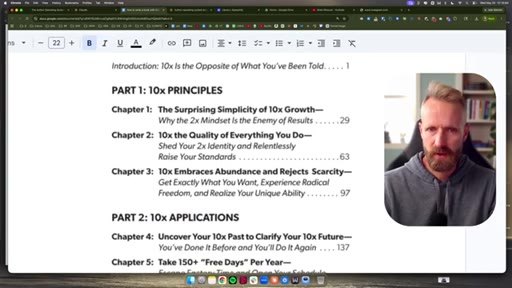
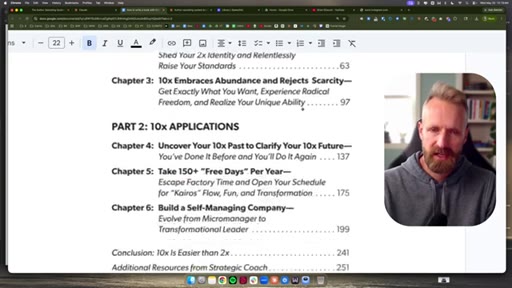
14:04Now I wanna show you a couple of outlines that work really well. This is the book 10 x is easier than two x by doctor Benjamin Hardy and Dan Sullivan. This is a fantastic
14:15book, and I just want you to look at how they structured this book. You've got an introduction up here, and then you've got part one principles,
14:25and this is where they talk about the principle of 10 x. Three chapters on that.
14:30And then part two is the applications. How do you actually apply it? How do you do it?
14:36So, basically, part one is how to think, and part two is what to do. It's six chapters with an introduction tacked on the front and a conclusion tacked on the end. Best selling book.
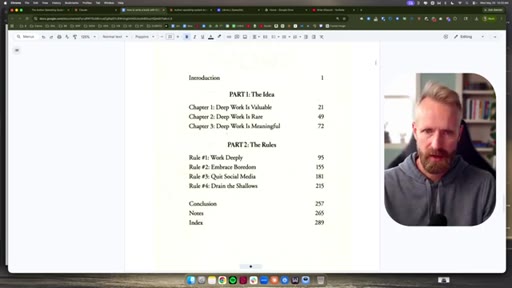
14:49Fantastic book. If you look at the book Deep Work by Cal Newport, again, it's the same framework.
14:55One of my favorite books. Introduction, part one is about the idea of deep work where they convince you on why it's so valuable to do and why it's meaningful and rare.
15:06I loved part one. By the time I got to part two, I was like, please tell me how to do deep work because I am sold on this concept. And then part two tells you the rules of deep work, how to actually do it.
15:18I mean, look at how clean this is. It's seven chapters with an introduction and a conclusion.
15:25This is what a great book looks like when the author takes the time to simplify the concept down to its essential components and remove anything else and combine any chapters that are kind of redundant to one another. This is not something that they likely got on the first try,
15:44but this is what you're aiming for with your first outline that you create. Alright.
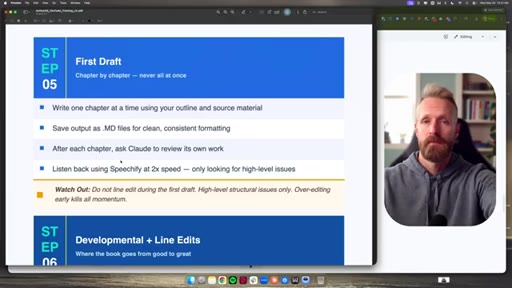
15:50Now we are on to step five, and this is where you're actually gonna start writing your book. So you've got all the prompts in there. You've got all of the raw material.
15:58You've got your writing style, which I don't think I mentioned this, but you wanna actually upload the writing style into that Claude project as a separate file so that it can always reference that as it writes your chapters. Chapters. Now what you do is you go into Claude and you have it draft the chapters one by one.
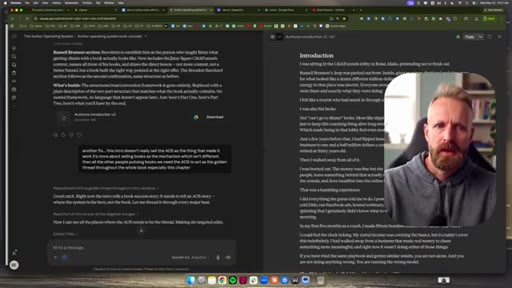
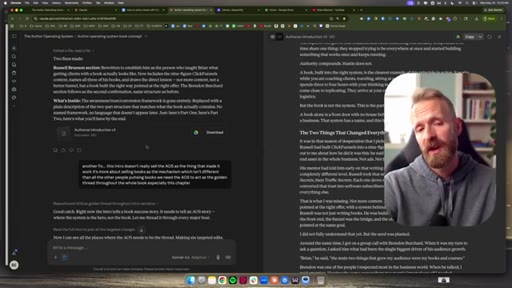
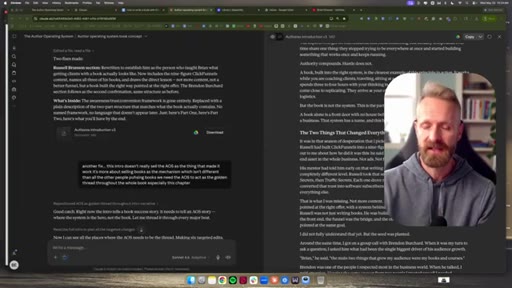
16:17And what you wanna do is have it create the chapters in MD files right in the chat thread. This makes it super easy because, like, for example, I've got the introduction to my book here. I can click on it, and I can see the introduction.
16:31And then if I want to change something about this, then I can tell it what to change. What it will do is actually update
16:40this MD file. So it's not just gonna generate a whole new introduction
16:47in the chat thread that I then have to, like, copy paste over to my Google Doc and all of that. That can get really messy, and you can't figure out where the old version and the new version is. These MD files are like living, breathing files in the chat thread.
17:03And at any point, as you're working with Claude, you can be like, just link me all the updated MD files, and it'll put all of these, like, in a stack, and then you can easily access the most updated version of each chapter. Another major, major tip
17:21that nobody knows about here in this phase, it's gonna sound simple, but it's a game changer. You wanna actually just ask Claude to review your work.
17:30So it writes a chapter. You say, now review your work. What it's gonna do is check what it wrote against all the prompts you gave it, against all the uploaded project material.
17:39It's gonna be like, oh, I found seven mistakes. There's redundancies. There's fabricated material in this chapter,
17:46and I put some em dashes in there, or I violated the writing style prompt. Would you like me to regenerate with fixes? And, of course, you say yes, and it updates that MD file right with the fixed version.
17:59That one step is gonna save you so much time. It's basically going back and editing its own work. A lot of people think AI
18:06is perfect, but it's actually not. It makes mistakes just like humans do.
18:12If you ask it to review its work, it will make your life so much easier. Now once you've drafted every single chapter of your book and you've asked Claude to review the work, you've got all the updated MD files,
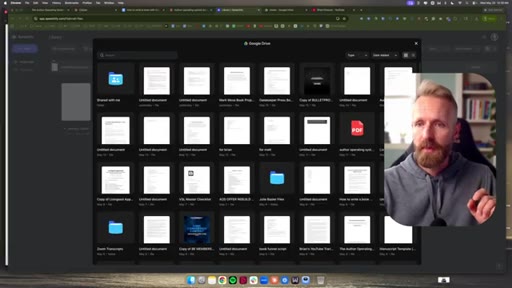
18:25what I do is I copy them over onto a Google Doc. You don't have to worry about formatting or anything. Just literally just copy paste it.
18:33It can be all on one page. Just make sure it's in order. Because what we're gonna do now is we're gonna move to step six,
18:40which is where we do the developmental edit and then the line edits. This is where we take your book from just being kinda good to great. And there's a fair amount of work involved in this step,
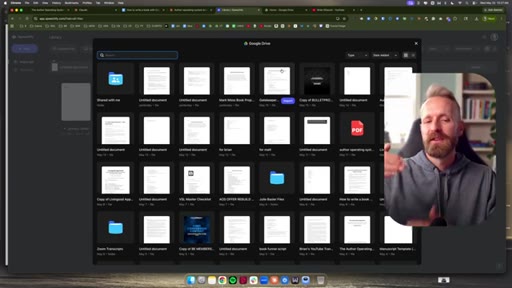
18:52and this is where the magic happens. Now here's a really cool tip that I like to do. Once I have all the chapters pasted onto a Google Doc, I take it over to this tool called Speechify.
19:04I will put a link down in the comments so you can try this thing out. There is, like, a price you have to pay after, like, the three day trial or whatever. But
19:14what you can do here is you can drop a Google Doc right into Speechify, and then you can listen to it.
19:23And it narrates it, and there's, like, really good narrators. I mean, they're AI narrators, but really cool voices that read it in, like, a storytelling kind of vibe.
19:33You can even have Snoop Dogg read your book if you want to. I'm a big hip hop fan, but I have not yet tried that. Uh, I just don't know if the genre quite matches,
19:43but, like, there's all these celebrity voices on there. And the reason why I use Speechify is because
19:50when I do that first draft of my book with Claude, it's not ready for a granular edit. Okay?
19:57So I will just listen to it at, like, one and a half times speed while I'm walking my dog. Maybe that takes me three or four hours to get through it.
20:07All the while, I'm just creating voice memos on my iPhone where I'm, like, saying all the things that I wanna change that I don't like about it. And then I upload those files
20:20to Claude so that it knows what to fix. So, again, the big picture idea here is we're doing a high level tour of the book, and we're slicing and dicing
20:32at a broad level. This is a developmental edit, but it's even, like, faster and higher level. One thing that we have to rewire our brains
20:42to when we learn to write books with AI is to not get granular too soon. That is how you'll get in the weeds, and you'll end up with a book that's just on a Google Doc, and you'll kinda give up because you've been wrestling with it for too long, you can't get it quite right, and it's frustrating.
20:59You're probably trying to get too close to it too soon. You literally just wanna, like, speed through it on audio a time or two, voice note feedback to Claude,
21:09and have it draft a second draft. Okay?
21:13And then I would do that again. At some point, your intuition's gonna tell you this book is really close.
21:20Like, it only needs some finishing touches. And so then you can transition out of this, like, big picture developmental
21:28edit into a line edit, and that's when I would actually go on to Google Doc, and I would use a tool like Grammarly to help me go through and fix all the more add a comma here,
21:42fixed grammatical stuff, that kind of thing. So to be clear, when you're in step six and you're drafting the book and you're reviewing it and drafting it again and reviewing it, there's a couple things that are gonna happen. One is it's very normal for you to restructure your book outline at this phase.
21:58You'll add chapters. You'll combine chapters. You'll delete chapters.
22:02That even happens if you were to work with Penguin Random House and their developmental editors. They often take a wrecking ball to the original outline and create a new one at this phase because now they can really see what's there. They can see the book at a much closer level,
22:19and so expect that to happen to some degree. And then the second thing is you really just stay in this phase where you're developmental editing the book in step six, and then you're going back to step five, and you're drafting another version.
22:35And then you're going to step six, doing developmental edit, going back to step five, drafting another version until
22:43you get to the point where it feels 90% there, and you're like, I don't need to see what's there anymore. It's all there. I just wanna shift to putting the polish on this thing.
22:54And that's when you read it word for word. You could even print it out and read it and mark it up with a pencil or whatever, and you go through it at a granular level of detail.
23:05Most people over edit too soon, so don't make that mistake until you feel like it's almost there.
23:12Alright. Congratulations to making it to step seven.
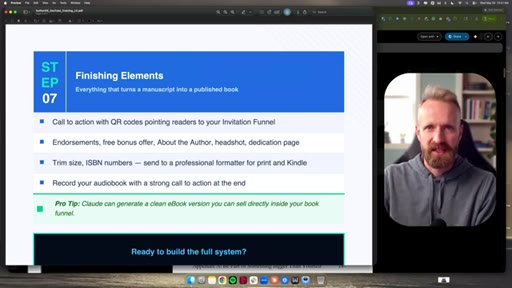
23:15This is the final step of the book where we wanna add all the finishing elements. We wanna have a call to action in your book where we invite them to take the next step to working with you, whatever that might look like, a little description, and QR code. I put that at the beginning and at the end and maybe even somewhere in the middle.
23:34I'd also have a free bonus in the book so that you can get the Amazon buyers and the Audible listeners, which you can attach a PDF to Audible with a QR code if you didn't know. You wanna get those people
23:47into your ecosystem, get their information so you can email them or text them or whatever and follow-up with them and send them into whatever it is that you want to sell. And by the way, Claude can actually generate a decent ebook version of your book
24:01so that you can have a digital copy to later sell in your book funnel. You're also gonna create an about the author page, just a little bio. You're gonna have a headshot.
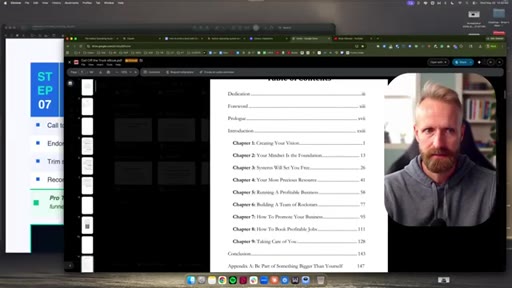
24:10You might write a dedication. You may reach out and get some endorsements like my client David Mormon did so that you can put them at the beginning of your book like this. This is what his endorsement page looks like.
24:22This is what his QR code page looks like. You just wanna have this stuff because this is how you turn a book into something that actually acts as an engine getting more customers and clients.
24:34You're gonna need to decide on a trim size for your book. I like five and a half by eight and a half. You can grab some books off your bookshelf and a little tape measure and decide what size feels right to you.
24:45CTAYou're gonna purchase your ISBN numbers. It's like the identifier for your book, and then you send that off to a professional formatter to format it for print and Kindle.
24:56CTAAnd then lastly, you're going to want to shift to recording your audiobook. I made a whole video on exactly how I record audiobooks,
25:06CTAwhich you can check out right here. So that's it. The seven steps to write a great book with Claude in 2026.
25:13CTAGo out there. Use this to crush it. Write a book that's gonna change the world and get more customers and clients for your business.
25:19CTAI appreciate you being here, and I will see you in the
— full transcript
§ 05 · For Joe

The one prompt most creators skip.

Claude writing playbook

After every chapter, ask Claude to review its own work - it finds fabrications, style drift, and em-dashes before they compound across a full manuscript.

  • Use a Claude Project as the single source of truth - upload everything you have ever said or written on your topic before writing word one.
  • Build a personal inventory of hobbies, stories, and quirks and stuff it into the Project so Claude can weave your brand into every analogy.
  • Generate 3 writing style versions from your real speech samples, iterate challenger vs. champion, stop at 80% - editing finishes the rest.
  • Save chapters as MD files in the chat thread; they update in place rather than spawning new copy-paste blocks.
  • Never line-edit until the book is 90% structurally sound - Speechify audio review at 1.5x is the fastest way to catch macro problems.
  • The 7-step structure maps cleanly onto a Killing Excuses episode or LFB breakdown for content.
§ 05 · For You

What this means if you want to write a book.

For the aspiring author

The bottleneck in AI book-writing is not the writing - it is the raw material you feed Claude before you start.

  • Before prompting Claude to write anything, gather every piece of content you have ever created on your topic: transcripts, emails, course recordings, social posts.
  • Ask Claude what is still missing for a complete book and fill those gaps before writing a single chapter.
  • Write one chapter at a time, then immediately ask Claude to review it - this one habit catches most problems that make AI books feel generic.
  • Listen to your draft on Speechify at 1.5x speed before editing; structural problems are easier to hear than to see.
  • Do not polish individual sentences until the whole manuscript feels right - over-editing too early is the most common reason people abandon their book mid-draft.
§ 06 · Frame Gallery

Visual moments.