The bait, then the rug-pull.
Cole Gordon opens with the pattern interrupt that powers every great business essay — that guy's a complete idiot, how the hell did he pull that off? — then drops the thesis at the 60-second mark: 80% of business success comes down to your offer. The next 59 minutes are the most practical and advanced takedown of offer engineering on YouTube right now, framed as a private-client training spliced into podcast format.
What the video promised.
stated at 01:30 "I'm gonna splice to a dense training I did for some private clients talking about everything I know about how to engineer offers that go absolutely nuclear and just print money." delivered at 59:20
Where the time goes.
01 · Cold open + thesis
Pattern interrupt — 'how did that idiot scale to 9 figures?' — into the thesis: 80% of business success comes from your offer. Cole stacks proof ($30M+ own company, 3,000+ consulted) and ladders into the promise: pricing power, cost curve, ad conversion, sales conversion, LTV/CAC.
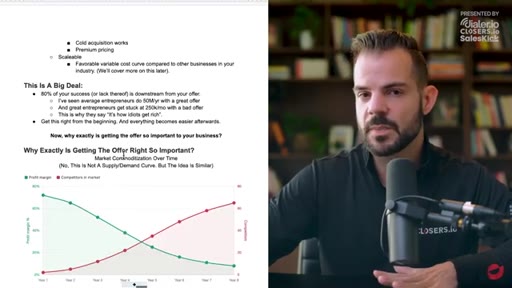
02 · What is an offer + the 3 components
Definition: what you sell + how you communicate it (positioning) + the terms. A good offer has packaging, economics, and scalability. Mediocre operators with banger offers blow past world-class operators with bad offers.
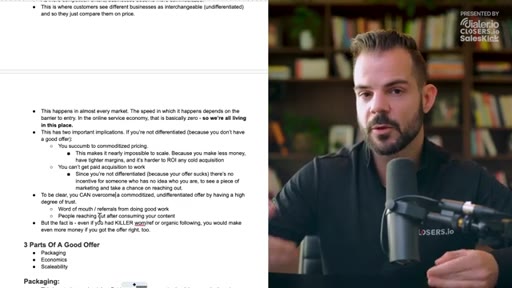
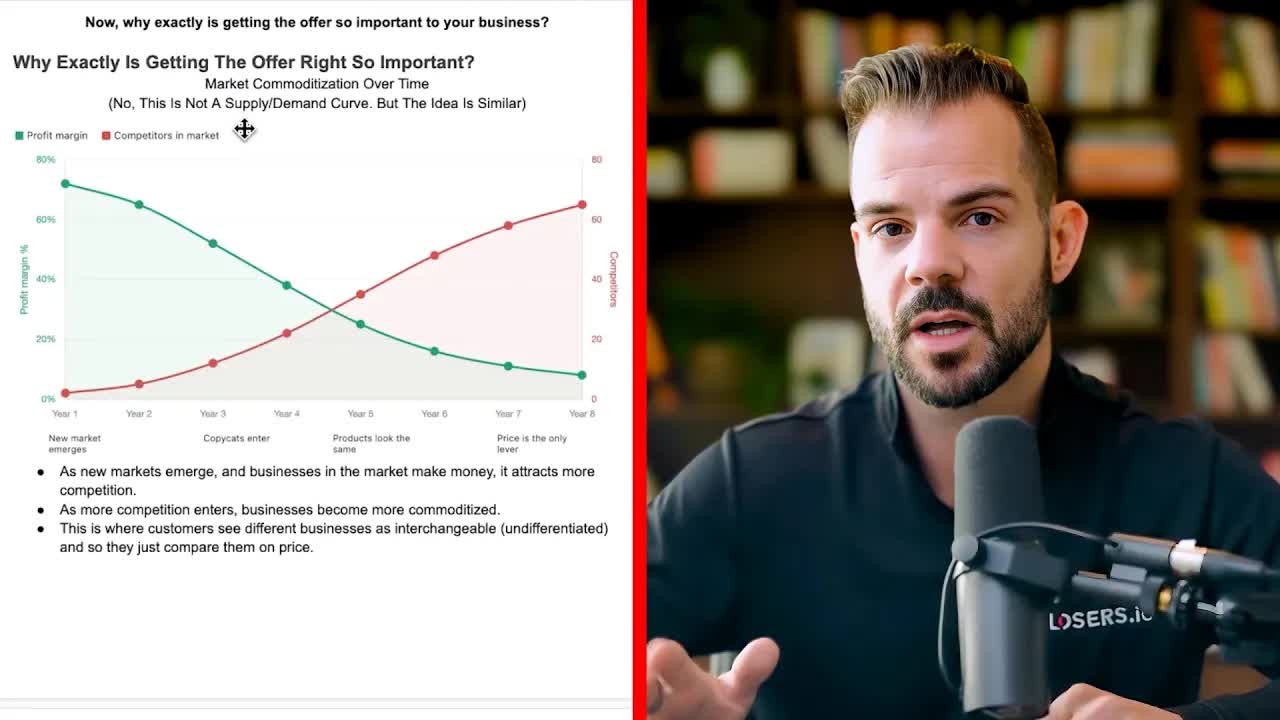
03 · Market commoditization curve
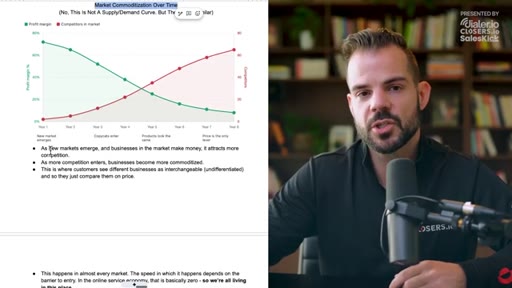
Every market commoditizes over time — barrier to entry sets the speed. Online services, AI, even SaaS are all in the commoditized zone. A good offer is the antidote. Trust (referrals + content) overcomes a bad offer but masks the underlying problem.
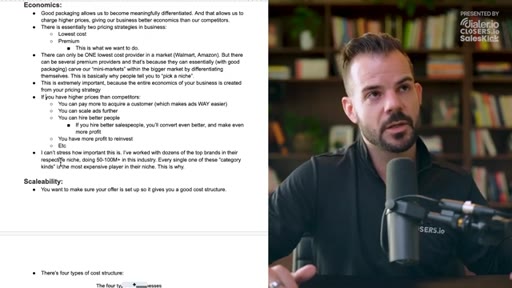
04 · Packaging, economics, scalability
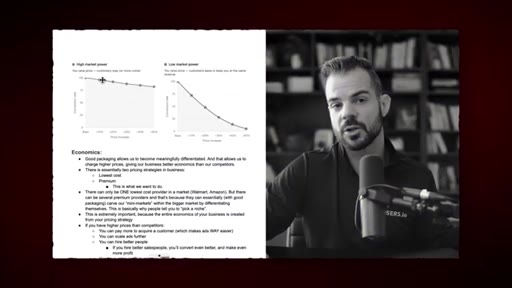
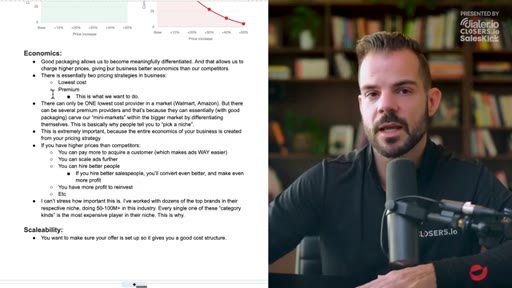
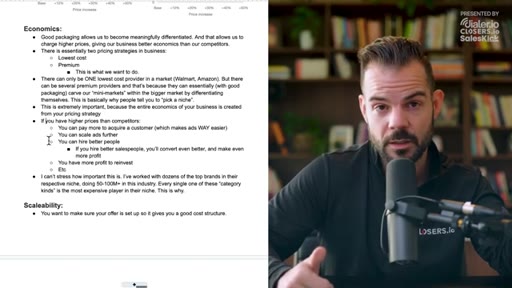
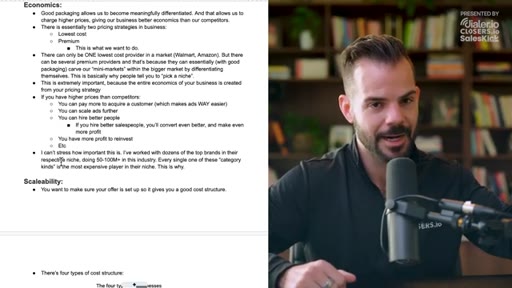
Packaging = how you communicate, drives differentiation and market power. Economics = pricing strategy (lowest cost OR premium — there's only one lowest, but many premiums). Cole: every top-dog in every niche he works with is the most expensive. All business strategy is pricing strategy.
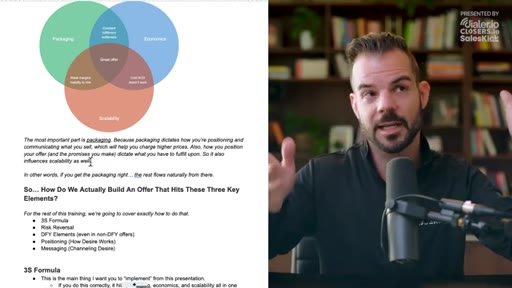
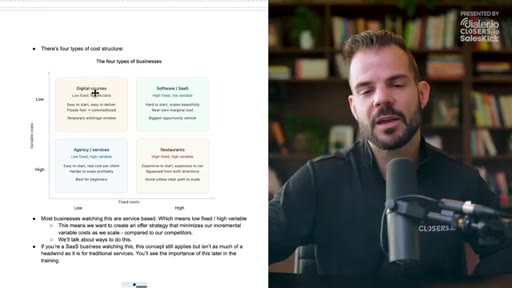
05 · The 4 cost structures
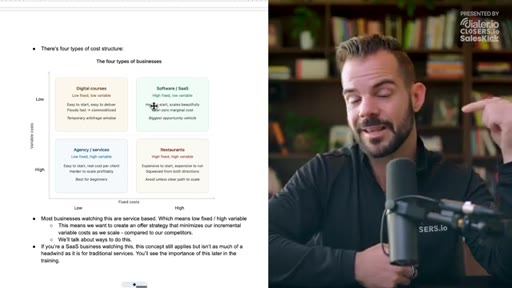
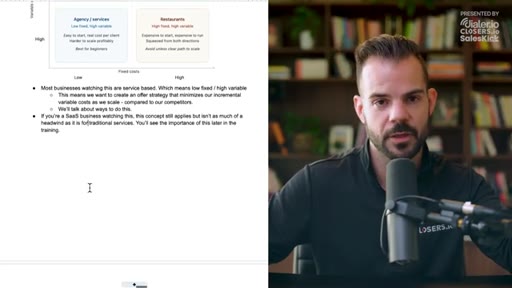
Low-fixed/high-variable = services (easy to start, hard to scale). High-fixed/low-variable = SaaS (huge leverage). Low-fixed/low-variable = digital courses (temporary arbitrage, commoditizes instantly). High-fixed/high-variable = restaurants (death). Most viewers are in services — design for low incremental cost at scale.
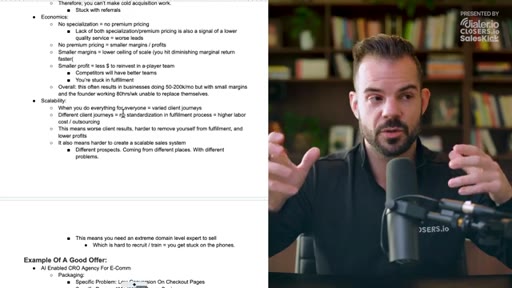
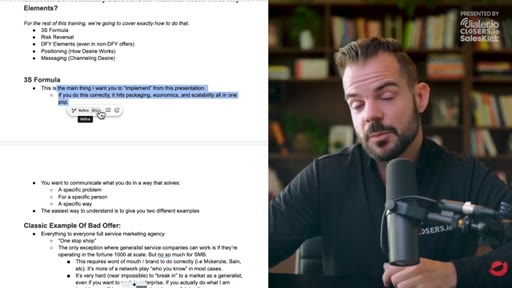
06 · The Three S Formula (introduced)
The big-daddy framework. Solve a SPECIFIC problem for a SPECIFIC person in a SPECIFIC way. Hits packaging, economics, and scalability in one stroke.
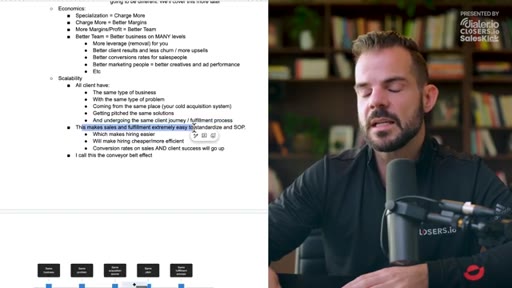
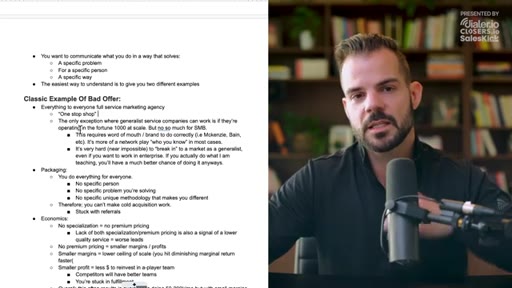
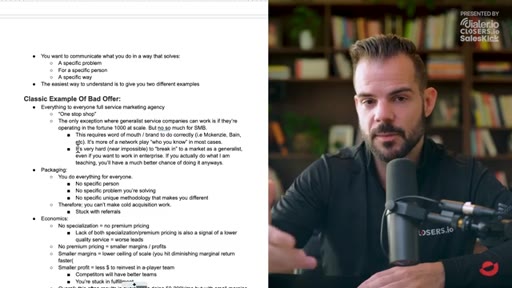
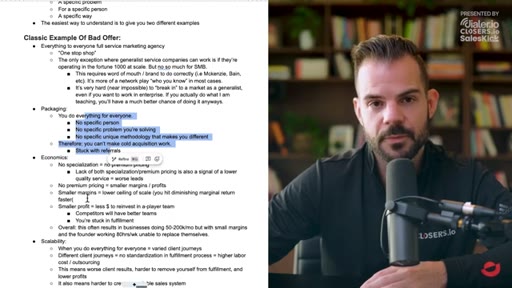
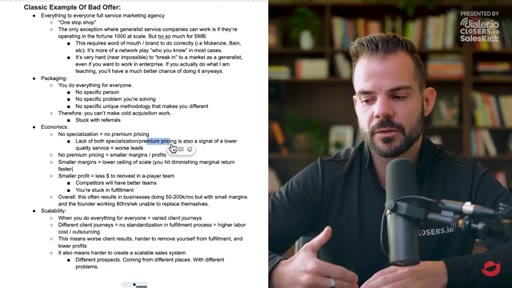
07 · Bad offer worked example (agency)
'Everything to everybody' full-service marketing agency = no specialization, no premium pricing, varied client journeys, no SOPs, stuck at $20-100k/mo working 80hr weeks. Gets nailed on all three components.
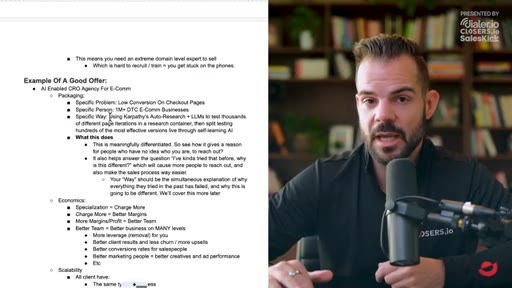
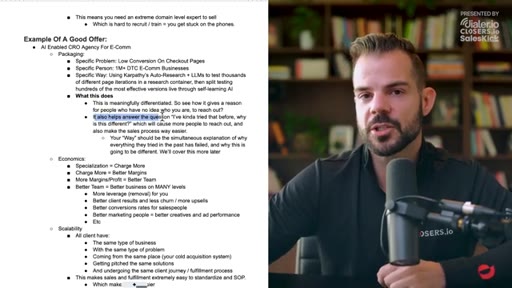
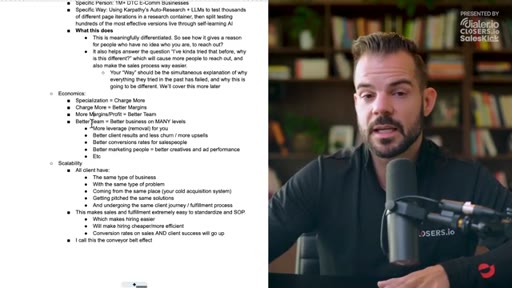
08 · Good offer worked example (CRO)
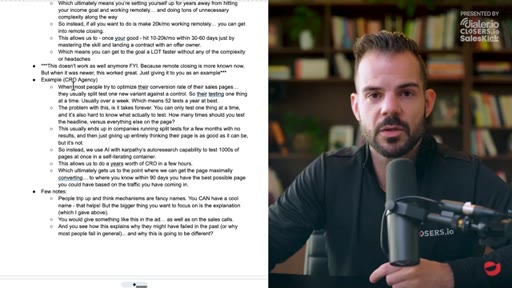
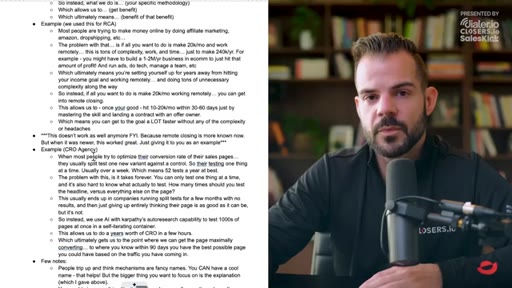
AI-enabled CRO agency for e-com: specific problem (low checkout conversion), specific person ($1M+ DTC), specific way (Karpathy auto-research + LLMs split-testing). Higher prices → better team → better results → flywheel.
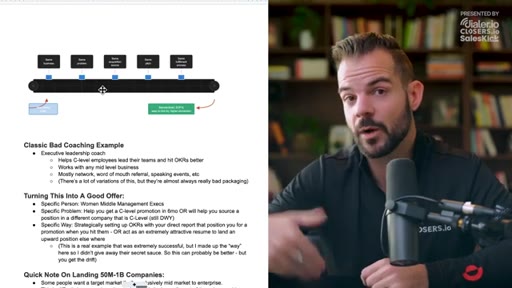
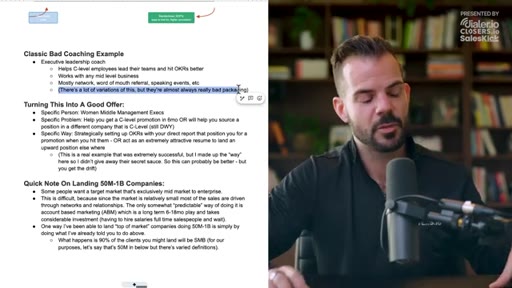
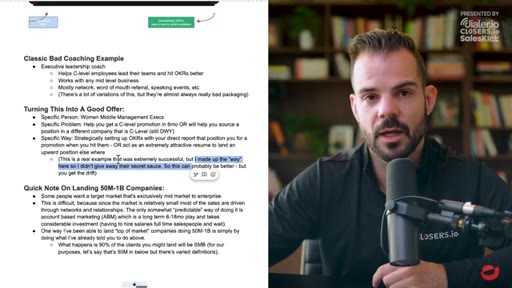
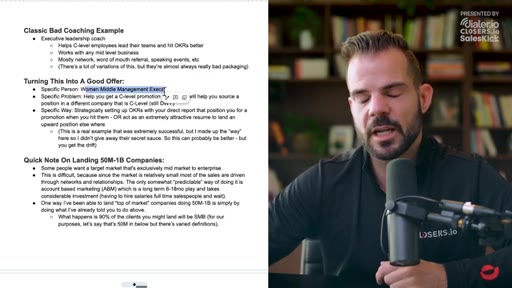
09 · Bad → good coaching example
Bad: 'executive leadership coach' helping C-levels with OKRs. Good: same client repositioned to 'women in middle management → C-level promotions in 6 months.' Specific person + specific problem + specific way (strategic OKRs with direct report).
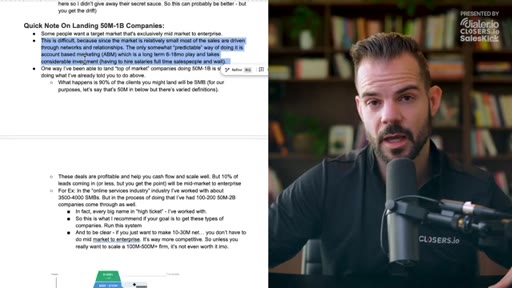
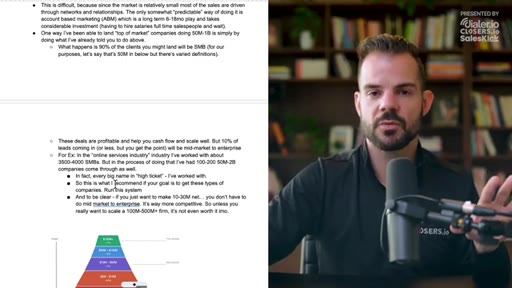
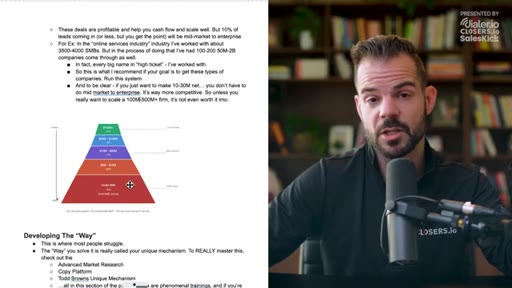
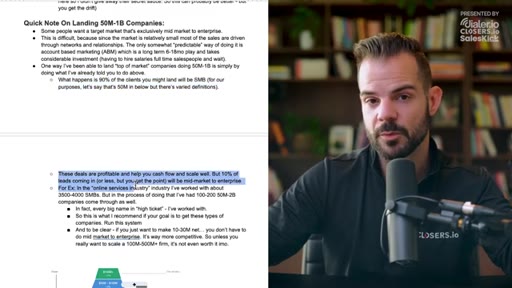
10 · Note on landing $50M–$1B+ companies
Enterprise sales = ABM = capital intensive + 6-18 month sales cycles. Instead: use the 3S formula on SMB, let the 5-10% enterprise leads come through organically as your case studies + referrals compound.
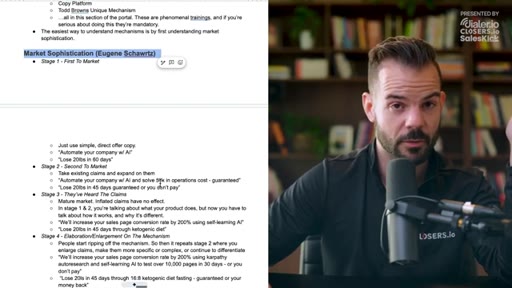
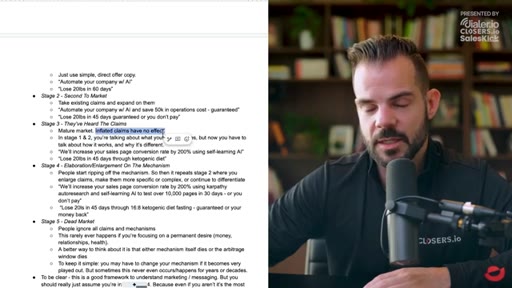
11 · Market sophistication (Eugene Schwartz)
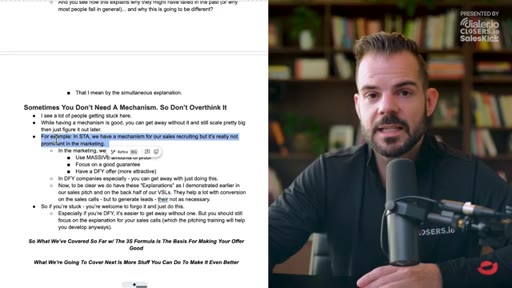
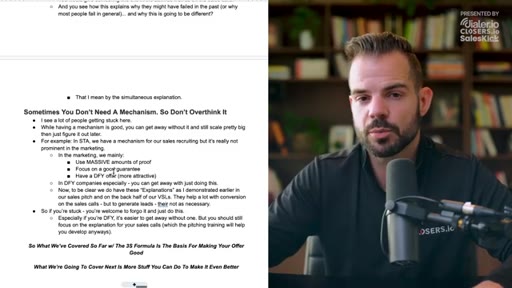
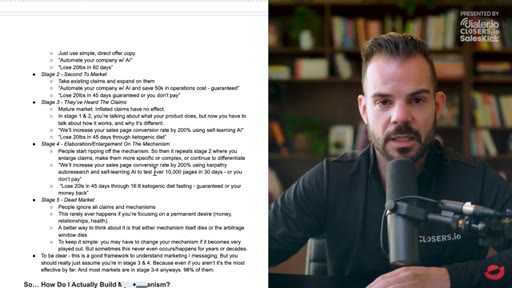
5 stages: first-to-market → expanded claims → mechanism → enlarged mechanism → dead market. Cole's hack: just assume you're in stage 3/4 and lead with a mechanism regardless. Permanent desires (money, relationships, health) rarely fully die.
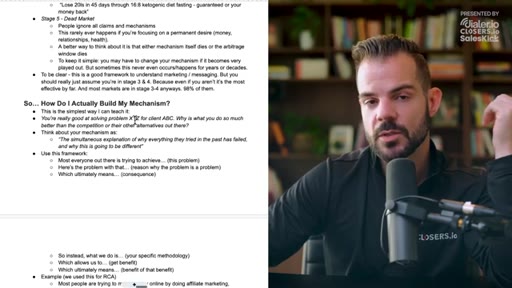
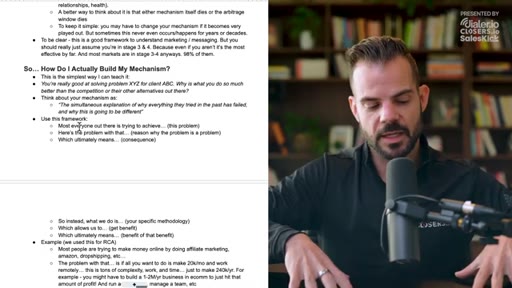
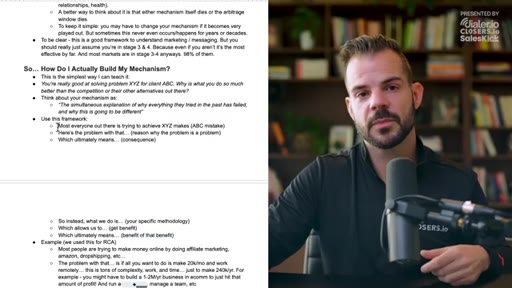
12 · The Mechanism Framework
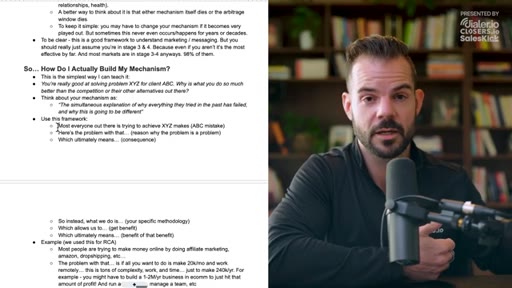
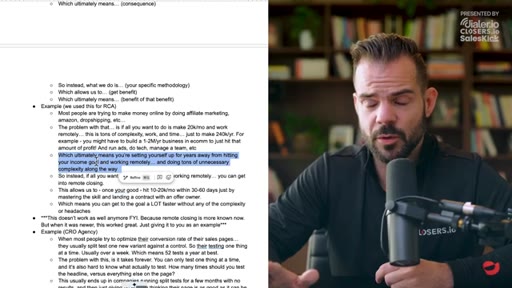
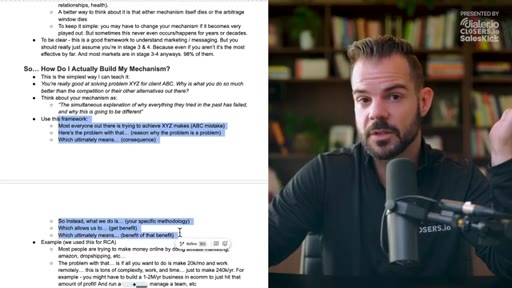
The script: 'Most people trying to achieve X make mistake Y. The problem with that is Z. So instead, what we do is [methodology], which allows [benefit] and ultimately [benefit of the benefit].' Worked live for media-buying vs offer engineering, and for RCA (affiliate marketing vs remote closing).
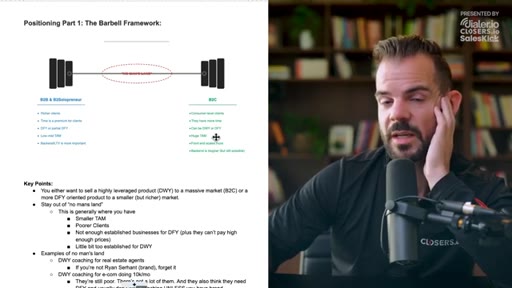
13 · The Barbell Framework
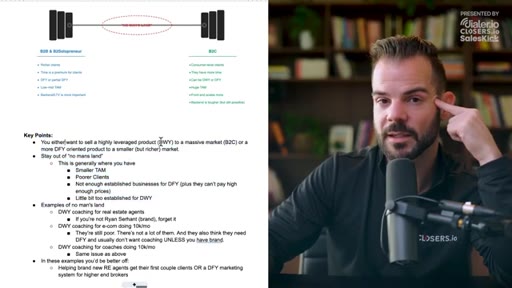
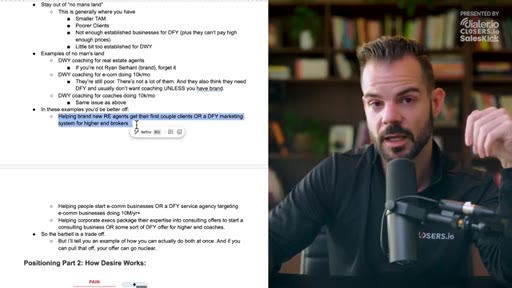
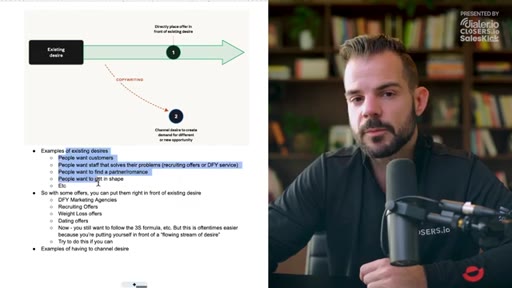
Sell highly-leveraged done-with-you to mass B2C, OR done-for-you to smaller-richer B2B/solopreneur. Stay OUT of no-man's-land (e.g. done-with-you coaching for $10k/mo coaches — broke, small TAM, wrong product type). Real-world: done-with-you for new coaches, OR done-for-you for $1M+ coaches.
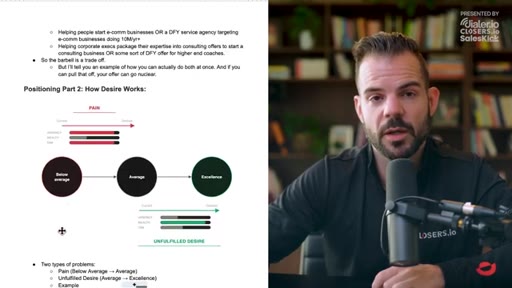
14 · Pain vs Unfulfilled Desire
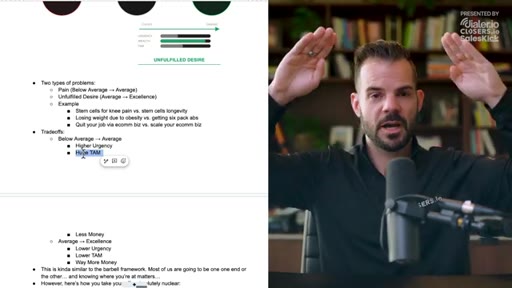
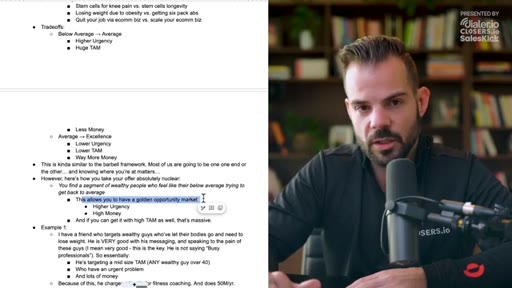
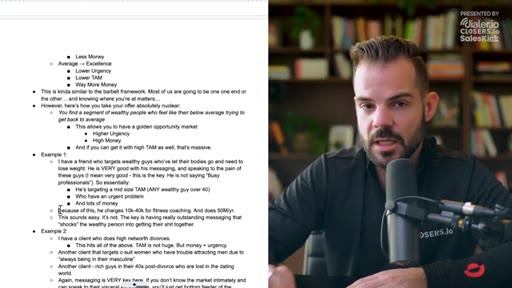
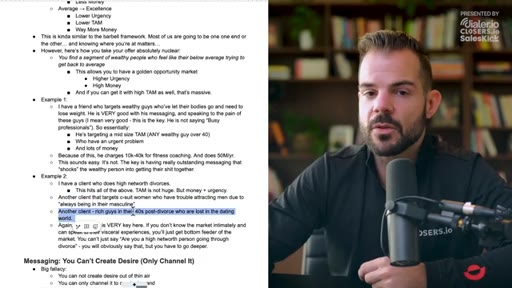
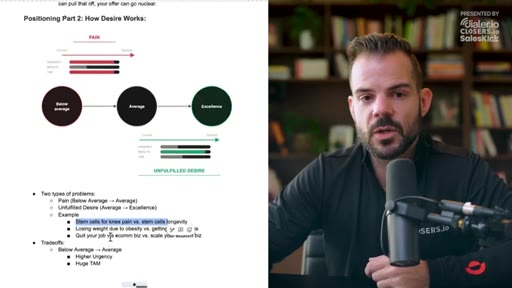
Below-average→average: high urgency, big TAM, less money. Average→excellence: low urgency, small TAM, more money. Golden quadrant: WEALTHY people who feel below-average trying to get back to average — high net worth divorce, wealthy guys who let bodies go, c-suite women in their masculine.
15 · Channeling desire (not creating it)
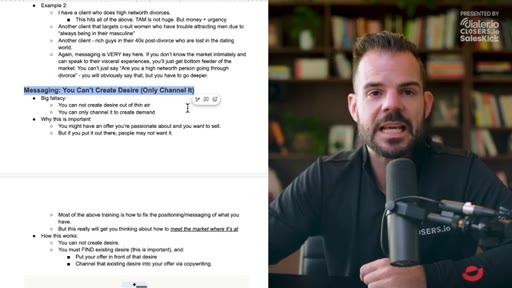
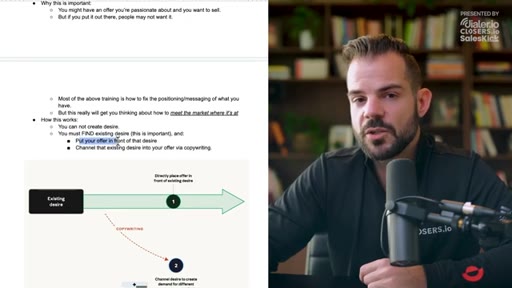
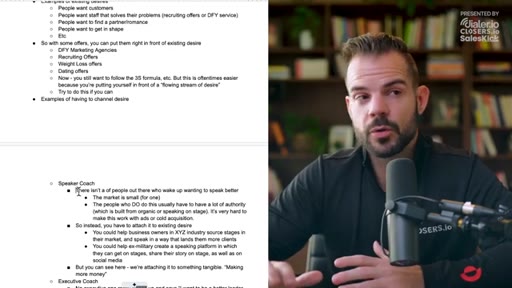
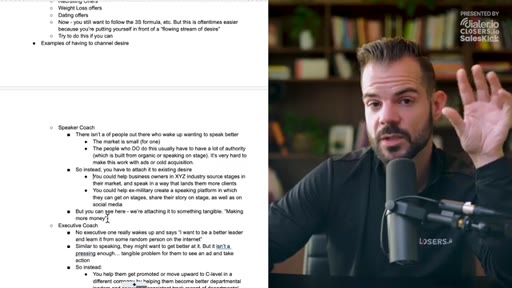
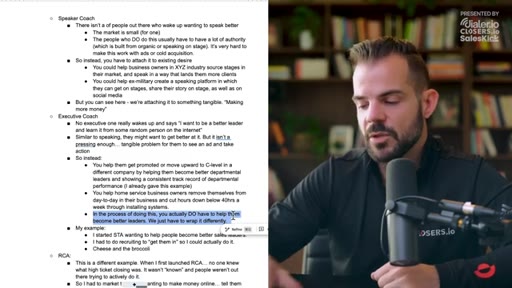
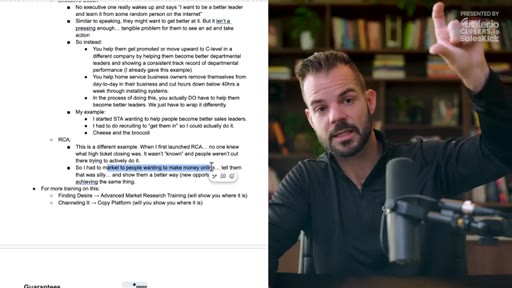
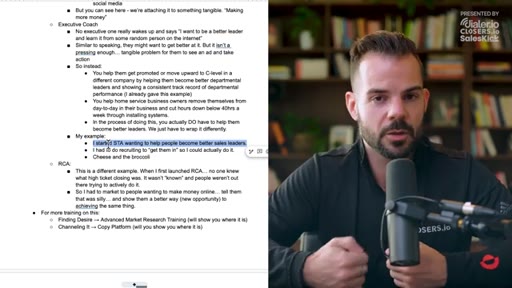
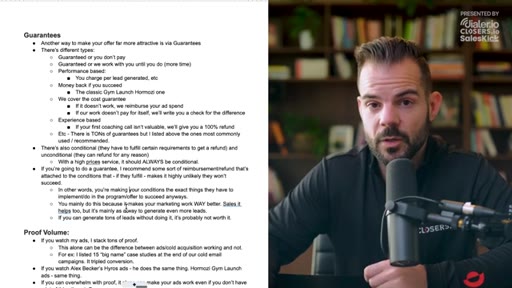
You cannot create desire — only channel existing desire into your offer. Speaker coach → 'speak to land clients.' Executive coach → 'get promoted to C-level.' Cole's own SDA: started wanting to help people be better sales leaders → had to wrap it in 'we place a rep for you' (cheese) to deliver the leadership coaching (broccoli).
16 · Guarantees + Proof Volume
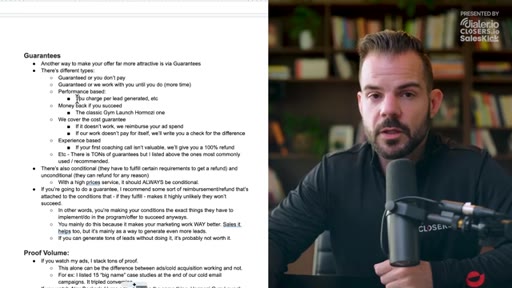
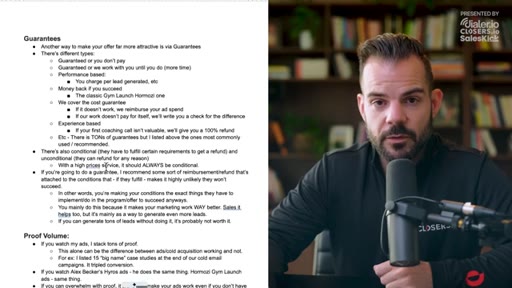
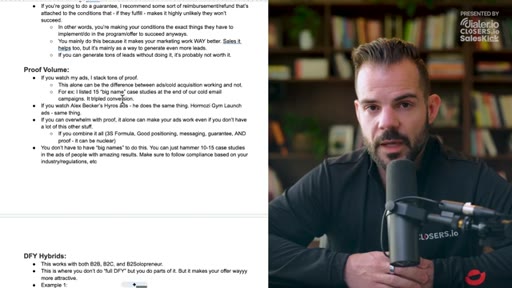
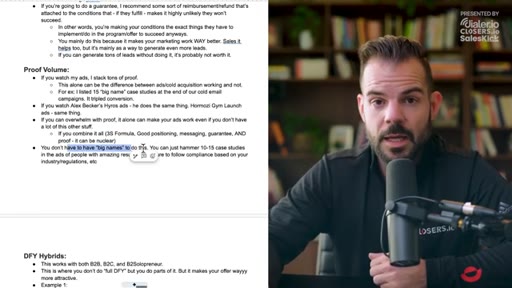
Guarantee types: or-you-don't-pay, performance-based, money-back-if-you-succeed (Gym Launch), we-cover-cost. Conditions = the actions that, if done, make success near-certain. Proof Volume: stacking 15 case studies at bottom of cold email tripled Cole's response rate.
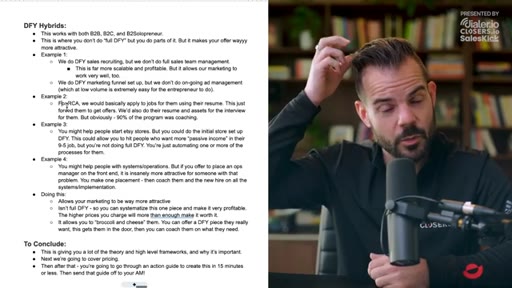
17 · Done-For-You Hybrids + close
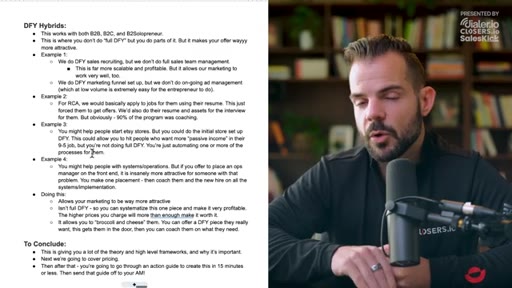
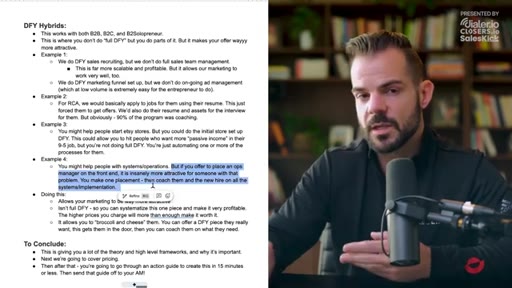
Don't do full DFY — too unscalable. Do part of it (the setup, the placement, the systems setup) DFY and consult/coach the rest. Closer: 'I'll send the action guide and study guide.'
Visual structure at a glance.
Named ideas worth stealing.
The 3 Components of a Good Offer
- Packaging
- Economics
- Scalability
Packaging = how you communicate what you do (drives differentiation + market power). Economics = pricing strategy (lowest-cost OR premium). Scalability = cost structure that smooths the cost curve at volume.
The Three S Formula
- Specific problem
- Specific person
- Specific way
The headline framework. Communicate what you do in a way that solves a specific problem for a specific person in a specific way. Hits packaging + economics + scalability in one stroke and produces the conveyor-belt effect downstream.
The 4 Cost Structures
- Low fixed + High variable — services (easy start, painful scale)
- High fixed + Low variable — SaaS (huge leverage)
- Low fixed + Low variable — digital courses (commoditizes instantly)
- High fixed + High variable — restaurants (death)
Most service businesses are in quadrant 1 — design your offer to smooth the cost curve so each marginal client doesn't require a marginal hire.
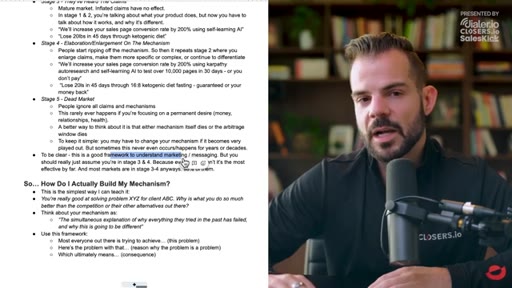
Eugene Schwartz's 5 Stages of Market Sophistication
- Stage 1: First to market — simple direct copy ('Automate your company with AI')
- Stage 2: Expanded claims ('...and save $50k in ops costs guaranteed')
- Stage 3: Mechanism ('...using Karpathy self-learning AI auto-research')
- Stage 4: Enlarged mechanism (claims inflated again)
- Stage 5: Dead market (rare in permanent-desire categories)
Cole's hack: just assume you're in stage 3/4 and lead with a mechanism regardless. Works even in less-mature markets.
The Mechanism Framework
- Most people trying to achieve X make mistake Y
- The problem with that is Z (consequence)
- So instead, what we do is [methodology]
- Which allows [benefit]
- And ultimately [benefit of the benefit]
Simultaneous explanation of why everything they tried in the past failed and why this is going to be different. Cole demos it live, ad-libbing it for both his current biz and a past one (RCA).
The Barbell Framework
- Left bell: Done-for-you to smaller/richer B2B/solopreneur (premium pricing, LTV-heavy)
- Right bell: Done-with-you to mass B2C (huge TAM, front-end-heavy)
- Middle: NO MAN'S LAND — done-with-you for poor markets that need DFY but can't pay (e.g. $10k/mo coaches)
Pick a side. Stay out of the middle. Real positioning errors live in the middle — the 'help $10k/mo coaches get to $50k' offer is a classic trap.
Pain vs Unfulfilled Desire (Positioning Part 2)
- Below-average → Average: pain. Higher urgency (loss aversion), bigger TAM, less money
- Average → Excellence: unfulfilled desire. Lower urgency, smaller TAM, more money
- Golden quadrant: wealthy people who feel below-average trying to get back to average (high urgency + high money)
Examples: wealthy guys who let their bodies go ($10–40k personal training, $50M/yr biz). High-net-worth divorce. C-suite women trapped in masculine. Rich post-divorce 40s guys lost dating. Hard to execute — requires visceral, agitated messaging.
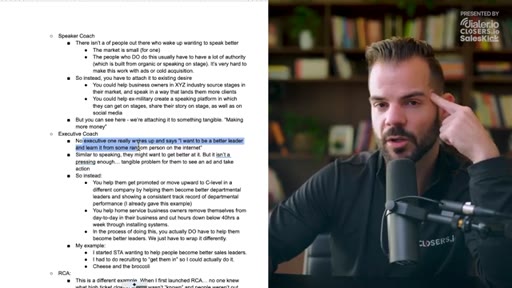
Channeling Desire (not Creating)
You cannot create desire — only channel existing desire (money, relationships, health) into your offer. The 'cheese and broccoli' approach: cheese = the existing-desire wrapper, broccoli = the actual transformation. Cole's SDA started as 'be a better sales leader' (broccoli) but had to wrap in 'we place a rep for you' (cheese).
Guarantee Types
- Guaranteed-or-you-don't-pay
- Guaranteed-or-we-work-with-you-until-you-do
- Performance-based (per lead, per result)
- Money-back-IF-you-succeed (Gym Launch — completed challenge → refund)
- We-cover-the-cost (reimburse ad spend if it doesn't pay for itself)
- Experience-based (first call not valuable → 100% refund)
Conditions = the actions that, if executed, make success near-certain. Real purpose = marketing differentiation, not sales-call closing.
Done-For-You Hybrids
Don't do full DFY (unscalable). Do PART of it DFY — the setup, the placement, the initial system — and consult/coach the rest. Marketing-attractive AND profitable.
Lines you could clip.
"80% of the success or failure in your business comes down to one single thing — and that thing is your offer. Not your funnel, not your team, not your work ethic. Offer."
"There's a saying about offers, which is: it's how idiots get rich. Because there's so much leverage in having the right offer."
"Solve a specific problem for a specific person in a specific way."
"All business strategy is pricing strategy."
"If you're truly everything to everybody, you're nobody to anybody."
"Your mechanism is a simultaneous explanation of why everything they tried in the past has failed and why this is going to be different."
"If you can find a segment of wealthy people who feel like they're below average trying to get to average — you can absolutely destroy."
"You cannot create desire. You can only channel it."
"The broccoli is the leadership — but the cheese is whatever you need to do to get them in."
How they spent the runtime.
- 31:20 – 33:00 · Saleskick (own sponsor — booking/calendar system for sales teams)
- 51:50 – 53:10 · Closers.io (own offer — marketing system install + sales team placement)
Things they pointed at.
How they asked for the click.
"If you want to work more personally with either me or my team, we can help you in two different ways. Number one, we can help you install a marketing system so you can generate more leads and ultimately scale the revenue of your business. Or b, we can help you with your sales team by placing setters or closers in your business. And if they don't perform, you don't pay."
Soft, mid-video CTA at the 51:50 mark, after the heaviest value-delivery section (mechanism + barbell). 'If they don't perform, you don't pay' is a baked-in guarantee inside the CTA itself — the strongest version of this pattern.
Word for word.
Steal the offer-engineering stack.
If 80% of business outcome is the offer, every framework Cole names in this video is a leverage point for Joe's product portfolio — not just MCN, but JoeFlow, Mod Boss, MCN+, and the $6 Stack positioning itself.
- Run every Joe product through the Three S Formula. Write down the specific person, specific problem, specific way for JoeFlow, Mod Boss, MCN+. If you can't fill all three slots tightly, the positioning is the problem — not the product.
- Apply the Mechanism Framework verbatim to the next VSL/ad script. 'Most creators trying to own their stack get sold yet another SaaS — the problem with that is rent compounds — so instead, we install the $6 Stack...'
- Place every product on the Barbell. JoeFlow $49–99 = right-bell (mass B2C, done-with-you). MCN+ membership = left-bell (DFY-leaning toolkit, smaller-richer creators). Kill any 'mid-tier for $10k/mo coaches' style offer in the roadmap — it's no-man's-land.
- Find Joe's 'wealthy people who feel below-average' quadrant. Strong candidate: 6/7-figure operators who feel out-coded by AI-native solos. High urgency, high money, mid-sized TAM — perfect MCN+ avatar.
- Wrap every transformation offer in cheese-and-broccoli. Cheese = the existing desire (more revenue, less SaaS spend, more time). Broccoli = the actual stack/skill transfer. Lead with cheese.
- Build a Proof Volume page. 15+ named case studies / testimonials in one place. Use it as the bottom block of every cold outreach.
- Pick a single guarantee type and bake it into a sales asset this week. 'Install the $6 Stack with us, and if it costs you more than $30 the first 3 months, we'll refund the install' is the kind of we-cover-the-cost guarantee Cole describes — and it's a marketing differentiator more than a sales one.
What this means if you're starting or stuck.
If you've been blaming your funnel, your team, or your effort — Cole's argument is you're probably mislabeling the problem. The fix is usually upstream of all of those.
- Write your current offer in one sentence. Test it against the Three S Formula: specific problem, specific person, specific way. If two of the three are vague, you have an offer problem, not a sales problem.
- Stop competing on price. Pick the most expensive sustainable price your category supports and engineer everything else to justify it — better team, better results, better marketing.
- Look at every offer you've ever made. Is it 'below-average → average' (pain-driven, urgent) or 'average → excellence' (aspiration, slow)? Knowing which one tells you whether to lead with loss-aversion language or with status language.
- If you're stuck around $20–100k/mo working 80 hours a week, you're almost certainly in 'everything to everybody' territory. Pick one specific person and one specific problem and rewrite the offer page tonight.
- Read Hormozi's $100M Offers AND Schwartz's Breakthrough Advertising. Cole names both as the upstream reading for this framework.