The bait, then the rug-pull.
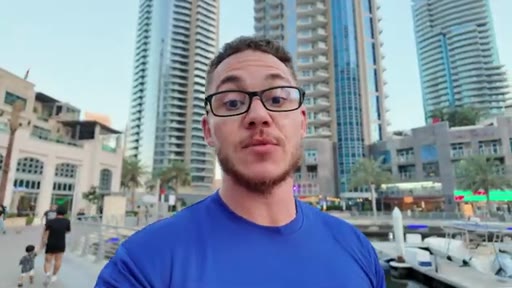
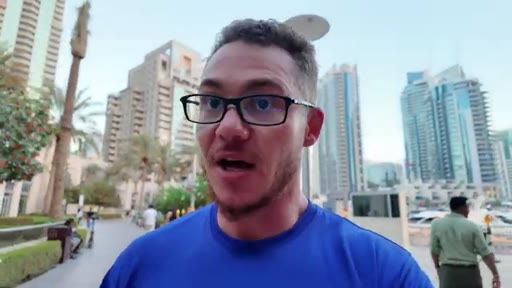
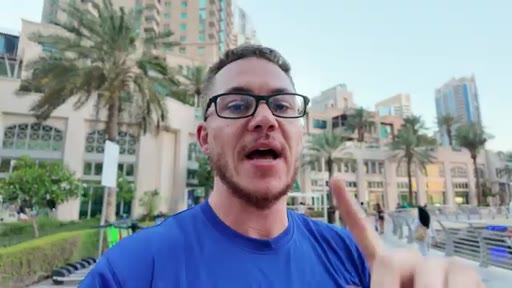
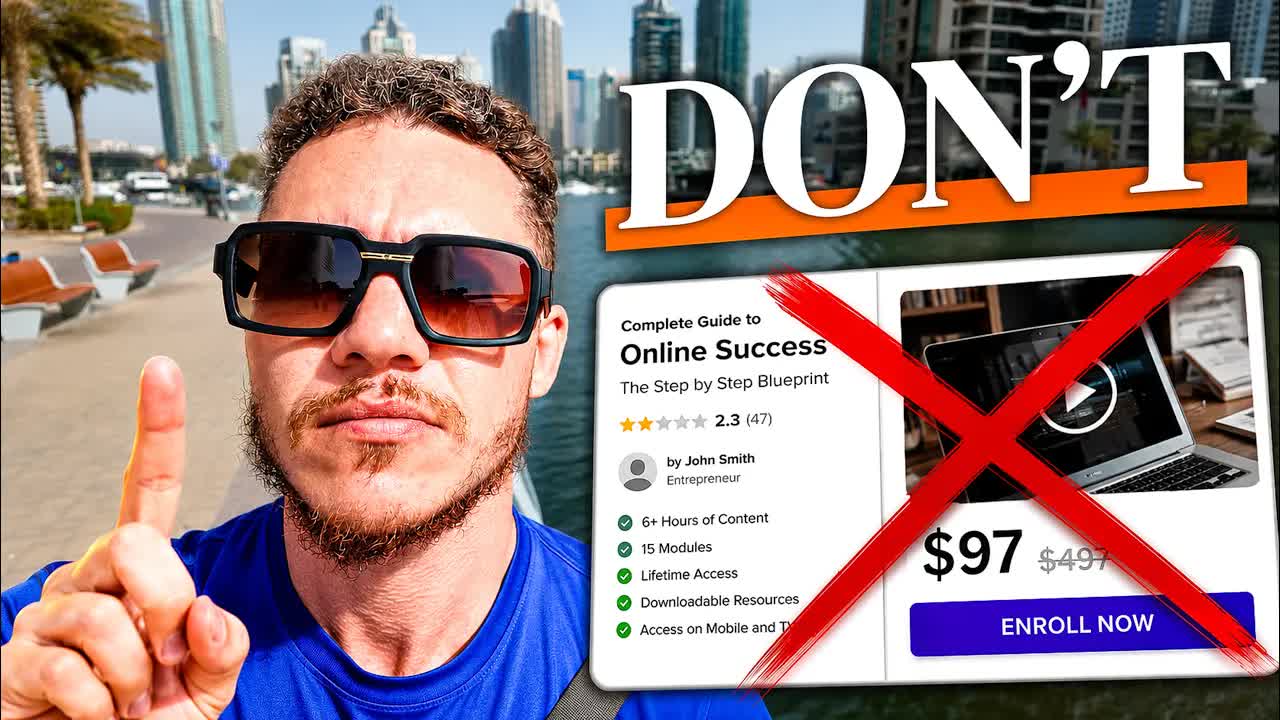
Dan Henry opens mid-stride on a Dubai waterfront promenade with four words and no setup: Stop launching $97 courses. Forty million dollars in personal digital product sales earns him the authority to say it. What follows is a tight economics lesson that reframes the entire cheap-course business model as a structural trap and hands you the escape hatch before the video ends.
What the video promised.
stated at 00:09 "In this video Im gonna show you why the economics do not work to scale a low ticket business, how you can take the same content and put it into something that will get people to buy a 3, 5, 10, even 25000 dollar offer." delivered at 05:51
Where the time goes.

01 · Hook + credential + promise
Pattern-interrupt open, $40M credential, three-part promise: why cheap courses fail, how to repurpose the content, how to create a premium offer from nothing.
02 · The 70% statistic
70% of course buyers never log in. Without a massive audience to rip volume, cheap courses will not produce real income.

03 · The 90% math breakdown
70% never log in plus half of the remaining 30% never finish equals 90% of buyers who never see your premium offer. The funnel is broken at the structural level.
04 · Workshop model and $250K proof point
Same $97 price, but now it is a live workshop. Near 100% show-up rate. Two runs this month. $250K in combined front-end and back-end sales.

05 · Why workshops convert: psychology of paying for events
Ticket buyers show up because they want to attend an event. They watch the whole thing. People that pay, pay attention. People that pay attention, pay more.

06 · Information vs implementation
The load-bearing principle: people pay little for information, a lot for implementation. 10% of workshop attendees want help implementing — that is your back-end.

07 · Client case study
Client spending $9, making $20 on a $97 workshop. Good ROAS, terrible income. No back-end offer. Contrast: other clients making six figures by adding an offer at the end.

08 · How to create a premium offer from nothing
If you have no high-ticket offer: weekly coaching calls, group coaching, done-for-you, two-day intensive. The point is not what you sell — it is that it helps them implement.

09 · Action steps summary
Take the $97 course, structure it as a 1-2 hour workshop, ask them to apply at the end, sell something way more expensive via a simple form.
10 · CTA — Million Dollar Webinar Workshop
Pitch for his paid workshop on scripting content to make people naturally want to apply and pay higher prices. Link in description.
Visual structure at a glance.


Named ideas worth stealing.
The 70/90 Rule
70% of course buyers never log in. Of the 30% who do, half never finish. Result: 90% of your buyers never reach your premium offer. The course-as-product is a funnel dead-end.
Information vs. Implementation Pricing
People pay a little for information, a lot for implementation. Structure any knowledge business so the front-end delivers information and the back-end sells the help implementing it.
The Workshop Funnel
Replace the course with a live workshop at the same $97 price. Near-100% show-up rate because people paid for an event ticket. End with an application to high-ticket. Front end covers ads; back end is where the real money lives.
Lines you could clip.
"People pay very little for information, but they pay a lot for implementation."
"They paid for a ticket to an event. They want to make the event. They want to show up."
"People that pay, pay attention. People that pay attention, paying more."
"I am not an amazing person. I just know the economics."
How they spent the runtime.
Things they pointed at.
How they asked for the click.
"I have a workshop that I do called the million dollar webinar workshop."
Soft pitch delivered naturally in the same walking-vlog register as the rest of the video. No hard sell, no price mention on camera. The entire video IS the sales funnel for this product.
Word for word.
Steal the funnel architecture.
Your cheapest offer is not a product — it is a front-end event that creates the room for a back-end sale.
- Take any JoeFlow or Clip Lab tutorial you would give away free — turn it into a paid 90-minute live workshop at $97.
- End the workshop with a single application to work with you at the LFB Line level ($1K/session). The workshop does the selling.
- Eliminate the sales call gatekeeping — text to close over chat, or set a call only after the workshop has already done 80% of the work.
- The title of the YouTube video IS the top of the funnel. Stop Renting Your Stack outperforms any generic opt-in page as a traffic hook.
- Economics rule: spend to break even on the front end ($97 workshop), make real money on the back end. Never expect the $97 to make you rich.
Why you never finished that course you bought.
The course you never opened was not a failure of your discipline — it was a product designed in a way that almost guarantees you would not use it.
- A live workshop forces engagement in a way a recorded course never can — consider choosing live cohorts or workshops over self-paced courses when you actually want to learn something.
- If you want real help with a skill, skip the $97 course and look for the practitioner who offers implementation help — coaching, done-for-you, or an intensive. That is where the actual transformation happens.
- The I will get to it later feeling you get with online courses is not laziness — it is how your brain processes optional, asynchronous content. Paid events that happen on a specific date bypass that completely.