Matt Pocock · Youtube · 15:16

I stopped using /grill-me for coding. Here's what I use instead

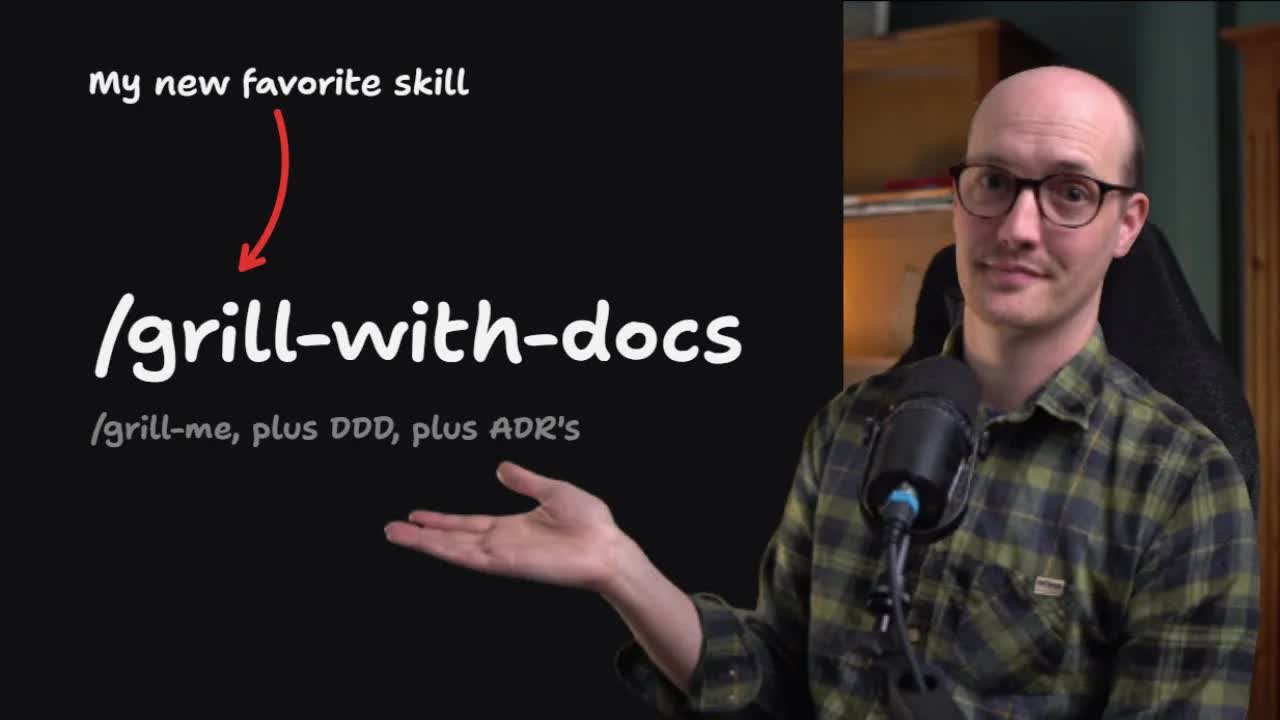
Matt Pocock retires his viral interview skill and introduces /grill-with-docs -- a DDD-powered replacement that builds shared language as it grills.

Posted
May 14th 2026
4 days ago
Duration
15:16
Format
Tutorial
educational
Channel
MP
Matt Pocock
§ 01 · The Hook

The bait, then the rug-pull.

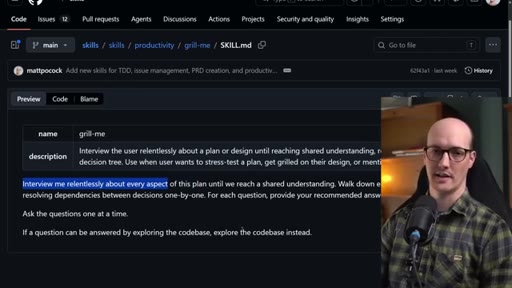
Four sentences. That was all it took to make /grill-me one of the most-talked-about Claude Code skills in the community -- Matt Pocock was getting five messages a day from engineers raving about it. So naturally, he killed it and built something better.

§ · Stated Promise

What the video promised.

stated at 00:44 "I've actually built a better one. Let's open up a session so I can explain a little bit more about where grill me goes wrong." delivered at 05:40
§ · Chapters

Where the time goes.

00:00 – 00:47

01 · The /grill-me backstory

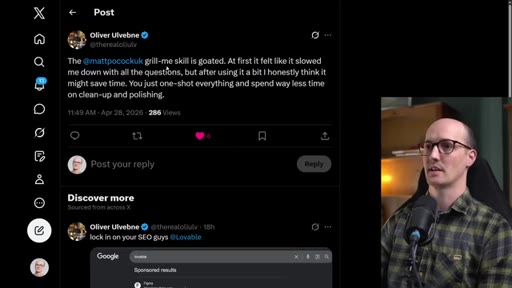
Matt explains the four sentences behind /grill-me, shows community praise, teases that he has replaced it.
00:47 – 03:00

02 · What goes wrong with /grill-me

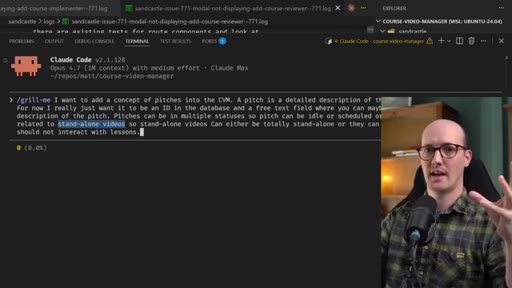
Opens a live session, pastes a prompt for a new pitch entity, explains the core problem: re-explaining domain jargon like standalone video every single session.
03:00 – 05:40

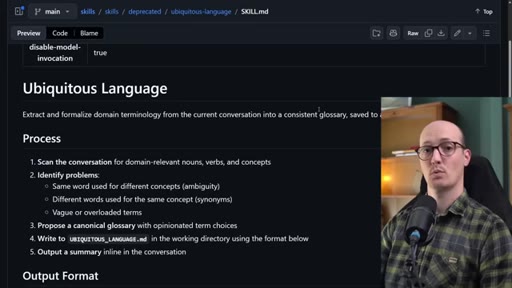
03 · Ubiquitous language and the new skill

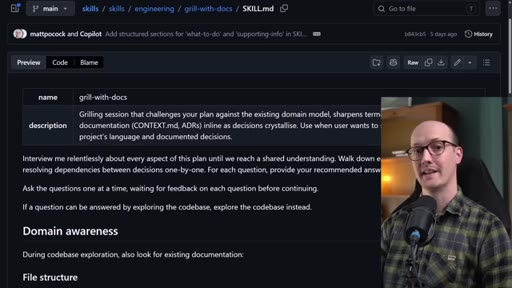
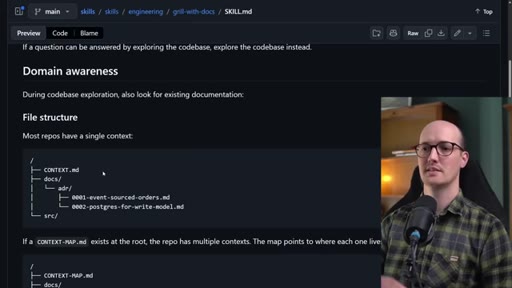
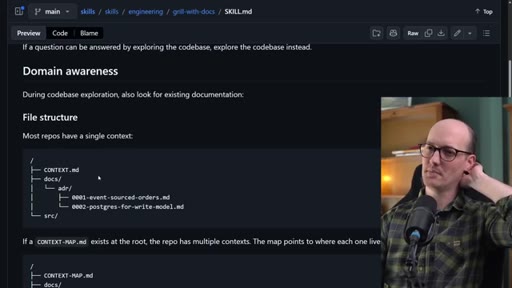
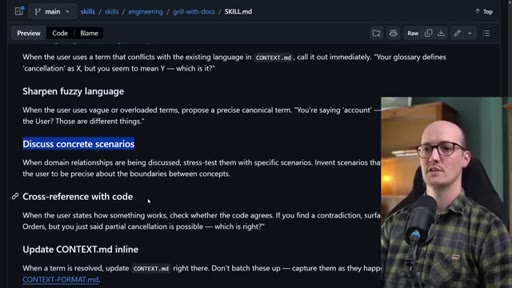
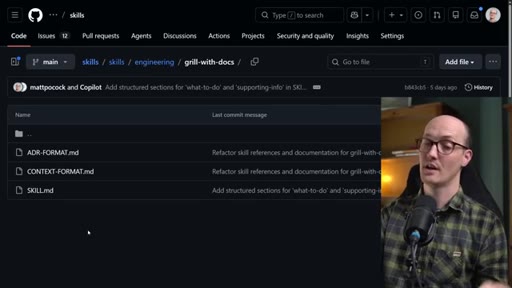
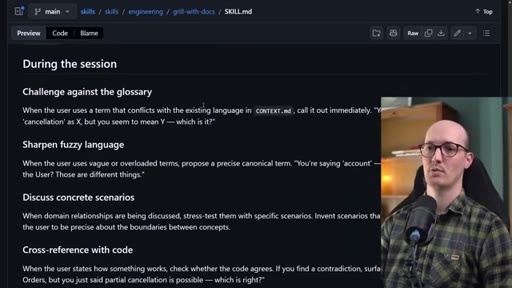
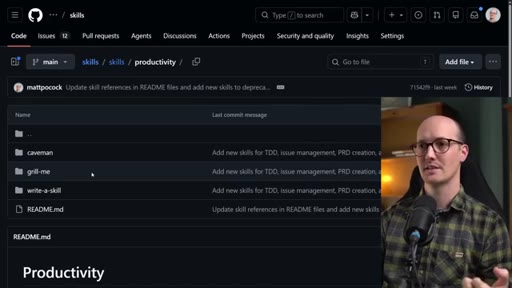
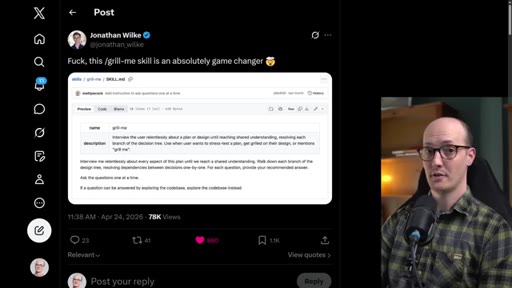
Introduces DDD concept from Eric Evans blue book. Shows the /grill-with-docs SKILL.md on GitHub -- same grilling core plus domain-awareness sections.
05:40 – 09:20

04 · Live demo: grilling a pitch entity

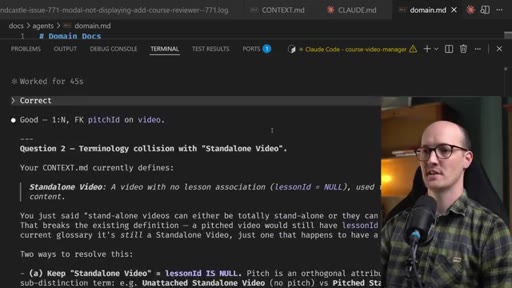
Runs /grill-with-docs on the real codebase. AI reads CONTEXT.md, clarifies cardinality, resolves terminology collision, handles status semantics and nullability.
09:20 – 12:00

05 · CONTEXT.md updates live

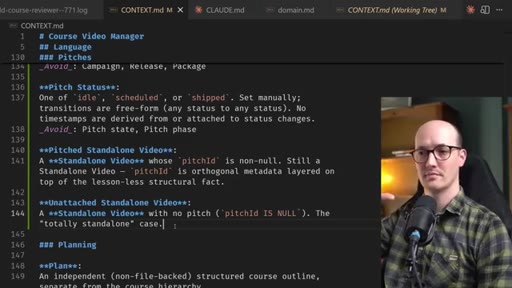
Matt asks the AI to save agreed language. CONTEXT.md updated with Pitch, Pitch Status, Pitched and Unattached Standalone Video. Reflection on why language precision matters.
12:00 – 14:00

06 · The three benefits

Concise replies, tighter thinking traces, easier code navigation -- all downstream effects of shared language. DDD works with humans and AI alike.
14:00 – 15:16

07 · Is /grill-me dead? + CTA

/grill-me moves to productivity skills for non-engineering use. Rule: codebase = /grill-with-docs, no codebase = /grill-me. Newsletter CTA.

§ · Storyboard

Visual structure at a glance.

open
live session
skill reveal
grilling demo
CONTEXT.md live
benefits
CTA
§ · Frameworks

Named ideas worth stealing.

03:30 concept

Ubiquitous Language (DDD)

A shared vocabulary document aligning codebase, developers, and domain experts. When all three groups use the same terms, the AI needs zero re-explanation.

Steal for Any project where you re-explain domain terms to Claude -- create a CONTEXT.md at repo root and feed it into your grilling skill
05:10 concept

ADR (Architectural Decision Record)

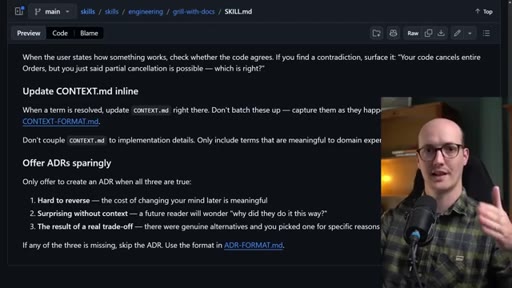
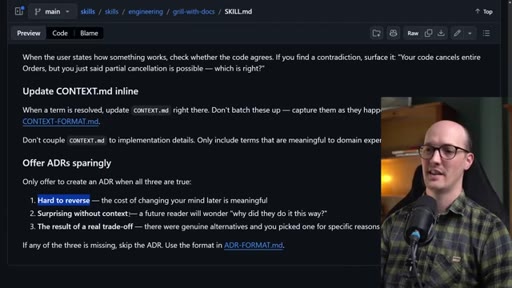
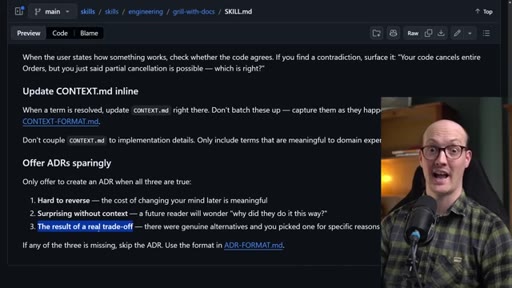
  1. Hard to reverse
  2. Surprising without context
  3. Result of a real trade-off

Lightweight markdown documenting non-obvious decisions. Only write one when all three criteria are met.

Steal for Document delete-cascade choices, schema decisions, status-machine design -- anything that will surprise a future reader
03:00 model

Grill-with-docs session loop

  1. Read CONTEXT.md at session start
  2. Challenge language against glossary
  3. Sharpen fuzzy terms to canonical ones
  4. Cross-reference with code
  5. Update CONTEXT.md inline during session
  6. Write ADR when all three thresholds met

The full /grill-with-docs flow -- extends /grill-me with domain-aware grounding

Steal for Direct drop-in for any Claude Code project; SKILL.md, CONTEXT-FORMAT.md, and ADR-FORMAT.md are public on GitHub
§ · Quotables

Lines you could clip.

08:15
"This might just feel like bike shedding to you, but this is going to affect every part of the code that's generated. All variable names or file names are gonna be based on these context.md documents."
Sharp defense of language precision -- counterintuitive to most devs, immediately relatable → TikTok hook
07:25
"It magically aligned with the thoughts I had before the words came out of their brain."
User testimonial -- vivid description of AI alignment feeling → IG reel cold open
12:18
"The same techniques that work with humans also, it turns out, work with AI."
Clean thesis, no setup needed → newsletter pull-quote
12:50
"Did its creator come along and stab it in the back? Absolutely not."
Self-aware humor about killing his own viral tool → TikTok hook
§ · Pacing

How they spent the runtime.

Hook length47s
Info densityhigh
Filler5%
§ · Resources Mentioned

Things they pointed at.

03:30bookDomain-Driven Design by Eric Evans
09:20toolWhisper Flow (dictation tool)
14:10productAI Skills for Real Engineers newsletter
§ · CTA Breakdown

How they asked for the click.

14:10 newsletter
"I keep everyone up to date on this with my AI skills for real engineers newsletter."

Soft sell with explicit no-spam promise, framed as skill changelog updates rather than a pitch.

§ 04 · The Script

Word for word.

HOOK opening / re-engagementCTA the pitch analogy story
00:00HOOKA few months ago, I wrote a few sentences about four sentences that have turned out to be the most influential four sentences
00:08HOOKI've ever written. I packaged these four sentences up into the grill me skill, which is a skill that you can use to get the LLM to interview you relentlessly. It interviews you until you reach a shared understanding,
00:20HOOKwalking down each branch of the design tree, resolving dependencies between decisions one by one. I know this skill is influential because every single day I receive about five messages of people saying they've tried it and they love it. This skill is an absolute game changer.
00:33HOOKWhat are your favorite skills? Grill me is great. I'm working on a project.
00:36HOOKBlah blah blah. The grill me skill asks me about ambiguities. Fantastic.
00:40HOOKGrill me skill is goated. At first, I felt like it slowed me down with all the questions. But after using it a bit, I honestly think it might save time.
00:47HOOKYou just one shot everything after you've kind of gathered all the context. And you tested the skill called Grill Me and blah blah blah blah blah. It's wonderful.
00:55HOOKWonderful. Wonderful. Wonderful.
00:56HOOKAnd after all that praise, you might think, well, you should probably stick with that skill, shouldn't you? That skill sounds pretty good. And it turns out, I've actually built a better one.
01:04I'm never very happy when I'm resting on my laurels. I always feel like there's improvements to be made at every single part of my process. And now, grill me has been replaced with a new skill.
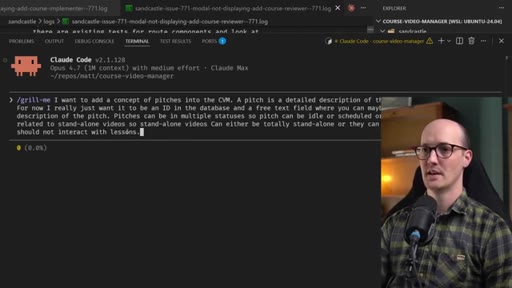
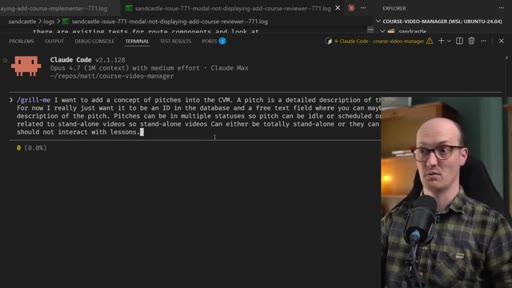
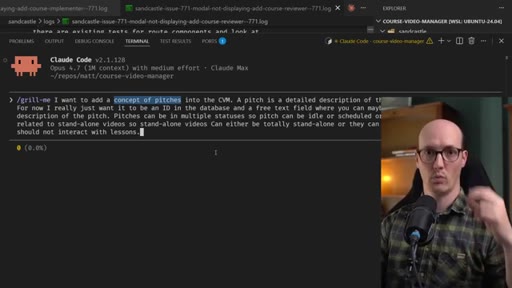
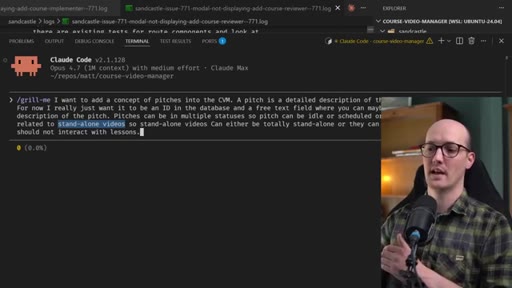
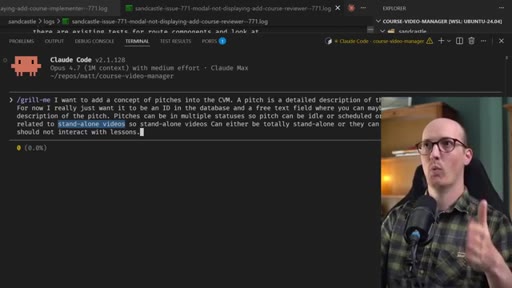
01:14Let's open up a session so that I can explain a little bit more about where grill me goes wrong. I'm gonna paste in a prompt that I've already added here. And this prompt is an idea for a new feature.
01:24I've just dictated this out so you just sort of be spared the details of it. But essentially, I want to create a new entity in my database and a new entity that my app is going to deal with. Currently, this application deals in courses, deals in lessons, deals in videos,
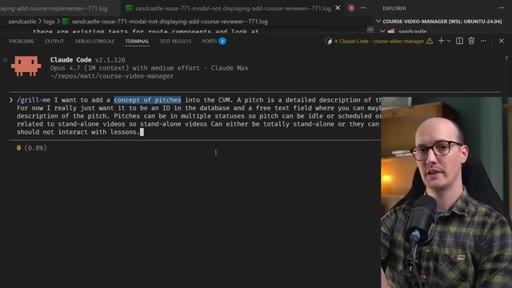
01:39and sections and a few other things. And I want to add a concept of pitches. There's this kind of mister beast style axiom where you should be thinking about the packaging for your video before you actually work out what's going in the video.
01:52And that's what a pitch is in this kind of setup. A pitch is really just the packaging for the video, the title, the description, how I'm gonna frame it to people, and I create a bunch of these pitches and then pick the best ones and then turn those into videos. Now what you notice here is as I'm communicating with the agent, we're really focusing on language.
02:10Right? We're really focusing on what is a pitch. I just had to communicate that to you so that you could follow along, and the agent will need to extract that information from me too.
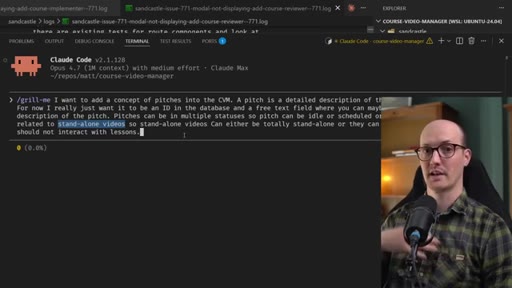
02:19But there's also some extra jargon in here that the agent doesn't know about yet. For instance, I'm talking about standalone videos. What does a standalone video mean?
02:28Oh, of course. It means a video that's not connected to a lesson or a course. Now, of course, I know that.
02:34That's kind of like a term of art for using this whole setup. But the agent doesn't know that yet. It doesn't have any concept of what that is.
02:41So during the grilling session, it's going to have to ask me what a standalone video is or try to figure it out from the code. So as I use grill me more and more and more, I would start to notice these times where the agent was being really really verbose, and I would have to remind it, no, there's already a term for that.
02:57And often though, there wasn't a term, or I was kind of thinking about things in a very verbose way myself, and that wasn't being challenged by the agent. Or we would actually land on some really good shared language,
03:10and then that wasn't documented anywhere. So I started to feel dissatisfied with Grillme because there was this piece missing from the puzzle, which is we were able to communicate about the code pretty effectively, but I would have to re explain all of the non obvious things about the code base and about the domain, the problem that we were solving before we could do anything productive.
03:30So I started to think to myself, what is the thinnest layer of documentation I could use to just give the AI a bit more of a leg up?
03:39So I came up with this skill, the ubiquitous language skill. Ubiquitous language is an idea that comes from domain driven design. This is the big blue book by Eric Evans that everyone goes on about.
03:49And what it does, it's it's essentially, you're trying to create a document which is the language that's used by the code base, that's used by developers,
03:59and that's used by domain experts. In other words, people that know about what you're building, but not how you're building it. All of those three groups should be using a shared language because that means that the domain expert can go, okay, there's something wrong with this particular section of the app.
04:13The developer knows what they're talking about and the code also reflects that. So what I would do is in the middle of a grilling session, when I noticed that we were needed to sharpen some language,
04:23I would use the ubiquitous language skill and correlates with, you know, ubiquitous language and try to create a ubiquitous language dot m d as we were going. So I had grill me and I had ubiquitous language and I was using them both at the same time and I realized wouldn't it be great if I just combine the two into a new skill?
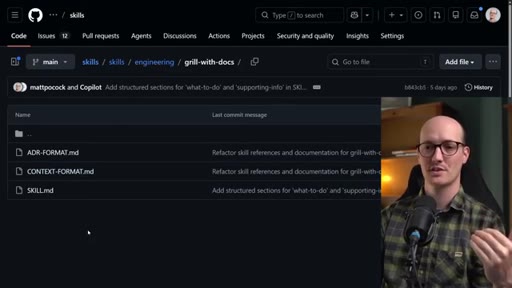
04:41And here is that new skill. It is grill with docs. It has exactly the same text as grill me at the top here, but it has a couple of extra pieces.
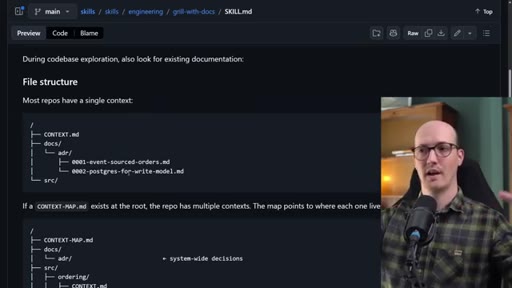
04:50The first thing it has is the ability to look for a context dot m d file. This context dot m d file will have document all of the shared language that's inside that context. Now context is like super overloaded, so I'm sort of uncomfortable but maybe okay with it.
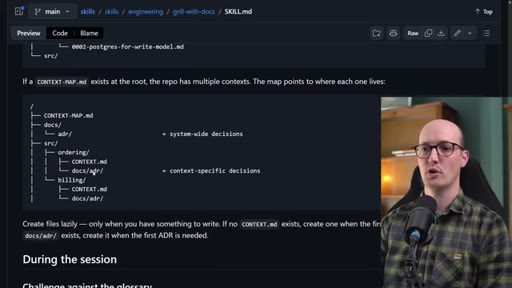
05:07It's essentially a bounded context in DDD is a part of the app in which you speak a shared language. So if you have a massive mono repo, you can have a context map here and have many different context inside. So that's how you would scale this to an enormous repo.
05:23But still, if you just have one pretty big repo where all the application is speaking the same language and the domain experts speak the same language, then you can just use a single context dot m d here. So it's instructed to look for this existing documentation to pull in this shared language. And then during the session, it's got some extra additions here to challenge,
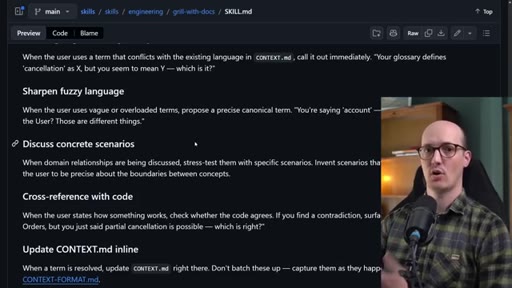
05:43uh, language usage against the existing glossary, to sharpen fuzzy language, discuss concrete scenarios, cross reference with code, and update it as you go.
05:53So this essentially helps you really sharpen your language as you're using the grill with doc skill. And this pays off as you go. I was asking some folks for feedback on this and I got some really nice quotes here.
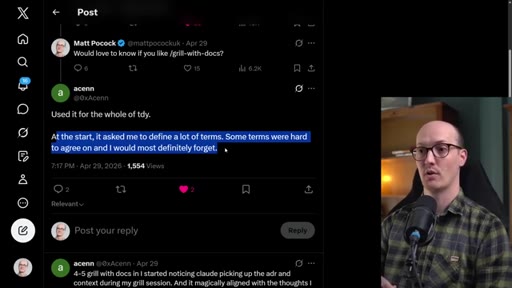
06:06So this guy used it for the whole of today. And at the start, it asked him to define a lot of terms. Some terms were hard to agree on and ones he would most definitely forget.
06:15But four or five sessions in, he started noticing that Claude was picking up the context during the grill session and it magically aligned with the thoughts I had before the words came out of their brain. So that's what you get out of this. By documenting the non obvious stuff, by agreeing on a shared language, you really can nail down and get a magical alignment between you and the AI where you just have to use far fewer words to communicate what you mean.
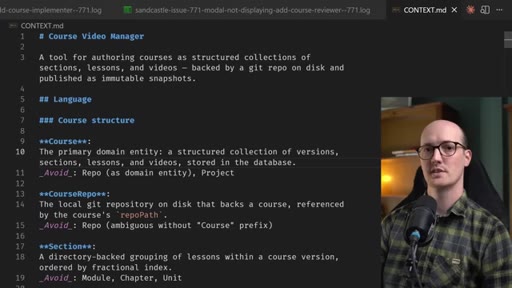
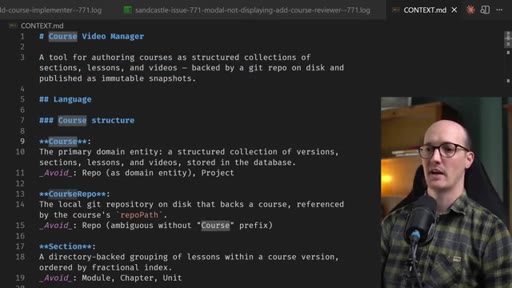
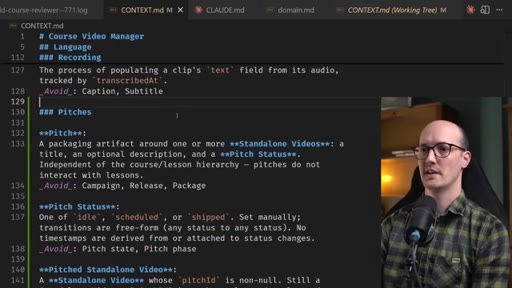
06:38For instance, here's the one that I have in my repo here. We essentially just have a little description about what the, you know, what the repo is.
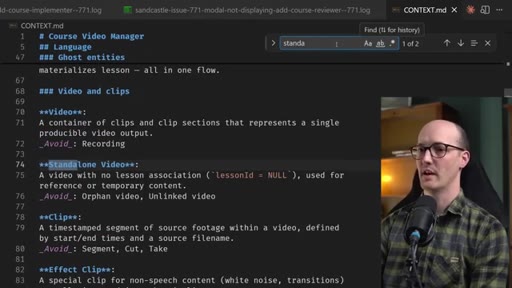
06:46Then we have a course and a course repo, and we have all of the entities inside here. Course versions as well because I have multiple versions. And if we look for the one that we were looking at before which is standalone
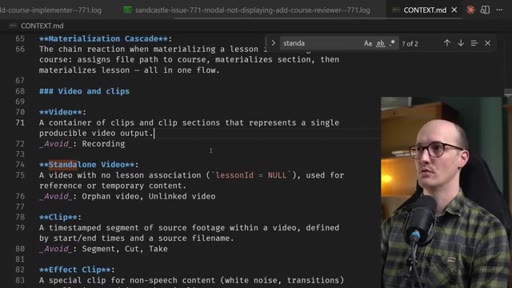
06:57video, it is just down here. So we have an exact specification
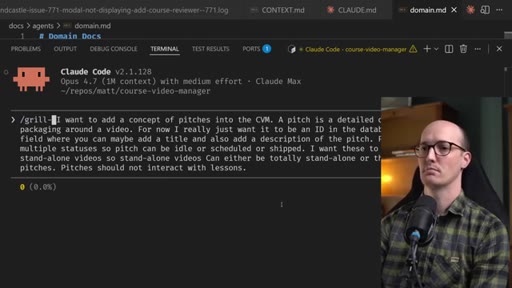
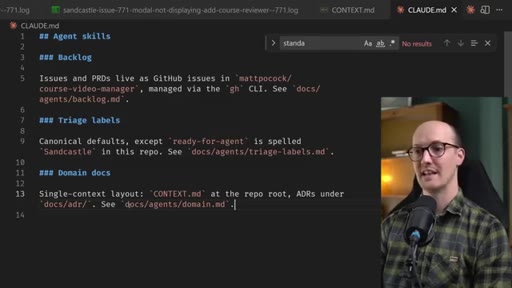
07:02for what standalone video means now. Now the grill with doc skill knows to look for this, but I also add a context pointer into not inside that claw dot m d, but inside the local claw dot m d here. So we have just this domain docs, a single context layout, context dot m d at the repo root, and you see this extra little bit of
07:23documentation for more information about where this stuff is. One final thing that grill with docs does is that there are some things that sharpening the fuzzy language will help with, but there are some things that it won't.
07:36And so I wanted a layer that would explain all the non obvious decisions that weren't able to be captured inside context dot m d. And so for that, I've gone with an architectural decision record. These ADRs here are really, like, simple markdown files that sit in your repo that essentially documents all of the non obvious decisions.
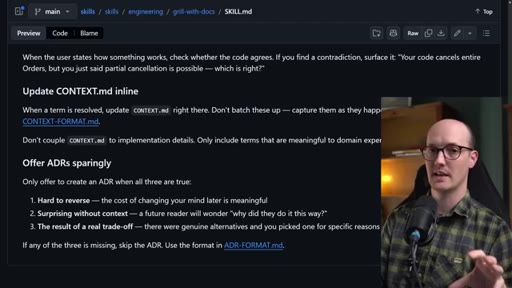
07:56Only want to create an ADR when the decision is hard to reverse. Because if it's just like, oh, we use this library instead of this library and they're kind of interchangeable, then you can always just swap later.
08:06It would be surprising without context, and plenty of decisions in a repo are surprising without context, especially more complex ones, and the result of a real trade off. In other words, that this decision has consequences down the line.
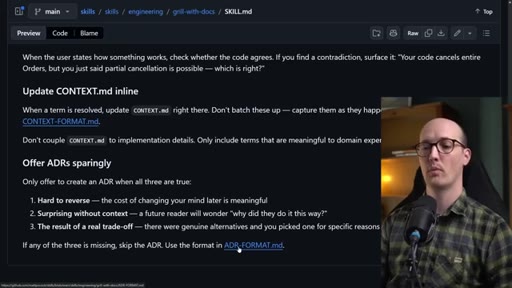
08:20And I've got an ADR format inside here that the LLM uses when it creates these ADRs. So now we understand all the pieces.
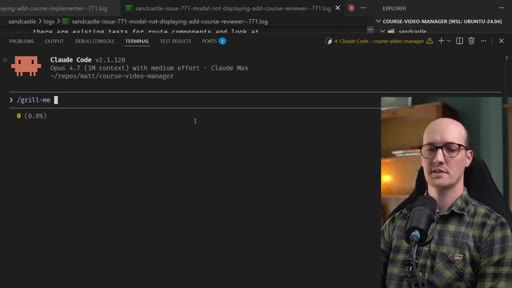
08:27Let's go back up to here. Let's replace grill me with grill with docs. And let's actually start this grilling session to see it in action.
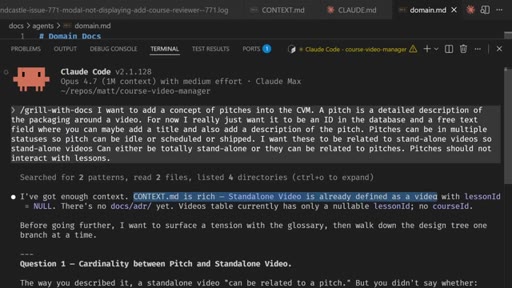
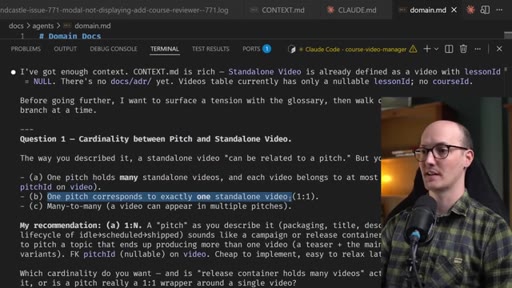
08:35Alright. So the first thing it has done is it said, oh, context dot m d is rich. Standalone video is already defined as a less
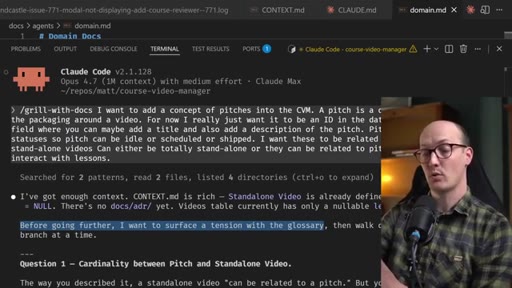
08:42a video with lesson ID equals null. And it says, before going further, I want to surface attention with the glossary. This is what you'll often find with Grille with Docs is that it really focuses on the language before you then actually go and talk about implementation details.
08:56It says there's cardinality between pitch and standalone video. It's asking whether one pitch holds many standalone videos or one pitch corresponds to exactly one standalone video. I think it might make sense to follow its recommendation here and go with, okay, we have one too many relationship here.
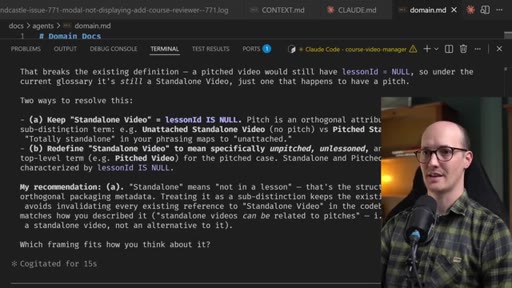
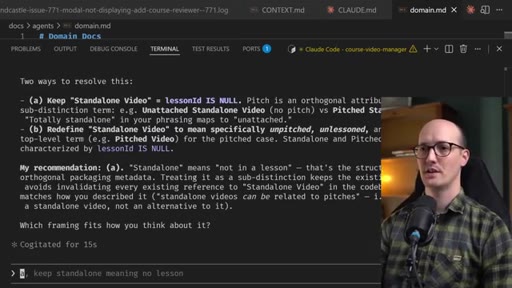
09:11So I'm just going to say correct. Very nice. Next up, it's noticing that there's a terminology collision with the standalone video.
09:19So it's saying that you have a standalone video that are either totally standalone or they can be related to pitches. So I think it's basically asking whether we keep standalone video as any pitched or unpitched lesson
09:33or we redefine it to mean specifically unpitched, unlessened video. Now the way we answer this question is going to influence everything afterwards.
09:39It's gonna influence whether standalone videos get their own section in the UI or whether we have standalone videos and videos with pitches kind of mixed in. Because the language that we're defining here is also the language that the user is going to be seeing on the page when they navigate around this.
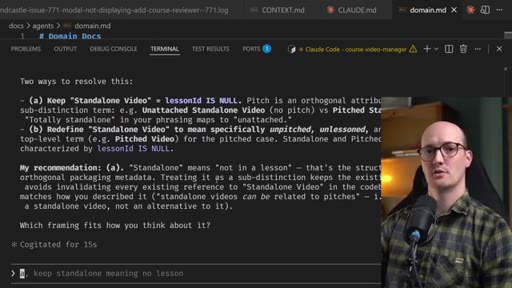
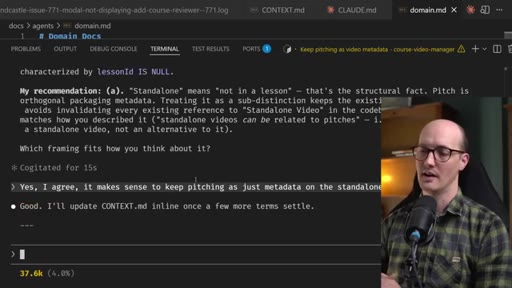
09:55And I think I'm agreeing with it, actually. I was actually going into this thinking we would probably have a separate section for pitched videos. But I think,
10:03yes, I agree. It makes sense to keep pitching as just metadata on the standalone video itself. This, by the way, is Whisper Flow, what I'm using for dictation.
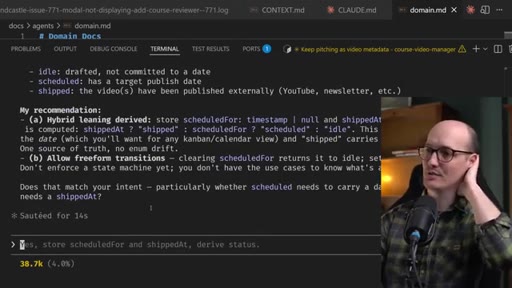
10:11It works okay. Uh, I'm not sure I recommend it but it's fine. It's now saying, okay, we need some status semantics here.
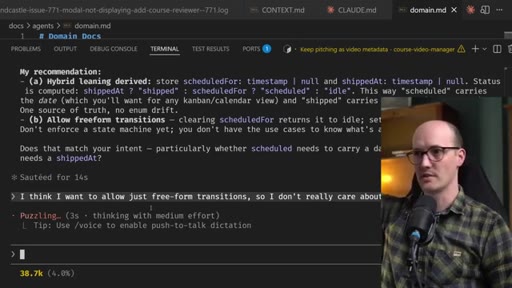
10:17So each pitch can be idle or scheduled or shipped here. I think I want just to allow I think I wanna allow just free form transitions. So I don't really care about this being automated.
10:31We can always layer on automation later, you know, like when you press, uh, send to YouTube or something, it goes into a new status. But for now, I'm okay just like toggling it myself. That's fine.
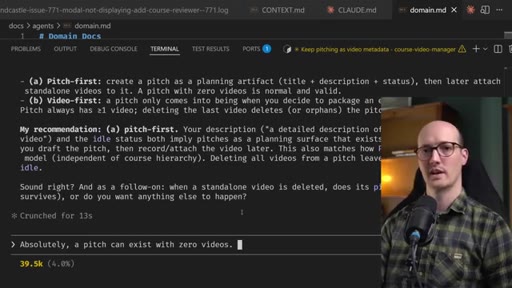
10:40It's now asking, can a pitch exist with zero videos? Absolutely, a pitch can exist with zero videos. The point here is that we're kind of generating
10:48pitches, ideas for videos, you know, and this is the mister beast thing. We're trying to
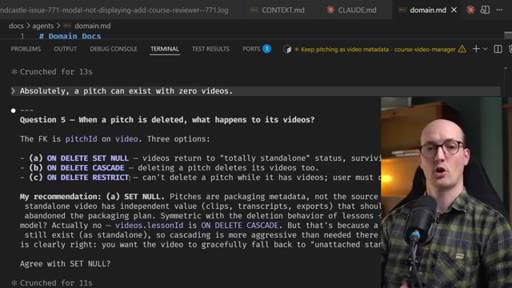
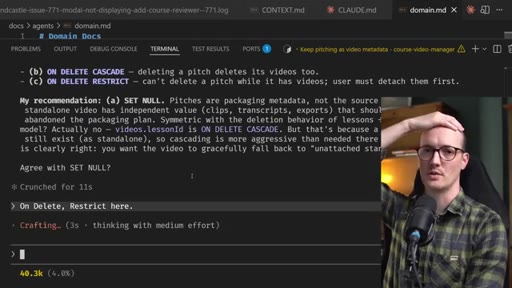
10:53get the packaging ready first. And this relationship, this language also goes into things as concrete as deletion cascades. So I think I'm going to say
11:03on delete restrict here. This is mostly because I just like
11:08restricted deletions. And mostly what I do is I tend to archive instead of delete when I actually do these. We're now getting into more implementation
11:15details here. So I think instead of just boring you with actually like implementing the grilling session here, I'm just gonna say, could you save what we have into context on d so far? If there's anything we haven't figured out, grill me about that before you make the adjustments.
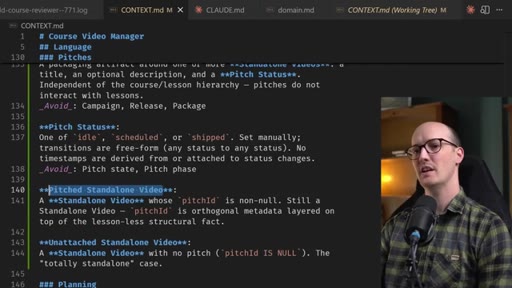
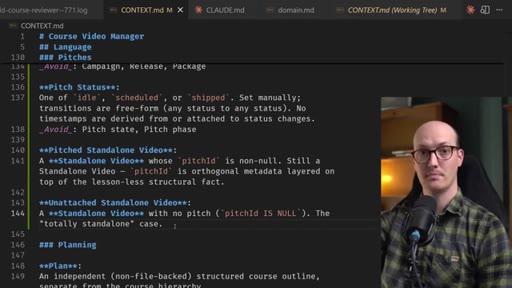
11:28And let's see what it goes for here. And, okay, it has made a bunch of updates into context on d. Specifically, it's added a bunch of pitch information here.
11:37So we've got pitch, the actual entity itself. We've got pitch status, the status the pitch can be in. Pitched standalone
11:44video is a little bit awkward. I might want to grill it about that. And then unattached
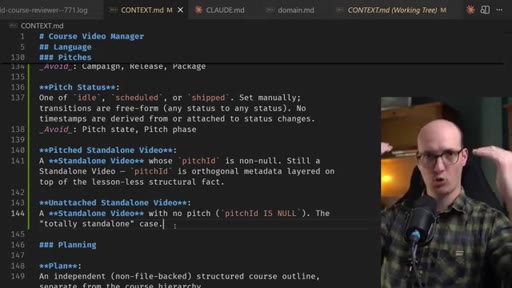
11:49standalone video. That's also like it's basically saying standalone standalone video. Now bear in mind, I'm like I might seem like pretty, you know, anal retentive about this language.
11:59This might just feel like bike shedding to you, but this is going to affect every part of the code that's generated. All variable names or file names are gonna be based on these context dot m d documents here. And so getting this right is absolutely crucial for feeling aligned with the AI.
12:15Now, course, we don't want to just endlessly bike shed, so I'm gonna call this now. I'm gonna say that's good enough. Let's ship with this.
12:21We can always change and refactor to a new language later. So let's quickly talk about the benefits here, what you actually get from going through this ceremony. The first thing that you get is concise replies.
12:32The AI is able to use fewer tokens to speak to you because you have this shared language, it doesn't need to verbosely repeat everything or re describe everything. It just says, okay, stand alone videos are changing. We're, uh, needed to make a change to the pitches and how the pitches display.
12:47This concision is also reflected in its own thinking traces as well. Because of course, AI uses language to think to itself, and so it's able to be much more aligned with your intention and actually use fewer tokens when it's thinking. This is something I've observed and it feels pretty nice.
13:03And finally, because the planning documents, because the way that you're speaking with the AI is also aligned with the way the code looks as well, then you end up with easier to navigate code because it's able to just okay. I need to find all the information about pitches.
13:16Let me just search for it. And of course, this makes sense because these are all the same benefits described in domain driven design itself. So the same techniques that work with humans also, it turns out, work with AI.
13:27You're probably thinking though, is Grillme dead? Did I just kill Grillme? Did its creator come along and stab it in the back?
13:33Absolutely not. I think Grillme is an excellent excellent skill,
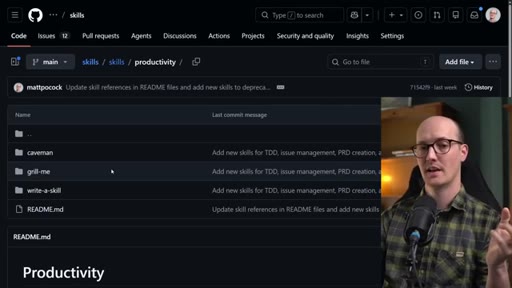
13:38but Grill with Docs is better when you have a code base. In my skills, have moved grill me into the productivity area here. So this is for general use cases, for use cases where you don't have a code base.
13:50CTAI had someone, this is the most amazing story, who said that they were writing a eulogy for their mom and they use Grill Me to get the AI to grill them about their mom and surface all these amazing stories. And so Grill Me has incredible use cases outside of engineering. And of course, if you are really early on in a project, actually, really early on in a project, I'd still probably recommend using Grille with Docs because you just get so much more out of that shared language.
14:16CTAAnd often at the start of a project is where you're trying to establish that shared language. So essentially, the rule is when you have a code base, use Grille with Docs. When you don't have a code base, use grill me.
14:26CTAI update these skills super duper regularly and I'm often thinking new thoughts about the skills or even how best to use them without changing the skills themselves. So I keep everyone up to date on this with my AI skills for real engineers newsletter. This is just an addition to the, uh, already good newsletter that I have that just gives you a few extra skills updates or maybe one a week when they happen.
14:48CTAI really freaking hate email spam and so I'm not gonna spam you. But this little page will help you basically keep up to date with all the skill change logs and have some nice extra additions here that you can just take a look at and learn how to use the skills better. Otherwise, thanks for watching and I'll see you in the next one.
15:03CTAThank you so much for following along. I really really appreciate it. And if you enjoy this skill, do let me know in the comments how you got on with it, what you noticed, and do raise an issue on the skills repo itself if you think there's something that I could improve.
— full transcript
§ 05 · For Joe

Steal the CONTEXT.md pattern.

grill-with-docs playbook

Shared language is not bike-shedding -- it is the multiplier that makes every AI session faster, tighter, and less repetitive.

  • Create a CONTEXT.md at your repo root -- one definition per domain term, with _Avoid_ aliases for confusables. Start it during your first grilling session.
  • Use /grill-with-docs (or build an equivalent) that reads CONTEXT.md before starting -- never let the AI start cold on domain terms.
  • Write an ADR only when the decision is hard to reverse, surprising without context, AND the result of a real trade-off. Most decisions do not qualify.
  • Let the AI propose canonical terms mid-session -- accept or push back, then lock them into CONTEXT.md before ending.
  • The language you agree on becomes your variable names, file names, and UI labels. Getting it right upfront is leverage, not perfectionism.
  • Keep /grill-me for non-engineering uses: brainstorming, writing, life decisions -- anything without a codebase.
  • Expect compounding returns: four or five sessions in, the AI anticipates your domain model and you need far fewer words to drive it.
§ 05 · For You

How to stop re-explaining yourself to AI.

practical lesson for any AI user

The reason your AI conversations feel repetitive is that you have no shared vocabulary -- and you can fix that with one text file.

  • Write down the 10-20 most important terms in your project or domain -- one plain-English definition each. This is your shared language document.
  • Paste that document at the start of any AI conversation where those terms matter. The AI no longer needs re-explanation of your domain-specific words.
  • When the AI uses a term you disagree with, correct it in the document immediately -- not just in chat where it gets forgotten next session.
  • This works for writing, business strategy, product planning -- anywhere you have repeated AI conversations about the same domain.
  • The payoff compounds: after a few sessions the AI speaks your language and you spend far fewer words getting to useful output.
§ 06 · Frame Gallery

Visual moments.