
Joanna Wiebe · Youtube · 14:22

If You've Been Called A Jack Of All Trades, This Will Change EVERYTHING

Joanna Wiebe names six archetypes for multi-passionate people and gives each one a concrete fix.

Posted
May 14th 2026
3 days ago
Duration
14:22
Format
Talking Head
educational
Channel
JW
Joanna Wiebe
§ 01 · The Hook

The bait, then the rug-pull.

The first sentence is an identity lock: if you have ever been called a jack of all trades, you felt seen before she said anything else. Joanna Wiebe then self-discloses: she built software, ran a training business, ran a consultancy, and was writing novels simultaneously. The diagnosis was not scattered talent. It was not knowing which kind of multi-passionate person she actually was.

§ · Stated Promise

What the video promised.

stated at 00:38 "These are the six archetypes of people with multiple creative interests and exactly what to do next depending on which one you are." delivered at 12:06
§ · Chapters

Where the time goes.

00:00 – 00:47

01 · Hook + promise

Identity lock for multi-passionate people; personal disclosure; teases 6 archetypes framework.

00:47 – 03:17

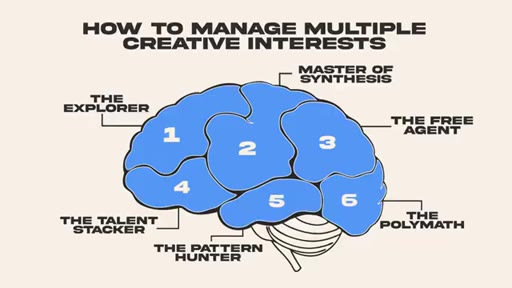
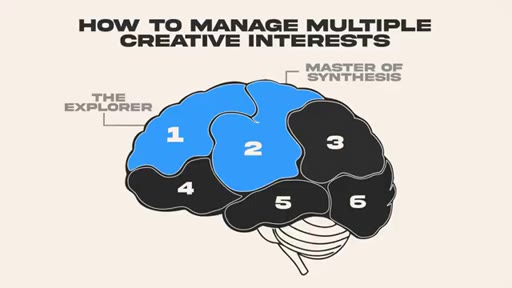
02 · Archetype 1: The Explorer

Multicurious, fast learner, follows novelty. Risk: confuses curiosity with mastery. Fix: panoramic lens.

03:17 – 06:00

03 · Archetype 2: Master of Synthesis

Sees connections between unrelated fields. Charlie Munger reference. Fix: hub skill + treat interests as R&D.

06:00 – 07:56

04 · Archetype 3: The Free Agent

Protecting identity, not unfocused. Matina Horner fear-of-success research. Fix: what problem is big enough.

07:56 – 10:13

05 · Archetype 4: The Talent Stacker

Not best at any single thing, rare because of combination. Scott Adams, Schwarzenegger, Dorsey. Fix: interest seasons + infinite mindset vision.

10:13 – 12:06

06 · Archetype 5: The Pattern Hunter

Builds frameworks, does not deploy them. Stops at insight. Fix: work broadly, execute narrowly.

12:06 – 14:22

07 · Archetype 6: The Polymath

Actual demonstrated mastery across domains. Nobel Prize bar. Fix: sequential depth, one domain to 80-90% mastery before stacking next.

§ · Storyboard

Visual structure at a glance.

hook
explorer
synthesis
free agent
talent stack
interest seasons card
pattern hunt
polymath
brain summary
§ · Frameworks

Named ideas worth stealing.

02:35 concept

Panoramic Lens

Find the unifying question under all interests and use it as the thread for exploration.

Steal for reframe scattered interests as one long investigation; works for any content series or learning curriculum
05:03 concept

Hub Skill

One core skill that lets you explore through it rather than getting lost inside it. Writing is the strongest example.

Steal for positions writing not as a niche but as infrastructure for creator-builders
05:18 concept

Interests as R&D

Companies invest in R&D they never directly apply to a product. You do not need a deliverable for every domain you explore.

Steal for permission structure for exploration without monetization pressure
07:17 concept

What problem is big enough to contain my interests?

Filter question for the Free Agent archetype. Reframes commitment from constraint to containment.

Steal for positioning question for builders who want to build something that encompasses all their skills
09:44 model

Interest Seasons

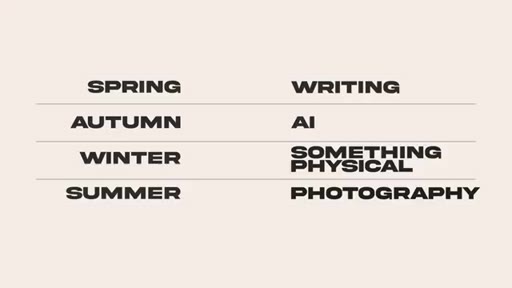
Rotate focus across quarters: winter/writing, spring/AI, summer/physical, autumn/photography. Leaving a season is the plan, not failure.

Steal for quarterly content and learning planning; makes the rotation intentional rather than guilt-inducing
11:55 concept

Work Broadly, Execute Narrowly

Keep cross-domain thinking alive but choose one arena to deploy insights into. Synthesis becomes competitive advantage inside a specific field.

Steal for positioning for generalist-brain builders who span product, content, and code
13:13 model

Sequential Depth

One domain to 80-90% mastery before stacking the next. A year of going all in beats five years of moderate engagement across many things.

Steal for course/cohort structure; annual focus themes; combats paralysis of leveling up everything at once
§ · Quotables

Lines you could clip.

02:50
"Natural curiosity is not the same as mastery."
Short, punchy, contrarian for multi-passionate audience. No setup needed. → TikTok hook
07:05
"Nobody is thinking about you anywhere near as much as you think about you."
Universal truth drop in the middle of a niche framework. → IG reel cold open
09:10
"A talent stacker without a vision is just a very busy person."
Tight punchline, no setup needed. → TikTok hook
11:15
"Building a brilliant framework and deploying it are not the same thing, and only one of them produces a result."
Directly calls out the builder who maps systems but never ships. → newsletter pull-quote
11:55
"Work broadly. Execute narrowly."
Two-word paired maxim. Twitter-native. → newsletter pull-quote
13:45
"A year of going all in on one thing is worth more toward your eventual polymathy than five years of moderate engagement across many things."
Counterintuitive for the target audience. Lands as relief, not criticism. → IG reel cold open
§ · Pacing

How they spent the runtime.

Hook length47s
Info densityhigh
Filler5%
§ · Resources Mentioned

Things they pointed at.

04:05channelShonda Rhimes
04:00book1991 meta-analysis on focus and career performance
06:00bookMatina Horner fear of success research 1969
08:06productScott Adams / Dilbert
09:10bookSimon Sinek - The Infinite Game
11:06bookPeter Drucker
11:16bookDaniel Kahneman - Thinking, Fast and Slow
12:42book2023 study linking creative accomplishment with polymathy
§ · CTA Breakdown

How they asked for the click.

14:09 next-video
"Now that you have an idea of which archetype might suit you best, the next best thing is to start that focused work immediately."

Soft close, no explicit subscribe ask. Closes with action urgency rather than a platform pitch.

§ 04 · The Script

Word for word.

HOOK opening / re-engagementCTA the pitch metaphor analogy story
00:00HOOKIf you have ever been called a jack of all trades or multi passionate, you might feel like the world is fighting you because you have too many interests. We live in a world where specializing in one skill is the default path that you're supposed to take. Now, I'm a person with multiple interests too.
00:16HOOKI've built software, run a training business, run a consultancy, and I was writing novels all at the same time. But managing all of these drained me and actually negatively affected my career and businesses growth.
00:29HOOKWhat finally changed everything was understanding which kind of multi passionate person I actually was. So these are the six archetypes of people with multiple creative interests and exactly what to do next depending on which one you are. The first archetype is called the explorer.
00:45HOOKI've seen a lot of Reddit threads where people claim to have too many interests. And here's what always sticks out to me. People with many interests get a lot of advice about perseverance even when things feel boring, but the explorer is not struggling to focus because things are boring.
01:00The explorer isn't seeking a dopamine hit. They just wanna try it all. That's the explorer.
01:05Multi curious, fast to learn, genuinely excited by many different things, and not trying to combine fields or find patterns between them. Think of Shonda Rhimes, the creator of Grey's Anatomy, and many others following creative curiosity across genres and domains not because she is building a unified intellectual theory,
01:25but because something caught her attention and she followed it. The research on why some people explore widely is broader than you might expect.
01:32Gret versus depth of interest gets shaped by environmental factors, parental influence identity, goal setting patterns,
01:40neurochemistry, and, of course, socioeconomic status, and access to different pursuits.
01:46There is no single clean explanation as to why you have so many interests, but there is clear data on what tends to happen as a result. So in 1991,
01:55meta analysis found that focus, allowing mastery of a subject, is actually a consistent predictor of career performance. If you wanna turn your many interests into financial stability, evidence is not enthusiastically on your side, at least not yet.
02:11Here is the uncomfortable part about the explorer. So there tends to be a belief in this archetype that because you learn quickly, you do not really need to do the repetitive,
02:20unglamorous work that mastery requires. You pick things up fast, so you figure you will catch up whenever you decide to settle. But an Olympian who trains at 4AM before school is not naturally committed.
02:32They chose to commit, and that choice and that practice that follows from it is what produces the result. So natural curiosity is not the same as mastery. If this feels like you and you are an explorer who does not want to abandon your many interests, but also feel that something needs to change, try what I call a panoramic lens.
02:50So instead of forcing yourself to pick one thing, choose a theme and give yourself a few years to work through it. Find the unifying question that runs underneath all of your interests, like what can fixing bikes, graphic design, bodybuilding, and whatever I discover next teach me about mindfulness?
03:08Now, every interest you explore is answering that question. So you can go from, like, wandering aimlessly to running one long investigation
03:17from many different angles. The second archetype is the master of synthesis. And if you can do this, you should start calling yourself the master of synthesis,
03:26and people will actually pay you a lot of money for this skill. The idea of having too many interests is like a little odd, isn't it? I mean, who's to say how many interests is the right amount?
03:37If you can learn to stop blaming yourself for loving many things instead of just one thing, you may actually see the value in connecting them. Now the master of synthesis sees how engineering and biology become biotech, how storytelling and data can become growth marketing, how two fields that look unrelated could actually together solve a difficult problem.
03:57Charlie Munger built a latticework of mental models across psychology, economics, and biology and deployed all of it toward investing. That's not scattered thinking.
04:06That is structured synthesis with a clear destination. So one thing worth clearing out, being a generalist and being a synthesizer are not the same thing. You do not need interests across wildly disconnected domains to feel like you can't focus.
04:20You could be a novelist with seven unfinished manuscripts. You could be a real estate agent who loves construction staging and garden design. All of these might live in one adjacent area.
04:30The feeling of too many interests does not always mean bread across fields. It can just mean there's no clear channel where all of the synthesis is supposed to go. Here's the thing.
04:40The roles that actually reward this kind of thinking are not always the obvious ones you might hear about growing up. So think venture capitalists, product managers,
04:48editors, think tank researchers, or even curriculum designers. These are all roles that are built for people who can move across domains and structure the connections into something others can use. So if this feels like you, build what's called a hub skill.
05:03One core skill that lets you explore through it rather than like getting lost inside of it. Writing is one the strongest examples because it lets you move across the human condition, logic, systems, literacy, and process while still producing something creative that you can point to.
05:18On top of that, treat your many interests as r and d, research and development. Companies invest in research they never directly apply to a product, and you're allowed to do the same. You do not need a deliverable for every domain you explore.
05:31Inventory your ideas on note cards or journal while you walk. Let your brain make the connections it is trying to make. That is not time you are wasting.
05:39That is the work that will make you exceptional in whichever arena you eventually point all of that synthesis toward. Next is the third archetype, the free agent. In the late nineteen sixties, psychologist Matina Horner studied what she called fear of success, defined as avoiding achievement because success is expected to bring negative consequences.
06:00Things like people will resent me. I will lose friends. People will expect even more from me.
06:05I will have to keep proving myself. What that fear actually looks like in practice is not paralysis. It looks like stopping just before breakthrough.
06:13Undercharging. Softening a bold idea until it no longer has edges. Finding the flaw in an opportunity that was genuinely good.
06:21Now from the outside, it just looks like having too many interests to commit to, but the free agent is someone protecting an identity. You do not wanna be pigeonholed. You do not wanna be known as the nerdy chess player or the lab technician or whatever label you have decided would flatten you into something smaller than you are.
06:39Now data shows that this pattern often traces back to adolescence when biologically the drive to explore is at its highest and what you watched your parents succeed or fail at begins to shape what you will allow yourself to become. So both successful and unsuccessful parents can produce this outcome.
06:56You look at each of them and you draw the same conclusion. I will not allow myself to be reduced to one thing. Now the hard truth is this, and it's something that freed me up so much the first time I heard it.
07:06Nobody is thinking about you anywhere near as much as you think about you. The identity you are carefully protecting is largely one you are guarding against a world that is not watching that closely. So if this free agent archetype
07:19is kind of resonating with you, try to use curiosity as your filter going forward. Ask yourself this useful question. What problem is big enough to contain my interests?
07:29So if you love teaching, AI, lab work, and building things with your hands, you might be genuinely well suited to build something that improves education through AI. That is not a pigeonhole. That is a container wide enough, big enough to hold everything you care about and then some.
07:45And if the financial pressure to commit is real but the interests still feel unresolved, let your day job cover the bills. Your post work hours are a legitimate space for exploration.
07:56You do not have to monetize your interest for them to matter, and you do not have to climb a ladder just because it exists. The talent stacker is the fourth archetype, and if there is one type in this list that should make people with many interests feel genuinely good about where they are headed, it is this one. Scott Adams, who created Dilbert, was not an exceptional cartoonist.
08:16He was not an exceptional writer. He had no particularly unusual insight into office culture on its own, but he combined those things in a way that almost nobody else could replicate, and it built something nobody else had built. That is the talent stacker.
08:31Not the best at any single thing, but rare because of how the things combine. My dad got his first teaching job because he had a class one driver's license from his years driving big rigs so he could drive the school bus. He also played baseball growing up, which meant he could coach the school team.
08:48His degree alone did not get him the job, but his many interests stacked together made him the only person who could walk in and do all of it. A great talent stacker is like Arnold Schwarzenegger who stacked bodybuilding, acting, business, politics. Jack Dorsey stacked technology, finance, UX, systems.
09:05The pattern is the same. All the talents in the world do nothing unless you can direct them toward something. A talent stacker without a vision is just a very busy person.
09:14What makes the talent stacker work is what Simon Sinek calls an infinite mindset. The best games, careers, businesses, relationships, they are infinite games. But most people measure them like finite games.
09:26Like, getting a promotion means they have won something. The talent stacker needs a big meaningful vision that all of those skills can serve. Without that, each skill is just another thing you're decent at.
09:38But with it, every new skill you add becomes a piece of something much larger than the skills themselves. So try to create interest seasons. That means if you have multiple talents you wanna develop but feel like you cannot run all of them at once, you're right.
09:53You can, but you can rotate. So winter might be for writing, spring for an AI pursuit, summer for something physical, autumn for photography. The key is going into each season with the decision that leaving the previous one behind is not failure, it's the plan, and keeping the stakes low enough that you can actually make progress.
10:13The fifth archetype is called the pattern hunter, and this is where a lot of very smart people quietly get stuck for years without understanding why. You might be a pattern hunter. The pattern hunter pursues many interests, not out of curiosity,
10:26but because every interest reveals another piece of a larger system. So unlike the explorer who is, you know, collecting experiences, the pattern hunter is building a mental architecture.
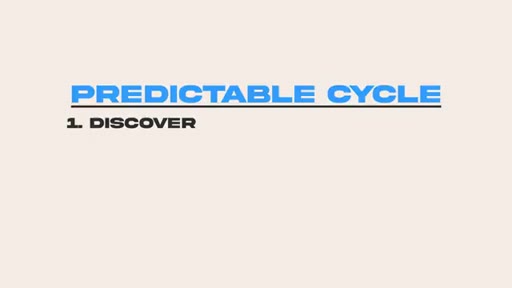
10:36They tend to have high tolerance for ambiguity. They do not, like, seize and freeze on conclusions, and they can sit with uncertainty for longer than most of us can. They move through a predictable cycle, discover a domain, connect it to three others, build a mental model, get excited about the theory, and then move on before ever doing anything with the framework they just built.
10:56Now the reward here is not executing the insight. The reward is finding it, which means the work consistently stops at the framework stage, and years can pass where someone is mapping systems rather than operating inside of one. The gap to watch for is mistaking that insight for progress.
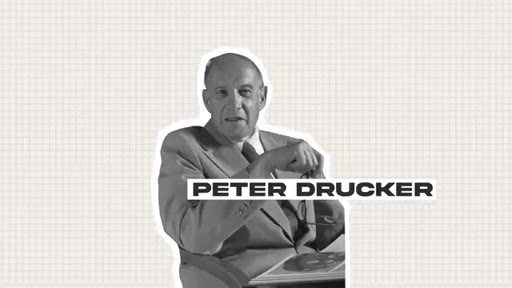
11:12Building a brilliant framework and deploying it are not the same thing, and only one of them produces a result. The examples that illustrate where this type actually leads are useful here. So Peter Drucker moved across fields and channeled the synthesis into management.
11:26Daniel Kahneman combined psychology and economics and brought it to decision science. What each of them did was choose one arena to deploy the pattern hunting into and work with real depth inside it. The synthesis never stopped, but it landed somewhere specific, and that is what made it visible.
11:43Work broadly. Execute narrowly. Keep thinking across domains because that is where your actual value comes from, and you probably cannot stop even if you want to.
11:53But choose one arena to deploy the insights into and treat the pattern finding as fuel for that arena rather than a destination on its own. The synthesis becomes the competitive advantage inside a specific field, not a substitute for having one.
12:09Pick the field, bring everything you find back to it, and let the output of all that thinking be visible in one place. The sixth and final archetype is the one almost everyone with many interests privately hopes that they are. It's the polymath.
12:22So the word comes from the Greek. Poly means many, and math means learner. So a polymath is someone who has learned many things deeply, not someone who is curious about many things.
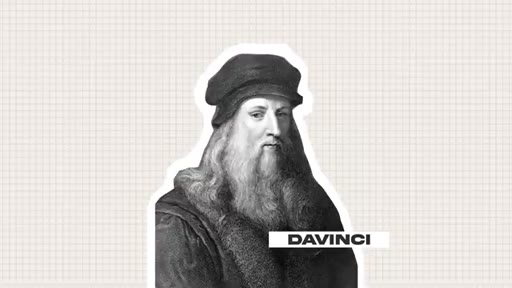
12:32A generalist knows a bit about a lot. A polymath achieves genuine mastery across several domains and makes actual contributions in more than one of them. Da Vinci was not nearly interested in art, engineering, and anatomy.
12:45He went deep in all of them. A twenty twenty three study linking high level creative accomplishment with polymathy found that Nobel Prize winners often have it.
12:56The bar is demonstrated competence and real contribution across fields. Now that is extremely rare. The explorer, the free agent, the master of synthesis, the talent stacker, the pattern hunter, all of them can feel like polymath y from the inside, but polymath the requires long term learning across multiple domains.
13:14This plus actual demonstrated mastery in several of them on top of it. Hence, Nobel Prize winners as polymaths. Now if becoming a true polymath is where you wanna go, awesome.
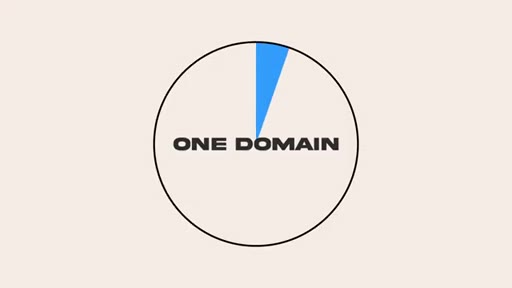
13:24The path starts with one thing at a time. So give yourself one domain to reach at least 80%, maybe 90% mastery of in the next eighteen months.
13:35During that time, try not to measure yourself by what you feel like you're giving up because that thinking will keep you feeling stuck and drained. The gain is that mastering one thing accelerates your capacity to master the next one and the one after that. That is how polymathy actually builds, through sequential depth each domain adding to the last.
13:55CTAA year of going all in on one thing is worth more toward your eventual polymathy than five years of moderate engagement across many things. When you come out the other side with something you are genuinely and seriously good at, you will have a real foundation to stack the next domain onto.
14:11CTASo those are the six archetypes for managing multiple creative interests. Now that you have an idea of which archetype might suit you best, the next best thing is to start that focused work immediately.
— full transcript
§ 05 · For Joe

The framework video that earns trust.

Six archetypes, six named fixes

Joanna Wiebe's copy chops are visible in every archetype name - the video works because every diagnosis has a label and every label has a tool.

  • Name your framework before you explain it. 'The Panoramic Lens', 'Interest Seasons', 'Hub Skill' stick because they are concrete nouns, not abstract advice.
  • Open with an identity lock, not a topic statement. 'If you've been called a jack of all trades' beats 'today we talk about multiple interests.'
  • Six archetypes in 14 minutes is roughly 2 minutes per archetype - that is the pace budget for any framework listicle video.
  • Self-disclosure early earns the right to give advice. Joanna opens with: I built software, ran a consultancy, wrote novels simultaneously. Do not skip this.
  • Graphic card inserts every 2-3 minutes reset attention without needing a new location. One host, one room, one shoot day.
  • No CTA pitch at the end - just action urgency. 'Start that focused work immediately' is more compelling than 'subscribe for more.'
§ 05 · For You

Which one are you?

Pick your archetype, apply the fix

Having too many interests is not a flaw - it is a specific type of person with a specific type of problem, and the fix depends on which type you actually are.

  • If you jump from interest to interest without committing: try the Panoramic Lens - find the one question all your interests are answering.
  • If you connect ideas across fields: build a hub skill (writing, teaching, coding) and treat your other interests as research, not distractions.
  • If you avoid committing because you do not want to be pigeonholed: ask what problem is big enough to contain everything you care about.
  • If you are decent at many things but best at none: you might be a Talent Stacker - all you need is a vision big enough for all the skills to serve.
  • If you love mapping systems but never ship: pick one arena and make your frameworks visible there.
  • If you want to master multiple domains: do them one at a time. One domain to 80-90% mastery before stacking the next is how polymathy actually builds.
§ 06 · Frame Gallery

Visual moments.