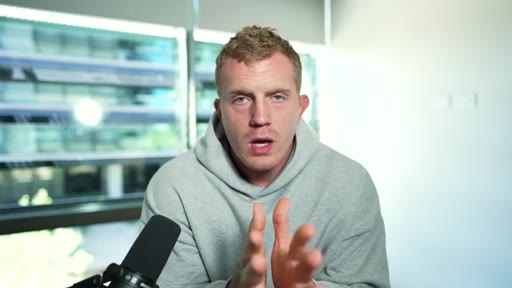
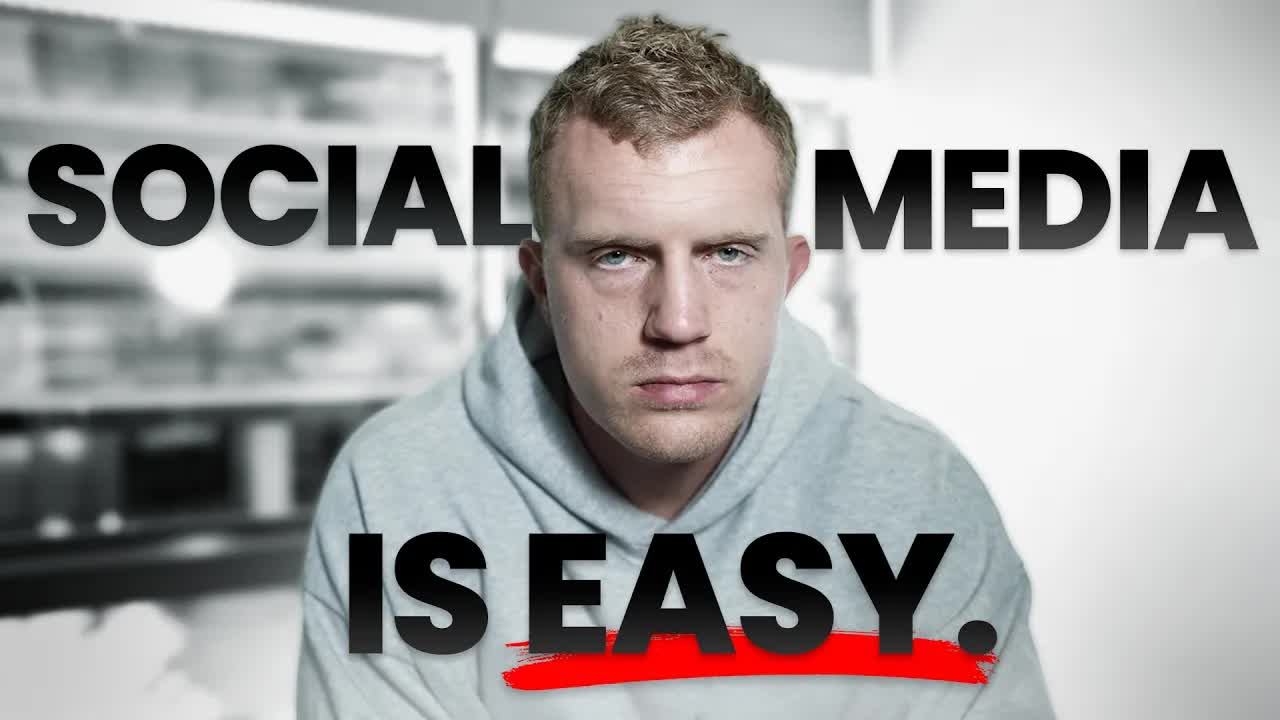
The bait, then the rug-pull.
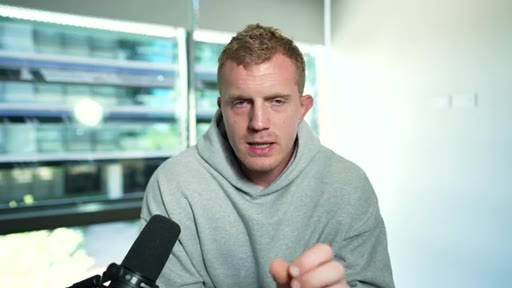
Dan Koe opens by admitting the hook is a hook — then making it land anyway. Seven failed businesses, five years of college Cs, and a web design job he quit after nine months are the credentials behind the arrogance, and they make the two habits feel earned rather than prescribed.
What the video promised.
stated at 06:42 "I can tell you the two levers that you actually need to pull to see social media growth faster." delivered at 07:52
Where the time goes.

01 · Origin story
Seven failed business models gave Dan accumulated skills before he ever touched social. He credits his early growth to not starting from scratch, and frames beginner hell as what happens when social media is your first endeavor.

02 · Lever 1: Validated content
People watch social media to hear familiar topics from fresh opinions. Craig Perry got 230K and 144K views on his first two YT videos by running this playbook. The 'how to get ahead of 99% of people' wave (Dan 1.7M, Mark Manson 4.5M, Hormozi, Bilyeu) proves a single topic sustains multiple massive creators.

03 · Eden product demo
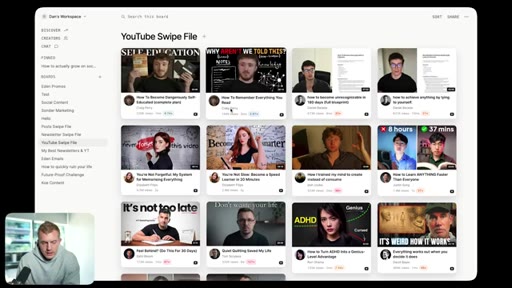
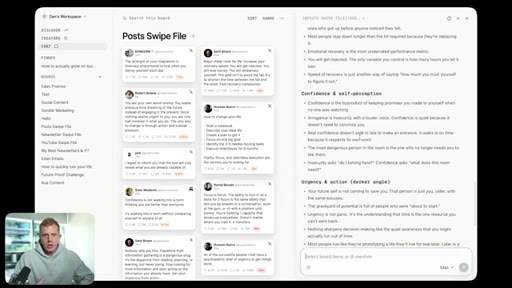
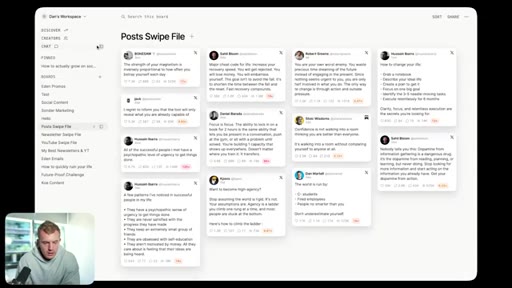
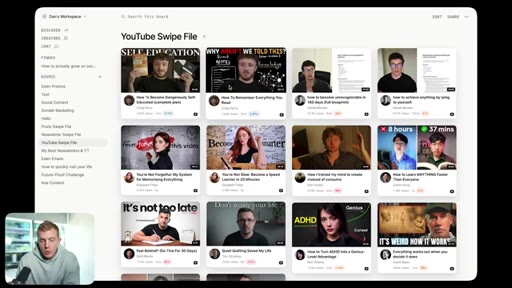
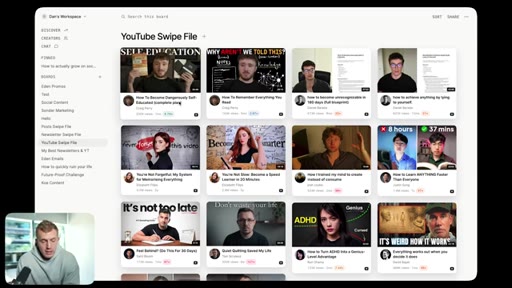
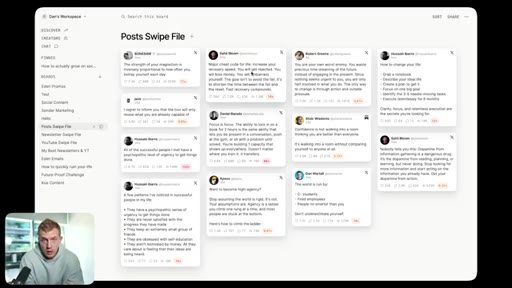
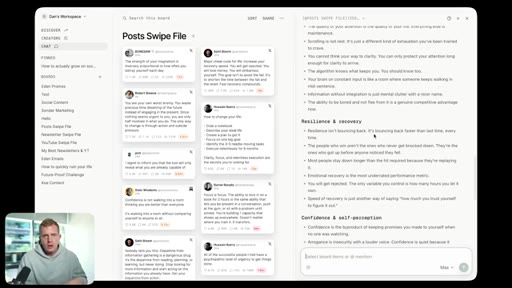
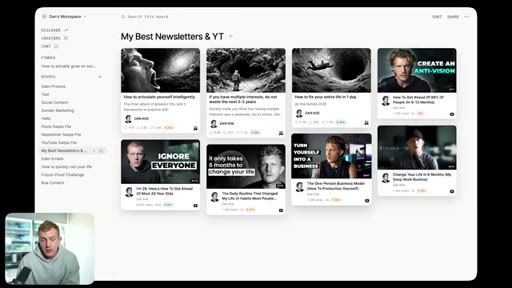
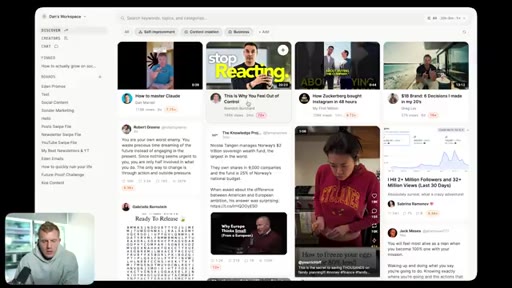
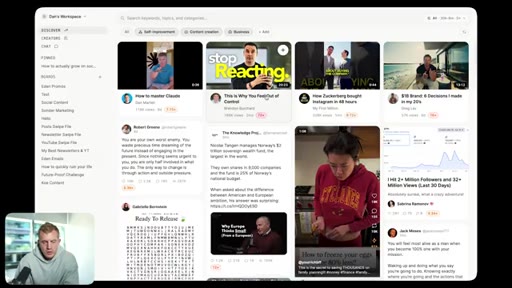
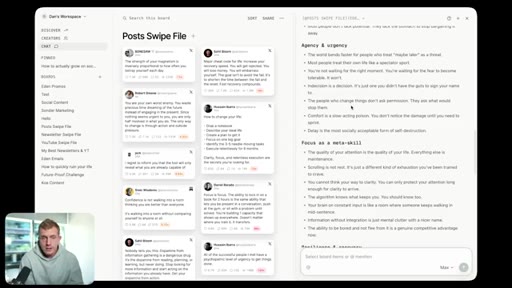
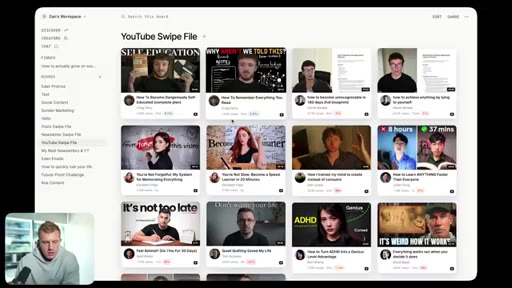
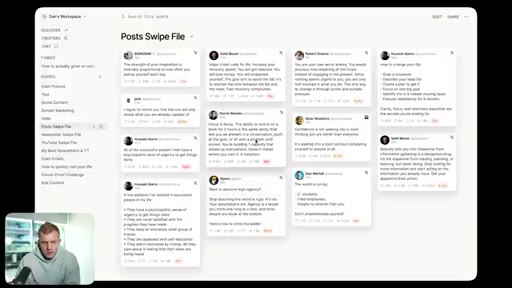
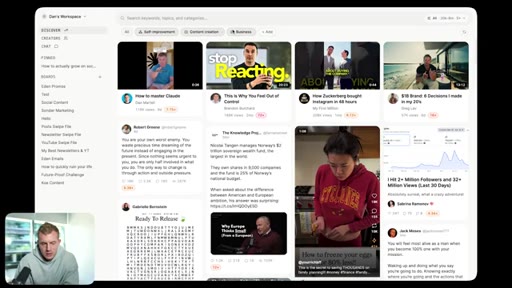
Screen-share of Eden (eden.so): YouTube Swipe File board, Posts Swipe File board, content discovery feed with platform filters, creator top-content search, AI chat over boards for worldview breakdowns and video outlines.

04 · Lever 2: Non-needy networking
The followers you want are currently following someone else. Seven-step framework from DM to genuine friendship to share request. Gym-friend analogy is the clearest metaphor. Key: real friends share great posts for free.

05 · Wrap + CTA
Subscribe CTA plus Eden link in description.
Visual structure at a glance.

Named ideas worth stealing.
Validated Content System
- Find a topic or title that has already performed well
- Add to a swipe file
- Run through AI for iterations, filter for ones that resonate
- Write your own opinion and angle on the validated structure
Study what already works, then bring your own perspective to the same proven territory.
Non-Needy Networking 7 Steps
- 1. Find someone to DM
- 2. Send simple genuine one-sentence praise
- 3. Show interest in what they're building
- 4. Show usefulness — share a resource relevant to their project
- 5. (Optional) Get on a call
- 6. Continue check-ins with articles tweets callbacks
- 7. Ask — share a high-effort post or invite to group chat
Manual algorithm bypass: build genuine creator friendships, then ask them to share your best content.
Proven Topic Wave Pattern
Topics cycle: explode, exhaust, reset, explode again. 'How to get ahead of 99% of people' ran through Dan Koe (1.7M), Mark Manson (4.5M), Alex Hormozi, and Tom Bilyeu — each making a completely different video on the same title.
Lines you could clip.
"If I had an ounce of muscle for every time that I've watched a nutrition one zero one video or just some creator's opinion on nutrition, I'd be Ronnie Coleman."
"Yes. AI gives you superpowers, but when everyone has superpowers, nobody has superpowers."
"Social media is like a video game. They have specific mechanics and levers you can learn and pull."
"Most people in today's world are antisocial. You would think that more people being on social media would be more social, but they're not."
How they spent the runtime.
Things they pointed at.
How they asked for the click.
"If you want to research outlier content or have a place to write high performing content, check out the new version of Eden."
Soft and earned — the entire middle third is a live demo so the CTA feels like a natural extension. No hard sell. Link in description only.
Word for word.
Two levers. Pull both.
Stop trying to come up with original ideas and start doing what already works — from your own angle — while building five real creator friendships who will share your best posts.
- Build a live swipe file of validated titles and posts — YouTube search plus top-filter on creator profiles.
- For every piece of content ask: what already-proven topic can I put my own opinion on?
- Time-block 30 min/day: 15 min writing validated content, 15 min genuine DMs to 3-5 creator peers.
- The gym-friend analogy is the networking template: casual contact, shared interest, mutual support, ask.
- The product-demo-inside-an-education-video format is the CTA template — use it for JoeFlow ModBoard and Clip Lab launches.
- Watch for topic waves coming back up — own your stack and self-host everything are overdue for a new explosion cycle.
- Non-needy networking removes algorithm dependency entirely — it is a manual growth lever you can pull any time.
You don't need a new idea. You need your own take on a good one.
The creators who grow aren't the ones with the most original thoughts — they're the ones willing to put their own honest perspective on topics people are already hungry for.
- Find a video or post you loved. Search that topic on YouTube. See how many creators have already made a version of it.
- Ask yourself: what's my actual take on this? What do I know from my own life that adds to it?
- Write or record that version. It's not copying — it's entering a conversation that already exists.
- Pick three people doing similar things and just be a real friend to them. Send them something useful. Check in. Ask nothing for a while.
- Growth feels slow at first because it compounds later — the two habits just need to be consistent, not perfect.