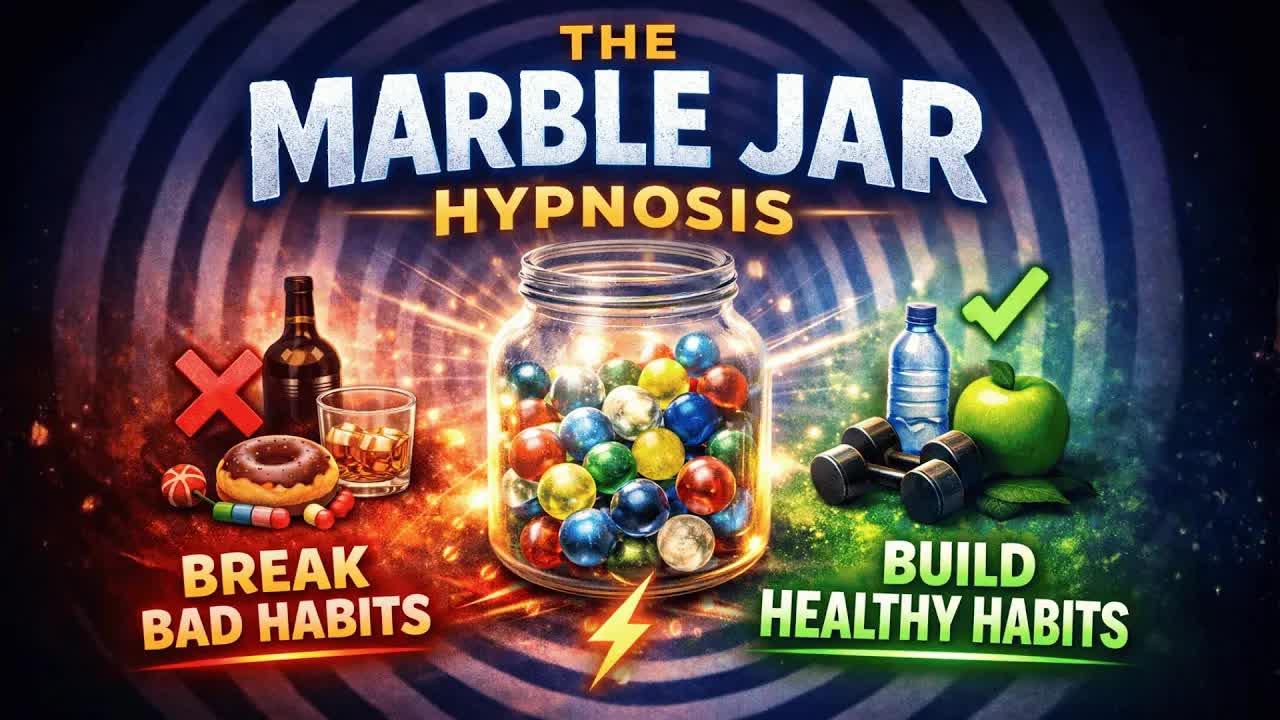
The bait, then the rug-pull.
The Hypnotist opens with a bet: you have at least one habit that is costing you something — energy, health, self-respect. The session that follows does not ask you to fight that habit. It asks you to stop wanting it.
Where the time goes.
01 · Intro and disclaimer
Legal disclaimer card, podcast jingle, show intro narration.

02 · Pre-session briefing
Adam explains the Whack-a-Mole replacement trap, introduces the Marble Jar physical reinforcement technique, and sets the session context: wine and sugar habits.

03 · Induction
Deep breathing guidance, progressive body relaxation, safe-place visualization, countdown from 10 to 1 into deep trance state.

04 · Alcohol identity reframe
Shifts listener identity from trying not to drink to someone who simply does not drink — modeled on the non-smoker who needs no willpower to avoid cigarettes.

05 · Refined sugar reframe
Frames refined sugar as a drug with cocaine-equivalent reward pathway activation, explains the spike-crash cycle, builds visceral recognition of what refined sugar does to the body.

06 · Choosing your addiction
Explains the brain reward-system engineering behind habit substitution; invites the listener to consciously redirect the dopamine drive toward movement, accomplishment, and real reward.
07 · Marble Jar visualization
Guides a vivid imagining of the physical jar filling with marbles across 6 months, future self assessment, intentional door closing and opening.

08 · Wake-up and return
Count 1 to 10 to return from trance, finger and toe wiggle, calibration to the present.

09 · Outro
Rating request, share prompt, ad-free subscription CTA for hypnosis-only version.
Lines you could clip.
"You are not someone who wants to drink, but is trying not to drink. You are someone who simply does not drink because you simply do not want to."
"The reward pathway activated by refined sugar is the same reward pathway activated by cocaine. The mechanisms of craving is chemically identical."
"What do you want to be addicted to? That drive to seek reward and pleasure is not going away. Nor would you want it to. The question is only ever — toward what shall this drive be aimed?"
"A substance gives the feeling of reward without the underlying reality. Whereas accomplishment gives the feeling of reward because of the underlying reality."
Things they pointed at.
Word for word.
Identity beats willpower every time.
The gap between trying not to and simply do not want is the entire distance between struggle and freedom — and the Marble Jar makes the healthy replacement feel as rewarding as the habit it replaces.
- Willpower keeps you attached to the thing you are resisting; identity reframing removes the attachment entirely, the way a lifelong non-smoker has no urge to resist a cigarette.
- The brain does not tolerate a closed dopamine door — when one habit is removed, it immediately searches for the nearest replacement, which is why intentional habit substitution must be deliberate, not accidental.
- Refined sugar activates the same reward pathway as cocaine, builds the same tolerance, and produces real withdrawal symptoms — the framing matters because it defuses the just a treat rationalization.
- The Marble Jar creates three separate reward moments from a single healthy choice: the act itself, the physical drop of the marble, and the visual accumulation over time — compounding behavioral reinforcement.
- Accomplishment and movement produce the same neurochemicals as substances, but the reward is proportionate to the underlying reality — it is earned rather than borrowed against future cost.
- The question is never how to eliminate the drive for reward, but toward what to aim it — redirecting an existing drive is more sustainable than suppressing a biological system.