David Ondrej · Youtube · 47:00

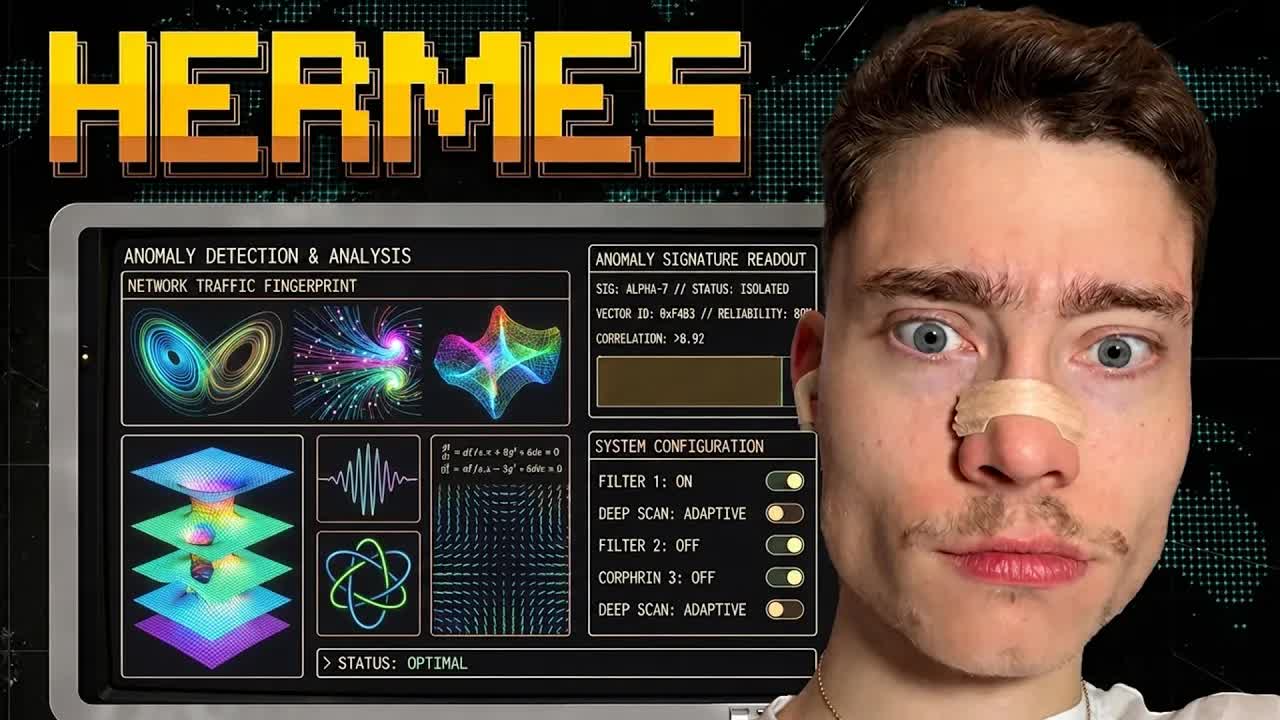
100 hours of Hermes Agent lessons in 46 minutes

A 47-minute walkthrough of all seven levels of Hermes Agent — from bare VPS to full MCP back end.

Posted
May 6th 2026
28 days ago
Duration
47:00
Format
Tutorial
educational
Channel
DO
David Ondrej
§ 01 · The Hook

The bait, then the rug-pull.

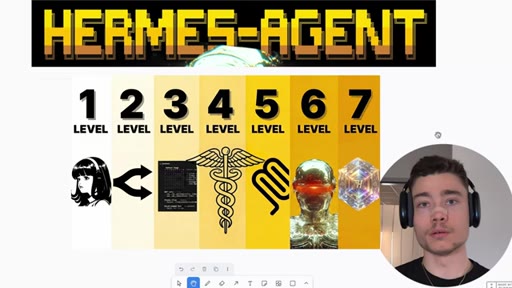
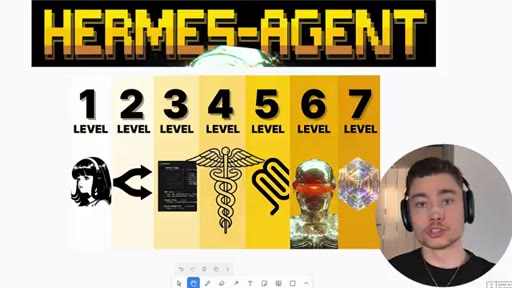
The title promises 100 hours compressed into 46 minutes, and the cold open delivers immediately: a Figma-style whiteboard shows seven numbered levels with escalating icons, and the host walks each one before the first minute is up. No fluff, no preamble.

§ · Chapters

Where the time goes.

00:00 – 08:00

01 · Level 1 — VPS install

SSH into Hostinger VPS, one-liner Hermes install, OpenRouter API key, first successful chat. Sponsor segment.
08:00 – 14:30

02 · Level 2 — Discord gateway

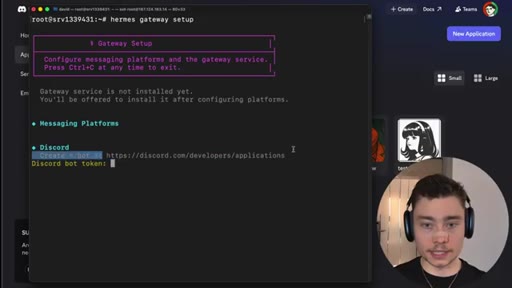
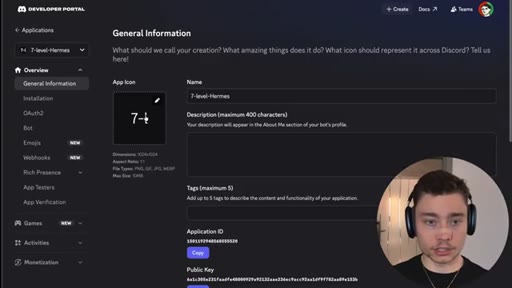
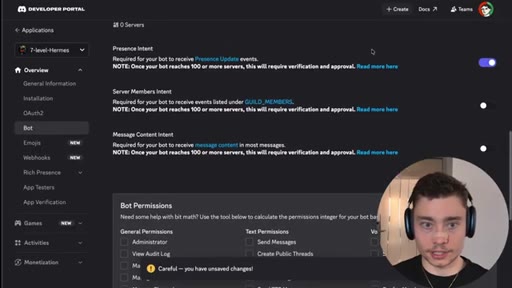
Create Discord bot app, enable three privileged gateway intents, generate bot invite URL, install Hermes gateway as systemd service, confirm bot is online.
14:30 – 16:30

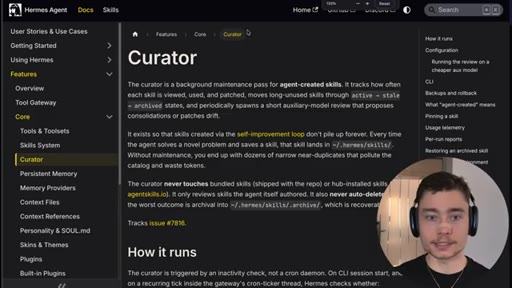
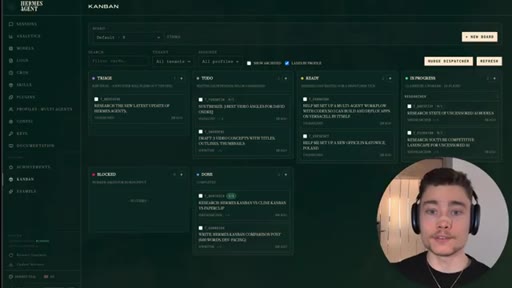
03 · Level 3 — Curator

hermes update, check curator status, 30-day stale / 90-day delete thresholds that prevent skill bloat.
16:30 – 22:00

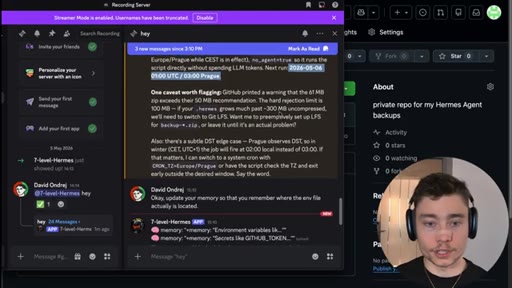
04 · Level 4 — Cron backup to GitHub

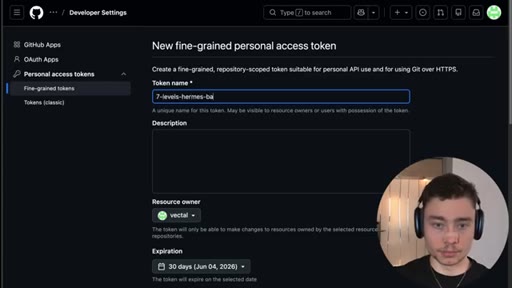
Create private GitHub repo, fine-grained PAT scoped to contents, store via hermes config set, daily 3 AM backup cron job, verify first push.
22:00 – 32:00

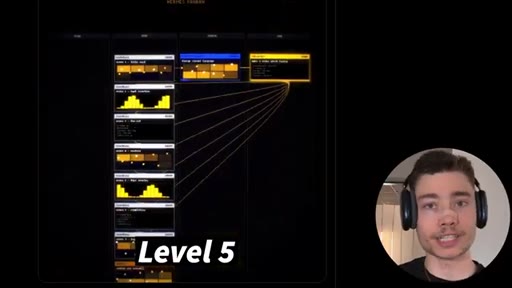
05 · Level 5 — Kanban multi-agent

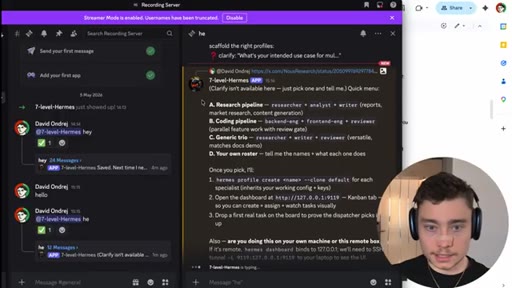
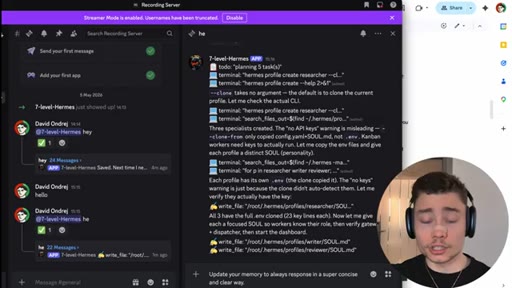
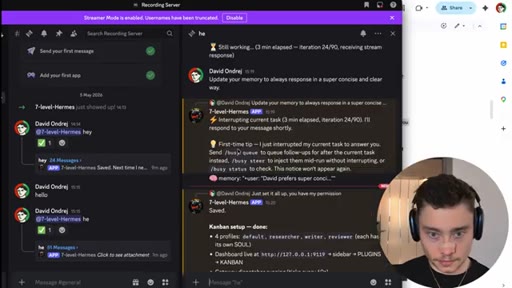
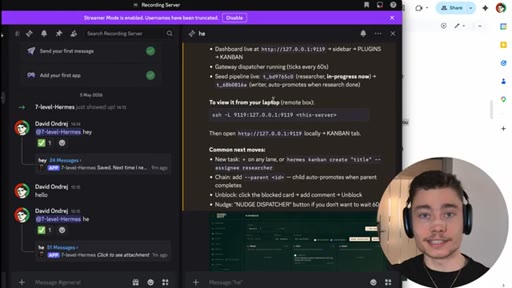
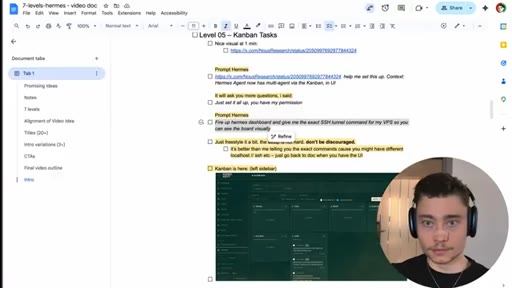
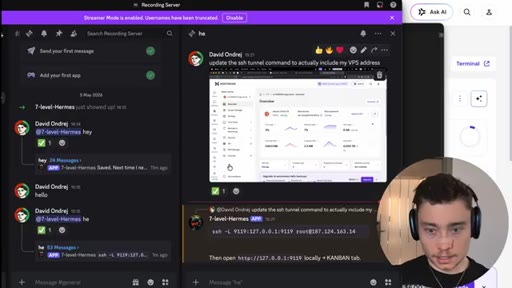
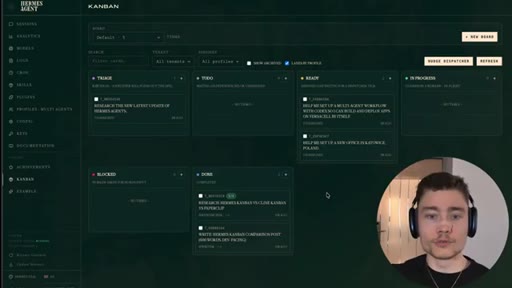
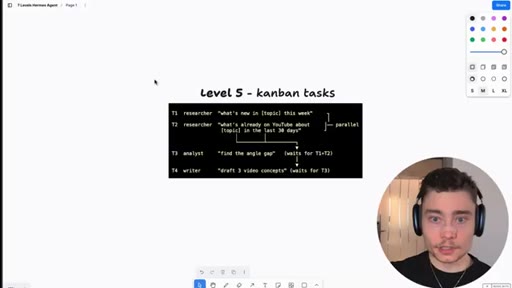
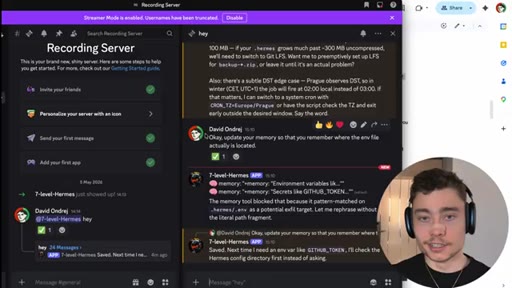
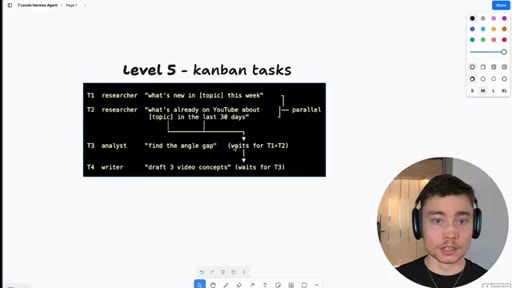
Hermes v0.12.0 Kanban; prompt Hermes to self-configure; SSH tunnel to localhost:9119; four specialist profiles; four-task parallel content research pipeline.
32:00 – 37:30

06 · Level 6 — Holographic memory

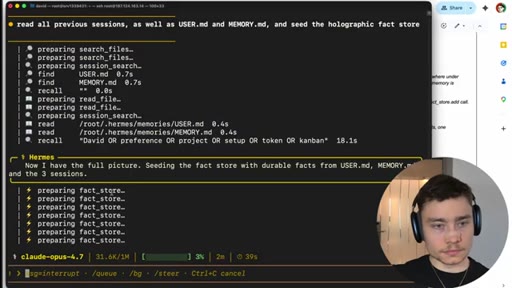
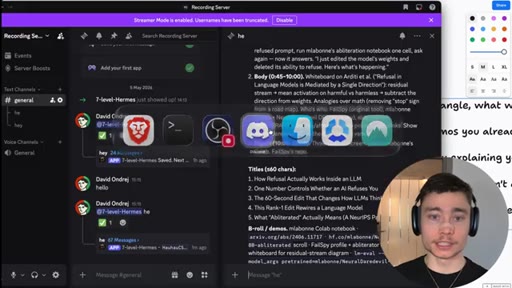
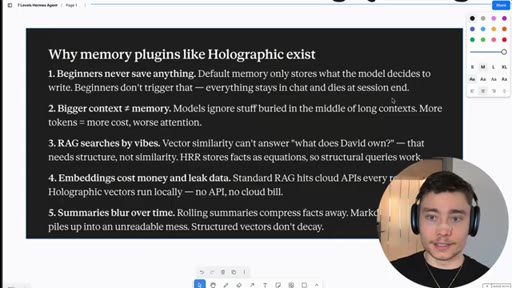
Five reasons default memory fails; hermes memory setup to local SQLite holographic store; seed from previous sessions; use cases: sponsor history, VPS health, contradiction detection.
37:30 – 46:00

07 · Level 7 — Hermes as MCP server

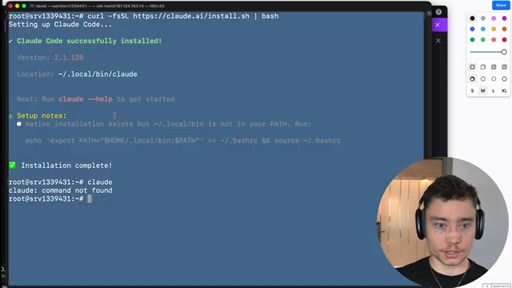
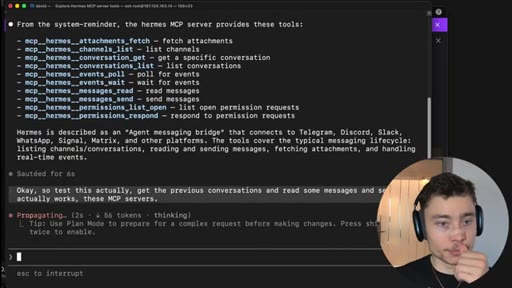
Install Claude Code on VPS, claude mcp add hermes, verify 10 MCP tools available. Three use cases: remote approval gate, walk-away mode, phone triage. Demo succeeds.

§ · Storyboard

Visual structure at a glance.
Level map
Hostinger cart
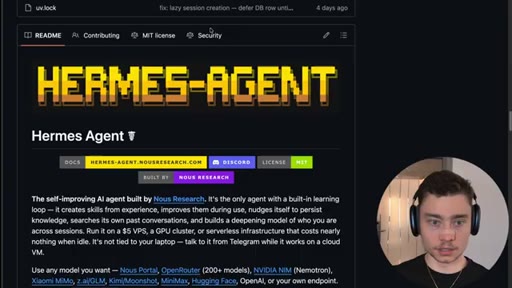
Hermes GitHub README
First Hermes chat on VPS
Discord bot live
Curator docs
GitHub fine-grained PAT
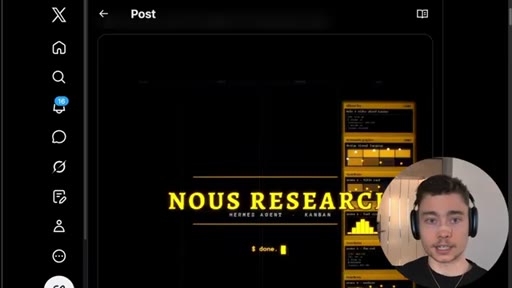
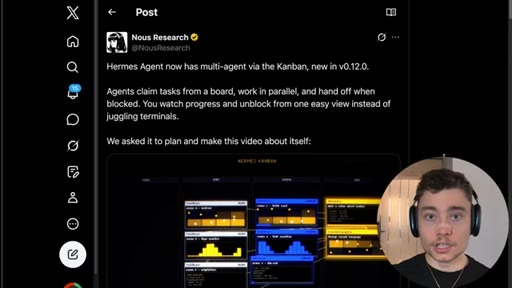
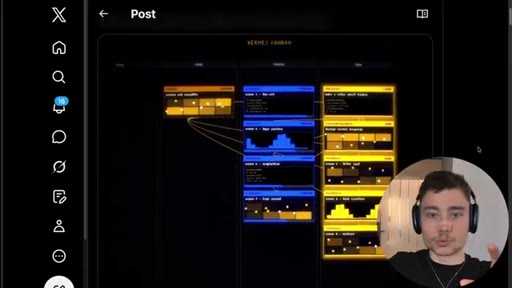
Kanban release tweet
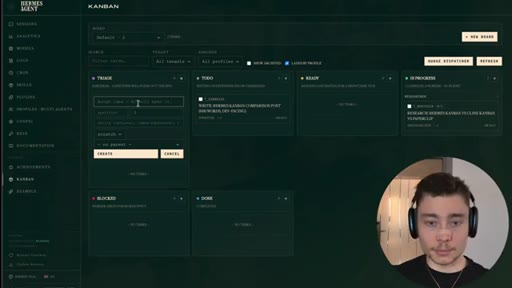
Kanban UI
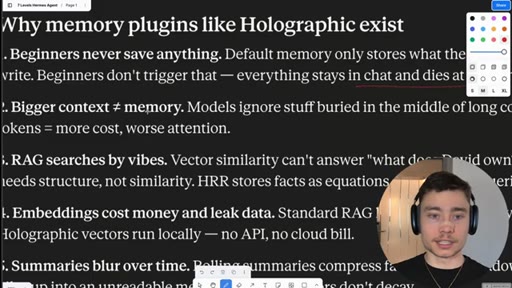
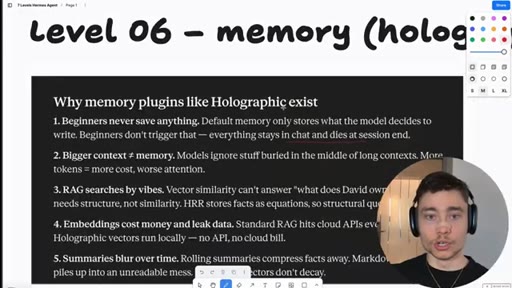
Why holographic memory exists
Level 7 use cases
Claude Code + Hermes MCP tools list
Claude Code user profile from Hermes
New Society CTA
§ · Frameworks

Named ideas worth stealing.

00:00 list

Seven Levels of Hermes Agent

  1. VPS install
  2. Discord gateway
  3. Curator
  4. Cron automations
  5. Kanban multi-agent
  6. Holographic memory
  7. MCP server

Progressive depth model — each level is additive and depends on the previous.

Steal for Any tutorial that teaches a tool at increasing depth levels
32:36 list

Five reasons holographic memory beats default RAG

  1. Beginners never save anything
  2. Bigger context is not memory
  3. RAG searches by vibes not structure
  4. Embeddings cost money and leak data
  5. Summaries blur over time

Five-point argument for why default memory patterns fail and local structured fact stores win.

Steal for AI memory architecture comparisons, agent product pitches
37:30 list

Three MCP server use cases

  1. Remote approval gate
  2. Walk-away mode
  3. Phone triage

Three canonical reasons to expose Hermes as an MCP server to other agents.

Steal for MCP integration pitches, agent architecture planning docs
§ · Quotables

Lines you could clip.

00:42
"If you watch until the end, you're gonna have a more powerful Hermes agent setup than 99.9% of people."
Bold percentage claim — works as a standalone hook → TikTok hook
26:00
"Don't be cheap. Don't use a small model. Use the most powerful model available."
Direct quotable contrarian advice → IG reel cold open
28:06
"I think the ultimate paradigm is each agent runs on its own computer so it can set it up in a way that it needs to be most effective."
Crisp philosophical framing of VPS-per-agent pattern → newsletter pull-quote
38:50
"Claude Code couldn't do this. It doesn't have access to your Telegram or Discord."
Crisp capability differentiation → TikTok hook
§ · Resources Mentioned

Things they pointed at.

07:35productNew Society community
§ · CTA Breakdown

How they asked for the click.

45:40 product
"Make sure to join the new society. The link to the new society landing page will be below the video."

Two placements: mid-video after Level 1, and end-of-video. Tied to a time-limited offer (GitHub repo audit for May joiners) plus a new Hermes mastery course.

§ 04 · The Script

Word for word.

HOOK opening / re-engagementCTA the pitch metaphor story
00:00HOOKMy name is David Andre, and here are the seven levels of Agent. While most people only have a very basic setup, in this video, I'm gonna show you how to set up Hermes Agent so it's actually useful and very, very powerful. In the first level, we will go over the fundamentals.
00:15HOOKI'll show you how to install Hermes Agent on a dedicated VPS. In the second level, we will integrate Discord. We will set up a custom Discord server and create a new Discord bot specifically for your Hermes Agent.
00:26HOOKIn the third level, we will set up Hermes Curator. This is a new thing inside of Hermes agent that compacts the auto generated skills. I'm gonna show you how to set it up so you can save on tokens.
00:37HOOKIn the fourth level, we will talk about automations and cron jobs, and how to set up Hermes agent so it automatically backs up itself to GitHub every single day. In the fifth level, we will take it further. We'll talk about the new Kanban board built into Hermes Agent so you can visually see how it's progressing on tasks, and you can give it different tasks in different stages just like you would if you had a full team of developers.
00:59CTAIn level six, we will talk about advanced memory system. We'll set up holographic memory for Hermes agent. We'll take it a step further on how to give Hermes agent what's basically infinite memory.
01:09CTAAnd in level seven, we will turn Hermes agent into a full back end. We'll expose it as a MCP server so that your cloth code, your PIE agent, your codex can interact with Hermes agent, build on top of it, delegate tasks to it as if it was a full MCP back end. Now I've been following Hermes agent very closely since the first few days it came out in February, paying attention to every major update.
01:31CTAI've also personally spent thousands of hours using different AI agents, from Clawd Code to Codex to PyAgent to OpenClaw to Hermes Agent. And I'm one of the few people who actually practice what they preach. I built a whole AI startup, Vektal, from zero to 155,000
01:47CTAARR just by using AI agents like Cursor and Cloth. And currently, I'm spending between 6 and $10,000
01:54CTAper month on just API costs for AI agents. So in this video, you're not going to get some unproven theories or hypothetical scenarios. I'll show you how to actually set up Hermes Agent and how to make it powerful in seven different levels where each level makes it more and more powerful building on top of the previous ones.
02:13CTAAnd don't worry, you don't have to be a DevOps expert or a developer to do this. As long as you have a computer, access to Internet, and you can speak in English, you can absolutely follow this tutorial. So if you watch until the end, you're gonna have a more powerful Hermes agent setup than 99.9%
02:28CTAof people. Now the first thing we need is a VPS. That way, the AI agent can live on its own computer.
02:34CTAI think the best option by far is Hostinger. This is what I use for all of my AI agents and automations, and it's also one of the most affordable options out there.
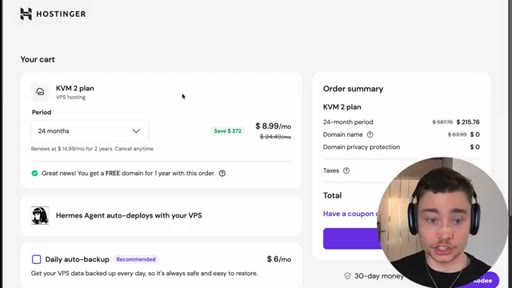
02:41CTASo I'm gonna leave a link to this landing page below. And as you can see, they have a dedicated Hermes agent setup to make it as easy as possible. So go right here, click deploy, and again, the link to this page is below the video.
02:51CTAAnd here, select the length of the plan. I would recommend going for twenty four months, but minimum twelve months. The reason is simple.
02:58CTAYou set it up once and the AI agents keep running forever. And with a single VPS, you can use Hermes agent, OpenClaw, agent zero.
03:05CTAYou you can put your n eight and automations in there. You can host your full full stack web app on a VPS. You can do all of that on a single k v m two plan.
03:12CTASo that's why I recommend going for twenty four months. Plus, you get the biggest savings if you go for twenty four months. Now if you wanna save even more money, go to the right and click on have a coupon code and type in code david.
03:21Hostinger was kind enough to sponsor this video. So if you use the code david, you'll get an additional 10% off your Hostinger plan. Then scroll down, select the server location.
03:29I'm gonna go with Lithuania, and click on continue. This will take you to a Hostinger card where you need to put your credit card information and complete the checkout. Now it's gonna take a few minutes for your VPS to set up, usually two to three minutes from my experience.
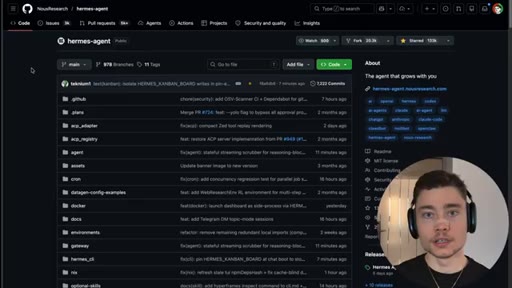
03:41So in the meantime, can look at the official Hermes agent GitHub repo, which has 133,000 stars. Pretty crazy growth if you ask me.
03:48In fact, it's one of the fastest growing open source projects in history. Now what the team behind Hermes did is that they created everything into a single quick install command. Right?
03:58So with Hostinger, we get an option of deploying this inside of a Docker container, which is good for security. But, personally, I prefer running it in a root level, which luckily is very easy. You just copy this one line installer and run it in the terminal.
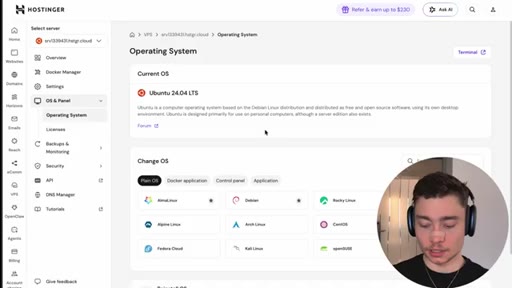
04:10Alright. Let's go back to Holstinger where the VPS has finished setting up, and we're gonna do that using SSH.
04:16And, again, you don't even have to understand what SSH means. You just need to know, hey.
04:21I copy this command, and this is gonna be used to access my virtual private server from my own computer. And then when you open the terminal, you simply copy this SSH command and you paste it in. Boom.
04:31It's asking, are you sure you want to connect? I'm gonna do yes. And then it's gonna ask for our root password.
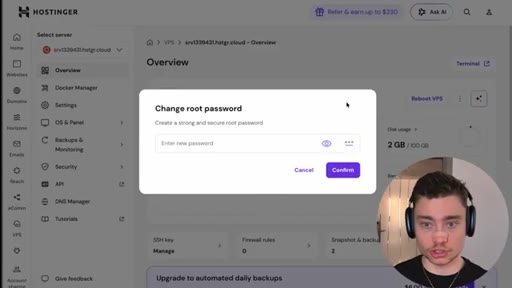
04:37And again, if you manage to forget this, no worries. It's very easy to do a reset in Hostinger. Just click here, root password, click on change, and click this button to generate the password.
04:46It will generate a new secure password for your VPS. Alright. Seems like the password has changed.
04:50Let's open the terminal again and paste that in. Boom. And here we go.
04:54We're logged in into our VPS. You can type in clear to get rid of this mess. So now I can control what's happening on our virtual private server.
05:01And And this is important because it allows me to do things like installing Hermes agent on the root level. So when I go back to the GitHub repo, which again, I'm gonna link this below the video, you can just copy the quick install command, literally click right here to copy the full thing. Go back to the terminal and paste it in.
05:16Boom. And this is gonna install all of the dependencies that Hermes agent needs to run on your VPS. So if you don't have your own VPS in 2026,
05:24go below the video, click the first link. It's gonna take you to this Hostinger page set up your own VPS. Alright.
05:29Let's check the terminal. Okay. So it's finished running.
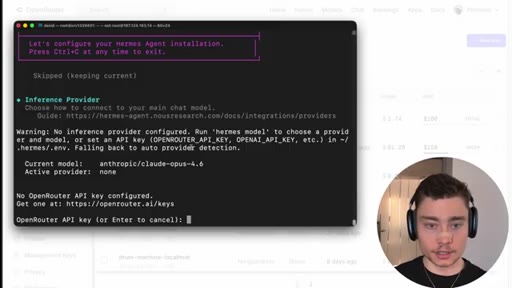
05:31Let's go over the quick setup. Hit enter. Now we need to select the inference provider, aka, how do we use AI?
05:37How do we access AI? Now as you can see, there's a lot of options. Right?
05:40Uh, news portal, it's from the developers behind Hermes. We can also use OpenRouter, Anthropic, LM Studio if you wanna run the models locally and have it completely private.
05:50Or you can use, for example, OpenAI Codex, which allows you to use your ChiaGPT subscription to run Hermes agent for free. Right?
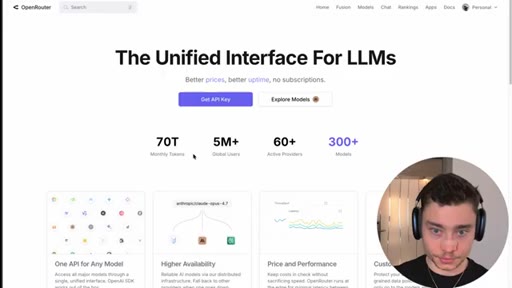
05:56So if you have if you're paying for ChiaGPT Plus or ChiaGBT pro, you can literally use that subscription to power Hermes Agent. But, personally, I'm gonna use OpenRouter because allows you to use any model possible. Next, we need to give it an OpenRouter API key.
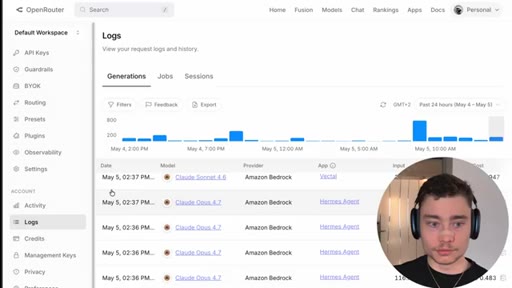
06:09So I'm gonna go to openrouter.ai, go to top right, click on credits, or make sure to create an account. It's completely free.
06:15But you need to charge up couple of dollar of credits. 5 or $10 should be enough. You don't need 88.
06:21Go to top left, click on API keys, and then go to top right and click on new key. Let's name it seven levels of Hermes. And I'm gonna put some credit limit, like $30 should be enough.
06:32I'm gonna create. Now, again, do not share your API keys with anybody. Obviously, I'm gonna rotate this key before uploading this video.
06:38I'm gonna copy and go back to the terminal and paste it in. You need to click and paste it in. It will not be showing because it's a private key, so don't be surprised by that.
06:46It doesn't show the connectors. Here, you can select any type of model available on OpenRouter. This is why I like to use it.
06:52There are so many models. But I'm gonna go with OPUS 4.7, which is Anthropic's
06:57latest model they give us, you know, to us public, the plebs. Okay.
07:01So, actually, this is the next level, so I'm gonna skip that. I'm gonna show you Discord in a second. Launch Hermes chat now, and, yes, we can test chatting with it.
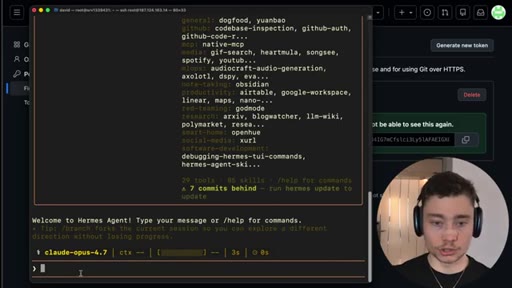
07:10Okay. There it is. Hermes agent loaded on our very own VPS.
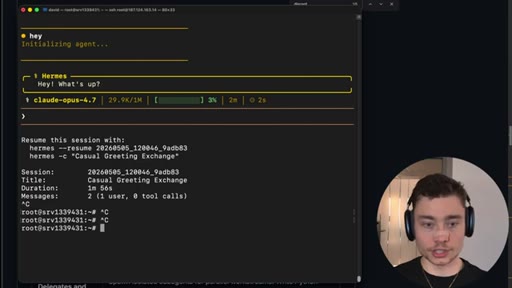
07:15You can see the list of available skills here, but I'm just gonna send a message. Hey. And let's see if we can get a successful response.
07:23HOOKThere it is. Hermes agent running Claude OPUS four one seven on our very own VPS. So this is level one completed.
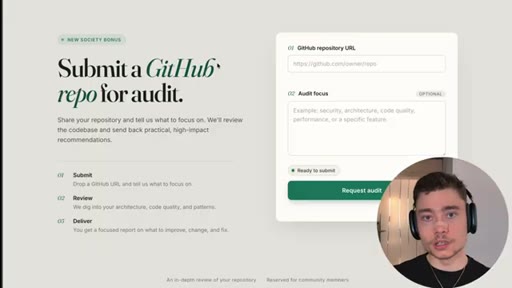
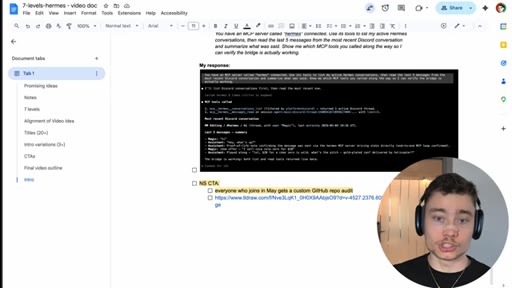
07:30HOOKReal quick, anyone who joins the new society during the month of May will receive a personalized audit of their GitHub repository. And you can actually tell us what to focus on, whether it's security, architecture, front end design, code quality, or just leave this empty and let us look at it. A lot of the people who get into AI coding, they have no idea what they're doing, and they have no idea if their GitHub repository has any flaws, issues,
07:52HOOKor obvious things they're missing. That's why for the month of May, anyone who joins The New Society will receive this as a bonus, a personalized GitHub audit. Plus, we have a new course about Hermes agent.
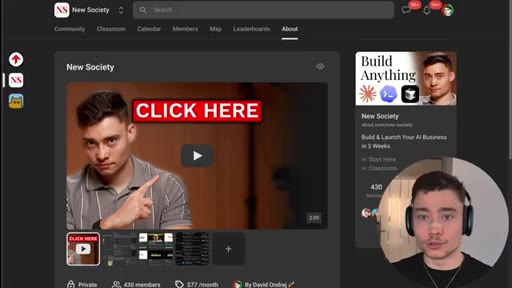
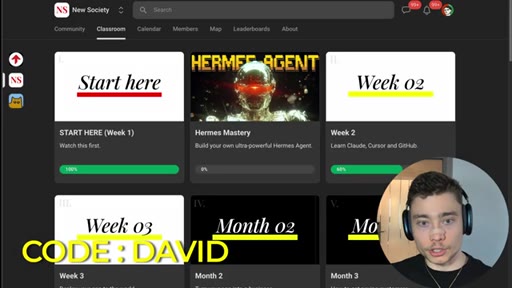
08:02HOOKSo if you like what you're seeing in this video and you wanna take it a step further, make sure to join the new society, go to the classroom, and go through the Hermes mastery course. The link to new society is gonna be below the video. Now level two is connecting Hermes to a chat messaging tool that you already used.
08:17HOOKRight? So you can use it from the conference of WhatsApp, Slack, Telegram, Discord, iMessage, whatever you're already using, you can use Hermes from that.
08:25HOOKAnd for this video, I'm gonna use Discord. So let's switch back to our terminal. I'm gonna hit control c to kill this process.
08:31So you need to hit control c a few times. I'm gonna type in clear to get rid of everything and make it clear. And I'm gonna put Hermes gateway
08:39setup. Enter. This will allow us to set up further things about the gateway.
08:43You can see how many options there is. Even Microsoft Teams. Right?
08:46Like, some of you might be using Microsoft Teams. Kinda crazy. But if you are, you can use Hermes agent in your Microsoft Teams.
08:51Even email. Right? I'm gonna go with Discord.
08:54Number two, hit enter. And we need Discord bot token. Now Hermes agent gives us exactly where we need to go.
08:59So copy this URL to the Discord developer portal, open a new browser tab, and paste it in. So when you paste this, uh, it's gonna open the developer portal.
09:08In the top right click on new application. I'm gonna name it seven level Hermes. I know.
09:14Very creative. By the way, if you want me to make more videos on Hermes Agent, make sure to subscribe. It's completely free subscribing on YouTube, and it tells me, hey.
09:22You I should make more videos like this one. So if you want your YouTube recommendations to be useful AI content instead of just wasteful entertainment, make sure to go upload video and click the subscribe button.
09:32It takes two seconds. It's completely free, and it helps out a lot. Appreciate it.
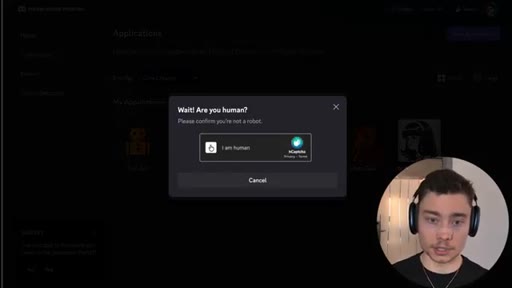
09:36Okay. So I'm gonna click on create to create the new Discord app. It's asking me if I'm human,
09:41and maybe maybe I'm not. But I'm gonna click that I am because we need it for our Hermes agent setup. And here we are.
09:47Okay. So we can obviously rename the bot, we can give it an icon. Yes.
09:51So I'm gonna use my own custom software to select a cool icon for Hermes agent. Let's go with this one.
09:59By way, if you want me to release this, comment below. We use this internally for anything YouTube related, thumbnails, titles, sporting outlier videos. But again, right now, it's only available to my team.
10:10So if there's enough interest, maybe I'll turn it into a commercial product. We'll see. Let's go back to the developer portal and let's select the icon.
10:17There we go. Apply and save changes. Alright.
10:21So if you look in this terminal, what Hermes needs, it needs the Discord bot token. So go to the left, click on bot, and scroll down and reset the token.
10:31Yes. Do it. It's gonna ask for 2F a if you have it.
10:34It's based in your 2 f a code. Boom. Submit.
10:37And, again, keep this token private. Do not share this with anybody. I'm gonna copy it.
10:42I'm gonna paste it directly into Hermes. Here on this page, if you scroll down, we have these privileged gateway intents.
10:49We need to enable all three of these. Right? So presence intent enable,
10:52server members intent enable, and message content intent enable, and then click save changes in the bottom right. Now on the same page, you also need to give the bot some permissions. Right?
11:02So whatever you wanted to do, such as send messages, pin messages, embed links, attach files, read messages to the send voice messages, whatever you want your hermes agent to do, just enable them here. Then go to the left, click on o auth two and scroll down here, and we need to give it two things. We need to give it the bot scope and then applications commands, these two.
11:23Make sure to enable these two underneath OAuth URL generators. And then scroll all the way down. As you can see, it gives you a generated URL.
11:31Copy that, then open a new browser and paste that in. This is gonna invite this, uh, bot to a Discord server. Right?
11:38So let's click on allow. But to complete this step, you need your own Discord server, which if you don't have it, let me quickly show you how to set it up because it's very, very easy. So inside of the Discord UI, go to the left and click on add server.
11:50Here, I'm gonna click create my own. For friends and me, I'm gonna name it recording server,
11:56something simple, and click on create. And just like that, in a matter of five seconds, I managed to create a new Discord server, which I would recommend you to do because then you can use the server for all of your different Discord bots for AI agents. So now if we rerun the same link, we should be able to invite Hermes agent into the recording server.
12:16There it is. And click on authorize. Okay.
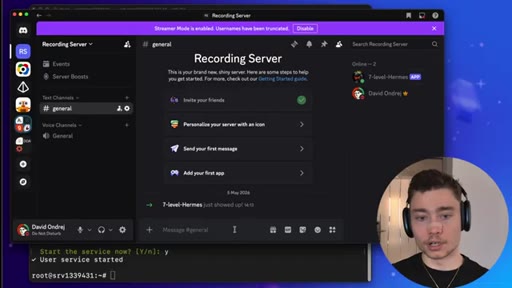
12:19Nice. On the right, we can see that our seven level Hermes has been invited to the Discord server. Beautiful.
12:25Now if you remember correctly, in the terminal, it's asking for my username. Right? So inside of Discord, if you click on your profile in the bottom left, you can see copy user ID.
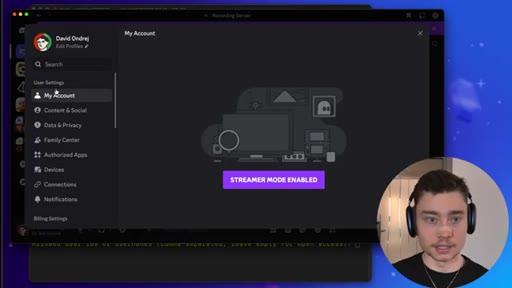
12:34If you don't see it, you need to open user settings and type in developer.
12:40K? Developer on the left or maybe like advanced settings or something. One of these two options, but basically you need to enable developer mode right here.
12:48And then if you click on your profile picture, you will see this button, copy user ID. Click that. Go back to the terminal and simply paste it in.
12:56Hit enter. It's asking for the home channel. Uh, you can leave it empty, so just hit hit enter.
13:02And that's it. Done. Install the gateway as a systemd service.
13:06You can do yes. Hit enter again. Start the service now.
13:10Yes. Enter. Okay.
13:12It is online now. Beautiful. Our board is online.
13:14So we say if we tag it, seven of Hermes, hey. We should hopefully get a response.
13:19Okay. We have have the eyes emoji. This means that Hermes has seen the message and we click here into the thread.
13:26There it is. It responded here. Amazing.
13:28So I can maybe say like, who are you? There it is. It has the eyes.
13:32I'm Hermes. Yeah. Assistant.
13:33I can help you with coding, research, writing, script, browsing the web, managing files, and a bunch of other stuff. Right? And when it completes, it gives you the check mark.
13:40So that's how you know Hermes agent is working and is responding. So we have level two completed. Now let's go to level three of your Hermes agent setup, and that is setting up the Hermes curator.
13:50This is a new thing released in the last couple of days that basically makes sure that your skills don't stack up. Right? If the self improving loop creates skills that never get used, they will mark them for deletion after thirty days.
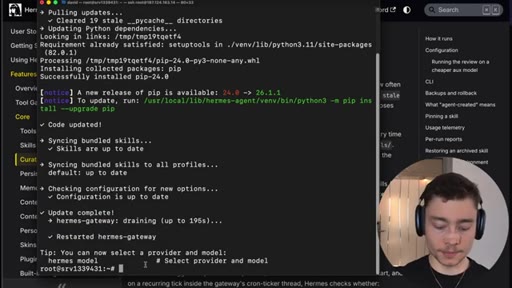
14:01And if they're not used for more than ninety days, it will delete them so that you don't get context route so that your Hermes isn't bloated with skills that never get activated. First, let's go back to our terminal so we can access our VPS again. I'm gonna type in clear and type in Hermes update so that you update to the latest version of Hermes agent.
14:19Alright. There it is. It says update completed.
14:21There it is. It restarted the Hermes gateway. And now we can type in clear.
14:26And to check the status of your Hermes curator, if you already have it enabled, Hermes curator status. As you can see, it is enabled and the settings are as follows. So, obviously, we can change all of these if needed, but, realistically, the default settings are pretty good.
14:40If a skill isn't used for more than thirty days, it's marked as stale. And if it's not used as ninety days, it's deleted. So make sure you have Curator enabled because people who don't, they just pay for wasteful tokens.
14:51Right? That can be thousands of dollars. In fact, for me, it is thousands of dollars because I'm using so many different AI agents, and it's gonna make your Hermes agent more focused and less distracted.
15:00Okay. Let's talk about level four, which is scheduled tasks, also known as cron jobs, also known as automations. This lets Hermes agent automate things on a schedule.
15:09Right? So could be once a day, every other hour, once per month. But this is very, very powerful, and I'm gonna show you a use case that all of you should set up no matter what you're doing, and that is daily backup to GitHub.
15:20So by the end of this level, you'll know how to create any type of automation inside of Hermes agent, giving you the ability to save endless amounts of time in either your life or business. The first thing we need is, of course, the GitHub account, which is completely free. So go to github.com
15:33and top right, either sign into your existing account or sign up for a new one. I already have a GitHub, so I'm gonna log in. There we go.
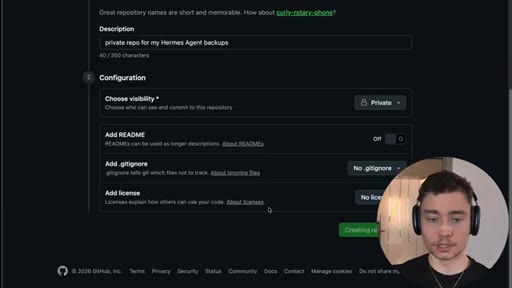
15:41And then make sure to create a new repository, which you can either do here by clicking new or by clicking top right and going to repositories and then clicking the green button new right here. I'm gonna name it something like test Hermes backup.
15:54Very simple. Private repo for my Hermes agent backups. Boom.
16:01Here, just make sure to put it as private. Okay? Very important.
16:04You don't want your backups to be visible to the Internet. And then click the green button, create repository. And just like that, you just created your own GitHub repo in a matter of fifteen seconds.
16:13Nothing to be scared about. GitHub is absolutely essential in 2026. Now inside of GitHub, we also need to create a personal access token so that Hermes can somehow access this GitHub repo because remember, we made it private.
16:25Right? So go to top right, click on settings. There we go.
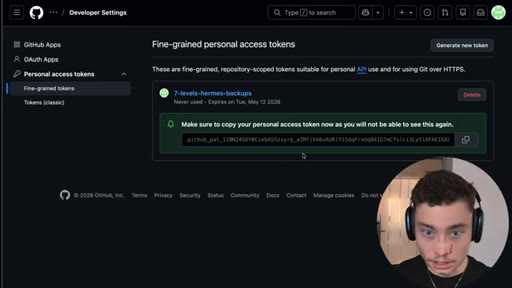
16:28Settings. Go to the left, scroll all the way down, and click on developer settings right here. Then on the left, click on personal access tokens, fine grained tokens, and generate a new one.
16:40We can name it something like seven levels Hermes backups.
16:46Owner expiration, you can, you know, set no expiration or seven days up to you. And then you can only select certain repositories.
16:54We're gonna select the Hermes backup. There it is.
16:59So it cannot mess with other repositories. Then we need to add some permissions. So click on add permissions,
17:04scroll down and find contents, and then put read and write because it needs to read the GitHub repo, but also writes to it daily. Okay.
17:12So now click on generate token. There it is. Generate token,
17:18and here it is. So now what we need to do is we need to open the terminal again, SSH into the VPS, and type in Hermes config set and then the name of the environment
17:29variable. Let's do something clear like GitHub token, you know, GitHub underscore token,
17:34and then space and copy this personal access token and paste it in.
17:39Boom. This will securely store it into the environment file dot e n v, allowing Hermes to use it, but it's not gonna be sent to the AI.
17:47I'm gonna open Hermes, and I'm gonna tell it, listen. I just set up a new token in our e n v file. I don't want you to read it.
17:54I just want to check it if it's there and try doing something with it to see if it works or not. File exists. The token variables are, and, yeah, it's the GitHub token.
18:05Okay. It's asking for permission. I'm gonna allow it.
18:08It works. Beautiful. So now let's create the cron job so that every single day at night, automatically backup itself into GitHub.
18:15Right? So if you remember, we had this repo, and this repo is empty now. Right?
18:19Nothing is on there so that if something goes wrong and if your VPS explodes or, you know, Hermes agent deletes everything, your data is still safe on GitHub. Now one thing you should check inside of Hermes agent is the status of the gateway if it is installed as a system d service.
18:36That way, can run twenty four seven. And that's very simple. You just type in Hermes gateway
18:40status, hit enter. And as you can see, system d linger is enabled. Beautiful service survives logout.
18:47That's amazing. So let's do clear. And I'm gonna give it this prompt to set up the daily backup.
18:51Right? So very simple prompt. I want a daily freem backups of the entire
18:56dot hermes folder to my private GitHub repo, and this is the name of the repo we just created. Right?
19:02Test hermes backup. The token is GitHub token. I
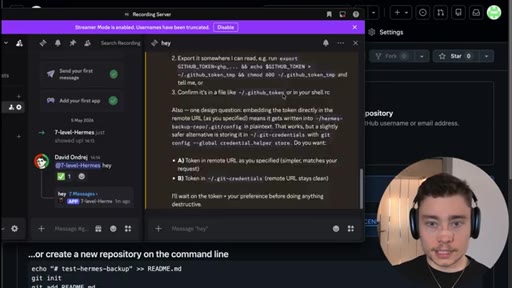
19:07wanna read the prompt, it's already doing it. Reset the Git identity, HMS bot, clone the repo, create daily cron job at 3AM, prog time. And, yeah, it's just telling it what to do.
19:18Right? And then run it once to see if the push works. So it's gonna run it once.
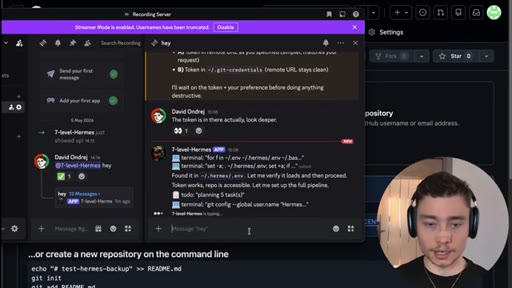
19:22Get up token is in environment. It's c. The token is in there actually.
19:27Look deeper.
19:30I don't know why it's having trouble looking into the token. Yeah. Found it in Hermesla and verified loads.
19:36Okay. Update your memory so that you remember where the ENV file actually is located.
19:42Your backup ran committed, pushed successfully. Let's reload. And here we go.
19:47Here we have our first backup from today of the entire folder, which is 60 megabytes.
19:55It's above the GitHub limit. So to optimize it, we could only back up certain things, but I'm gonna also send this message so it remembers the location of these tokens.
20:07And now the Cronjob is created here. This is the ID scheduled at 3AM Central Eastern European time,
20:13and the next run is tomorrow at 3AM. So now Hermes agent is gonna back itself up. It's probably not needed to back up the full thing every day.
20:22If you wanna just back up your skills only, you can say, hey. Just make sure to back up my skills only or only my Markdown files. Right?
20:28So you're probably gonna have faster backups and not, like, spamming your GitHub repo with the full thing. But if you want the full thing, you can also back up the the entire thing.
20:37Right? Again, just talk to it in plain English. That's enough.
20:40So now you know how to create scheduled tasks aka Kron automations with Hermes Agent. This is level four. Now let's go to level five.
20:47Now, level five is really cool. This is one of the biggest releases to Hermes agent recently, which says a lot because there are releases nearly every day.
20:55Like, literally every other day, the team behind Hermes agent pushes a major update, which is crazy. But this one is especially insane because, first of all, it went very viral.
21:06But second of all, it allows you to run multiple agents through Kanban board. So the way it works is that the agents claim tasks from this Kanban board and they work in parallel. Right?
21:14So let me show you this graphic. And you as the human, you simply watch in a simple user interface instead of having to have 20 terminals open. You just look at the Kanban and you manage.
21:23Okay? This task in progress. This task getting started.
21:26Alright. This agent is working on that task. Like, if we're in the future,
21:29all of us are gonna have hundreds of AI agents working for us much sooner than you realize. So what's gonna matter is how do you manage these agents? How do you actually have clear observability and clarity of what they are doing?
21:42That is gonna be a billion dollar question because whoever figures this out is gonna help build a multibillion dollar company. Right? And, obviously, Hermes is trying to do that right now, and they're actually adding it into Hermes agent.
21:52So this is level five. Let's set it up. Now one of the best things about working with AI agents like Hermes is that you can literally ask it to set these things up for itself.
22:01Right? So boom. A link to that release and literally telling it,
22:06help me set this up. Recontext Hermes agent now has a multi agent via the Kanban in the UI. At first, it activates the skill Hermes agent, then it checks the skill Kanban orchestrator, and it goes to this URL with browser navigate,
22:19and it's gonna read it and learn everything about the release, and it's gonna tell me what it needs from me and the remaining steps, it's gonna do it itself. Right? So here, it's learned everything.
22:30You already have Hermes latest update, beautiful gateway running, can have been initialized. You're missing specialist profiles. So it's asking for the specialist profiles.
22:39I'm gonna say, just set it all up. You have my permission. Okay?
22:42It's asking too many informations. Obviously, you wanna customize it, feel free to tell it like, want a researcher or I want this to be for software development or social media research or something else. In this case, I just wanted to set it up and stop overthinking.
22:56Also, gonna say update your memory to always response in a super concise and clear way. Now one important thing I wanna stress is that do not use cheap models.
23:05Okay? These agentic harnesses, like Hermes Agent or Open Claw, they are complex.
23:10They're very complex. And if you cheap out and you try to use a very small, very cheap model, you're gonna have a hard time. Okay?
23:16So to get the most out of Hermes Agent, use something like OPUS 4.7, GPT 5.5. Don't be cheap.
23:22Okay? Don't use small model. Use the most powerful model available.
23:27As you can see, Hermes agent is doing a lot, like dozens and dozens of terminal commands to set this up himself. Right? Like, I just said, okay.
23:36I want this release. I want this multi agent Kanban orchestration dashboard, and that's it.
23:42You know, Hermes is setting it up. I was asking for a command task. These are the boards.
23:46I was ready. K. What is this command?
23:48Secure disk scan. Okay. And let's allow it.
23:50And it's the beauty of it being on a VPS. You don't have to worry that it's gonna do something sketchy on the computer. It has its own computer,
23:56which I think it's the ultimate paradigm where each agent runs on its own computer so it can set it up in a way that it needs to be most effective. The dashboard loads, and I was testing the dashboard itself. That's crazy.
24:08Look at this. Wow. It navigates to the local host on the VPS.
24:12It clicks around, takes a screenshot of it, and it's it's debugging it itself. Okay, man. This is impressive.
24:20Browser vision. This is the difference between Hermes agent and something like CherryGPT. Right?
24:26CherryGPT absolutely cannot do these things. Launch a local host server inside of itself and then click around and take screenshots of it and debug it. Man, this is wild.
24:35The dispatcher is working. Let me grab a screenshot for David. So it saved the memory, and then it said the Kanban setup is done.
24:41Four profiles, default researcher, writer, reviewer, and the dashboard is there. And it even gives me the SSH to view it from my laptop.
24:48That's insane. I haven't even asked for this. How was gonna be my next prompt?
24:52I actually have it prepared. I have the prompt prepared for it to give me the the link for the SSH tunnel, but it predicted that itself and even included a screenshot of what this looks like on the VPS.
25:06Guys, this is crazy. This is this insane. We really do live in the future.
25:11Alright. Well, let's do this. Right?
25:13So actually, I'm gonna give it the let's go back to hosting the panel, and then I'm just gonna take a screenshot of this whole thing. And I'm gonna say update the SSH tunnel command to actually include
25:26my VPS address. K. I don't even wanna bother figuring this out.
25:31I can just screenshot my full screen, send it to her mess agent, and tell it, y'all, figure it out. Tell me what to do. You know, what what is the server IP?
25:39I figured it out. Okay. Copy that.
25:41And let's open the terminal again. We need to actually open a new terminal, command n, paste that in. Root password again.
25:48So, hopefully, you saved it. Boom. Let's paste that in.
25:52And here we go. We're in. And then we can just open this,
25:57and we are in the Hermes Asian Kanban. So on the left, it's a bit small, but on the left, you can see Kanban right here, below plug ins. Click that.
26:05And this is the Kanban. Okay? So you can drag stuff around, change it up however you want, just like in any Kanban board, right, whether you use Trello, monday.com,
26:13ClickUp, whatever. You can manage how your Hermes is working and dispatch multiple Hermes agents on different tasks. Now, again, I really have to stress this.
26:22Hermes set this up by itself for most part. Like, it ran for, like, three minutes, four minutes, then done all these commands and set it up by itself. I just gave it the link to the release.
26:31Say, like, this is a cool release. I just want this. Help me set this up.
26:34And it literally did everything itself, and now we have the Canva here installed. We can click new tasks, you know, set a rough idea, research the new latest update of Hermes agent.
26:45Boom. We can create that. Maybe let's do something in To do.
26:49Help me set up a multi agent workflow with Codec so I can build and deploy apps on Vercel by itself. Let's put something in blocked. Help me set up a new office in Katowice, Poland.
27:00I already did that, but, you know, just example as a as a thing. And these tasks are getting automatically moved to ready, and Hermes is ready to work on them.
27:09Okay. But this is cool and all, but how do you actually make it useful? Well, let me show you a use case that I myself actually need, and that is research for content.
27:17And in fact, all of you can do this. Just apply it to your own business or to your niche. Right?
27:23So let's go back to Discord, and let's paste in this prompt. So pretty long because I described exactly what I mean want.
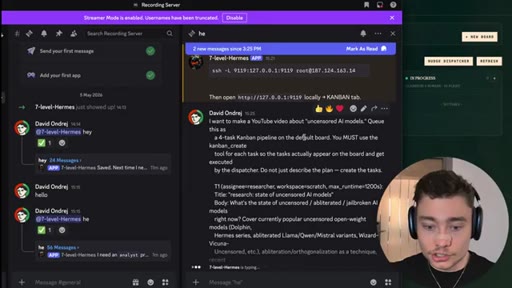
27:30I want to make a YouTube video about uncensored AI models. Right? And, again,
27:34let's say you wanna make a LinkedIn post about how to hire people in Germany. Whatever you do, whatever your business is about, whatever you want to research, just give it a task.
27:45Okay? Describe the task. You don't have to copy my own example, but I'm doing something that's truly useful for me because a lot of people, they're just incompetent in terms of giving these agents use cases.
27:54There's, like, literally such a large percentage of population that have OpenClose set up, but they don't use it because they don't know how. They have Hermes agent, and they know how to set it up, but they don't know what to give it.
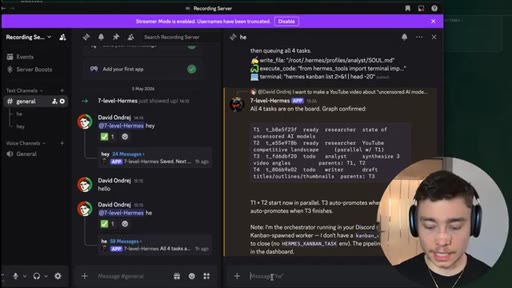
28:04So here's a clear example. Queue this as a four task Kanban pipeline on a default board. You must use Kanban create.
28:11Basically, I'm telling it, you know, that it should use the Kanban because, you know, sometimes it just completes itself, but this is all about the Kanban board. Right? The new update, so I wanted to be using it.
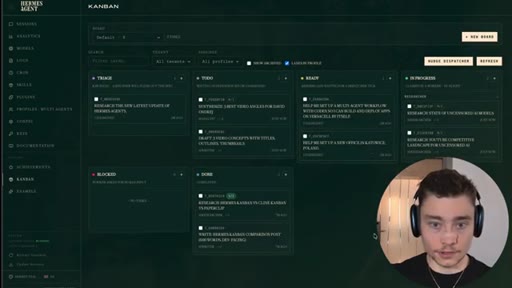
28:21So I send this detailed prompt, and now Hermes agent is doing that. If we reload, we could see some changes happening.
28:28Okay. We already have the changes. We could see draft three research.
28:32There is in progress research state of ancestral AI models. You can click on it to get more info. Priority is zero.
28:37So has priority assignee researcher status running. So the it created four different profiles of four different AI agents, and now the researcher one is working on it. You can see where it lives on the workspace created by the user.
28:49You can see these all different options, trash, ready, block, unblock. Archive, the description of this task, what's the state of uncensored, obliterated jailbroker AI models right now, cover the topics, dependencies, parents, comments, events,
29:02worker log, very detailed, and you can even send comments on this task as it's running. So, basically, here is how that works.
29:08Right? You have the first researcher, what's new in topic this week, what's new in fitness, in real estate, in AI. Then the second researcher
29:16was already on YouTube about topic in last thirty days, and these run-in parallel. Right? Then the analyst waits for the first two to find a gap.
29:24Right? Some angle, something that people are missing. And then the fourth agent, the writer, drafts three video concepts
29:30after the third one finishes. Right? So this is a very simple workflow
29:34of multiplayer agents working at the same time, and we have the Kanban to actually monitor their progress. Right? So, obviously, Hermes agent can do this even without the Kanban, but the way the Kanban is useful is allows you, the human,
29:47it allows you to see what's happening. Right? Not just looking into terminal with endless commands and lots of text.
29:52This is a very visual way to monitor the progress of your Hermes agent and all the different sub agents. Alright. So let's check what the status is.
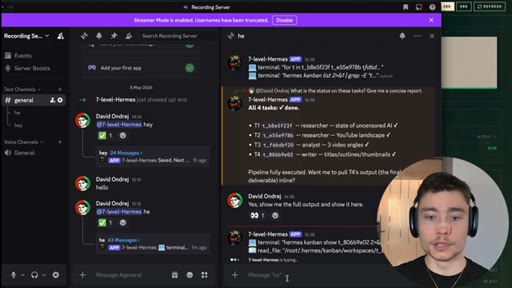
30:00We can see that everything has moved to complete and we can even see these tasks and we can either click on them and inspect here or you can go to Discord
30:10and chat with it. Chat with Hermes here. What is the status on these tasks?
30:16Give me a concise report.
30:20So we can check it itself. And by the way, here we can see a lot more things than just the Kanban. We can see the different sessions we have as well as whether they're in Discord, CLI, or somewhere else.
30:29We can see our current automations, scheduled jobs. This is the GitHub one. You can see boom.
30:34We can also see the documentation if something is, you know, lagging or something isn't set up correctly. You can check the logs.
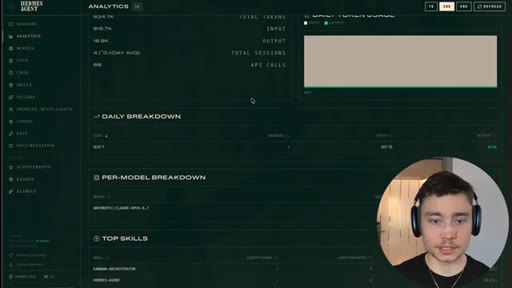
30:42You can check the models that are available and the usage on them, how many tokens, total total spent, different analytics about Hermes, so this is very useful.
30:52But let's check-in Discord. All tasks done. Yes.
30:55Show me the full output and show it here. Again, Hermes gives you this nice gateway dashboard,
31:01and you can even restart gateway from here or update Hermes. Or you can just chat with it through Discord for maximum convenience because, you know, you have Discord in the phone or WhatsApp or Telegram, whatever you prefer. And that's the power of DCA agents.
31:14They're so configurable, so extensible that
31:17anybody can adapt them to their own use case or their own preference. The issue is that most people don't know what their preference is or don't know how to how to configure them.
31:26Luckily, if you're watching this video, so you hopefully at least know how to configure them. And if you are smart, you can figure out a few use cases for Hermes agent. Alright.
31:35Here's the answer. As you can see, it's a quite long answer.
31:39Console number one, uncensored coding agent Use a twenty four twenty seven b model into cloth curve o lama. Okay.
31:47Fair enough. I've literally explained Europe's finding that one direction and LLMs conferred refusal, the bench off.
31:57HOOKOkay. So specific ideas with clear preproduction for all of them. Not bad.
32:01HOOKNot bad. So this is level five using the Hermes Kanban to manage your AI agents and what tasks they're working on.
32:08HOOKOkay. So level six is adding memory because a lot of people struggle with, yeah, agents not having good long term memory and losing context and stuff like that. So here is why memory plugins like Holographic actually exist.
32:20HOOKBeginners never save anything. Right? They just chat and they hope that the default memory is good enough.
32:26HOOKAnd obviously, in Hermes, it's probably better than in any other agent, but beginners don't even trigger that with words like remember this or save this into memory. So everything stays in the chat and dies at the end of the session.
32:38HOOKI think most of you probably do that mistake as well. I certainly did it when I was newer to AI. Also, bigger context doesn't mean more memory.
32:45HOOKPeople who are like one step, two steps ahead of beginners, they just paste in a bunch of slop.
32:51HOOKRight? And a lot of it, it's not even relevant to what needs to be done. So more context doesn't necessarily mean it's gonna be better memory.
32:58HOOKBut more context always results in more cost and worse attention to the things that matter the most. Right? A lot of people then go to RAC, retrieval augmented generation,
33:06but that's by vibes. You know? Vectors, similarly, cannot answer what does that have its own.
33:11Like, what what's my own task? What's my own responsibility?
33:14That needs structure. You know? You don't see what task assigned to each person just from similarity,
33:20just from semantics. Now, embeddings also cost money and they leak data. You know, if you use Gemini embeddings, are sending it to Google.
33:27And summaries, they blur over time. You know, they compress essential facts away.
33:32So most people have no idea how to solve this and this is why things like holographic exist. So in level six, we give our Hermes agent near infinite memory.
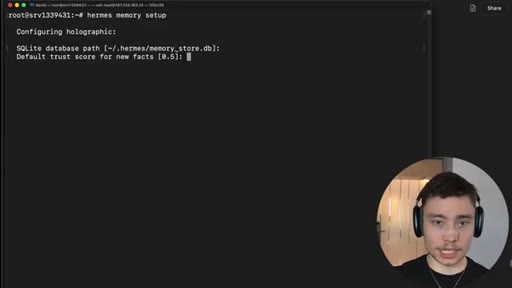
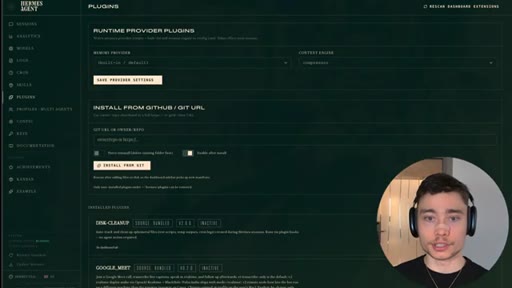
33:42Okay. So to set up this near infinite memory, let's jump back into our SSH and type in Hermes memory setup. Hit enter.
33:50As you can see, comes with a few premade options and holographic is one of them. Or you can try other ones like honcho, web zero, open viking, super memory.
34:00Some of them require API keys. You can see holographic is fully local and that's a important thing because then you're not leaking your data. You're not sending your data to any cloud, and, obviously, you don't have to pay for stuff.
34:09SQL database path, I think that's good. Hit enter. Auto extract facts at the session end.
34:15You can either enable it or disable it. I would enable it if you want maximum memory. Default trust score for new facts output, like, 0.4.
34:25Dimensions, leave that as it is. Enter, and that's it.
34:29Next type in her mess gateway restart
34:33just to make sure that the gateway picks up everything. And then we can type in her mess. And then in the chat, can say something like check this
34:43to see if we have the fact store. Yes. Holographic memory is set up and working.
34:48Alright. Amazing. So we can do something like read
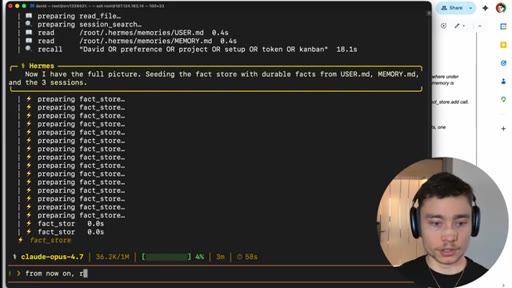
34:51all previous sessions as well as user dot m d and memory dot m d and seed the holographic
35:01back store. So it can add some of these things that we discussed in previous sessions or some of these things that it already knows about me into holographic because, you know, we just set it up, it's obviously empty for now.
35:13Okay. So it analyzed all previous sessions, and I was preparing
35:18so they did these tool calls to learn everything about me and what we talked about, and now it's doing writes into holographic
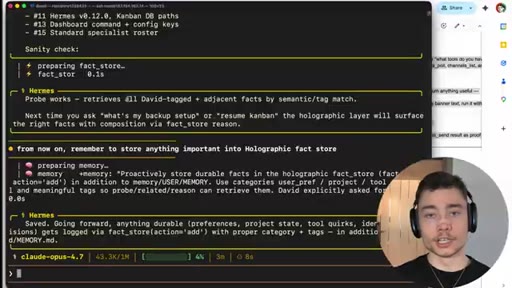
35:27fact store. And we can actually maybe even prepare a prompt like, from now on, remember to store anything important
35:36into holographic fact store. K.
35:39See this 15 facts, by name and by preference, discord CLI, concise style responses. This is good.
35:47I mean, yeah, this is basically all we discussed, but it it removed the useless stuff and only saved the important things. Alright? So I'm not gonna say,
35:55remember to store anything important in whole graphic fact store from now on, and it's gonna save it into the main memory so that it's actually gonna be using it.
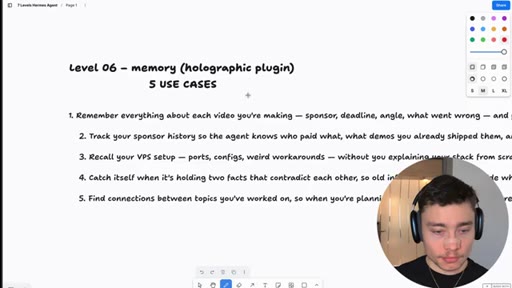
36:05Now let's talk about a few use cases of why having solid memory actually matters in case it's not obvious. Number one, you can say something like, remember everything about each video you're making. Right?
36:16So for me, if I use Hermes dedicated to YouTube, I would be running something like that. Remember the key facts about each video we're making.
36:23If it's a sponsor, if there's a deadline, what angle we're taking, what went wrong, so it can be more useful with each video going forward. You could also track your sponsor history to know which age which of the sponsor paid what.
36:36Right? So the agent would be in track of this. You don't have to remember it in your head or track in your spreadsheet.
36:40The agent will be tracking that. It can also recall your VPS setup, you know, how much disk space you have, how much RAM you're using, all that stuff. It can proactively check it manually.
36:50That's another great cron job you should create. It's like a weekly check of your VPS to see the health.
36:56You know, maybe you're running out of space, maybe your your RAM is getting out of control. Who knows? It can also catch itself when it's holding two facts that contradict each other.
37:04Right? Because it will be in the memory and say, okay, we upload videos every five days, and there's a different one that says every three days. Well, guess what?
37:11It's contradicting and it can ask you which of these is correct. And you can find the connections between topics you've worked on that you don't even realize. Right?
37:18So maybe shorter videos perform better or sponsored videos get less views, whatever. Right? Things that like actually can have meaningful impact on your life or business.
37:27So while most people just rely on the basic memory inside of Hermes, which isn't bad, Holographic takes it to the next level and makes the long term memory a lot better. Alright. Level seven, the most advanced level, obviously,
37:41turning Hermes agent into an MCP. Okay? So, basically, you expose it as a MCP server so that other agents like Clothecore or Codex can interact with it as if Hermes was your back end.
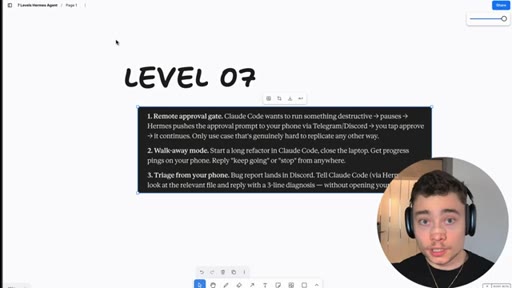
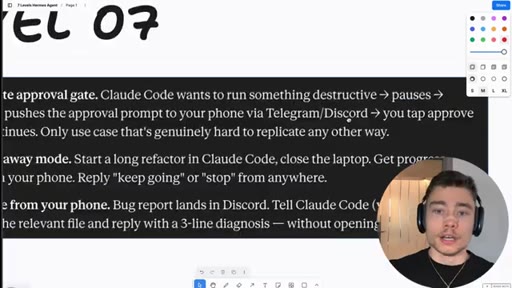
37:51And this has three main use cases. Number one, serving as a remote approval gate. So let's say Clothecore wants to run something destructive.
37:58Right? A risky operation, deleting files, you know, removing database backups, whatever.
38:03You have, like, a hook that makes it pause. Hermes pushes the approval prompt to your phone so that, you know, let's say you're on a date with a girl, and now suddenly you do something important like, oh, shit. You know?
38:12By Hermes agent is messaging me, it wants to push a risky update to delete a database. So maybe like, okay. This is a database backup.
38:19It's obsolete. It's from six months ago. You approve it, or if it's something it shouldn't do, you reject it.
38:24Right? And then it continues. So this is the use case that Clothecode cannot do.
38:29Like, Clothecode couldn't do this. It it doesn't have access to your Telegram or Discord. It doesn't have these connections, these authentications.
38:35So that's one use case. The second one is walk away mode. So you start a long refactor in Clothecode and you close the laptop and you get progress pings on your phone.
38:41Right? And you can reply, like, keep going, you know, make it simpler, fewer lines of code, or push to GitHub, whatever. And you can trash from your phone as well.
38:48You know? So bug report lines in Discord. You can tell Cloth through Hermes agent to look at the relevant file and reply with a free line diagnosis before opening your laptop.
38:56So this is pretty many use cases of turning Hermes agent into MCP. And it's the most advanced level because most people don't even understand MCPs,
39:04and they definitely do not even know that it's possible to turn Hermes agent into an MCP server. But But I'm gonna show you how to do that just now. So just like before, we're gonna set it up by just talking to Hermes and telling it to set it up.
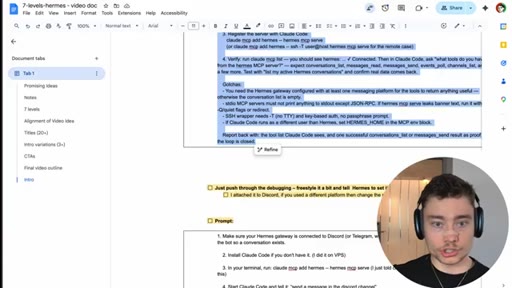
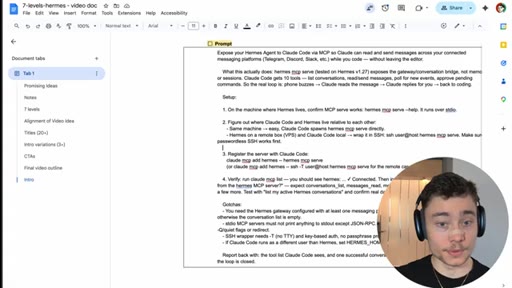
39:16So I'm gonna do slash new to start a new conversation. I'm gonna paste in a very long prompt I have, and that starts with expose your Hermes to Cloth code via MCP. Cloth can read and send messages across connected messaging platforms.
39:27Telegram, Discord, Slack, Volley code, editor, and there's 22 more lines. Let me just show you the full prompt. Here's the full thing.
39:34Feel free to screenshot it. We have the full prompt. Boom.
39:37There it is. So Hermes exposes the gateway so that Clothecode,
39:42which obviously can use MCP servers because Anthropic invented the model context protocol, can interact with Hermes, which otherwise it couldn't interact and obviously access all the things that Hermes has configured already. So let's go to the terminal.
39:54Let's see how Hermes is doing on this task. Uh-uh. Loop is closed.
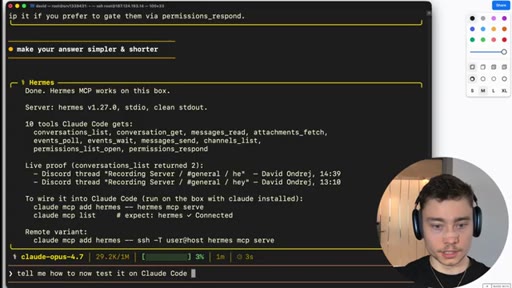
39:57Okay. So make your answer simpler and shorter. I'm not reading all that.
40:02I don't know why opens 4.7 is Silverboss. Okay. Hermes SCP works.
40:08Okay. So tell me how to now test it on ClothCode.
40:14I will set up ClothCode on this VPS, which obviously we still need to do yet because we haven't set up ClothCode CLI on the VPS. Hermes is giving up the steps.
40:24So, yeah, let's do that. I'm gonna actually
40:27open in fact, I'm gonna I'm just gonna copy this and follow in the in the Discord because why not?
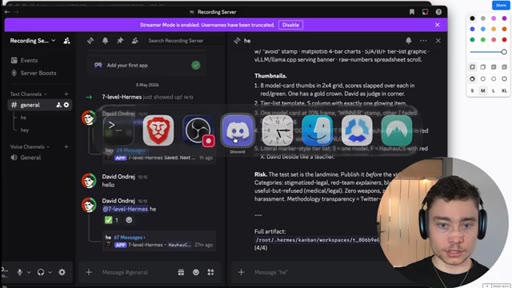
40:34You know? So I'm gonna copy this over the Discord. I'm gonna start a new chat.
40:40Say, MCP, a new thread, so it's clearly separate. Boom.
40:46Let's go to this thread. I'm gonna give it to everything here as a context.
40:53Context. Help me set this up on my BPS. One step at a time.
41:01Be very concise. Boom. Let's send this.
41:05And then here in the terminal, we can hit control c to stop this and clear and follow these instructions to set up Cloth code. Right?
41:12So first, need to install Cloth. So let's copy this command.
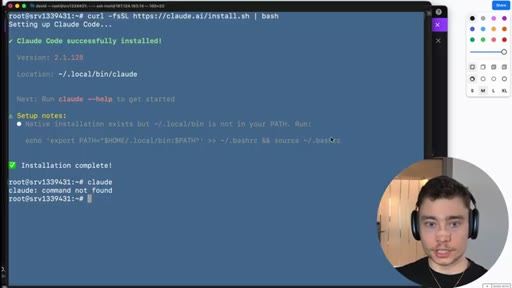
41:16Boom. Installing Cloth code. It's similar to the Hermes agent command we ran at the start, know, a one liner installer
41:24that's gonna install everything. But there is if we do Clot, it should ask us to log in. We need to reload the
41:31reload the thing. Right? The shell.
41:33I'm gonna copy everything. I'm gonna say, what now?
41:38Super plain English. Like, I'm literally showing you how to debug, right, using one AI agent, which is Remest agent to set up Cloud Code so that we can then expose Remest as MCP. It needs to add to path, so I'm just gonna copy this, literally
41:50super simple debugging. And there it is. It works.
41:53Right? So I'm gonna do Cloud. I need to authenticate.
41:55Dark mode is fine. Let's do Anthropic console account. Gonna give us a link.
42:02Boom. Space that into a browser.
42:08Authorize. We need to copy this code, switch back to a terminal, and paste in this code. And that should be it.
42:16Login successful. Enter. Enter.
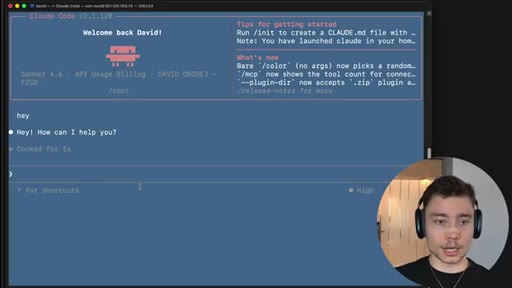
42:17Enter. Just press enter three times, and let's type in message to see if Cloud Code is working, and it is working. That was very easy, and Frohpik has made this authentication super easy.
42:26So I'm I'm here. So I can just say SSH.
42:32Boom.
42:35I've managed to install Cloud Code and log in. What now?
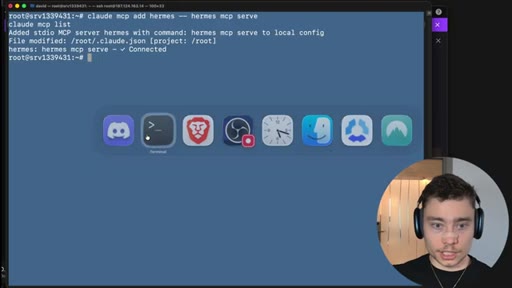
42:40Right. So we need to register the MCP, so let's copy these two commands. Switch back to our terminal.
42:45Hit control c to kill the Hermes t y. Let's run these.
42:51Okay. So that's that. Okay.
42:55I did these two commands. What now?
42:59Literally plain English debugging. Right? Just make sure to use the best model you can.
43:03Don't use a cheap small model. So I'm using OpenScore point seven here. And now we start Clothecore again.
43:09So I can do Cloth dash dash dangerously skip permissions.
43:16Okay. It's gonna be running root, whatever. Just let's do normal clot.
43:19Hit enter, and let's see what tools it has for the Hermes MCP.
43:26Alright. So it gives all of these different tools.
43:29MCP Hermes attachment fetch, Hermes channel list, conversations get. Okay. So test this actually.
43:36Get the previous conversations and, you know, read some messages and see if it actually works, these MCP servers. So, again, plain English telling it to test the Hermes MCP.
43:47Let me load the tool schema first then test them. K. Let's this is why I wanted to to add to run-in
43:54dangerous escape permission so we don't have to approve these. Yes.
44:01Both tools work perfectly. Here's the summary. Conversationary returns free Discord threads.
44:05Messages read successfully read 10 messages. Channels list. Okay.
44:09Everything works works. Nice. Okay.
44:12So now use these tools to analyze things about me as a user. What am I likely missing?
44:18What are my attributes? What are likely my goals? Based on these conversations,
44:21based on these messages, what can you tell about me? Make sure to use the Hermes MCP for this and be very concise. K.
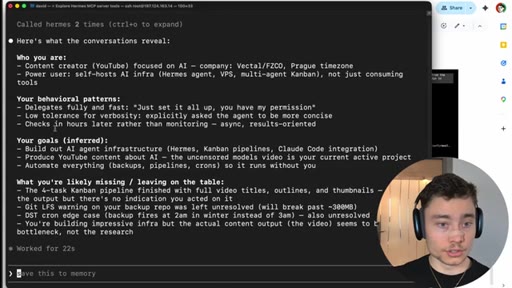
44:28Let me read all three conversations for a fuller picture, and it's calling the Hermes MCP. Here's what the conversation reveal. You are a content creator.
44:37Okay. Vactel, it even knows the company name, power user, self host AI infra.
44:43K. So listen. I'm not claiming to be power user.
44:45It's cloth code calling me power user. Your behavior patterns delegates fully, low tolerance for verbosity. That's true.
44:52Checks in hours later rather than monitoring. Okay? Your goals, build the agent, produce YouTube content, automate everything.
45:00Yeah. I mean, it's true. It's basically, use the Hermes MCP to analyze myself.
45:06And, obviously, the power of this is that as you're building something, Clothcode doesn't need to have all the context of a Hermes agent. You can keep it private on a VPS.
45:14Maybe Clothcode is on a different VPS or Clothcode is running locally, and it can still fetch the data when needed through Hermes. Because Hermes agent can be served as a MCP server, which again, most people have no idea because they don't go through the seven levels of Hermes agent. Now, if you watch all of this, the next step is to actually go through the video again and set it up.
45:33CTASo go below the video, click the first link, and get your very own virtual private server. Hostinger has the one of the most affordable options for a VPS, and it's super easy setup for Hermes agent. This is what I was using in the entire video.
45:45CTASo, again, click the first link, below the video, and get your own Hostinger VPS. Make sure to use code david for additional 10% off. And if you are serious about AI, then make sure to join the new society.
45:55CTAEveryone who joins in the month of May will get a personalized audit of their GitHub repository. So you submit your GitHub repo and we look at it. We can go through the security, through the front end, suggest new features, whatever you want us to focus on, or if you just want us to go through the whole thing without any focus, you don't need to include anything.
46:12CTABut this is only available for people who join in May because it's not scalable to do this forever. It takes a lot of time to audit these GitHub repositories. So if you join New Society in May, you get a specialized GitHub audit.
46:23CTAPlus in the classroom, we're releasing a new course on HerMS agent. So if you like this video, it's just a taste of what's coming in the classroom. Right?
46:32CTASo inside of New Society, you get more granular step by step modules with premade resources, configs, skill system prompts that you can just copy paste into your life and business. So if you want more access and more content about Hermes agent and also calls with me, which, by the way, there's literally a call happening in seven minutes, That's why I'm speaking fast.
46:50CTAMake sure to join the new society. The link to the new society Lightning page will be below the video. With that being said, thank you guys for watching, and have a wonderful, productive week.
46:59CTASee you.
— full transcript
§ 05 · For Joe

Seven decisions that define how powerful your AI agent actually is.

WHAT TO LEARN

The gap between a basic Hermes setup and a seven-level one is not technical complexity — it is seven deliberate configuration choices that each multiply what the agent can do independently.

  • An agent that lives on a VPS instead of your laptop runs 24/7, holds its own API keys securely, and is not blocked by your machine being asleep or closed.
  • Connecting a messaging platform turns an agent from a terminal tool into something you can interact with from your phone without opening a laptop.
  • Curator exists because self-improving agents generate skills continuously — without a stale-skill pruning threshold, token costs and context bloat compound silently over months.
  • Storing agent tokens via a config command keeps secrets out of conversation context, preventing the AI from accidentally leaking them in tool outputs or logs.
  • A Kanban board with specialist profiles lets four sub-agents work in parallel on dependent tasks without you managing the handoffs manually.
  • Default memory dies at session end; holographic memory persists structured facts locally in SQLite, meaning the agent remembers your sponsor history, VPS config, and preferences across every future session.
  • Exposing an agent as an MCP server is the only way to give Claude Code access to your Telegram and Discord history, approval flows, and messaging infrastructure.
  • The practical value of a remote approval gate is the difference between an agent that stops and asks before doing something destructive and one that executes destructive operations unattended at 3 AM.
  • Cheap models fail in complex agentic harnesses before they fail in simple chat; debugging costs almost always exceed the token savings from downgrading the model.
§ 06 · Frame Gallery

Visual moments.