Greg Isenberg · Youtube · 37:00

Hermes Agent: The New OpenClaw?

A 37-minute walkthrough of the personal AI agent that fixed everything OpenClaw got wrong — memory, stability, and token cost.

Posted
April 20th 2026
29 days ago
Duration
37:00
Format
Interview
educational
Channel
GI
Greg Isenberg
§ 01 · The Hook

The bait, then the rug-pull.

Three problems, one migration. Imran Muthuvappa kept having to re-explain himself to OpenClaw, restart a gateway hourly, and watch tokens drain with no visibility into why. Hermes Agent solved all three — and Imran brought receipts: a 90% reduction in token spend and a personal agent that now runs on his phone.

§ · Voices

Who's talking.

00:00hostGreg Isenberg
00:46guestImran Muthuvappa
§ · Topics

Where the time goes.

00:00 – 01:38

01 · Intro + Promise

Greg frames Hermes as the OpenClaw killer; Imran promises install, Android, G-Stack, and skills by the end.
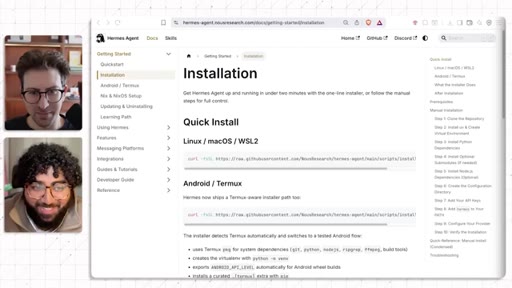
01:38 – 04:26

02 · Why Imran Left OpenClaw

Three problems: no memory, gateway instability (hourly restarts), zero token visibility. Hermes fixes all three with SQLite-backed persistent memory.
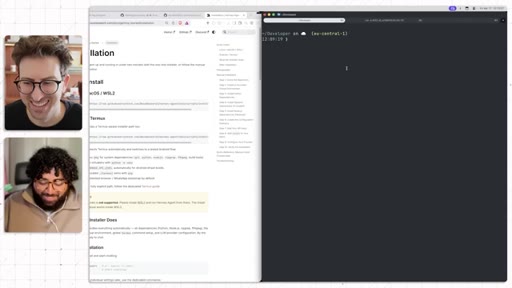
04:26 – 07:26

03 · What You Get Out of the Box

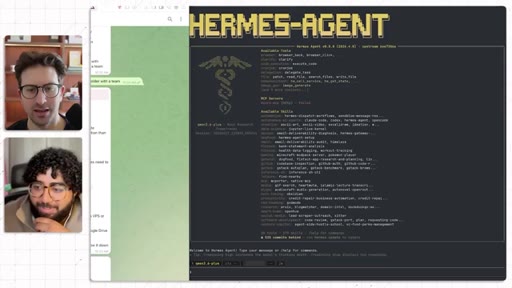
40+ built-in tools, pre-installed Mac skills (Apple Notes, Reminders, Find My, iMessage), model picker with OpenRouter integration.
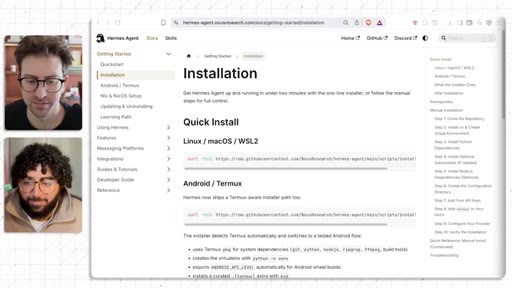
07:06 – 10:26

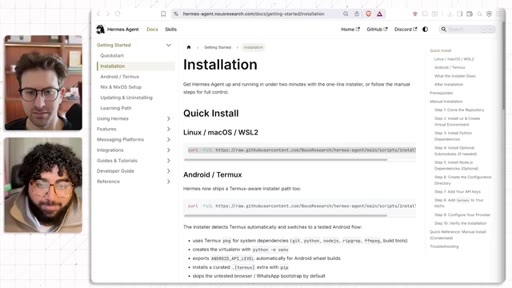
04 · Installation: Mac, Linux, WSL

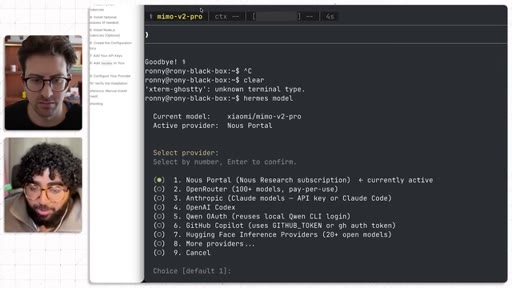
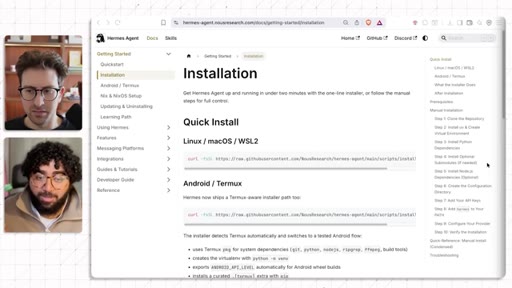
One-line install command, optional Xcode Developer Tools on Mac, skip onboarding. Key command: hermes model.
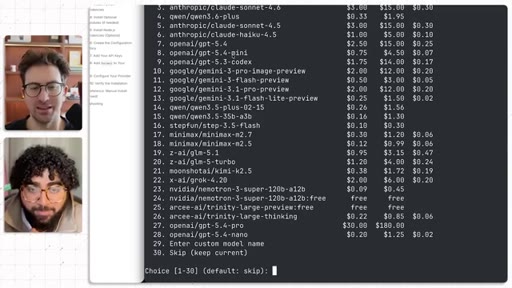
10:26 – 12:21

05 · Token Cost: OpenRouter Strategy

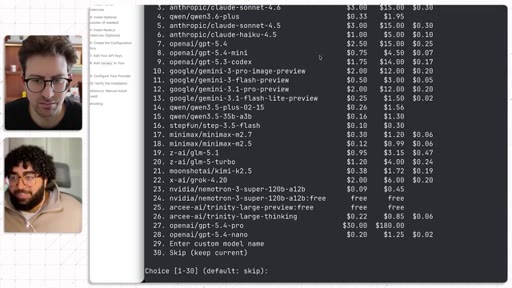
Transparent pricing, free models (NVIDIA NemoTron), access to Anthropic and Qwen. ~10x cost difference between Sonnet and Qwen on input tokens.
12:21 – 13:21

06 · Write Code Once, Run Forever

For recurring tasks: have the agent write deterministic code once. 90% token spend reduction — to per 5 days.

12:21 – 15:10

07 · Telegram + Muppets Fleet

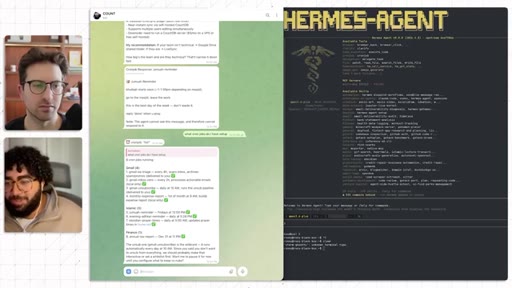
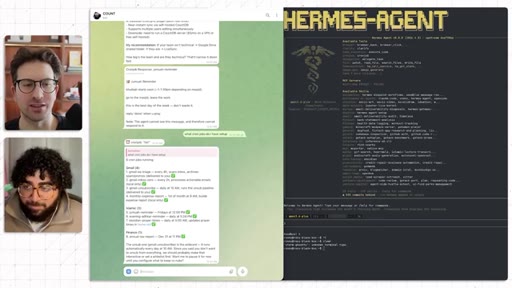
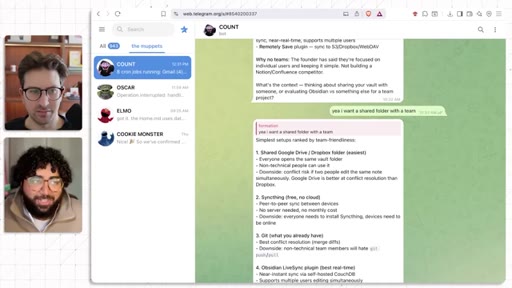
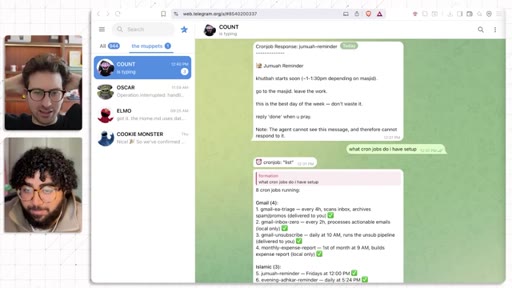
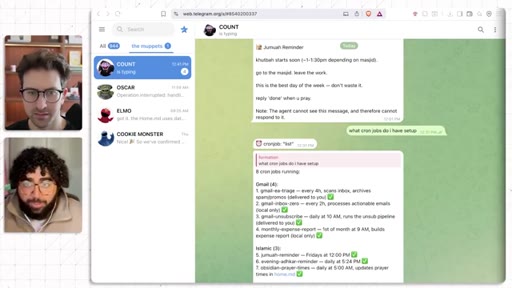
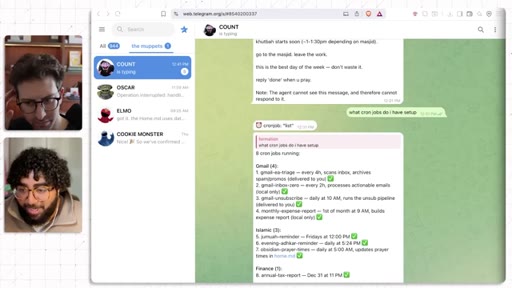
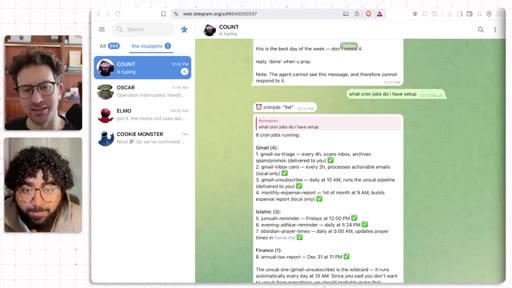
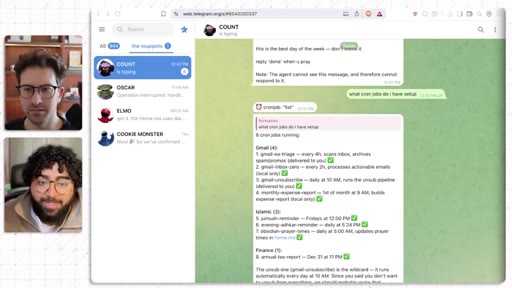
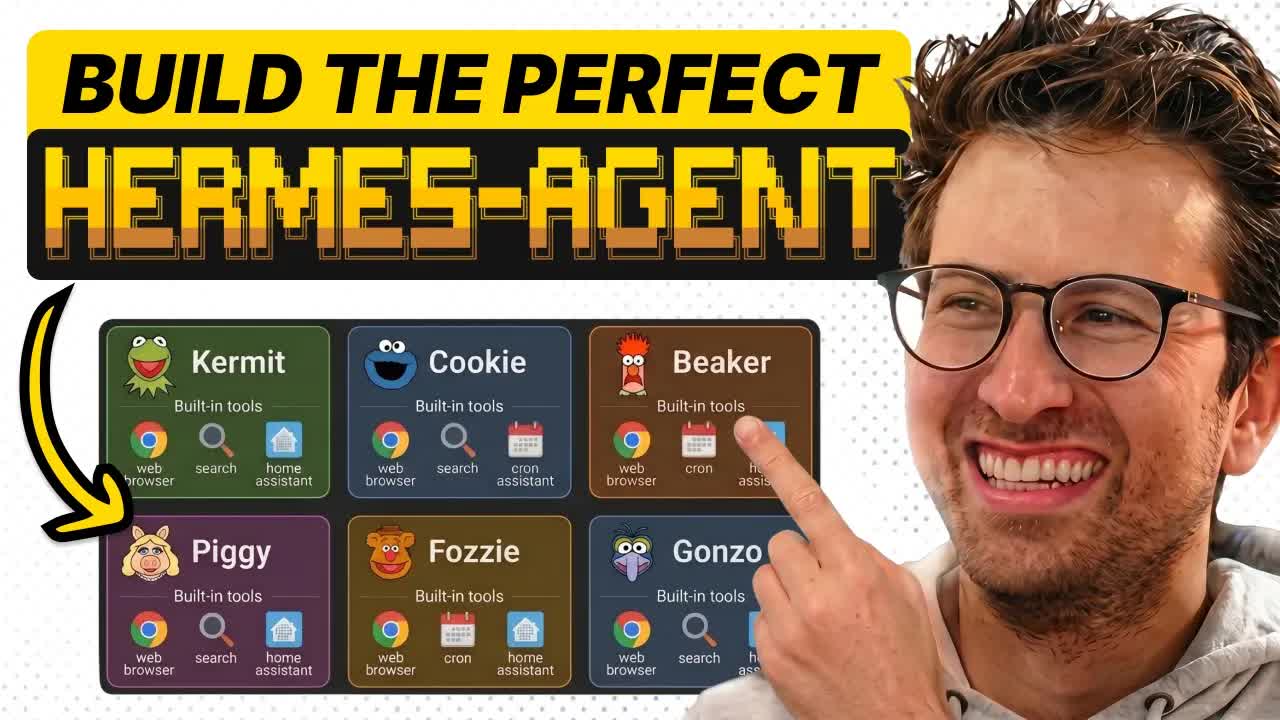
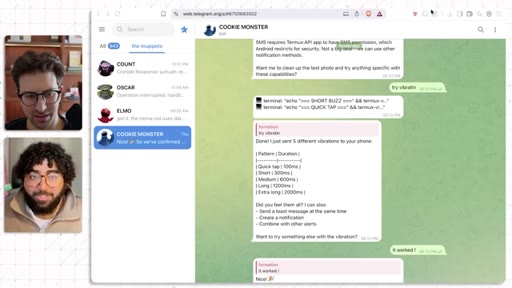
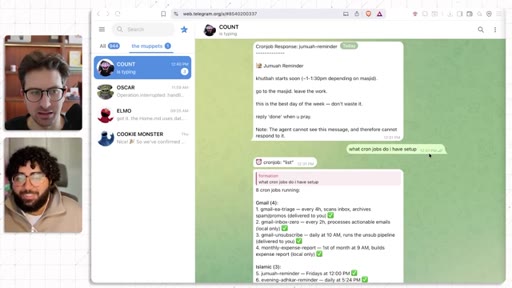
Agents named after Muppets (COUNT, OSCAR, ELMO, COOKIE MONSTER). Chat in Telegram just like the terminal.
13:01 – 15:10

08 · Android via Termux

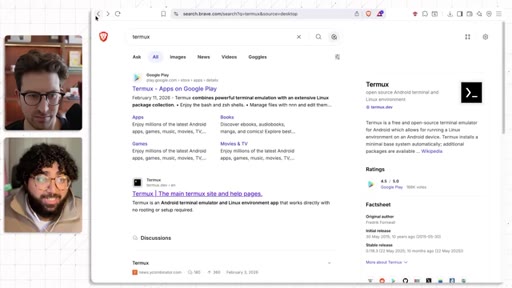
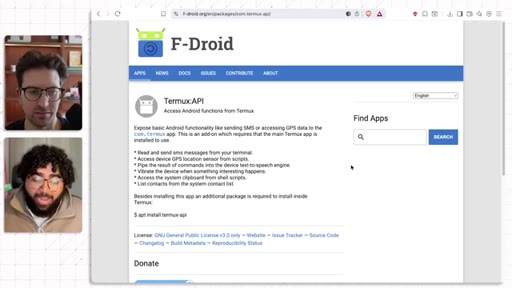
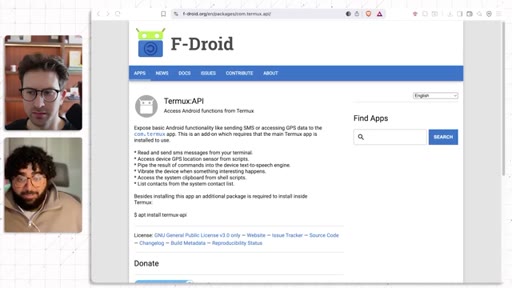
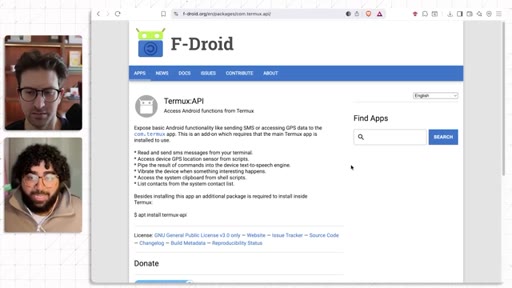
Cookie Monster on a Solana Seeker Android 15 phone. Termux API unlocks camera, SMS, WiFi, sensors. On-device social posting with real MAC address.
15:10 – 21:07

09 · Auditing Your Life + Tips

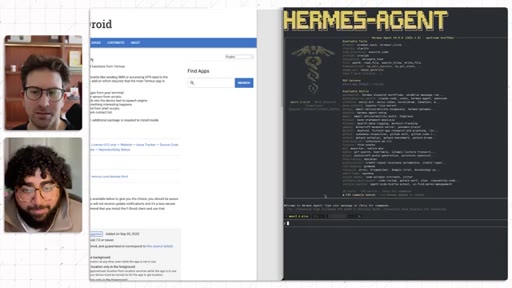
Use the agent to figure out what to automate. Live demo: Hermes reads memory to answer where Greg spends time. Update daily — still beta.
21:07 – 25:58

10 · Multi-Agent Design

Most people need 1-2 agents (work + personal). Cron jobs vs. sub-agents still open. Sub-agents let you assign cheaper models to deterministic tasks.
25:58 – 30:02

11 · Obsidian as Daily Dashboard

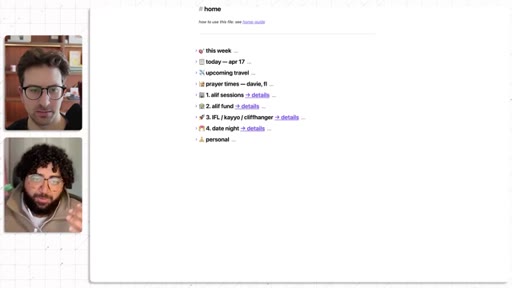
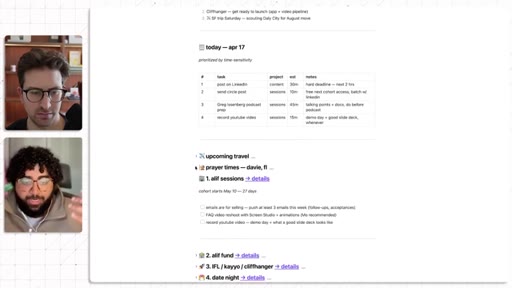
Hermes organizes home.md daily: priorities, travel, work, personal. Markdown is agent-readable/writable — cleaner than Telegram walls of text.
27:16 – 29:11

12 · Must-Use Prompts

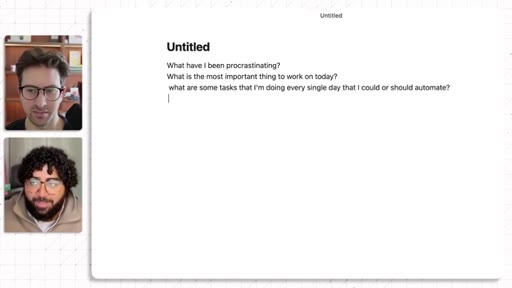
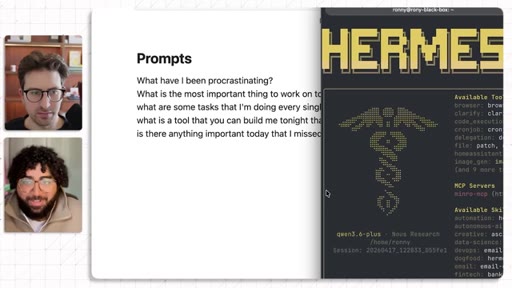
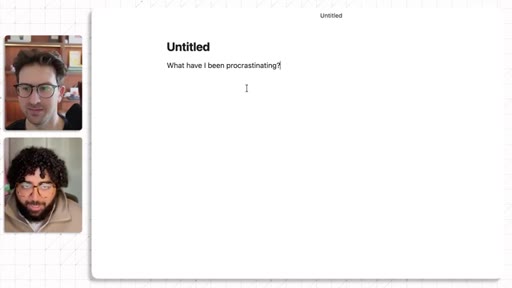
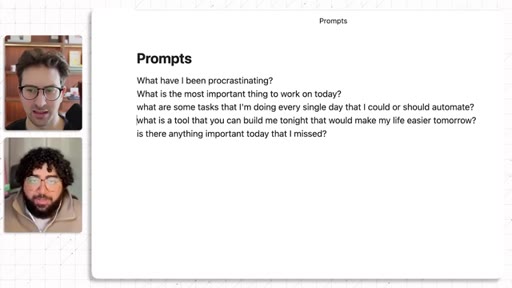
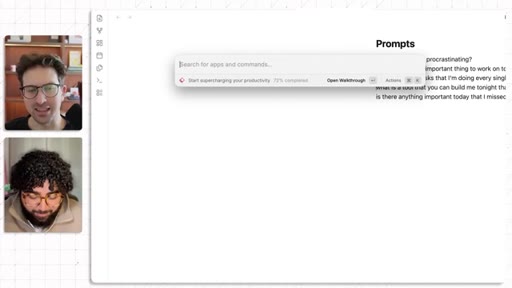
Five meta-prompts shown on screen: procrastination, priority, automate, build tonight, anything missed.
31:29 – 37:00

13 · Must-Install Skills + Customization Trap

Obsidian, Honcho Dev Memory, G-Stack (Gary Tan / YC, free). Customizing is not the skill. The requirement is defaulting to the agent for daily work.

§ · Quotables

Lines you could clip.

31:14
"Learning how to use Hermes agent is not actually the skill. It's gonna become the requirement."
declarative thesis, no setup needed, works as a standalone take → TikTok hook
34:42
"Customizing it is not the skill — it's more about what you get done with it."
common creator trap named and closed in one sentence → IG reel cold open
12:11
"I basically got my token spend down from about every five days down to maybe every five days. So about a little bit over a 90% reduction."
concrete numbers, before/after, instant credibility → newsletter pull-quote
11:00
"Instead of requiring an agent in the loop every single time, you can actually write the code to make it more deterministic."
practical insight most people miss, automation-first thinking → TikTok hook
14:46
"You can have it running on an almost infinitely scalable amount of Android phones and run accounts and post from there."
novel/surprising capability, sparks immediate reaction → IG reel cold open
§ · Resources Mentioned

Things they pointed at.

01:38toolOpenClaw
13:20toolTermux ↗
13:40toolF-Droid ↗
20:40toolTailscale ↗
24:00toolObsidian ↗
32:50toolG-Stack by Gary Tan (YC)
36:58linkAlif fund ↗
§ 04 · The Script

Word for word.

HOOK opening / re-engagementCTA the pitch analogy story
00:00HOOKErmes agent. You're seeing it everywhere. People are calling it the OpenCloud killer, and today's episode is about how you can actually install it, how you can connect it with g stack by Gary Tan, how you can connect it to Obsidian, how you can create skills.
00:14HOOKWe go through step by step how you can get started with Hermes agent. This is everything you need to know for how to run it, get started, and actually how you can even use it on an Android device. So enjoy the episode.
00:28HOOKIt's with my dear friend, Imran, who just explains technical concepts in such a such a clear way. It's a breath of fresh air.
00:35HOOKEnjoy the episode, the introduction to Hermes Agents.
00:46HOOKI begged them to come on and Imran has come on. Uh, thank you for for for coming on. By the end of this episode, Imran, what are people gonna get?
00:56HOOKBy the end of this episode, you'll learn how to install Ermes agent, which is the best personal agent. It has built in memory. It learns about your workflows and helps save you time, money, and allows you to do more.
01:07HOOKAnd I'll even show you how to install it on an Android phone. Okay. Cool.
01:11HOOKYeah. So I've been hearing a lot about Hermes. Obviously, it's going viral.
01:14HOOKIs it the new Open Claw? I don't know. Imran,
01:17HOOKI I just need you to explain it in the simplest terms, the most clear terms so that after at the end of this episode, I can actually go on my computer, get Hermes going. So you're committing to to making it as clear as possible and and sharing as much sauce as possible?
01:34HOOKExactly. Yeah. That's what I'll do.
01:36HOOKAlright. Alright. Let's do it.
01:38HOOKAlright. So the first thing, uh, the way that I found Ermes agent was that I tried using OpenClaw. And when I was using OpenClaw, I ran into basically three massive issues.
01:47HOOKThe first issue is that I kept having to tell it to do the same things over and over again because there was no built in memory system. Right? And this is a common problem.
01:57HOOKUh, the second problem I found was that I had to keep restarting the gateway. I think there was a day where I had to restart the gateway once an hour. And so that was, like, really useless.
02:06HOOKI felt like I spent more time setting up OpenClaw than I was actually like using it to make my life better. And the third big problem with OpenClaw for me was just that it was eating up tokens and I had no visibility into how or why.
02:20HOOKSo I quickly migrated over to Nebula, which is if you're looking to build, uh, if you're looking to kinda have just like a AI coworker, Nebula is probably the better tool. Um, but if you wanna have like personalized workflows, if wanna kinda tinker under their hood, and you wanna have a system that learns over time, I highly suggest using Ermes.
02:38HOOKSo, uh, the the three things that Ermes does better than OpenClaw are basically solving the three problems that I mentioned. One is that it has a built in memory system. So every time you complete a task and successfully complete it, it automatically writes to its own memory.
02:54HOOKThis way, like, over time, it gets better. Um, it also uses a typical, like, normal SQL lite database,
03:01HOOKwhich is the same type of database as, you know, normal web applications. And what that allows it to do is search in real time for times where it's done something successfully for you.
03:11HOOKSo if it didn't save it to its memory, it can actually go and search through all of the logs of all the things you've asked it to do and remember it. Even things like API keys, if you forget to save them to an environment variable, but you kind of passed it to the agent, it can actually search through and find it for you.
03:28HOOKUh, and the last thing is it's just more stable. Like, haven't had to restart it in, like, over a week, which is way better than what happened with OpenClaw.
03:36HOOKSo I'll walk you guys through the installation. But before I do, Greg, do you have any questions so far? Yeah.
03:42HOOKI mean, I guess I'll see by the end of this. But, you know, for me it's like, I think a lot of us listening, we might have heard of OpenClaw or might have start you know, installed OpenClaw.
03:54HOOKYou know, I I'm just what I'm begging to know is, like what I don't want actually, should restart. What I don't wanna have happen is I install Hermes,
04:04HOOKand then a week later, I go back to OpenClaw, basically. You know what I mean? Like, I just kinda wanna pick an ecosystem
04:10HOOKand be like, this is my personal agent. Mhmm. No.
04:13HOOKMakes a lot of sense. And that's kind of the problem that I was having before. I kept switching and jumping between different agents until I landed on Hermes and I've been using it for over three weeks now, which in this space is a lot of time.
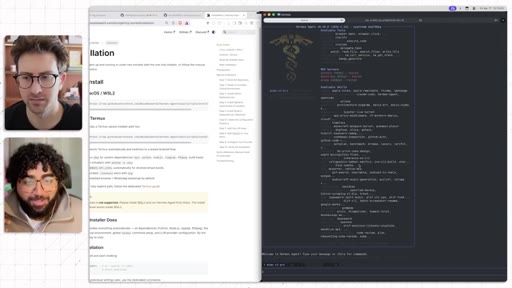
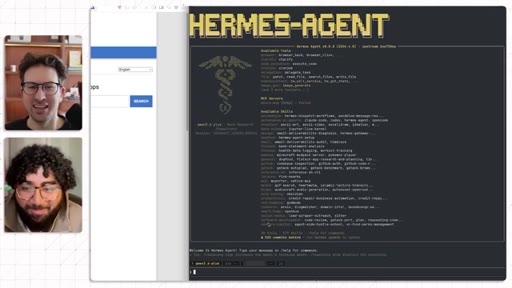
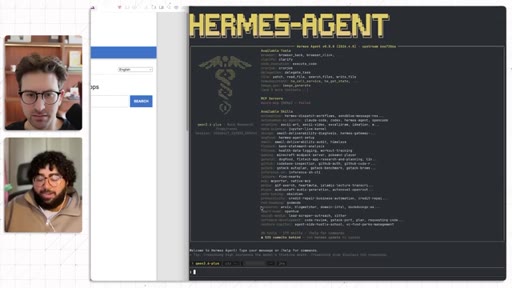
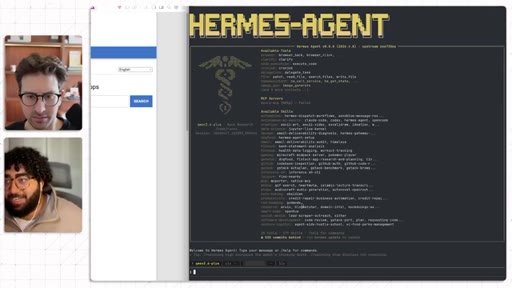
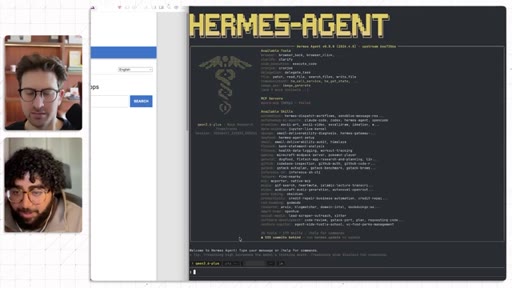
04:25HOOKUm, so I'll before we get into the installation, I'll walk you really quickly on my setup. So when you just type in Hermes in your terminal after it's installed, um, it's gonna try to open up my Xcode
04:36m c p, which is not running right now, so it'll it'll fire up in a second. Cool. Yeah.
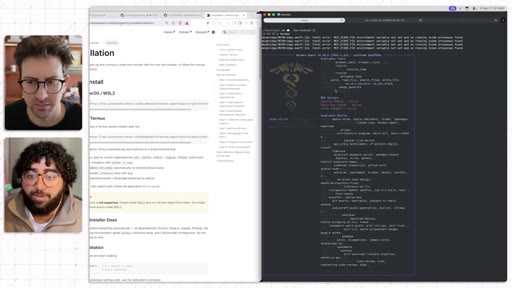
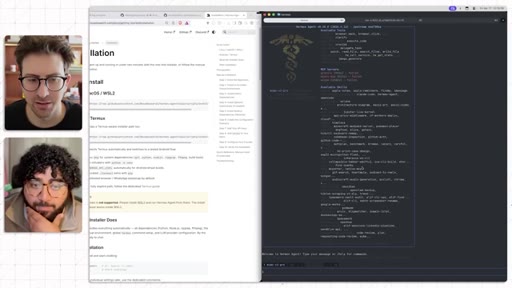
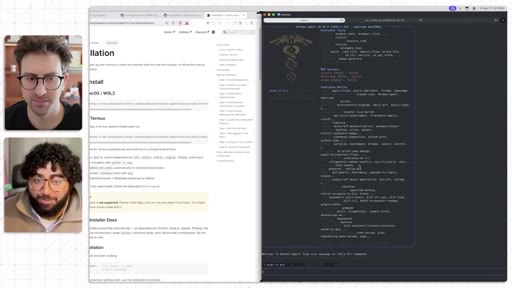
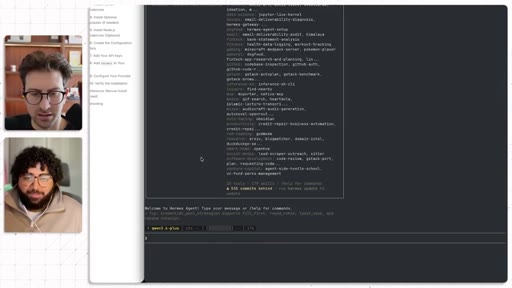
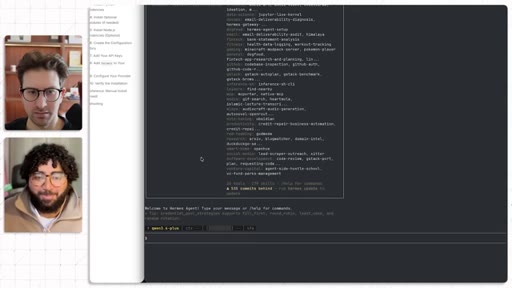
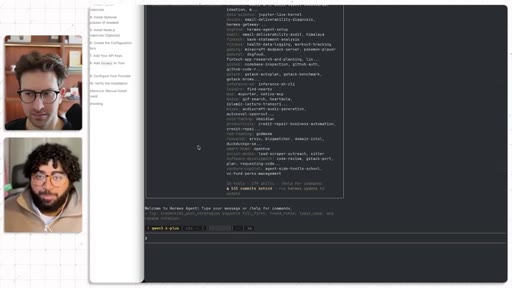
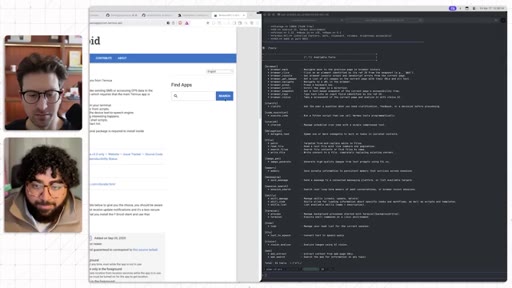
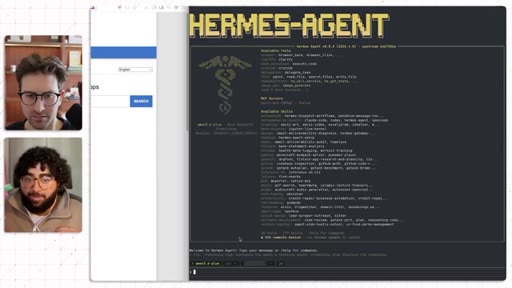
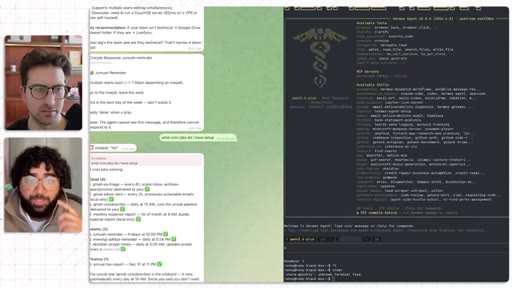
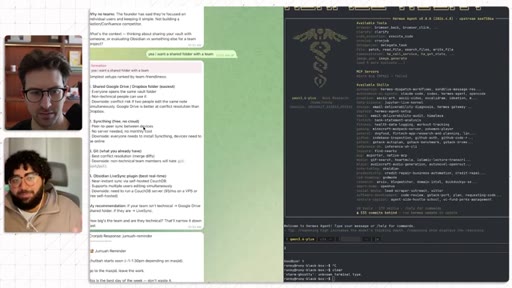
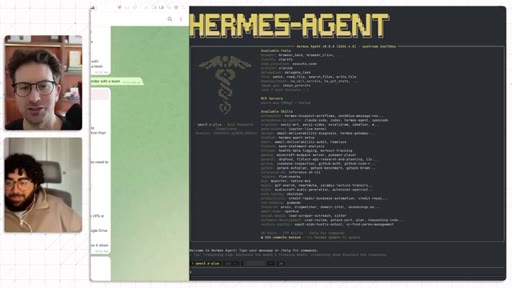
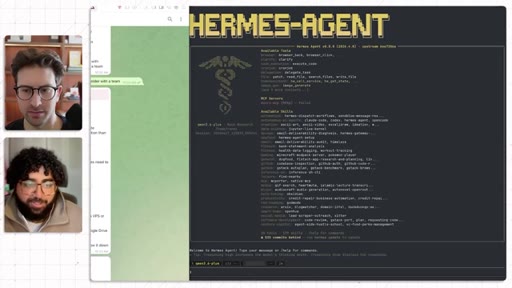
04:42And I'll zoom out a little bit. You can see here, um, when you open up Hermes for the first time, on the top, you'll see the available tools.
04:51So Hermes comes built in with 40 plus built in tools that OpenCloud doesn't have. So you'll have to go find out which tools to install. Uh, many of the built in tools will cover almost all of the basic tasks that you'll need to do.
05:04If you wanna fire up a browser, if you wanna search the web, if you wanna create recurring scheduled cron jobs or like scheduled like code, um, it has all of that built in. Even things like image generation are built in, home assistant capabilities.
05:18You don't really have to configure or go figure out what the best tools are. Um, the other thing you'll notice about Hermes when you first install it is that it has a lot of the really most popular available skills pre installed as well. So like I'm on a MacBook, so it has all of like the Apple notes, Apple reminders.
05:37It's got find my, it's got iMessage. I did not have to go and find this from a skills hub. It was already ready to go as soon as I installed it.
05:44So if you wanna talk about simplicity of installation and having all those skills you need, Hermes is probably the best one for that. What about security? Like are those like if I install some of those skills,
05:59are those like do I have peace of mind knowing that that's secure? Yeah.
06:03No. That's a really good question. Um, so there's a couple ways around this.
06:07One, I think you can always ask the agent to do an audit of your security setup, uh, which a lot of people don't think about. It's kinda almost like meta prompting it. So Hermes has knowledge of where the keys are stored in your configuration,
06:21um, and you can say, is this a secure setup? Tell me why or why not. And it'll go through and let you know if there are any secret keys exposed on your computer, if they're in plain text, if like a firewall is set up poorly, it'll let you know.
06:33Um, the other thing that's very unique to Hermes is that it's built to also, out of the box, be able to be ran inside of a Docker container in case you want it on your machine but isolated from the rest of your files. And then you can also run it on modal as like a serverless service as well. So it's really flexible in how you win.
06:52I personally am a little bit risky and I just kinda run it on the bare metal. And I'm just routinely making sure like every day I'm updating it and I'm also making sure that like I ask it to, you know, secure my own setup. Cool.
07:07Let's let's keep going. Alright. So the installation, if you're on a Mac, is pretty straightforward.
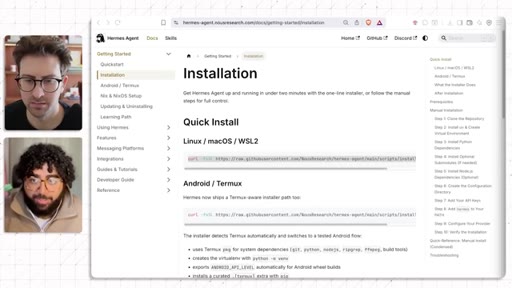
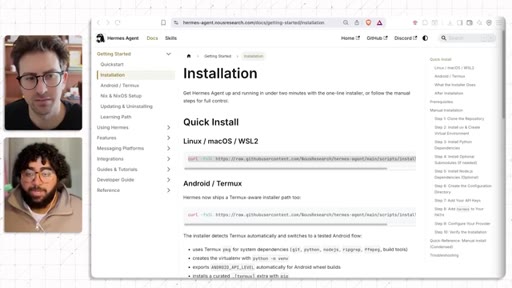
07:13You can just head over to the Ermes agent documentation. It's on the new research website.
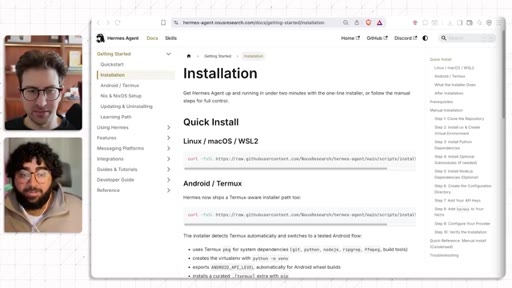
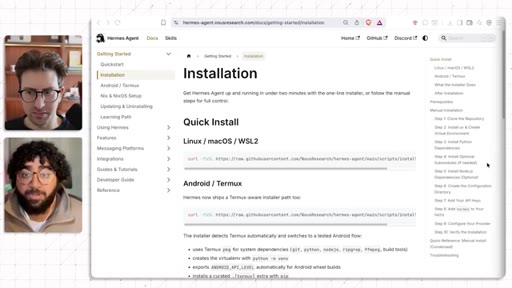
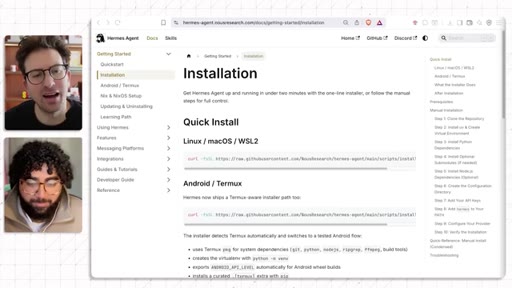
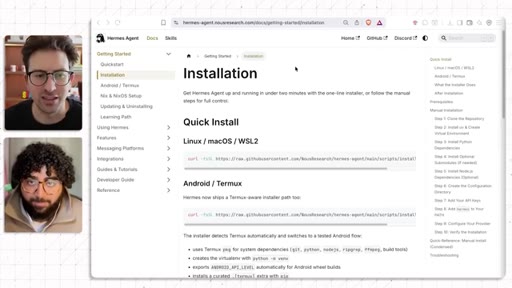
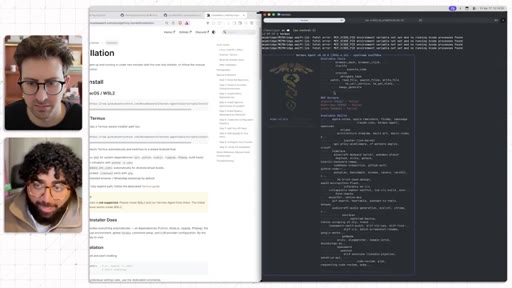
07:19And if you're on Linux, Mac OS, or even Windows Subsystem for Linux, it's just this one line command. If it's your first time installing a tool like this on a Mac, you'll probably need to install the Xcode developer tools.
07:32So I covered that in the video that Greg found me through, but basically you would do like Xcode dash select dash dash install. You can see this command right here and I will actually run it here.
07:45Um, I already have it installed, you can see, and if you need to update it, you can update it later. Um, so, yeah, you can just go ahead and copy this command and paste it in and it'll run.
07:55Now, obviously, I have it installed as already, so it'll just go through the update.
08:01Another thing that I found was that you can actually skip the, um, you can skip the onboarding and you can just close out of it.
08:10Um, and the most important commands that you'll need to know once you have it installed is just this one right here, is Ermes model. So this kind of brings me into the next, uh, the next problem that I had with OpenClaw, which was that with OpenClaw, I just did not have enough visibility into how much I was spending on tokens.
08:27And I was like it was like a constant battle to figure out like exactly which model to use. Oh, wait. I gotta run the install again.
08:33Let's try one more time. I think I broke it. Also with OpenClaw,
08:39you can't use Anthropic anymore.
08:43Right? So with Hermes,
08:46can you use an Anthropic API key seamlessly? Correct.
08:51Yeah. You can use, uh, you can use an Anthropic API key. You also have access to
08:56the, uh, new router as well. So let me show you. Alright.
08:59So this is a this is one that's running on my gaming PC just I had this as a backup. So if we type or let me clear this out so it's easier. And I'll type
09:09Hermes model. And here you can see, um, these are all the different providers that you can use to select a model. Again, this is already
09:18out like, this is all, like, out of the box. I did not have to go install anything. Um, and the two biggest ways to save money on this is really just to use either the new portal
09:27or OpenRouter. So if I go on OpenRouter, can see I'll be able to see all of the different models.
09:33And the cool thing about OpenRouter is that every once in a while, you'll have some free models available. So here NVIDIA's Nemotron, uh, is free this week.
09:43So if you wanted to use that model and you just want to run it for completely free, it's available as well. You can see also through OpenRouter, I'm able to access Anthropix models here. Remember you're asking.
09:54So they're both available And you can see a very clear layout of exactly how much it'll cost. So, you know, if I if I wanna use Quen 3.6 plus, it's probably only gonna cost me 33¢
10:06per million tokens, uh, for input and about a dollar 95 per million tokens of output.
10:12And you can see the price difference between SONNET and QUEN. Right?
10:16So you could it's like almost like one tenth the price on the input tokens which is like really good. Mean, you sort of know in sense, like, you know how much you're gonna spend on tokens. You don't really know once you have it set up, like, how you know, what your date
10:32well, I mean, you'll find out basically Yeah. Based on the
10:37the task you give it, how much things are gonna cost. And and I think that that's sort of the issue I think some people are having is, like, they're spending I mean, it's not crazy to spend hundreds of dollars a day on your OpenClaw instance at this point.
10:53Yeah. So actually the one of the interesting ways to fix that using the Ermes agent, um, is that you can actually once you have a task that you know that you wanna run rip like on a recurring basis, you can actually have it write the code one time for it. So instead of requiring an agent in the loop every single time that you need to do something, you can actually write the code to make it like more deterministic.
11:16And that'll actually long term save you tokens because you won't be spending tokens on actually, um, like doing the processing every single time.
11:26Like, you'll just do it the first time, get it to write the code. And then, you know, if you're using a free model, you can use the free model to write the code and then you basically will spend no tokens on that singular skill or task forever.
11:37That's like another thing that I noticed. I I realized that a lot of people are not if if you come from a software engineering world, you're always kind of thinking in this methodology of like don't repeat yourself.
11:48Yeah. Like if you are like in the habit of like building reports every single day or you want like kind of, like, a daily digest, a lot of those things can be automated with just pure code instead of relying on an LLM to do, like, a web scrape or something like that. And that will also save you a bunch of tokens.
12:01Um, so by just switching to Ermes Agent and OpenRouter, I basically got my token spend down from like it was like about like a $130 every five days down to like maybe like $10 a $10
12:14every five days. So about like a a little bit over a 90% reduction. And I'm still able to do all the things that I wanna do.
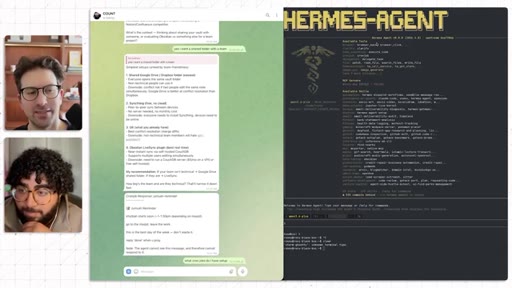
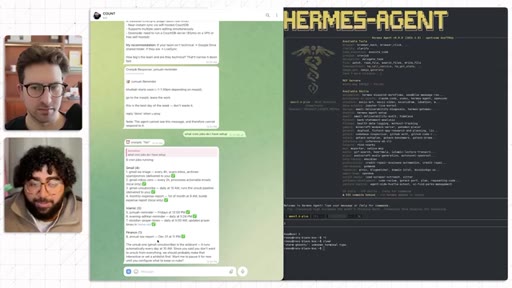
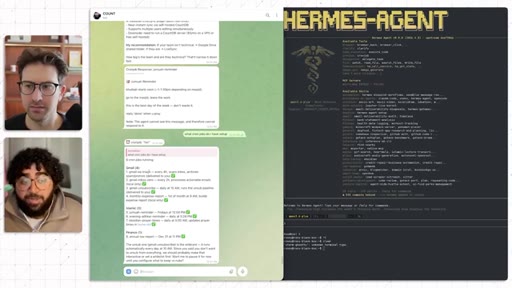
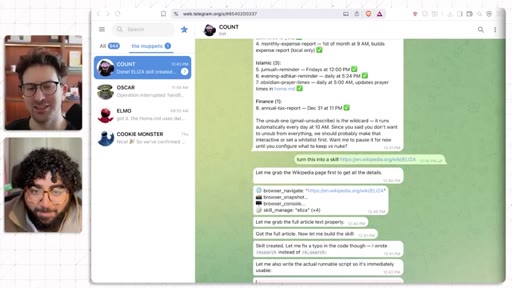
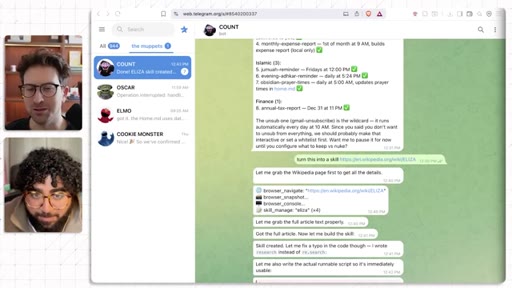
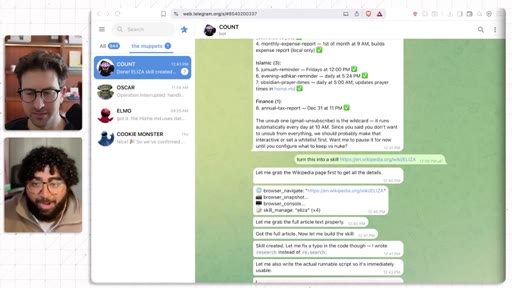
12:22The other important thing that I think everyone will want to know is that, of course, Hermes agent does allow you to have a connection to Telegram. So you can see all my agents here are named after the Muppets. So I still have a lot of room for expansion if I need to add more agents.
12:37There's still a bunch more Muppets I can go through. Um, and I can talk to them in Telegram just like how I can talk to them inside of the terminal.
12:46And this Cookie Monster one is super special because if you kind of take a sneak peek at the screen here, this one is actually running on a Solana Seeker Android phone that I have right here. So I wanted to talk a little bit about that because I got this set up finally yesterday. If you want to set up Hermes agent on an Android phone, you'll see here that there's actually, uh, the same way that you install it on your computer.
13:11There is a script that you can install to put it on an Android phone. And so here I have installed it on the Android phone and you can see what device am I on and it says here I'm on a Seeker Android 15 phone running via Termux. So That's really Yeah.
13:27So and then people are like if some of the people who saw that I was doing this on Twitter were asking like, oh, like, why would I install it on an Android phone instead of installing it on a computer? So before I get into that, uh, I will say that the there are a few extra steps for installing it on Android. The first thing is that you need an app called Termux.
13:45Termux is basically like a a terminal inside of Android. So it'll kinda look exactly like your normal Mac term terminal. And then if you wanna extend it even further,
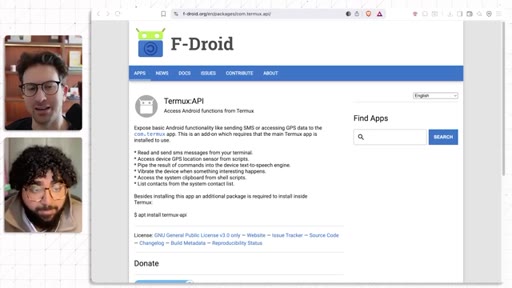
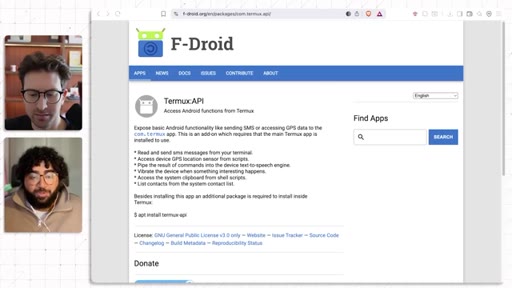
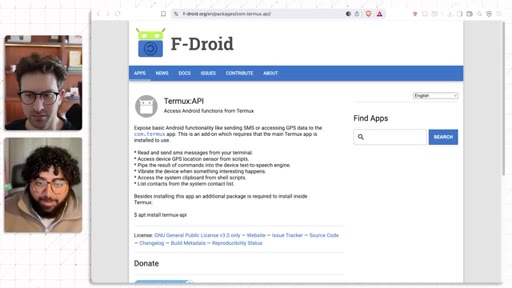
13:55there's another app called the Termux API. And the Termux API app, um, it's it's available on the f droid, which is an open source, uh, Android app store. Uh, but the Termux API actually gives you access to the sensor data on your phone.
14:12So you can access information about the battery, you can change the WiFi network, you can change the volume of the device, you can take photos using the Android phone,
14:22uh, you can adjust the brightness, you can trigger the vibration motor. There's like all basically everything that the Android phone has access to, you now have access to. So you can imagine a world where instead of having this running on a Mac mini, which is like sold out, you can have it running on an Android phone that's, you know, Android phones are very cheap and you can put a SIM card inside of it, you can bring it with you, you can have it read your text messages that are sent directly to that number, you can automate basically a two factor authentication that comes in via SMS.
14:53And basically, like, you now have a version of, an always on low power dedicated agent device that isn't a Mac mini and that isn't as expensive. A lot of people listen to this podcast, the startup ideas podcast because,
15:09you know, I I don't just bring on people who, you know, give practical AI tutorials, but also they like ideas, they like ways to make money using some of these, you know, new technologies and stuff like that.
15:20You know, with the Android Hermes instance specifically,
15:26can do you have any ideas that come to mind around like, you know, if I were trying to make money with Hermes agent on Android,
15:35you know, what are what are the some things that come to mind, top of mind? Yeah. The first thing is
15:41probably because you have access to the Termux API, you can actually fire off commands on the Android phone itself.
15:48Like, you can tap the screen and you can like send notifications. So if I think one of the next things I wanna set up is of course, like everyone, some sort of like social media automation that uses the phone directly.
16:00So right now we have a lot of scheduler tools and people complain that social media scheduling tools, they nerf your reach because, you know, like, they're going through the API instead of on the device. Well, this kinda solves that because you can actually post the content directly from the device.
16:16Um, that's one thing that's, like, super cool. Right? So instead of having to, you know, literally, like, open up your phone and download a video that's generated and post it that way, uh, you could have this technically running on
16:27an almost infinitely scalable amount of Android phones and run accounts and post from there. And it will still show that it came from a device with like a real MAC address. That's one way.
16:37Another thing that I've seen is just of course, like, there's like the make money part of it, but also, you know, I have a lot of the very basic parts of my life that are annoying, like, already automated.
16:49So, like, I have an email triaging agent that every morning goes through my emails, deletes the ones that are, like, unnecessary, unsubscribes from things that I subscribe to that are, like, really useless, and then shows me a digest of the important emails.
17:02That might not directly make me more money right now, but it's still saving me about, like, thirty minutes to an hour a day and just allowing me to do more. Cool. Yeah.
17:10I think the hard part is just figuring out like, taking stock auditing your your personal life to be like, are the things I need automated?
17:19Mhmm. And then also from a business perspective, what are the things I need to be automated?
17:24I think that's part of the hard part. And I guess, like, you know, you could you can ask Ermez's agent to audit your life, right, and start asking you questions to help you like, ask it to help you, you know?
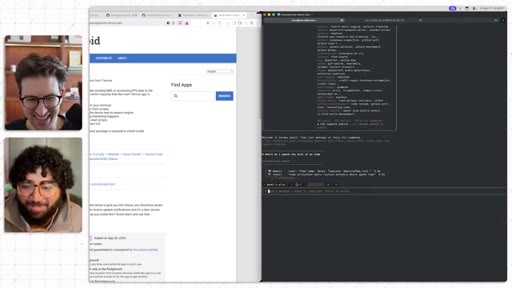
17:37Yeah. Like, we can do this. Like, where do I spend the bulk of my time?
17:41And let's see if it knows from my memories. And if this gets too intimate, we can always cut it out.
17:47That's what we want, Imran. We wanted to get into it. Yeah.
17:51So like it knows where I live, knows what times that I'm in. It's like, okay, where do I spend time? What am I asking questions about?
17:58That's awesome. Is that something that you recommend people,
18:02you know, use Hermes agent to help help you set it up and and and productize some some of the stuff that you're doing? Yeah. So I think, like, the idea of using agents to get things done is like a new paradigm.
18:14So the easiest way to, like, get used to it is to solve, like, personal problems in your life. So the biggest, like, personal problem that I first solved with an agent was, um, like, figuring out what to cook at home because my wife and I, like, we love DoorDashing, we love eating out, but, obviously, like, that's not, you know, that's not the healthiest and that also costs a lot of money.
18:32So the first thing I did was I set up a local speech to text model on my actual computer and I sent a a long, like, eight minute telegram voice message of me going through my fridge and my pantry of every single thing and every single ingredient that's in my pantry.
18:48And I said every day, can you send me a recipe or three recipes based on what's in my pantry and what, like, my fitness goals are? Um, it seems like something small, but it kinda takes a lot of, like, mental load away from, like, my day to day. Um, there's a lot of things, like, I think that if you start doing, like, really basic stuff like that,
19:05um, you know, like we can you can kinda automate a lot. Also, we gotta we gotta cut this out, bro.
19:11There's a lot of personal stuff in here. Is there's no way too much.
19:16Rafa, let's blur it out. We're gonna blur it out. So Okay.
19:20We have to blur this out. It's a lot, bro. It's a lot.
19:22We're blurring it up, but we're keeping this in the sense that, like, if you do this, it works. Exactly.
19:29Yeah. It does work. It's very intimate, so definitely can't show you guys everything.
19:33It's intimate also because it knows you. Right? Mhmm.
19:35And you've you put in the work with it. Right? So if you're starting this from scratch,
19:40it won't be intimate. Right? It won't be.
19:42Yeah. So, like, when you started from scratch, like, you'll have all the tools, you'll have the skills. As you talk to it every single day and you use it for work over and over again, it'll like I said, it'll store in its memory.
19:51It'll begin to learn exactly what you do, what, like, um, and how it can help you. And you can even ask it, like, every night you can ask it, like, what's one or two things that you can build for me that would make my life better?
20:03And it'll do that for you. Okay. What are what are other must know things about Hermes agent?
20:09You do still have to update it every night. It's still technically beta software. So you can see I haven't updated this one since
20:16in nine days and I am five hundred and thirty five commits behind, which is quite a bit. So you do still have to update it every single day.
20:26It is still technically beta software. You still should probably
20:31constantly, you know, lock it down in certain ways. A really simple way to
20:37lock down Ermes agent but still have access to it from anywhere is one to set up like Telegram or WhatsApp. Another thing that I highly recommend for any of these tools is that you install Tailscale and you configure Tailscale correctly. So Tailscale will allow your phone and all of your computers to be on the same kind of virtual network,
20:56And then you can remotely access them using any like terminal SSH app. We just let you kind of remote in and like monitor it and chat with it that way as well. Before before we head out, is there a question that I shoulda asked you about Hermes' agent that I didn't ask you?
21:13Should you migrate from OpenClot? I mean, I've got my yeah.
21:18I mean, that's the big question. Right? Should you
21:21now that we've seen it, I mean well, we've we've sort of you know, I should've I let's actually would you be open to showing your Muppets? Yeah. Yeah.
21:31Yeah. And and also, like,
21:35with respect to your Muppets, like, does it make sense to set up, you know, one agent, multiple agents? Like, how how do people think about designing
21:46their their agents? You know, like, do I create one that's called, like, social media manager and it's just doing social media stuff? Or how should I think about this?
21:55Yeah. So this is something that's still kind of a work in progress for me as well. Yeah.
21:59So you can see count, uh, is is, uh, is my main kind of agent. It's the one that's running on my gaming computer. Um, and you can see this has all of like my personal stuff set up.
22:09So I have cron jobs for like doing my Gmail triage, for unsubscribing to emails, to give me like expense reports, like some more personal stuff, like finance stuff is all set up here. Um, these are technically cron jobs, they're not sub agents.
22:23I have seen people set these up as sub agents. The benefit of that is that you can assign specific models to each one. So I could have a Gmail email triage sub agent that I have assigned a cheaper model to, right, because it's more deterministic and it'll tell me like, if if it's, a really simple task, you can assign a, like, a a cheaper model to it, um, and kinda save money that way and you can add, like, more specific instructions.
22:48But I've also seen people just set it up as a cron job. So I have it set up as a cron job. I don't have it set up as a sub agent.
22:54Um, so I think a lot of these kind of specifics are still being figured out. We don't really know if it's better to have it as a sub agent or not. The thing that is that we can agree on is that having an agent that has memory and learns over time is incredibly powerful.
23:13Um, and I have four set up here just because I'm like a tinkerer, but I actually think the most optimal way to do it is to have one set up or two. And the only reason why I say two is if you have one for work and one for personal stuff.
23:28Like, I imagine if I worked at, like, a Fortune 500 company, they wouldn't let me, like, run Urmesh Agent with all my personal stuff on it on my work computer. But I still wanna have the capabilities of being able to kinda, like, automate or do work really efficiently.
23:40Mhmm. It's also it feels cleaner a little bit if it's personal and work.
23:45Like, my to do list, for example, I have like, the way I run my life, you know, I use things, the to do to do app, and I just have personal and and work.
23:57And, like, to me, that just, like, makes the most sense. So, like, when I the way I'm gonna set this up after this call is I'm gonna set up a personal one, I'm gonna set up a work one. Yeah.
24:06And I I think, um, another thing that maybe we didn't cover that I think we talked about a little bit on Twitter is that, um, this is like Obsidian. So, uh, I was never a big Obsidian fan. I kinda just stored everything in my Apple notes,
24:18um, and kinda hope for the best. The The cool thing about Obsidian is that even if you have, like, multiple agents, um, it's all, like, markdown files.
24:25So now Yeah. This this tool that was, instead of having to know markdown, you can just tell agents to, like, organize them. So I have this kind of setup as just, my home MD file.
24:35So it tells me all the important things I need to know about this week. It tells me about, like, things I need to get done today, upcoming travel, things for, like, my day job, things for, like, you know, personal stuff, and it's all organized and set up automatically by the agent every day. And so I would not have been able to go through,
24:53like, the painstaking effort of, like, putting this together by myself every single morning. But now, like, I have an agent that does it for me and it's just so much easier. But this is like not something I would have done before.
25:06I would I I wouldn't think to use Obsidian in the past but because I now have agents I can kind of manipulate it really easily. It just makes it much more fun and easy to use. Right.
25:15So you're is your recommendation that, you know, once you get Hermes installed, post install, start,
25:22you know, using it with Obsidian? I think Obsidian is a really clean layout because if you look at like if you look at Telegram, like, some of these just kind of read as like massive
25:33walls of text and even if I even if I like organize it or even if I put something in like my sole MD file to specify that it should speak concisely, like, just it becomes really unruly and it's like really hard to find like the most important information. There are people that are like experimenting
25:50with building like kind of like mission control dashboards but I I I just feel like the easiest is like the one that you can see on your phone and your computer, you know. And if someone saw your Obsidian and is like, man, Imran has this really
26:04like that's that's my dream. How do I how do they go from like how do they make a similar thing?
26:10Like how how do you actually do that? Yeah. So my Obsidian was set up by my Hermes agent after using my Hermes agents for, like, twenty days.
26:18So So it's as it learned about me. Yeah. You think it you think it takes twenty days?
26:23No. I I think I think it takes I think it takes building up the habit of using of default going to the agent to get work done even if you can do it yourself. That's the biggest thing.
26:32Okay. So maybe it's like seven days maybe it's seven days of like using it, you know, consistently and then after that their Emez agent knows a, you know, a good chunk about you and then
26:46you can have it create a similar Obsidian stack. Mhmm. Right?
26:51Yeah. And and you still right now, you still kind of have to meta prompt it. So you can ask it at the end of every day like, what is something you should build for the work I do?
27:00Or what is one way that you can, uh, what is, like, one one task I'm doing over and over again that I should set up as a cron job? Um, and it'll know, but you still kind of have to prompt it.
27:09Right? So I'm hoping in the future that you don't have to do that. That it just kinda knows automatically,
27:14but we'll get there. We're pretty close. That's really interesting.
27:17Could you, like, open up I know this is we're we're sort of doing this live, but, could you open up, a doc just so and and just, like, write out, like, the the prompts that people should should be thinking about
27:31around around for for Hermes agent, like, what what are the ones that you're using, Emron, that you're like it seems obvious to you but, you know, people might,
27:42you know, not know. Yeah. A really basic one is like
27:47what have I been procrastinating? Right? That's a good one because it has access to your to do list.
27:53If you're listening to this podcast, like, you're probably doing a lot and there's probably something that's, like, you know, under the hood that, like, you just haven't gotten to yet. Another one is, um, what is the most important thing to work on today?
28:05Right? And, like, that's, like, super important. Another one would be, like I like I mentioned, like, what
28:13are some tasks that I'm doing every single day that I could or should automate?
28:20Another one would be, what is a tool that you can build me tonight that would make my life easier tomorrow? Right?
28:28Like, these types of things, like, where you're yeah. This you're right. This does kinda seem obvious to me,
28:34But to many people like it's kind of a new new way of thinking.
28:39I'm trying to think of another one.
28:43Is there anything important today that I've missed? Right? Anything around
28:48cron jobs, MD files?
28:52I'm trying to think. Yeah. I think I think I think
28:56the cron job setup could be is like a little bit difficult in the beginning because I feel that people don't understand,
29:04like, what a cron job is. It's still a very technical term, uh, but it's essentially just something that runs on a schedule. And
29:13you like, everyone does everyone has a list of tasks or a list of things that they do every single day that probably could or should be automated. Right? And so asking it to set up Cronjobs for those things will just kinda make your life a little bit easier.
29:26The last thing I did wanna show you now that I'm thinking about it is I actually have I wanna show you there
29:35was a psychiatrist that
29:40made a computer or made like a computer program. Yes.
29:46His name is Joseph Weisenbaum.
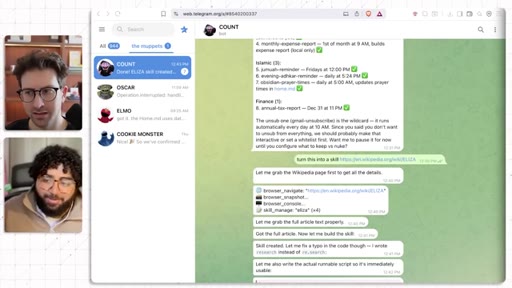
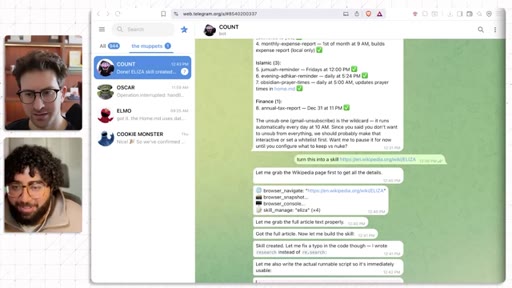
29:49And he made a natural language processing computer program over the course of three years at MIT that's basically like like a chatbot therapist. And I've actually loaded this up as a skill inside of Hermes where I can, like, talk to it every single day and, like, help it it it will basically help me self actualize about what I should also work on.
30:12So there's a lot of these like weird like little like niche like personal development things that you can actually build really easily. Right?
30:19It took them three years to build out this like natural language processing like kind of like psychiatrist thing. But like you can just drop this Wikipedia file inside of your MMS agent and say like you'll turn this into a skill and it'll do it.
30:34That's really cool. Yeah.
30:39Yeah. That's sort of the daunting part about, you know, be it OpenClaw or Hermes is, like, you sort of need the ideas around like, I'm sure a lot of people wouldn't have come across that, you know, Wikipedia article and been like, oh, I should make this a skill.
30:54Right? So the prompting
30:56yourself to actually think about like, oh, I'm navigating the Internet or I'm navigating the world. How can I make this a skill so that I can use this every day?
31:06Just has to be a part of your it's it's just how you work today in the AJAI. Yeah. Exactly.
31:11The biggest thing is, like, learning how to use Irma's agent is not actually the skill. It's gonna become the requirement. You know?
31:17Exactly. Yeah. And whether it's, like, Irma's today, maybe OpenClaw gets better, maybe Claude Cowork, maybe it's Nebula, whatever it is, like, you still need to know what to do with it, and that's, like, kinda where where it counts.
31:30Last question around skills. I know that you showed some pre built Hermes
31:37skills.
31:40You know, what are what are some, you know, must install skills that you recommend for people listening? Yeah.
31:48So I definitely recommend installing the Obsidian skill. Um, I actually don't even use the Obsidian CLI, but I use the Obsidian skill. That one's really important.
31:58I've seen some people install the honcho dev memory skill. I haven't needed to set that up yet, though I think I probably will because there are some memory limits on Hermes and you kinda wanna keep like your context
32:10as small as possible. Um, another really useful one let me see from my ghosty.
32:19Well, so a lot of these skills I've built myself. Right? Like, I have, like, a bank statement analysis one.
32:24So I definitely think, like, whatever you do, you should always, like, start with, like try to build out your own skills around, like, personal finance and like fitness and like all the things that you already pay for. Um, and maybe those aren't ones that you actually go down, but they're ones that you build. Um, another really interesting one that I think everyone should play around with are of course all of the software development related skills.
32:46I even you can see here, I actually ported over g stack by Gary Tan into Hermes before it was widely available on Hermes. So I definitely you know, if you're working on a startup,
32:57it's definitely like a really cool cool skill to use g stack. And yeah, like I think those are the big ones. Just because I think some people don't know what g stack is, can you just give a quick primer on what g stack is
33:10and you know, how why you think that people should install g stack with Hermes? Yeah.
33:16Yeah. So g stack is basically the way I understand it, um, is it was built for a Claude code and it was made by Gary Tan, the CEO of Y Combinator. Um, essentially,
33:27the idea is that it takes the Y Combinator style startup process, which is like figuring out what works week over week, asking the right questions about what you should improve about your product and your business, and then helping you go and implement that as code, um, and make decisions on that.
33:42So, um, those types of things were previously only available to people who were in Y Combinator, which was like the best which is like the one of the best startup accelerators in the world. Um, but now a lot of that knowledge has been basically open sourced as a skill that you can bolt on to your agent. Um, and that's something that like was never available before in the past.
34:01So if you're obviously working on a startup like an app or something and you're not in San Francisco or maybe like you're not familiar with like the startup methodologies, I highly recommend using something like that.
34:12And it's a no brainer. It's free. It's free.
34:15Yeah. Yeah. It's like the the agent itself is like it's like Hermes agent is like basically
34:20like it's like nineties tuner car culture. Right? Like you can go find the parts you want and you can put them on and you should like learn how to customize it for yourself.
34:28As long as you remember that like customizing it is not the skill but it's more about what you get done with it. Right. And I think it's like
34:36you do have to remind yourself that I like how you said that customizing is not the skill and there's so many people who are just obsessed with the customization and then they're not actually
34:48doing anything. Right? Like so
34:50it's it's like, don't be an artist about it. Right?
34:54Like Mhmm.
34:57At the end of the day, you want something that's gonna add value to your own personal life, that's gonna add value to your business life. And and it's
35:07it's a rabbit hole basically and to to go down and where you're like optimizing and optimizing and optimizing, but
35:16don't do it. Yeah. This handles the optimization for you.
35:19Like, the biggest thing when people say like a lot of people have asked me like what's been the most useful thing about like Hermes agent. Like, day to day, I work at a fund and I'm able to talk to more founders and have better conversations with them because a lot of the background work is now handled by my personal agent.
35:35That's awesome. That's a huge win for me. If we can talk to 20% more companies or 30% more companies,
35:41we have better signal, we get better deal flow, we're helping out more founders, we're eventually gonna return more as a fund. Right? It just makes me better at my job.
35:49It's a big deal. Right? Like, you do that's the way I see it is like if you value your time at, say, dollars 500 an hour in terms of the opportunities that could come,
35:58CTAthat's a that's a huge that's a huge deal. So Imran, thank you so much for giving us, you know, the go to guide for installing Ermes agent,
36:08CTAplaying with Ermes agent, making skills, installing it with g stack and Obsidian.
36:13CTAI really appreciate it. I'll include links for where you can follow Imran on the Internet, which is where I found him.
36:21CTAAnd I I think that you're super talented at at explaining technical concepts in a really simple way.
36:28CTASo I would love to have you back on the show. But people, let us let me know. Let me know in the comments, you know.
36:34CTAIs this did did did you did you feel it? I think he he he brought this off.
36:39CTASo thanks again, Imran. Is there anything you wanna leave people with? Yeah.
36:43CTAI work at a fund. It's called Alif. Check us out alif.build,
36:47CTAalif.build. And of course, I'm on social media at Imranye. I think after this, I'm just gonna make more videos.
36:55CTAThere you go. Let's do it. Yeah.
36:56CTALet's do it. Alright. Thanks a lot.
36:58CTAAlright. Thanks for having me, man.
— full transcript
§ 05 · For Joe

The memory moat is real.

Own Your Stack playbook

Hermes isn't just a better OpenClaw — it's the first personal agent with a genuine switching cost: it learns you over time, and that memory is yours.

  • Install Hermes today and use it for every task for 7 days straight — before customizing anything.
  • Set up OpenRouter on day one: pick a cheap model for deterministic tasks, reserve Sonnet for ambiguous ones.
  • For any task you repeat daily, ask the agent to write the code to automate it permanently — remove the LLM from the loop.
  • Name your agents. Give them roles. The Muppets framing forces you to think about scope before you build.
  • Use the nightly meta-prompt: 'What is one tool you can build me tonight that would make my life easier tomorrow?' Compound this over 30 days.
  • If you're building a product, install G-Stack (Gary Tan / YC) immediately — YC methodology for free, as an agent skill.
  • Point at the 90% cost reduction claim with your audience: the 'always-on AI agent for /week' is a real story now.
§ 05 · For You

Your own AI that remembers you.

If you're thinking about trying it

Hermes Agent is the first personal AI tool that gets better the more you use it — because it actually remembers what you've asked it to do.

  • Start with one simple daily task (morning email triage, recipe suggestions, daily priorities) and let the agent handle it every day for a week.
  • Use the five prompts Imran showed: procrastination, today's priority, what to automate, what to build tonight, anything missed.
  • Don't spend the first week customizing — just talk to it about what you actually do each day. The memory builds from real conversations.
  • If you have an old Android phone, it can run Hermes 24/7 without touching your main computer.
  • The goal isn't a fancy setup — it's getting back 30 minutes a day on things that used to require your full attention.
§ 06 · Frame Gallery

Visual moments.