
Goda Go · Youtube · 26:47

I build OpenClaw REPLICA inside Claude Code (FREE Course)

A 27-minute free course showing how to build a Telegram-connected Claude Code agent with persistent memory, Siri voice triggering, and a multi-agent board of directors using Bun, Supabase, and an open-source GitHub repo.

Posted
February 13th 2026
3 months ago
Duration
26:47
Format
Tutorial
educational
Channel
GG
Goda Go
§ 01 · The Hook

The bait, then the rug-pull.

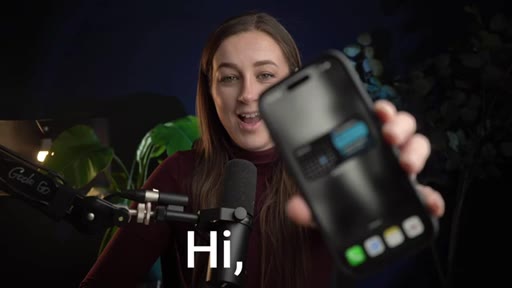
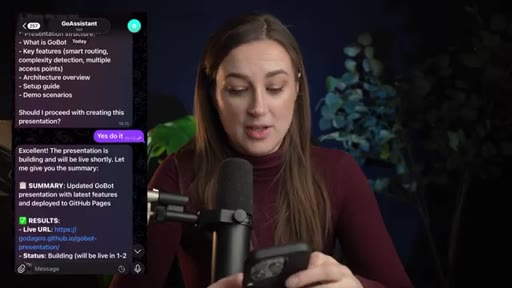
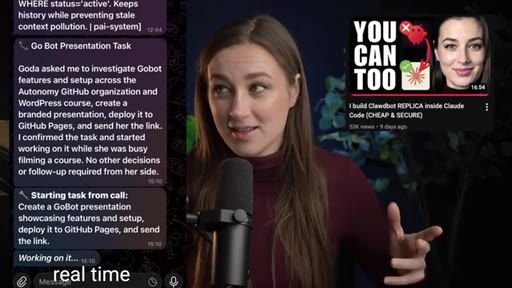
Before Goda says a word of explanation, she lifts her phone and calls her AI. The bot answers, accepts a complex task on camera, and deploys a GitHub Pages presentation before the intro is over. This is not a pre-built demo. It is the product running live, and that is the whole argument for the next 27 minutes.

§ · Stated Promise

What the video promised.

stated at 01:28 "After this video and mini course, you are going to be able to communicate to your Claude Code using your Telegram like a messaging app, and you will have memory. You can send voice messages, and you will have proactive check-ins." delivered at 21:15
§ · Chapters

Where the time goes.

00:00 – 00:55

01 · Cold open: live Siri demo

Calls GoBot via Siri, bot accepts a complex GitHub task and deploys slides to Pages in real time.
00:55 – 02:17

02 · Course promise + free vs paid scope

Telegram messaging, memory, voice, proactive check-ins all free. VPS, multi-agent, full calling are paid community.
02:17 – 04:07

03 · What is GoBot: live slides

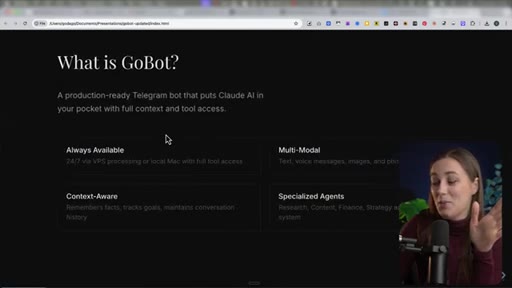
Slides appear live (made by the bot). 3-tier architecture: Telegram bot, Gateway/Mac Relay, Claude Code. Multi-modal, context-aware, specialized agents.
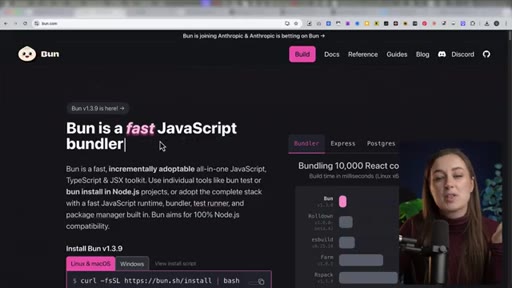
04:07 – 05:24

04 · Prerequisites: Bun + Claude Code

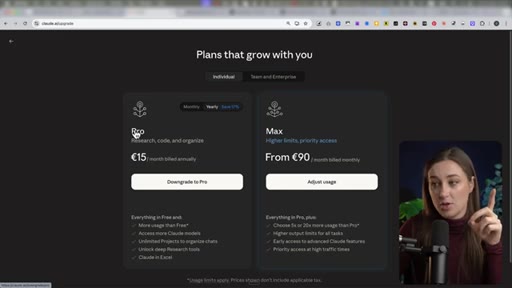
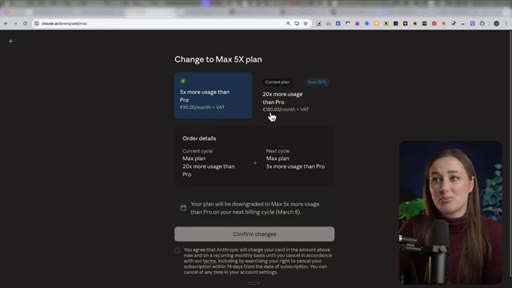
Bun JS runtime (free). Claude Code via Pro ($20/mo) or Max ($100-$200/mo). Repo: 175 stars, 76 forks.
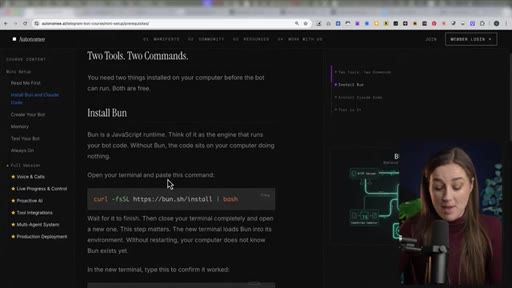
05:24 – 07:22

05 · Install Bun + authenticate Claude Code

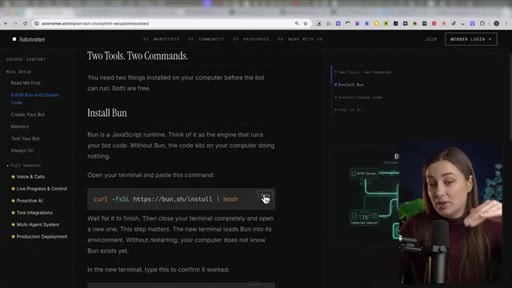
Terminal commands for Bun install. Verify with bun version. Claude Code install docs for Mac/Windows; authenticate with subscription link.
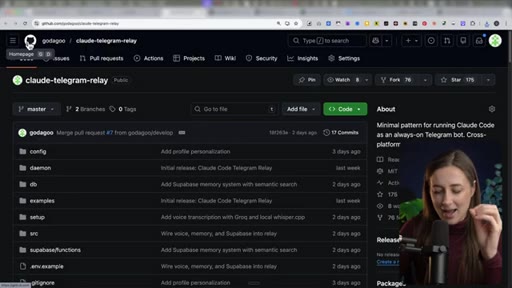
07:22 – 09:23

06 · Step 1: Get the code

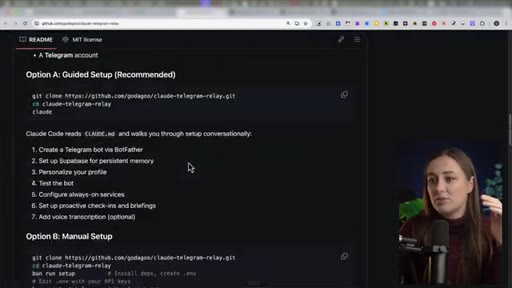
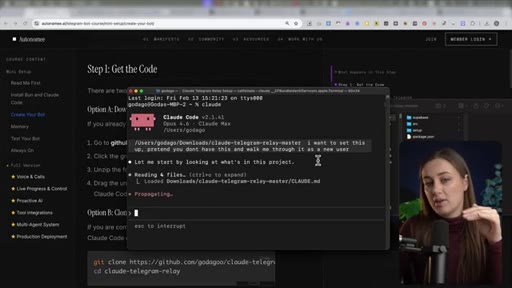
Clone github.com/godagoo/claude-telegram-relay or download ZIP. Drag folder into Claude Code, say set this up. Automated setup ~3 min.
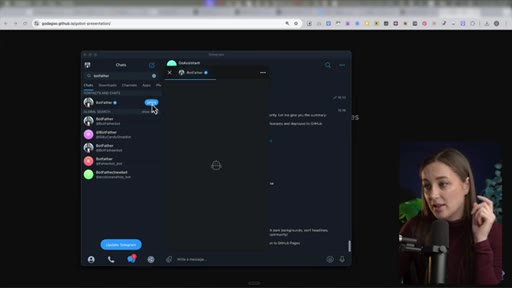
09:23 – 11:12

07 · Step 2: Create Telegram bot via BotFather

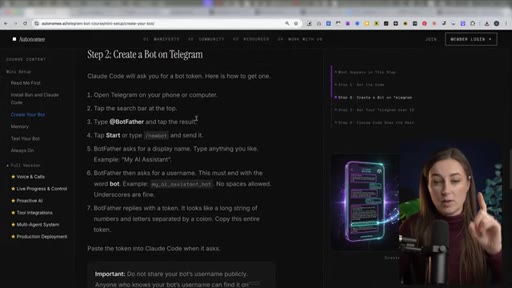
Search BotFather (blue checkmark), /newbot, pick username. Token = password, never show on video.
11:12 – 12:06

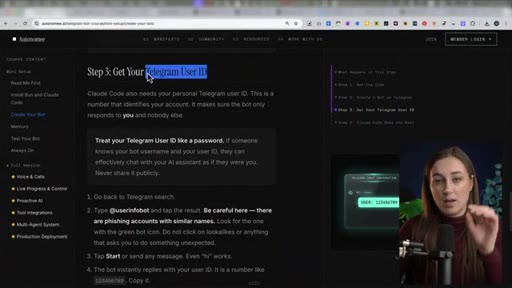
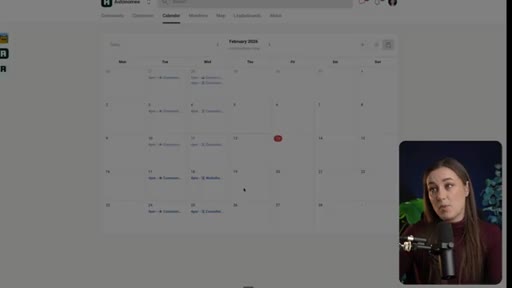
08 · Step 3: Get Telegram User ID

Search userinfobot in Telegram. Security: username + user ID together lets anyone hijack your bot.
12:06 – 15:13

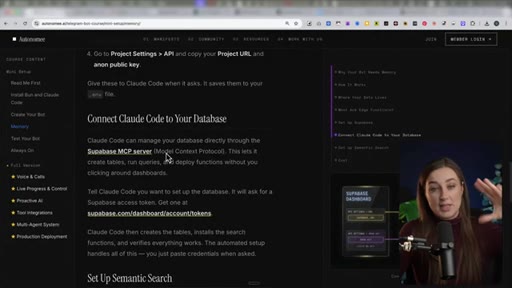
09 · Memory setup: Supabase

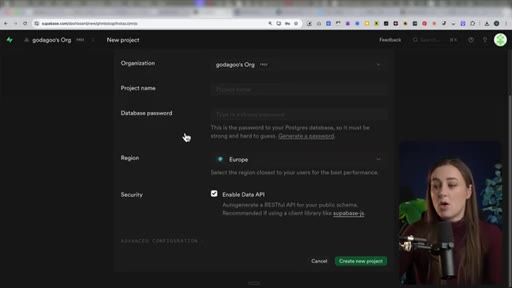
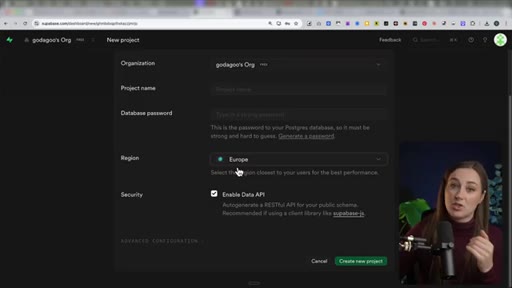
Conversation history, semantic search, facts + goals detection, intent detection. Supabase free tier 2 projects. Create org, project, enable Data API.
15:13 – 17:14

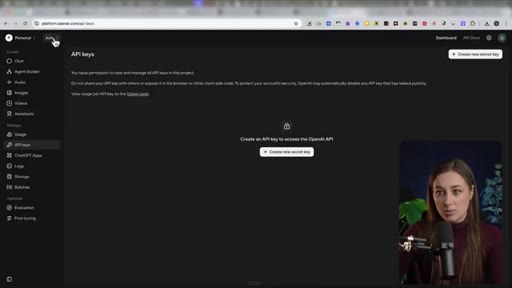
10 · Supabase MCP + OpenAI embeddings

Install official Supabase MCP server, provide access token. Store OPENAI_API_KEY in edge function secrets. Embeddings cost pennies.
17:14 – 21:15

11 · Test the bot + first Telegram message

Claude Code populates user profile for context. Message bot on Telegram, typing indicator appears. Bot is live.
21:15 – 23:16

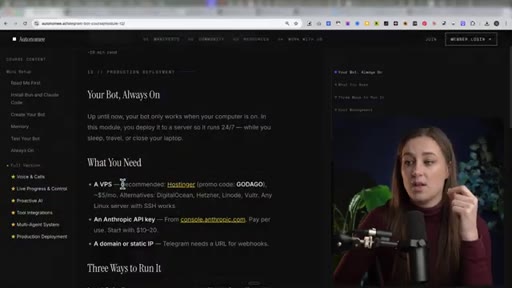
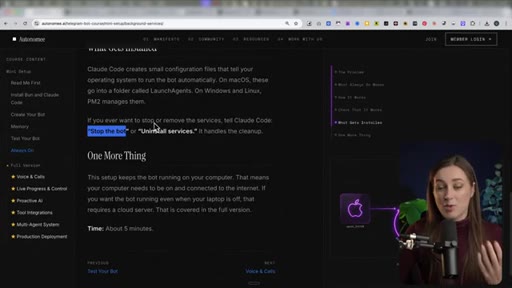
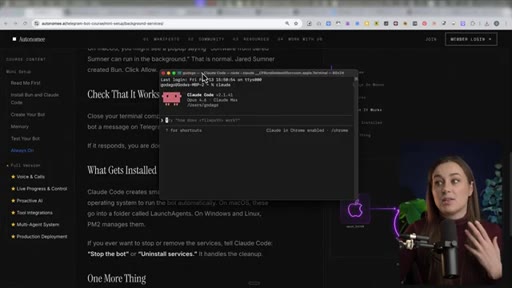
12 · Always On: LaunchD / PM2

Claude Code writes LaunchD (Mac) or PM2 (Windows/Linux) config automatically. Close terminal, bot keeps running.
23:16 – 24:36

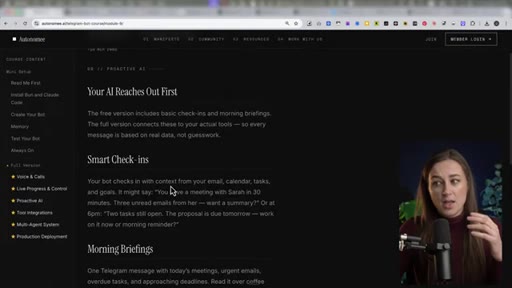
13 · Q&A: voice calls, proactive AI, live progress

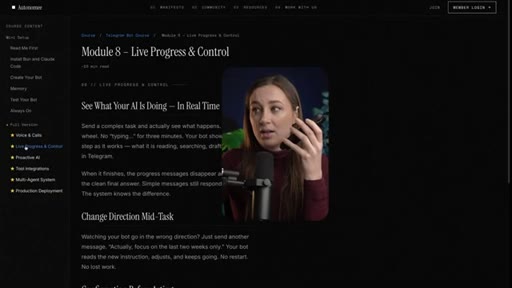
Voice call demo via Siri. Bot recalls personal context. Live progress + control: real-time step reporting, interrupt mid-task.
24:36 – 26:47

14 · Multi-agent + VPS + community CTA

Board of directors: Orchestrator + Research/Content/Finance/Strategy agents in Telegram groups. Hybrid Mac+VPS routing. Fallback chain. Community CTA.

§ · Storyboard

Visual structure at a glance.

Siri call live demo
course promise
GoBot architecture slides
clone + setup
memory / Supabase
first Telegram message
multi-agent board
community CTA
§ · Frameworks

Named ideas worth stealing.

25:30 model

Hybrid Local/VPS Routing

  1. Local Mac with subscription (fixed cost, computer on)
  2. VPS with Anthropic API (pay-per-use, computer off)

While computer is on, route through Claude Code subscription. When computer is off, route through API on VPS. Best of both worlds.

Steal for JoeFlow engine architecture: local engine while running, cloud fallback when closed
25:50 model

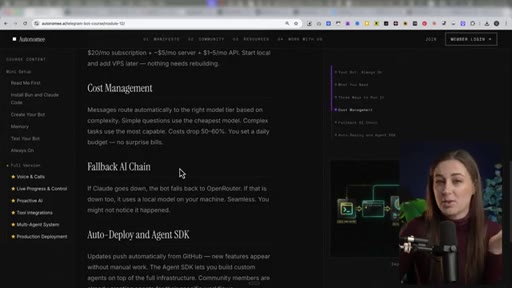
Fallback AI Chain

  1. Primary: Anthropic Claude
  2. Fallback 1: OpenRouter (specific models)
  3. Fallback 2: Local model on VPS

If Anthropic goes down, agent reroutes automatically. Never a single point of failure.

Steal for Any production agent system needing resilience without code changes
24:36 model

Board of Directors Multi-Agent

  1. Orchestrator (general routing)
  2. Research agent
  3. Content agent
  4. Finance agent
  5. Strategy agent

One orchestrator in a Telegram group with topics. Each topic has a specialized agent. Agents can invoke critic mode and consult each other.

Steal for JoeFlow Batch / Chef orchestrator pattern: one master agent routing to specialized workers
15:13 concept

MCP-First Setup Automation

Let Claude Code install and configure its own tooling via MCP server rather than hand-holding every SQL step. AI configures AI.

Steal for JoeFlow install experience: let the engine configure its own dependencies on first run
26:36 concept

Free Course as Acquisition Layer

Free GitHub repo + tutorial delivers real value up to exactly the edge where paid offer begins. Creates genuine trust and qualified leads.

Steal for JoeFlow free tier + MCN+ positioning: the free version is the acquisition layer, not a teaser
§ · Quotables

Lines you could clip.

02:47
"Claude Code is not just for developers. It's like your personal infrastructure with AI that is able to connect all the things, both execute on strategy, but also have hands to do things."
Reframes Claude Code for non-technical audience, opens a new market segment → TikTok hook
02:10
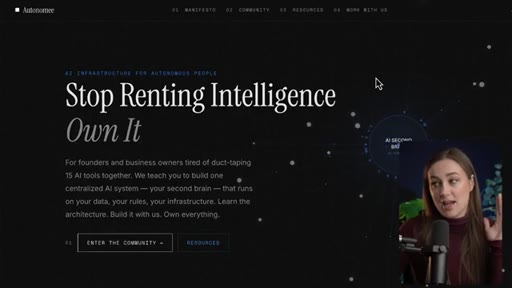
"Stop renting intelligence. Own it."
Perfect six-word tagline. Directly applicable to Joe's positioning. → IG reel cold open
25:55
"This is your AI second brain. This is your knowledge. This is your tools. You don't want to stop working."
Stakes statement, justifies the fallback chain emotionally → newsletter pull-quote
04:41
"I personally been paying $200 to Anthropic forever and that's been my one of the best investments that I ever made."
Blunt price + conviction. Persuasive for anyone on the fence about Max plan. → TikTok hook
§ · Pacing

How they spent the runtime.

Hook length55s
Info densityhigh
Filler8%
§ · Resources Mentioned

Things they pointed at.

§ · CTA Breakdown

How they asked for the click.

26:36 product
"Inside of the community, we have a full course explaining multi agents and how to set up VPS and also how to do it securely, proactive AI, ADS, and we have constant building."

Soft and earned. Free course genuinely delivers, paid pitch only arrives after full value is established. Shows Skool community page with course thumbnails.

§ 04 · The Script

Word for word.

HOOK opening / re-engagementCTA the pitch analogy story
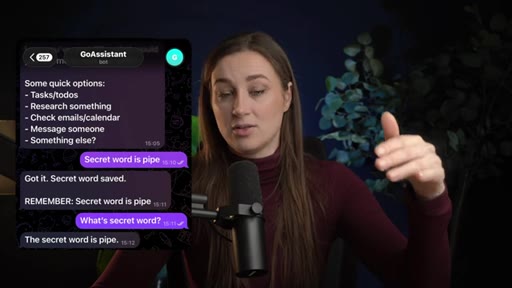
00:00HOOKHi, Siri. Call GoBot.
00:07HOOKHey, Goda. Hi. I see you've been busy with filming today.
00:11HOOKHow's the free Claude bot alternative setup video coming along? We are filming a course today. I have a big task for you.
00:20HOOKI want you to go to my autonomy organization on GitHub, investigate everything about Go bot features and setup.
00:28HOOKYou can also look at the WordPress, the course for full setup. And I want you to create a presentation using my autonomy branding,
00:38HOOKdeploy it to GitHub, turn it into pages, and send me a link to the presentation. Got it.
00:44HOOKThat's a big one. So you want me to investigate the GoBot features and set up across your autonomy key? Okay.
00:49HOOKGood luck. Okay. So I figured how to trigger my CloudBot replica
00:55HOOKwith the phone, so Siri is finally useful. And now I can watch it step by step executing the task. And this runs twenty four seven now.
01:04HOOKSo even if I shut down my computer, it keeps going. And after the last video, hundreds if probably not a thousand people asked me how to do it, how to build Clawbot replica inside
01:18HOOKClawd code yourself. So this is going to be the mini course that I promised. I've been working hard on trying to make it as useful as possible.
01:27HOOKAfter this video and mini course, you are going to able to communicate to your clot code using your telegram like a messaging app, and you will have memory. You can use send voice messages, and you will have proactive check ins. If you are interested in the full features like calling and actually going and doing big task and having twenty four seven hosted on VPS.
01:49HOOKYou can check out all those features for the full version. And if you want to personalize and fully set it up because it's a little bit more complex, you can join our community.
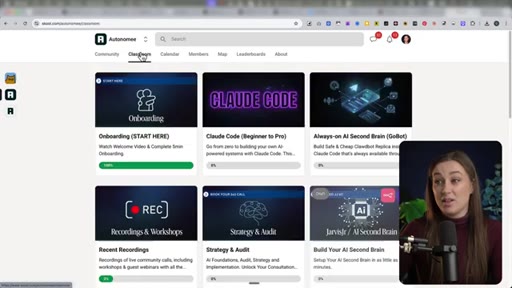
01:59HOOKLet's dive in now. I built my new website the business, and it's called Autonomy. I'm very proud of it.
02:05HOOKAnd I can also fully edit my website just by making a call, giving it a task, it goes and edits. That's the whole other video that I'm planning to make. You can navigate to resources.
02:17This is the knowledge base and here you go. Build your own Clobot replica inside ClotCode.
02:24So what you're going to build is an AI agents you can call, command, and control. You can totally get started,
02:31and it's free. And I know that people are already building on top of that. First thing to address that this works on Mac, Windows, or Linux.
02:38So it doesn't matter what operating system you have. We are using Cloud Code. The number one thing for you to understand that Cloud Code is not just for developers.
02:47It's like your personal infrastructure with AI that is able to connect all the things, both execute on strategy, but also have hands to do things. Oh my god.
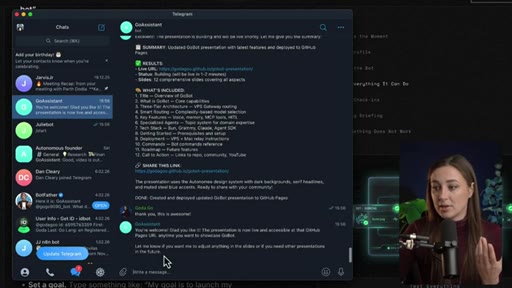
02:58Okay. So, the slides, it just literally popped up. I'm not cutting this part.
03:03Okay? So, we're going to look at the slides together. So, this is the full version.
03:09Okay. What is GoBot? It's always available multimodal context aware specialized agents.
03:15So this is also I'm going to talk about I implemented multi agent. I've like been working with multi agent framework, so I had to do it. Three tier architecture,
03:25Telegram bot, it goes to the so this is the full version. Okay? Gateway, Mac Relay, I don't want to spend too much time.
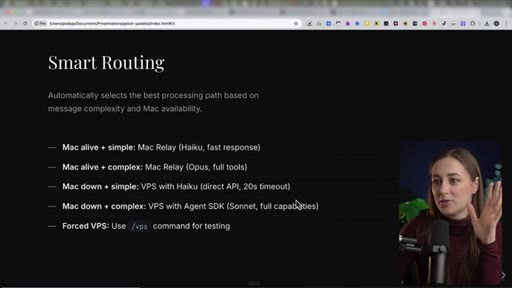
03:31Smart routing, key features, voice integration,
03:36multi user ready. I don't know. Like, if this is not crazy
03:40to you, it is absolutely crazy for me that I can just call, tell it what to do, and it opens on my computer fully done. And I need to confirm it to push it to Pages so I can publicly share it.
03:52Okay? Oh my god. And I got a link.
03:55I literally got the link to the same slides. I need to optimize the slides to be mobile friendly. Back to the course.
04:01Okay? Now what you need? Two things.
04:04We need Bun. It is very fast JavaScript runtime.
04:07So, basically, this allows us to run while your computer so it's basically like running in the background. Like, imagine when you play from Spotify music, no matter what you do, its music is playing. So it's kind of the same principle.
04:19This is completely for free. And then clot code. So for clot code, you can get clot code with clot subscription.
04:27You can even get clot code with clot pro subscription. Monthly, it's around $20. If you want
04:34real power, you go with a max plan. And max plan has two tiers, around $100 and $200.
04:41So I personally been paying $200 to Anthropic forever for a moment that they had that option in Cloud Code, and that's been my one of the best investments that I ever made.
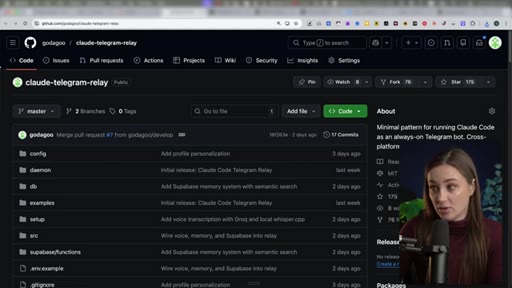
04:55So I hope they never increase that price, please. The next thing, the code. So there is a public GitHub repo that I put together, and you can see that 175
05:05people started. There's 76 people that forked it, so they are making their own versions.
05:10You can read exactly about text. So if you are familiar how to run different commands, just go clone it, and it has automated setup.
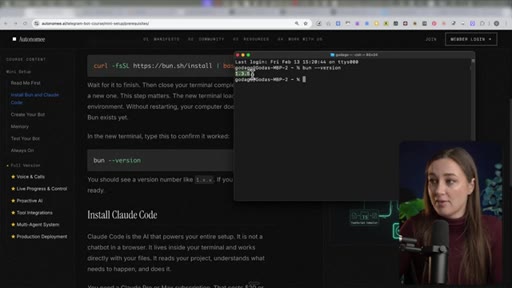
05:18So now how do you install BUN and ClotCode? So I already mentioned you need subscription from ClotCode. But for installing BUN, you need to run this command in your terminal.
05:29To open terminal on at least Mac, you go into Spotlight and type terminal. Boom. This is your terminal look.
05:37So this is what we are going to use. This is what developers are very familiar. And to be honest, it's kind of like a full circle because when computer started, everything was in terminal.
05:46Now we are back in terminal. So it's a little bit funny. You would run this command first,
05:51and then you need to close your terminal. So you just copy. Let's open it again.
05:55You copy, paste it, and click enter. Once you have bun installed, you also want to double check if everything went well.
06:04So you can go BUN version. So let's do it together. Again, if I press this,
06:09I have 1.35. If everything installed, this is what you will see. Now installing ClotCode.
06:15There are official installation documents. Depending if you're on Mac or Windows, the installation command will look different. These are the commands.
06:23You just copy, paste it in your terminal, and it does the setup. In my case, I already have it installed. Once you have clot installed, the next thing you are going to do, again, open your terminal and type clot.
06:35Let's make it bigger. Just clot. Just as a name.
06:38You press enter. And if you first time set it up, it's going to ask you to authenticate with your subscription.
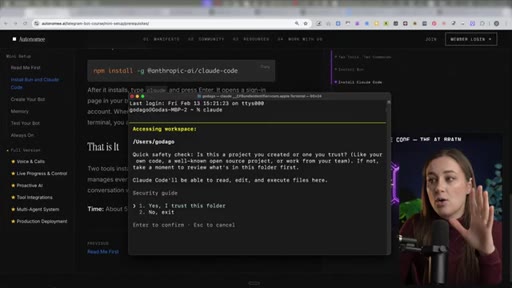
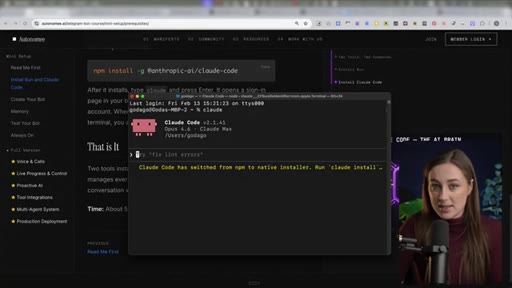
06:45So, again, you click the link, you select your email that you have a subscription, it generates like a special link, you click on that, and boom, you are inside. It's asking me about accessing certain workspace, so I'm saying, yes, I trust this folder. You are inside clot code, and you have a, like, lovely icon, so it's not as scary.
07:05It's really just like a chat interface. It just looks a bit different, uh, but you type and you press enter, basically.
07:12Now we are going to connect Telegram to our clot code. Step one is get the code. There is two ways to get the code.
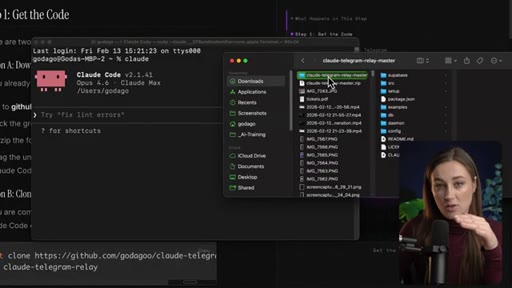
07:19You can go to this repo, click on the green button, and download ZIP. And this is if you want to start, but you don't have GitHub account, you can just do that.
07:30However, I highly highly highly recommend if I would not say it's a must to have GitHub account, so you can actually also do version control on your setup. If you have GitHub account and you actually clone this repo, when they push new updates, which I just did two days ago, you can update your whole setup with the new feature that I added or the community added or if there is any bugs.
07:54So having a GitHub account is really really important. If you don't have GitHub account and you just downloaded the file, you go to your download folder and you have this zip file. Unzip it.
08:07And all you can do and this is applies to also images because ClotCode can also analyze images, files, like literally anything you can feed it. You just drag this folder, boom. And then you just say, I want to set this up.
08:22In ClotCode, once you press enter and send it, you actually are seeing what is happening. If you just freshly set up clot code, it might throw a lot of, like, can I do this? Can I do this?
08:33Those permissions that you are seeing, it's not related to the setup that you just got, but it's like a clot code setup. You can change those permissions and loosen up. This is like a gray area, and you have to be really smart about what permissions you give to go on autopilot.
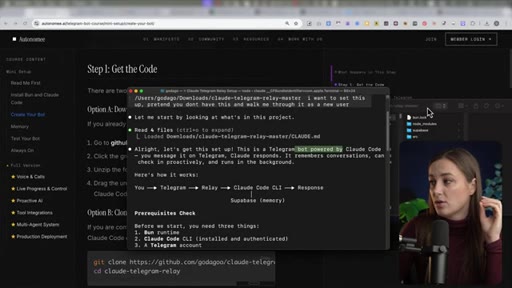
08:48Let's get this setup. This is a Telegram bot powered by clot code. You message it, blah blah blah.
08:54So this is you get how it runs. Bind and clot code are both installed. Phase one estimates three minutes.
09:00Like, I asked my community members. They said, like, it every guide is running in two minutes. It's going to tell you what to do, but also what it needs, and you just paste.
09:08It. Step two, create bot in Telegram. Very simple.
09:11So first of all, you need to download Telegram. Telegram runs both on your phone, on a tablet, on a desktop. Literally, you will be able to access this no matter where you are.
09:20So you go to Telegram. In a search, type bot father.
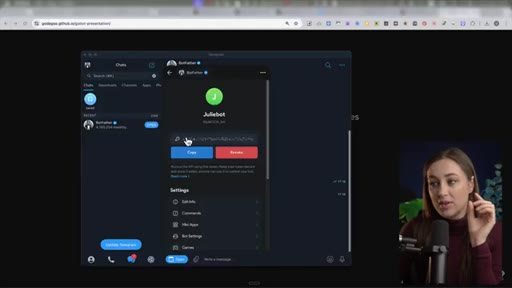
09:25This is what you're going to see. There's going to be, like, a phishing accounts. Make sure that this one with the blue check mark, open it, click create new bot.
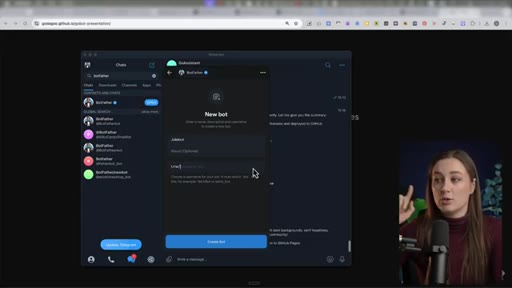
09:34It's asking, like, what's the bot name? So put something like Julie bot. Here here is important.
09:40Treat your username private. Because if you share your username, anybody can find it on Telegram just like we found bot favour. In a sense, we anybody can message you.
09:50I will tell you about security measures, how to prevent that anybody can message you and extract information from your Telegram bot. But even with usernames, we're kind of private.
10:00But we said Julie, let's do Julie one two three four five underscore bot. You create a bot.
10:07Click on your bot, and this is oh my god. I'm so happy that they implemented this.
10:12This is the token that we need. Token is private. Never show it to anyone.
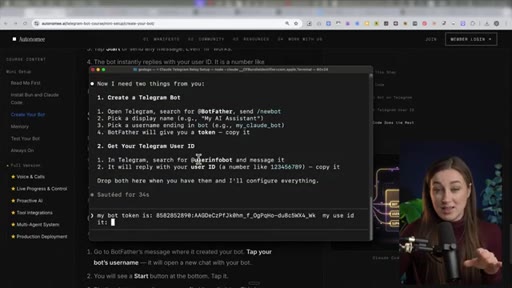
10:17Just copy this, paste it in your automated setup. So I do copy,
10:22and here you would say my bot token is next thing that we need is Telegram user ID. So I'm going to show you how to get it, but before we do that, I want to make it very, very clear.
10:35Treat this as your password. I saw so many tutorials on YouTube from people setting up Clotbots, and, basically,
10:43they're showing on the video their user ID. If I have your username and your Telegram user ID, I can spin up an agent in a second and basically message your bot passing in this Telegram user ID and extracting everything that they want.
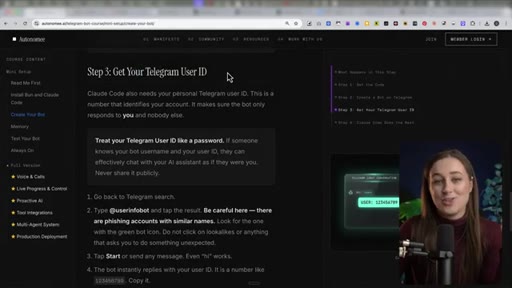
11:01Anyway, go to user info bot. In the search, type this one. Once again, please click on the green one and not all the fishy ones.
11:11So this is the official. Now I'm not going to click on it because it immediately exposes my Telegram user ID.
11:19But, basically, once you click on it and click start, it tells your ID a string of numbers. Go back to your terminal and you paste the user ID. I'm not going to follow along here with automated setup because I think it's really straightforward.
11:36And if you have any issues, you can submit them in a GitHub repo. But I'm going to explain you what's happening and how to set up the rest. And at this point,
11:44you would be able to already message it. Okay? Now memory.
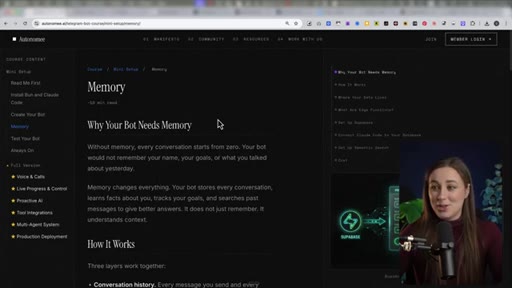
11:49Because if you just send a message and you say, like, hey. My name is Goda. And just say, hi, Goda.
11:55And you're like, what's my name? There is no memory. Right?
11:58We have to set up memory. That's kind of like a basics that we need. Many different ways how you can do this.
12:03I personally use super base. We are next week having a workshop on comparison between super base and convex. But you want a database that is secure, is hosted in different regions
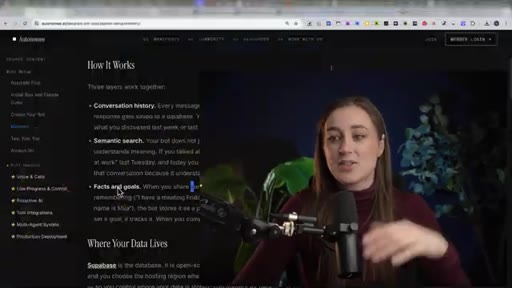
12:15because of data protection. Once we set up memory, which we are going to do in a second, you're going to have conversation history, also semantic search. Your bot not only pulls the whole messages, but pulls the meaning.
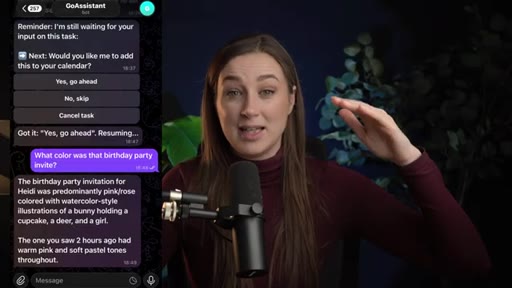
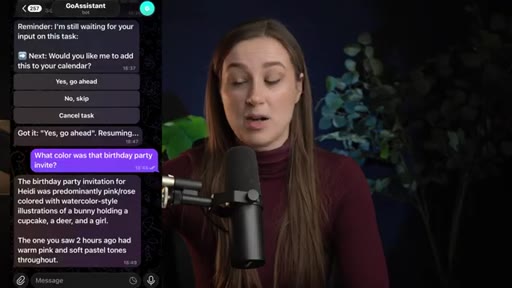
12:27So if you are like, hey. What was this kind of, like, invite that they got last week?
12:34Okay? So this is not something very specific, but there is bits of pieces of information that matches multiple outputs. I also implemented facts and goals.
12:43There is intent detection. If you say something and it's a fact, it's going to detect that this is a fact. Like, for example, my daughter's name is x.
12:52It's going to add it to its memory so you don't have to repeat it again and again. Calls, many people do it differently. You can do task, like, whatever it is.
13:00But if you say, like, oh, I want to do this next week, that's a goal detected. It's going to add. So in proactive check ins, it's going to ask you, like, hey.
13:08How is that thing going? You wanted to do this at that date. Did you finish it?
13:13This is, a absolutely, like, a basic basic setup, but I think it already is kind of pretty cool experience. So where is your memories and data live? Like, we are going to use Superbase for this.
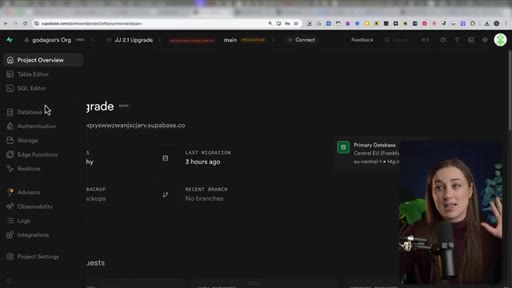
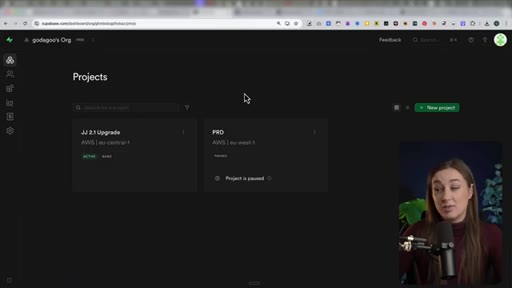
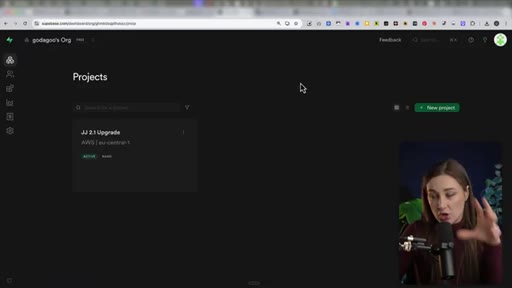
13:24So this is the platform, of alternative of Google's Firebase. Once you create an account, you create your organization. Inside an organization on the free tier, you are able to have two projects.
13:36So, actually, I'm going to just delete this project so I can show you.
13:41To create your own, you click to create new project. You need to give it a name, database password. Do create that.
13:49We never know what happens and save it somewhere. Just it's a good practice. Now the region.
13:54Usually, you select the region because this is where your servers live. There are two ways to consider this. If you would ever set it up this for businesses, it's very important where data is stored and all the policies about it, but you're setting this up probably for yourself.
14:10You need to select where you are based because then it's the closest server to use when there's this latency. You always want to be as close to the server that you selected. And you need to enable this because we are going to use data API.
14:22And then you just create new project. That's it. Once you have your project, it's going to be empty, but we are going to let AI to set up the whole database for us.
14:31Edge functions, the tables, SQL is like everything is already preloaded for you. Of course, keep in mind, this is like very basic version. Uh, there is a lot to be desired from this, which you can find in the full version and breakdown,
14:45but it's good to start. It's good to start. You have this functional bot.
14:48We are leveraging edge functions. If you want to learn about that, I put it in writing here. Next thing, in set the automated step, it's going to ask you for your project URL
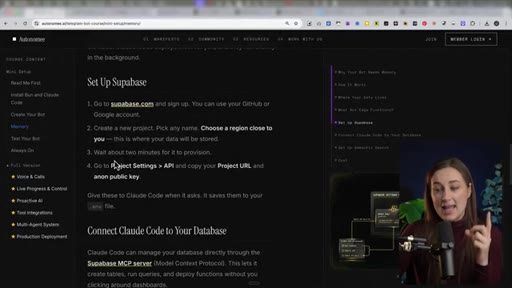
14:59and add on public key. Go to the top bar where it says connect. In different connections, you can see API keys.
15:07From here, you need your project URL and you need your Anon key. Copy both and give it to your setup. For setting up the whole database, we are going to use Superbase MCP server.
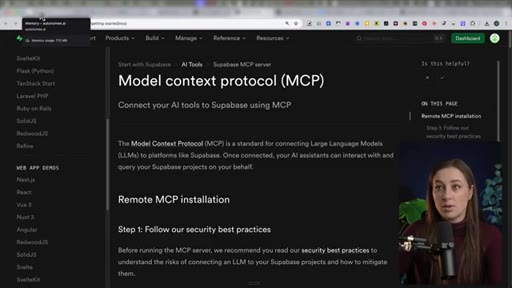
15:18In a automated setup, it's going to prompt you to get it officially from Superbase. That's very important. Use only official one.
15:26And install Superbase MCP server. So there is the full guide how to do it, and automated setup is going to walk you through. Once you have Superbase
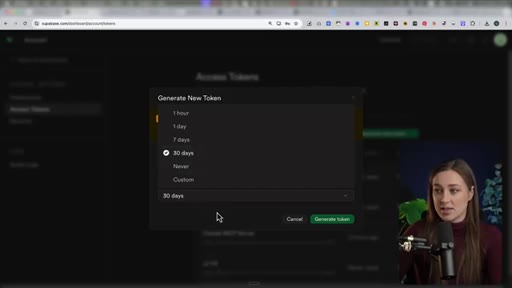
15:36MCP, it's going to ask you for your account token. If you want to find access token, you go to account preferences,
15:44and here you have preferences and access token. Click generate new token. Give it a name.
15:50For expiry, you can start with thirty days, but, honestly, you can set it to never as well. But, again, this is like a password to your database.
15:58Right? So treat it like one. Julie, I like, I I I don't know why it's Julie.
16:03Generate token. Boom. So this is what you will see as the access token.
16:07Again, copy and give it to automated setup. It's not necessary, but you can set up semantic search.
16:15You're going to have messages. And for messages, we have this embeddings.
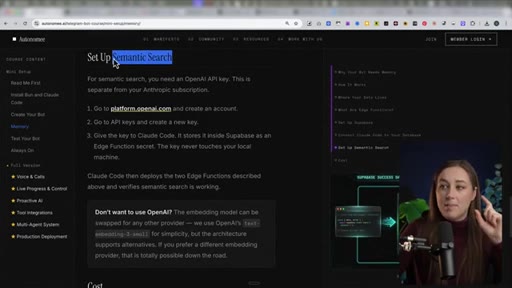
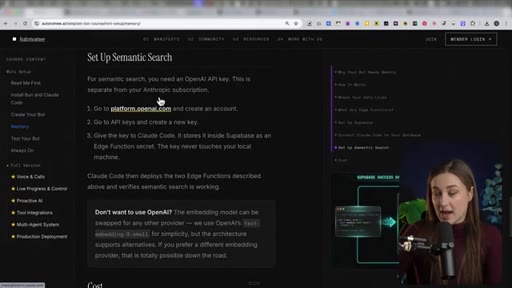
16:20So this is basically just a string of numbers and the coordinates of the word meaning for setting up semantic search. It's going to install edge functions, but it's not going to work unless you give it API key. We are going to use OpenAI embeddings.
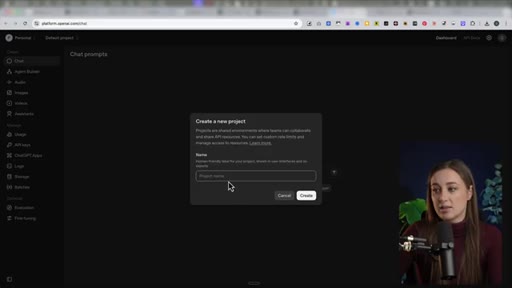
16:35You can use any other embeddings. To create OpenAI API account, you go to platform.openai.com. Once you create account, if you don't have any, you are going to see something like this.
16:46It looks today like this, maybe tomorrow a bit different. You will have default project. I have multiple different projects.
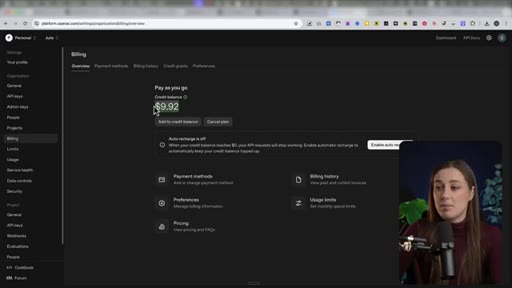
16:53You can create a dedicated project, Julie. This allows you once you have a project, are more organized and you can track your API spendings. To enable API, you have to set up billing.
17:04And I think if you're new, you're going to get, like, a $5 credit, maybe changed.
17:10But, usually, for new users, they were giving some credits. Once you set up your project, we will need API keys. You don't have any billing enabled, it won't allow you to set up API keys.
17:21Go to settings, billing, and attach a credit card and just add some balance. So I now use OpenAI,
17:28I think, only for embeddings for the project, and it's insanely cheap. Embeddings are super cheap.
17:35If you have $510, it's going to last you forever. Once you added some credit, go back to dashboard, API keys, and, again, create new secret key.
17:44You give it a name. We say Julie. Create secret key.
17:48This is what you need to copy. Now important, we're going to place this API key in super base because this is just for super base.
17:55Once you copy and click done, it's going to disappear. You won't be able to copy it again. You will have to create new key.
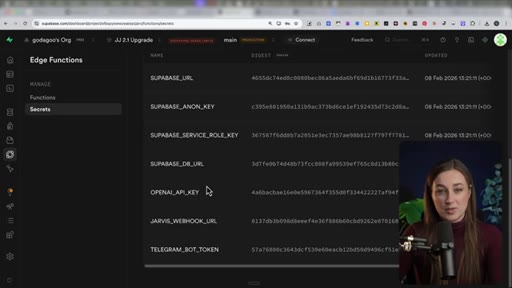
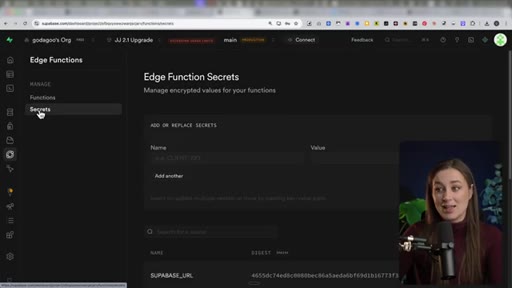
18:02So copy this, maybe save it in some document. We need to go to edge functions. I have many different edge functions,
18:09but for edge functions to have functionality to create embeddings, those need secret. Add a secret, but here is super super important.
18:19You have to give it not some random name, but you have to give it exactly this. OpenAI underscore API underscore key in capital letters.
18:28Paste it like this. And I already have one API key right here saved, so I'm not going to add another one because then this is a variable.
18:38And if there are two, the same variables, that doesn't really work. Regarding cost, super base free tier is insanely general as you get 500 megabytes
18:47of storage, and we are storing only text. In a full setup, we are storing also images. So for example, you can send an image.
18:54It detects intent. Considering that intent, it goes looks at the image. But also, we are storing image and creating embedding.
19:02So I don't know. Like, after a month, you can say, like, hey. I send you this image of camera.
19:08What model was that camera? It's going to be able to tell you because we are storing all, so images become part of our memory. But to start Superbase is free.
19:18OpenAI embeddings are pennies. This is the moment when you are testing your bot.
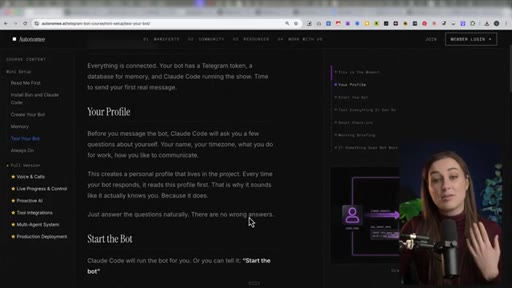
19:22So at this point, you should be done with your setup. Now it's going to ask you some things about your profile so that basically it's not like dumb and it has a little bit of context information about you.
19:34Again, if you're already using Clot code and you have your MD file with information about you, that context It's just an additional thing, and this is for people just getting started. If you want to start messaging your bot, you click on this username,
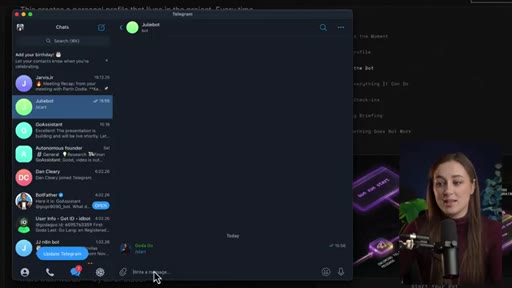
19:48Julie. Click messages. To actually start,
19:52click big blue start button. Boom. You are inside.
19:55You just say hi, and let's say, for example, here we say thank you. This is awesome. At the top, you're going to see typing.
20:04Well, this is my full setup. I think I implemented typing also in there.
20:10If I haven't, I'm going to add it because it's pretty cool. So you can actually see that something is happening. Right?
20:16Okay. So now this right now, it runs only while your terminal is running.
20:21So we need to make sure that it's running all the time. So this is why we go on always on. And when I say all the time, you have to understand that this runs while your computer runs because it's on your machine.
20:33In a full version, we set up a hybrid model where for when your computer is on, we are using Mac with your subscription, which is fixed cost. If you wanna go and your computer is off or in your backpack, you have VPS, exactly the same function.
20:48We are using Cloud Agent SDK, but more on that in the full setup, and we can teach you, and we can help you set it up inside Commute. Now if you are on Mac, you're going to use LaunchHD. If you're on Windows, it's called PM two.
21:04However, don't need to worry. It doesn't matter on what software you you are. You just basically know to meet it set up.
21:10Just say it, make it always on. It will know what to do. Test it if it works when terminal is closed.
21:16You just basically close it, terminate, gone, and then text your Telegram bot, and it should answer you no matter what.
21:23And if for some reason you want to stop it again, go to Cloud Code and say, hey. Stop my Telegram bot. From this point on, no matter when you open Cloud Code, if you say Telegram bot, it will know what you're talking about.
21:36Gosh. I imagine this video is already pretty long, but top questions that I received from the previous video, want to just address. So voice calls, voice transcription,
21:45this is additional, like, phone calls. Also, that your phone calls have context of what happened. If I call now, hi, Siri.
21:53Call Go bot. So we can see if it actually has any memory. Okay?
21:57Hey, good. Hi. Do you remember what we did last?
22:02Yeah. I do. This week, you've been pretty busy.
22:04You were working on filming content, including getting that free Claude bot alternative setup with a mini course done. You also asked me to create that GoBot presentation and deploy it to GitHub pages, which we got live.
22:15Thank you. I think you'd recovered from the norovirus. Why?
22:20Why is it always spilling a tea? Like, one one thing actually some I I saw a comment that the next task on me to make sure that when it is on a call, that it has like a security measures to identify what is personal information and do not reveal that.
22:37But this is I I imagine this is just a problem that I have. Right? Because I just bring it up on video calls.
22:43I call it call to task. I hope it becomes a thing. At the beginning of video, I included this, like, live progress and control.
22:50So I really wanted that I can see what's happening because I was just giving big task and it goes.
22:57And I don't know what's happening. Right? So now it's reporting you what it's doing, and you can interrupt it and have control.
23:04Proactive AI. So this is where I'm really proud about it. So, of course, you have smart chickens.
23:10So they run on a schedule and they are con contextual in the full version. There is, like, frameworks. It decides, should I even check-in?
23:18Should I call? Should I text? What it's about?
23:21What's important? Then you have morning briefings, for example. If you want to set it up, like, I love this executive briefings.
23:28This full version course is in the community because, honestly, like, if you go, like, oh, why don't you open source everything? Yeah. I can.
23:36Same as any 10 JSON files for workflows. Yeah. You can just give them, but the reality is that
23:4299% of people take those and hoard those things and never set it up because they run into some issue. I also built multi agent systems.
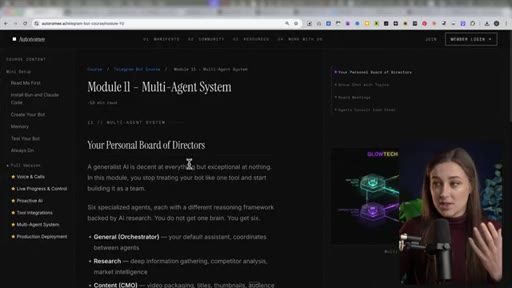
23:51This is kind of MVP, the bigger project that I'm working on, which is autonomous entrepreneurs. So this is the idea is of board of directors.
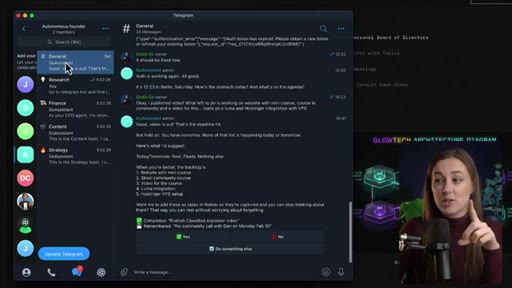
24:00We have orchestrator. I have researcher, content finance, strategy. This is how it looks.
24:04We are using Telegram groups, and then we have topics. We have specialized agents for each topic. And for example, strategy, it knows whether it's strategy,
24:14content, it knows whether it's content. But the general one is orchestrator. If I send slash command board, it goes and checks with every single specialized agent what is working, what is the memory,
24:25their special skills. Another thing that each agent can invoke, critic mode.
24:30So if they see that they need kind of like an edge, they use critic mode and there is the whole kind of smart prompt behind it. Each agent can also go and consult with another agent. But more on that in the community.
24:44And this production development. So many people ask, like, okay. Can you set it up this for businesses?
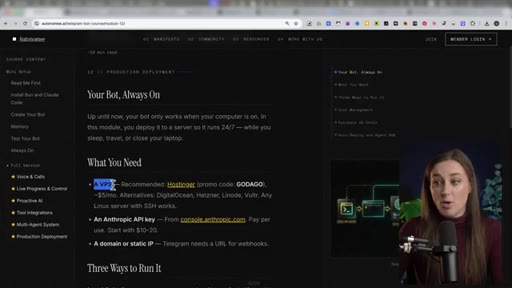
24:49But this setup with VPS, You can totally make this production development for the business and make it always on.
24:57On VPS, very important, we are not using clot code.
25:01You are paying per API calls and using agent SDK. So this is different.
25:07And many people ask, like, oh, can I still use subscription on VPS? Theoretically, yes.
25:14But OnTraffic is banning accounts. So I would not recommend it.
25:18What I recommend is, like, a hybrid approach, which I use. Everything while my computer is on is going through the subscription. But if my computer is off, it's going through APIs.
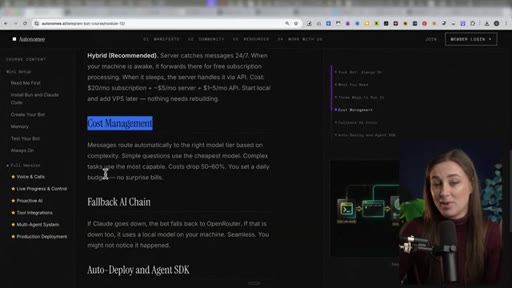
25:29We have, like, smart routing. So if it is just a simple high, it goes to high. If it is, like, something a little bit more com complex on it, if it's really complex,
25:39multistep process, it uses OPUS. So this is for cost management and then, of course, fallback AI chain.
25:45So this is also for Mac and also VPS that if on traffic goes down, that we have a fallback model because this is your AI second brain. This is your knowledge.
25:55This is your tools. You don't want to kind of, like, stop working. For fallbacks,
25:59there are different ways to do it, but in my case, I'm using fallback as open router to specific models, and second fallback is basically to the local model. You can also run local models on VPS if you want to.
26:13I'm curious what everyone is going to build on top. I already saw that people are building. Build something that is yours and your infrastructure.
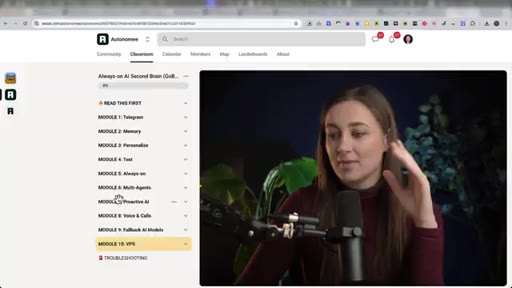
26:22Inside of the community, we have a full course explaining multi agents and how to set up VPS and also how to do it securely,
26:30CTAproactive AI, ADS, and we have constant building. So we released the full version yesterday.
26:37CTAI already pushed multiple updates and community members giving their ideas, and we are building on top of that. So I this is really exciting.
— full transcript
§ 05 · For Joe

The free course IS the product.

Autonomee playbook

Goda does not tease the good stuff. She gives it all away, calibrated to stop exactly where you need to pay.

  • Lead with working proof, not slides. Siri call in first 3 seconds beats any intro.
  • Build the free course to the exact edge of where your paid offer begins. Not less. Not more.
  • Reframe your tool for non-developers explicitly. 'Not just for developers' is a line Joe needs for JoeFlow.
  • Hybrid local/VPS routing is the right architecture for JoeFlow engine. Steal this model.
  • The fallback chain Anthropic to OpenRouter to local is three lines of config. Do it.
  • MCP-first setup: let Claude Code configure its own infrastructure. This is the install experience for JoeFlow Batch templates.
  • 'Stop renting intelligence. Own it.' Six-word positioning Joe already owns philosophically but does not say this cleanly.
§ 05 · For You

You can build your own AI assistant.

For non-developers

You do not need to know how to code to have a personal AI agent that remembers everything, answers Telegram messages, and runs tasks while you sleep.

  • Claude Code automated setup handles almost everything. Your job is to copy-paste a few tokens.
  • Supabase free tier is enough for personal memory storage. No credit card needed to start.
  • OpenAI embeddings for semantic search cost pennies. $5-10 lasts months of personal use.
  • Making the bot always on requires one command to Claude Code: 'make it always on.' It figures out LaunchD or PM2 by itself.
  • Keep your Telegram username and user ID private. Treat them like passwords.
§ 06 · Frame Gallery

Visual moments.