Greg Isenberg · Youtube · 31:28

Claude Code Clearly Explained (and how to use it)

Ross Mike and Greg Isenberg run a live crash course: plan better, skip Rolph until you can walk, and build software worth caring about.

Posted
January 19th 2026
3 months ago
Duration
31:28
Format
Interview
educational
Channel
GI
Greg Isenberg
§ 01 · The Hook

The bait, then the rug-pull.

Ross Mike opens with a blunt promise: no other Claude Code tutorial on the internet is this simple. What follows is not a feature tour but a philosophy - garbage in, garbage out - delivered live over a shared whiteboard and a running terminal while Greg Isenberg plays the curious skeptic.

§ · Voices

Who's talking.

00:00hostGreg Isenberg
00:54guestRoss Mike
§ · Topics

Where the time goes.

00:00 – 01:22

01 · Cold open + guest intro

Greg promises the simplest Claude Code tutorial on the internet. Ross commits to a blueprint by end of episode.
01:22 – 05:30

02 · Input quality = output quality

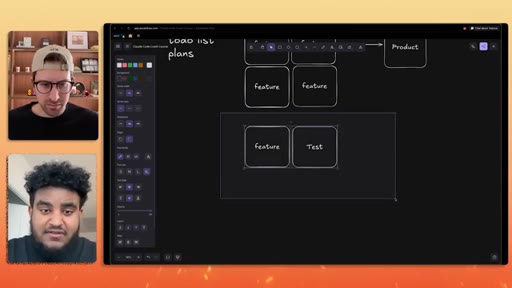
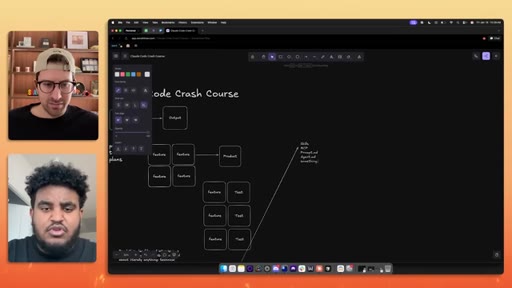
Core thesis: model quality is no longer the bottleneck. Your PRD/plan is. Think in features, not product descriptions. Each feature needs a test before moving to the next.
05:30 – 14:37

03 · Live AskUserQuestionTool demo

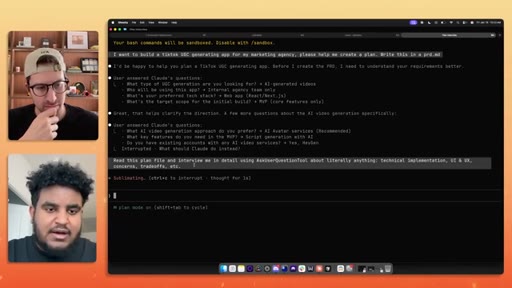
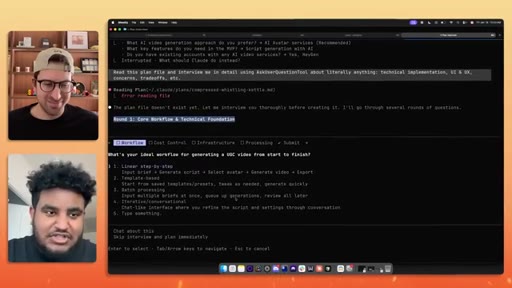
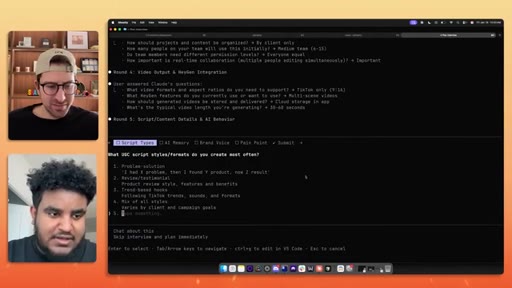
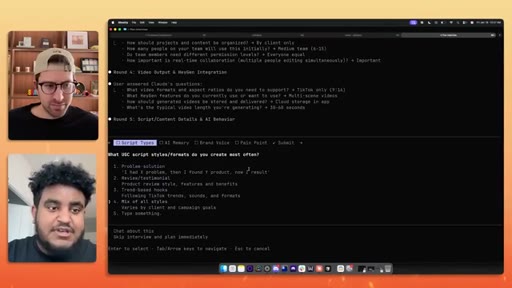
Ross demos planning a TikTok UGC app. First, standard plan mode (shift+tab). Then he pastes a prompt invoking AskUserQuestionTool -- Claude runs 4+ rounds of granular questions covering workflow, hosting, UI style, video format, and script generation.
14:37 – 17:00

04 · Why NOT to use Rolph as a beginner

The Tesla self-driving analogy: learn to drive first. Building feature-by-feature builds vibe QA instincts that agentic loops skip.
17:00 – 24:00

05 · How agentic loops work + live demo

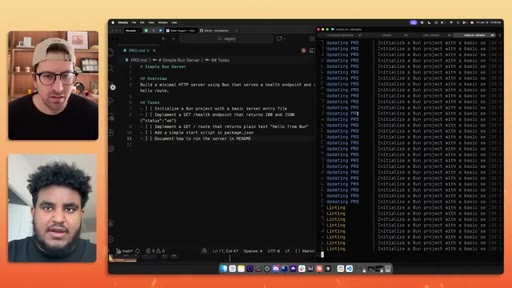
Ross explains Ralph Wiggum loops (PRD.md + progress.txt + build + test + lint cycle). Shows his custom loop running a Bun server build live. Reiterates: great loop + bad plan = token donation.
24:00 – 27:50

06 · Tips and tricks (live whiteboard)

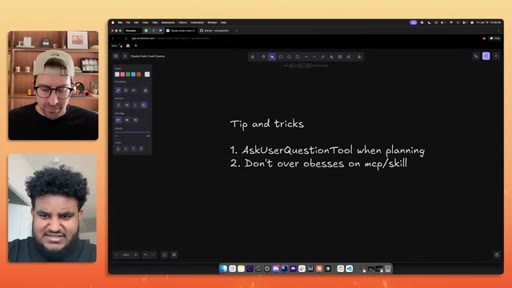
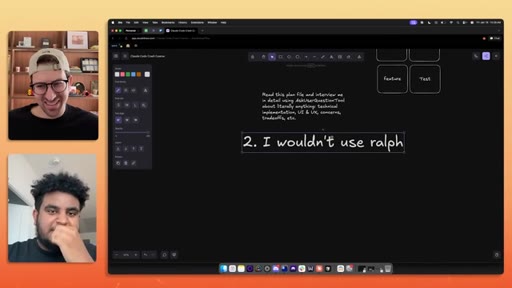
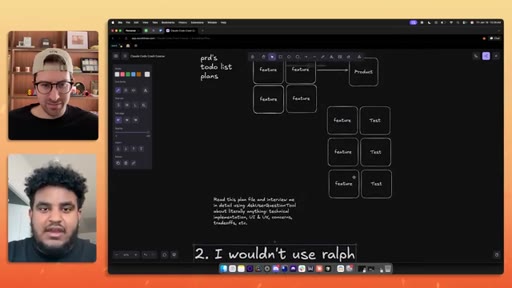
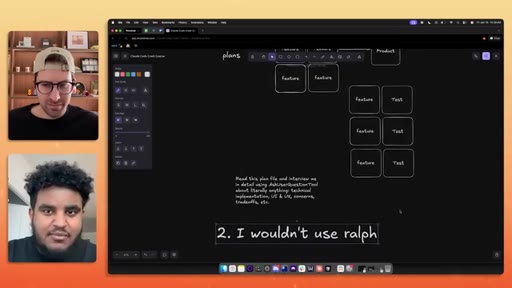
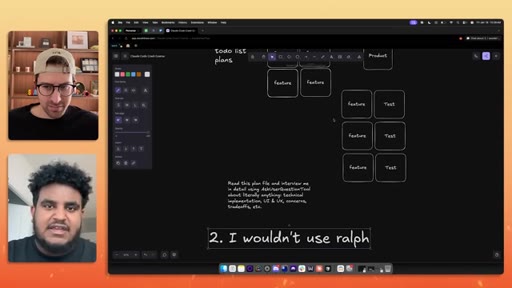
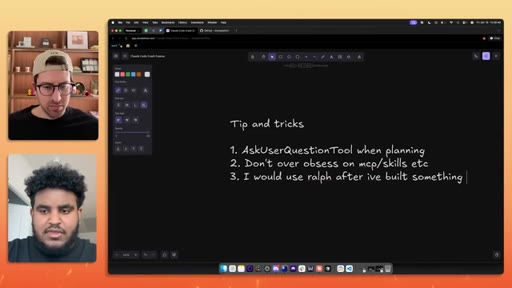
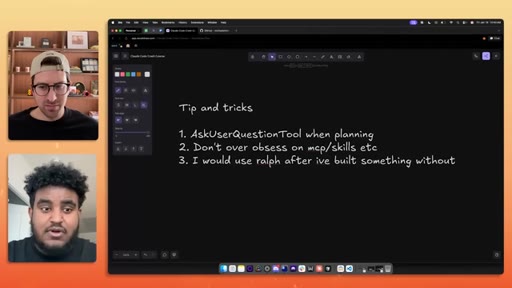
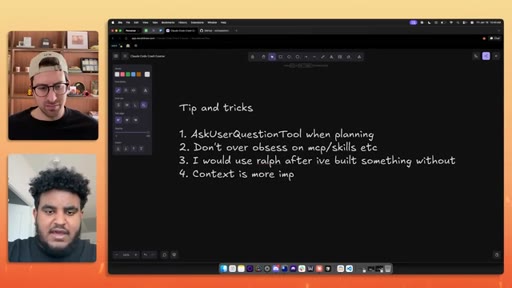
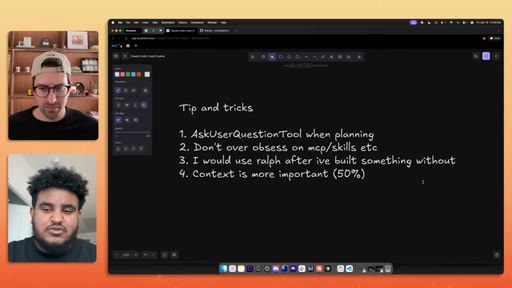
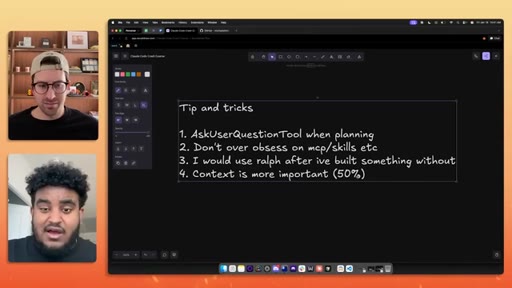
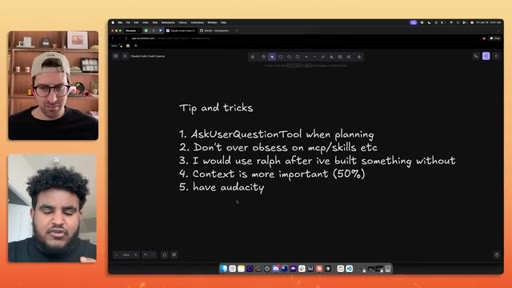
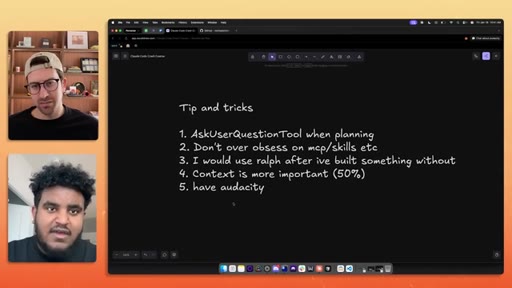
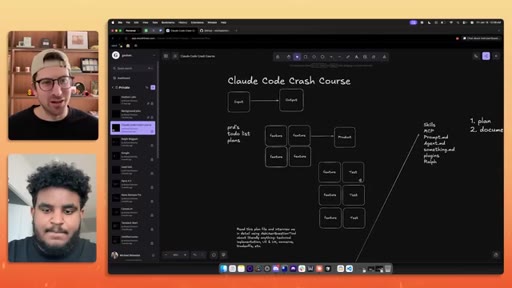
Ross builds a 5-point list on screen: (1) AskUserQuestionTool, (2) don't obsess over MCP/skills, (3) Rolph only after you've shipped without it, (4) 50% context rule, (5) have audacity.

27:50 – 31:28

07 · Audacity + Animo app + wrap

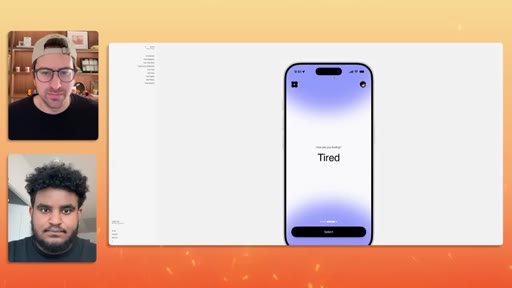
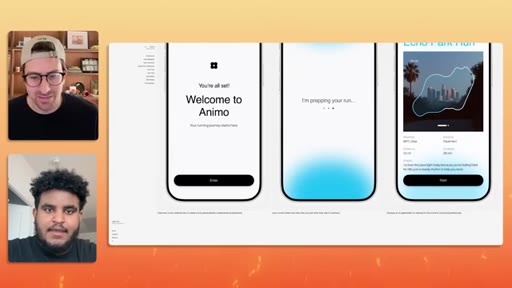
Greg shows the Animo emotion-based running app as a benchmark for taste. Both agree scroll-stopping software requires thought, not just code generation.

§ · Quotables

Lines you could clip.

02:16
"If you are producing slop, it's because you've given it slop."
Punchy thesis, no setup needed, universally applicable → TikTok hook
18:15
"If your plan sucks, then the Rolph loop won't matter. You're just donating money to Anthropic."
Memorable burn with a memorable recipient → IG reel cold open
14:06
"Building personal software is easy, but building software others are going to use is very, very difficult."
Counterintuitive for the vibe-coding era, great pull-quote → newsletter pull-quote
25:37
"There isn't a URL that I, myself, or Greg can click on that you've built - you have no business using Rolph."
Concrete benchmark + roast energy → TikTok hook
27:00
"Software development is starting to become easy, but software engineering is very, very hard."
Clean distinction most creators miss, tweetable → newsletter pull-quote
§ · Resources Mentioned

Things they pointed at.

19:08toolRoss Mike's custom Rolph loop (GitHub)
28:00productAnimo (emotion-based running app)
§ 04 · The Script

Word for word.

HOOK opening / re-engagementCTA the pitch metaphor analogy
00:00HOOKSo you wanna use code. You wanna get the most of it, but you don't know exactly how. This is a crash course, how to master Claude code, and we explain it in the most simple way. There are thousands, literally thousands of other Claude code tutorials on the Internet, but there are none as simple as this. I brought on professor Ross Mike. He comes on and he shares it in the simplest way so that anyone
00:23HOOKcan create jaw dropping startups and software using Claude Code. We're gonna give you the exact steps for how you can set it up, thinking about the beginner, how to think about the terminal, how to think about prompting. But if you stick around to the end of this episode, there's a tips and tricks section, which I think is super valuable,
00:43HOOKand I can't wait to see what you build.
00:54We got Ross Mike on the pod. By the end of this episode, what are people gonna learn? Hopefully, you're going to not feel overwhelmed with Claude Code. I know the terminal is scary and it's a big boogeyman, but I'm gonna give you the blueprint, how to use it. I'm also gonna share consider this the ultimate crash course on how to use Cloud Code or any agent effectively.
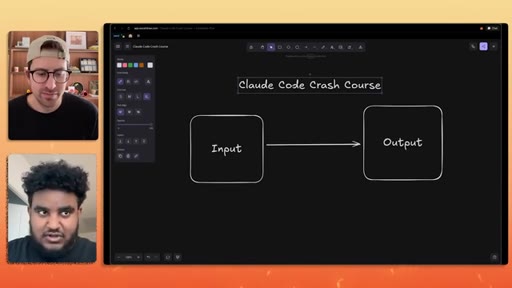
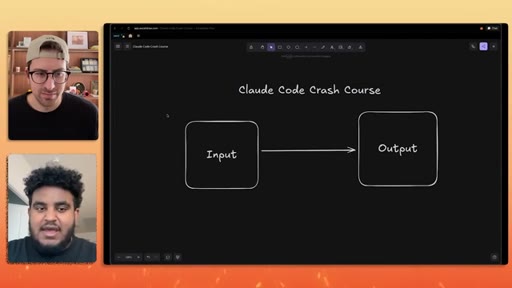
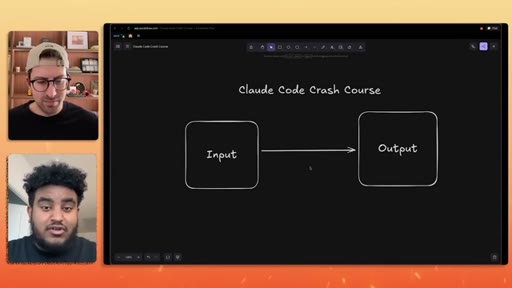
01:15Okay. Let's let's get into it. So I mean, the best way to start these episodes is with sharing our screen. So when we think of building applications using AI, using some sort of agent like Cloud Code or OpenCoder or Codex, whatever it is, there's a couple of things that you always have to keep in mind. You know, the principles never really change. One thing that it's important for us to understand is however good your inputs are will dictate how good your output is. Right? We're getting to a point where the models are so freakishly
01:50good that if you are producing, quote, unquote, slop, it's because you've given it slop. Right? Um, there was a time where the models weren't good enough. There was a time where, you know, we had serious qualms and issues with the quality of code the models gave us. But now we're starting to get to a point where even myself, like, I'm reviewing a lot more code than I write, and I never thought I'd be able to say that in the early, uh, months of 2026.
02:16So very important for us to understand. Our inputs, how good they are, how precise they are, how articulate they are, are just as good as our outputs, and we'll dictate just how good our outputs will be. And the way I want people to think about this is, Greg, is, like, imagine you were communicating this to a human to a human engineer. Right? If you give them sparse
02:37instructions and if anyone is in, like, client work, you realize that most clients, they they they tell you one thing, but you have to sort of extract the deeper thoughts of what it is they want. It's the same way when we work with these agents, when we work with Claude Code. We need to be really, really precise
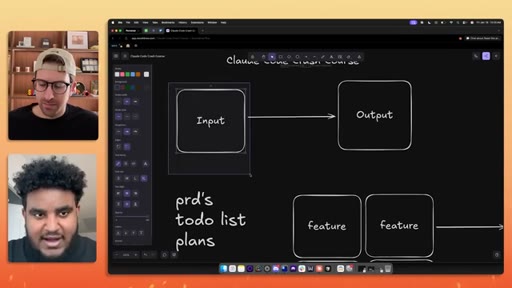
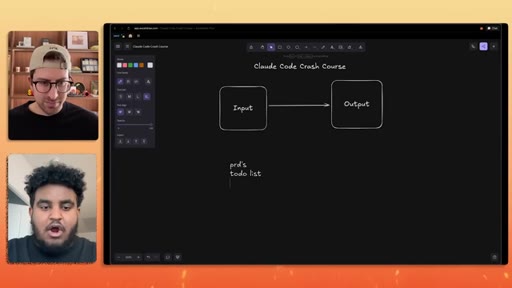
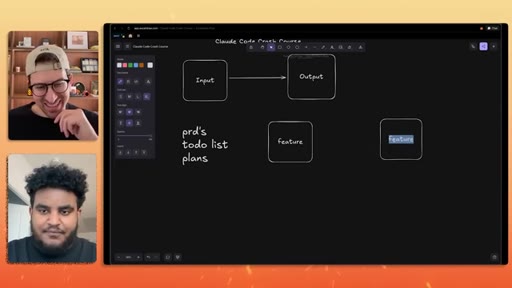
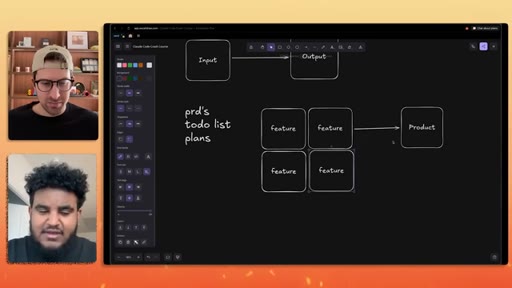
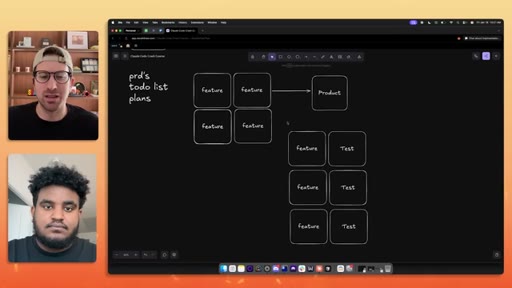
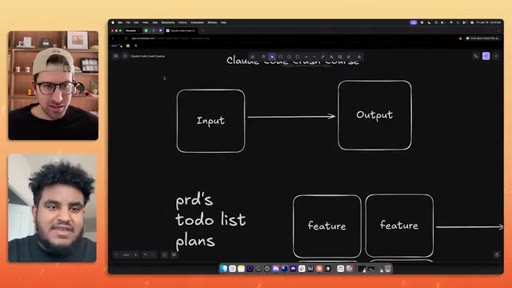
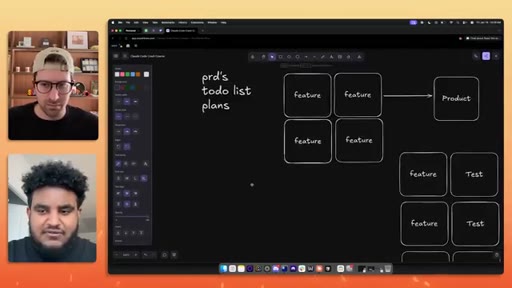
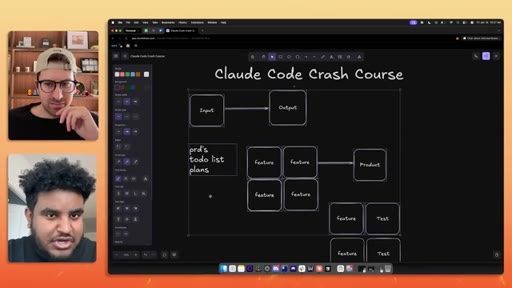
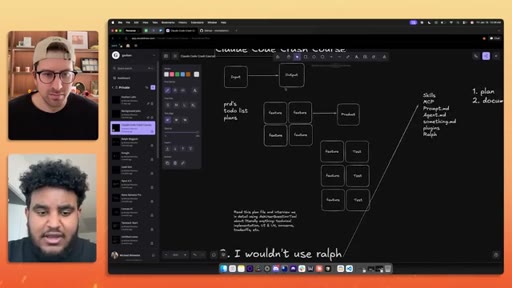
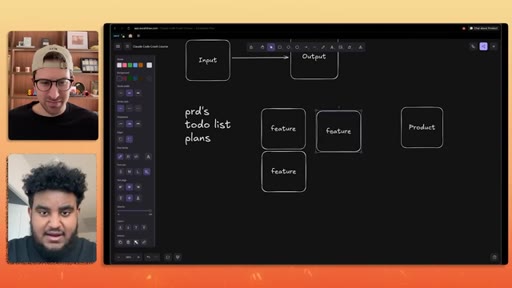
02:55with how we build our inputs. Now what do I mean by inputs? What I mean is our PRDs or our to do list or our plans. Right? Like, there's you know, people are giving you different names. Um, it doesn't really matter. It's all the same thing. Right? And when we think of a PRD or when we think of a to do list or when we think of a plan, I want us to think in such a way as this. Let's say I'm trying to build
03:20this product. Right? Let's say, I don't know, Greg, any product ideas that Me have product ideas? Yeah. That's actually the first best best person to ask. Right?
03:33Let's say I go on idealbrowser.com and I was just going to it. I was just going to it. Yeah. Pick pick the idea of the day from Idea Browser. It says it's a diagnostic tool for appliance text losing hundreds of repeat visits. See, I have no idea what that means, but let's say I know what that means. Essentially, when thinking of this idea and looking to build this into a full fledged product, generally, the way you're going to think is, okay. If the if product x does
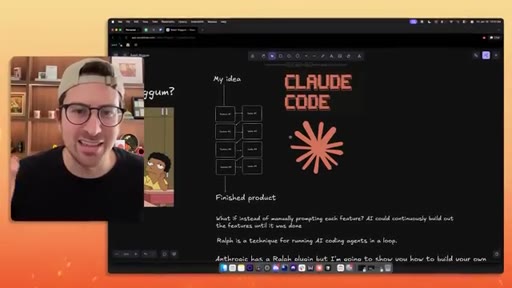
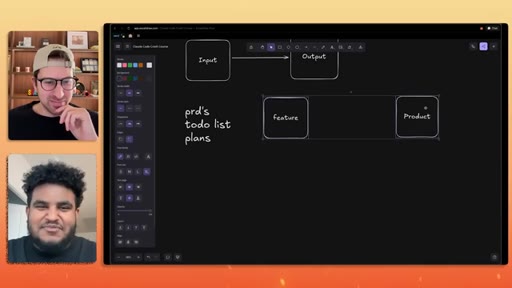
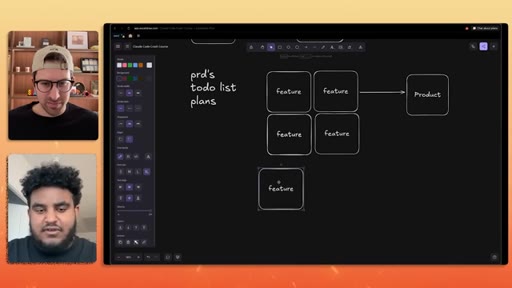
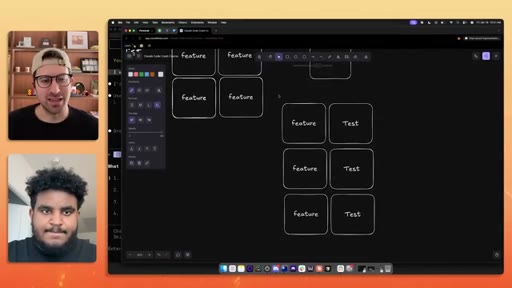
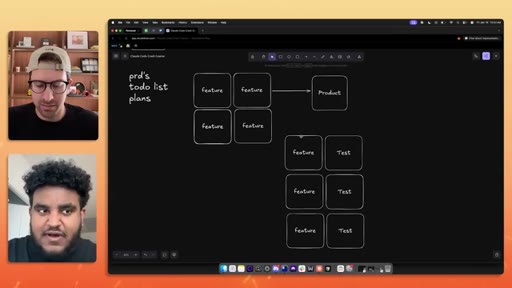
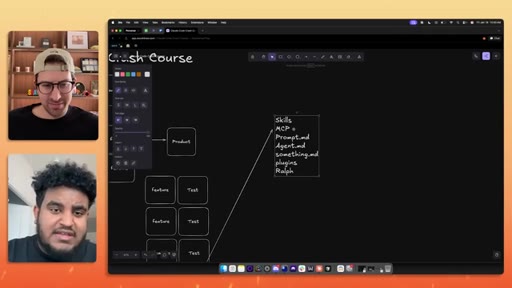
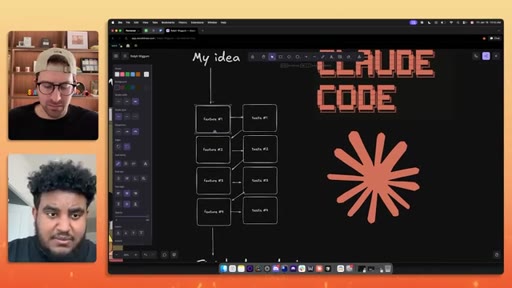
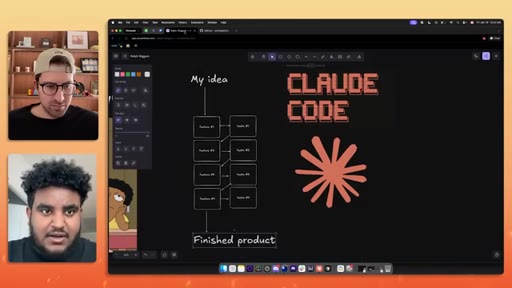
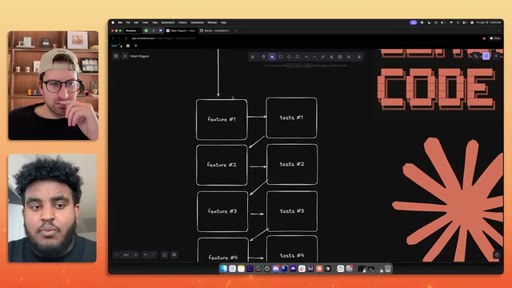
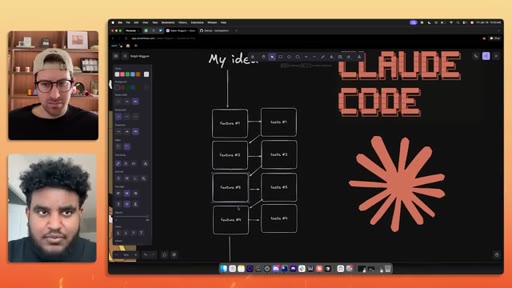
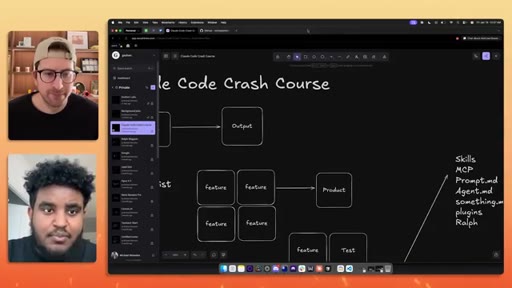
04:02y zed a b and c, how I would reach that is I'm going to think of features. Right? So let's say there's four core features to this application that Greg just mentioned. And if I have these four features built out, we can safely assume that we have said product. Right?
04:20The way we are to design our PRDs to do list and plans is such that we want the agent, the model to build out all these features. Right? Because all these features put together is our product. You see, a lot of times people will describe a product, not describe features, and will be frustrated with AI. Like, AI is supposed to magically know what you're thinking about.
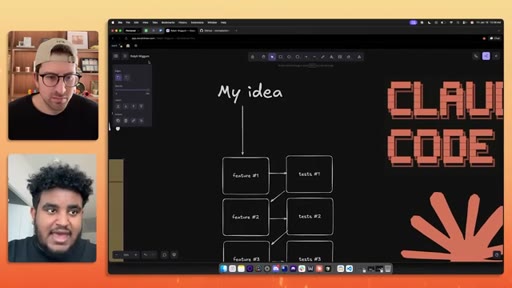
04:44By the way, Greg, am I making sense so far or am A 100%. I'm with you. Yeah. So we really need to think in features. But here's the cool part. When developing features, oftentimes, the issue with models is, like, you'll develop a feature or, like, let's say, the model develops a feature. We don't know if it works. We don't know if it did it the right way. That's where with all the cool Ralph stuff that's happening, we can introduce tests. Right? So let's say, uh, the model, the agent build builds feature one. Before moving moving on to feature two, what I'm going to do is I'm going to get the model to write a test. If that test passes, then we'll work on the second feature. If that test passes, we work on the third feature. Right? So we're finally entering an era where
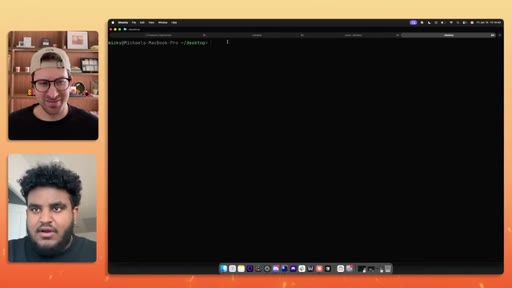
05:27you can really build something serious with these models. So instead of telling you about just, uh, planning, why don't we do actual planning together? So I'm gonna pop up my terminal.
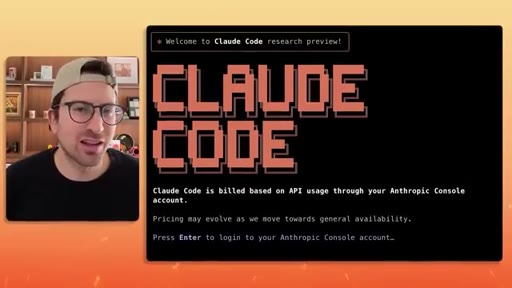
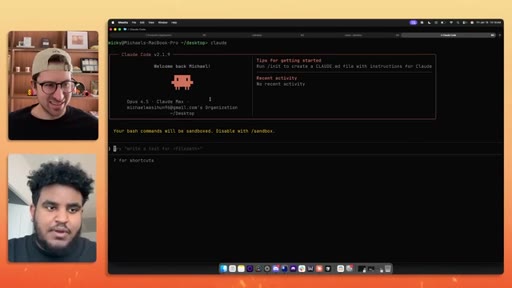
05:40So I know everyone's afraid of the terminal, but in all honesty, if you don't know how to use a terminal, ask AI. Like, it's the, like, simplest thing. And if not, you can even download the Claude code app and go on code section, give it a specific folder you want to work on, and use the app. Like, there's literally no excuse to not use Claude code. If you're afraid, boohoo, just jump into use AI, you have all the tools. That being said, I'm just going to type in Claude,
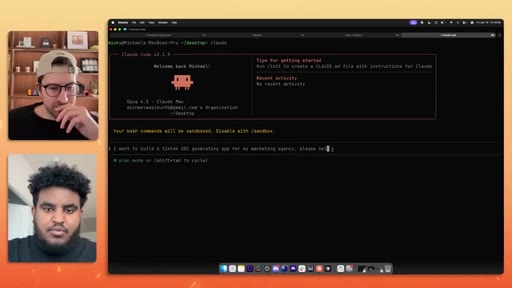
06:04and we're going to have, uh, Claude code open. And usually how people plan is they'll click shift tab. Right? And then you have plan mode on and you can say, let's say, I want to build TikTok UGC
06:20generating app for my marketing agency. I see, like, these UGC apps everywhere.
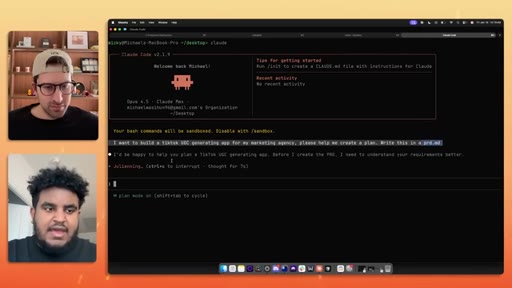
06:28Um, please help me create a plan. Write this
06:36in the in PRD dot MD file. So this is how most people have planning setup. Right? You'll tell Cloud Code or Cursor or whatever agent,
06:50uh, to do the plan for you and you ask it to be in some file and like it says, it'd be happy to help you plan this out and it'll ask you some questions, etcetera, etcetera. But I found that there's a better way to get an even more concise plan and this way, it actually gets you to think a lot more about trade offs, concerns, UI, UX decisions because most of the time, you're sort of allowing the AI to have free reign over certain decisions, which I think, uh, will lead you with a finished product that you're not excited about.
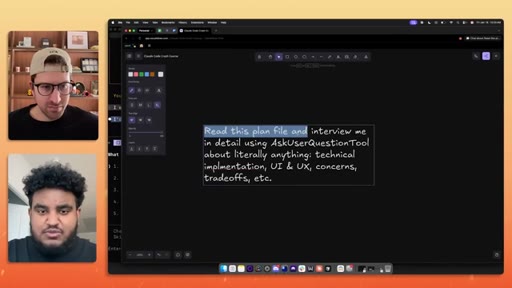
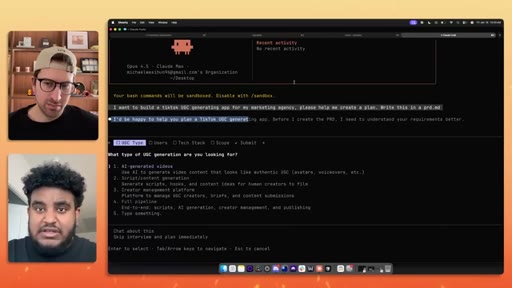
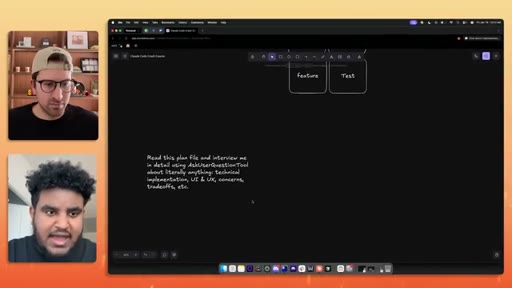
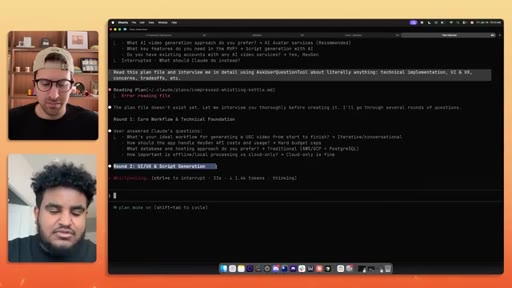
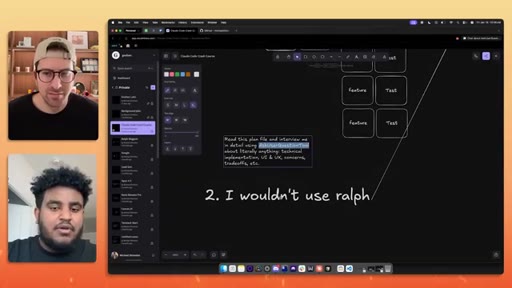
07:21And that's invoking a special tool. I was gonna show you guys the tweet, but unfortunately, Twitter's down right now. But Cloud Code has a specific tool called ask user question tool. And essentially, what this tool does, it starts to interview about the specifics of your plan. Right? So I'm gonna drop this prompt where it says read this plan file, interview me in detail using the ask user question tool about literally anything, technical implementation, UI, UX concerns, and trade offs. I spelled implementation wrong. Do not judge me.
07:54And what this is going to do is it's going to go past the plan that we have and start to ask us about minute details. So let's finish off this plan first. I'm just going to accept, um, this is internal use. Uh, tech stack will use react. I just want core features.
08:10We'll submit answers. And then Cloud Code, you'll see, might ask us a few more questions, but this will generally be the plan. Right. So it's it's not just it's not just the plan. It's the right plan. Right? Like, to what you were saying, like, go back scroll back up here, the features and yeah.
08:29The features and test. Like, the way I think about this, and I don't know if you agree, is, like, if you ask Claude Code to build you a car, it doesn't really know what a car is. It doesn't understand, like, you need a steering wheel and a, you know, a radio and you need wheels. So the the the hard part is trying to figure out is basically explaining what those things are in a really
08:52succinct and clear way, and that's what this interview is basically doing. It's it's explaining each of them, and then we're gonna test each of those features. Exactly. Like, think of think of it this way, like a simple example. Let's say you ask the AI agent to build you a specific feature. Right? How is it going to present that specific feature? Did you want it in a dashboard? Did you want it to be a modal? Did did it have to be a separate page? Like, when you don't specify these minute details, it will make the assumption for you. And with Ralph loops and all these type of things, like, you might have a whole application built out and it's not exactly to the liking or the expectations you had. Right? So let me continue. I'll just make some selections here just so we can move on
09:36and then hit submit. And then I'm gonna pause this planning here and then I'm going to paste this. I'm gonna say read this plan file and I'm gonna tag the plan file. It's called PRD dot MD. We have that right here. And I'm gonna say interview me the details about this question, or I don't even need to tag it because it has it in its context,
09:58but I just want to show you how annoyingly, uh, annoying this is going to get. Meaning, it's going to keep asking me questions about said plan or said, uh, app idea. So
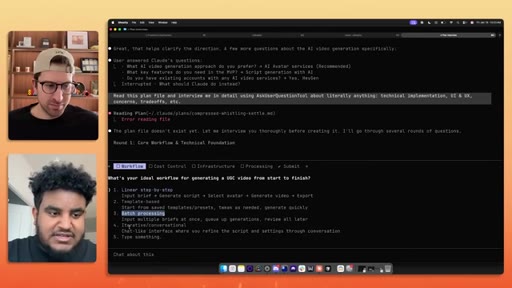
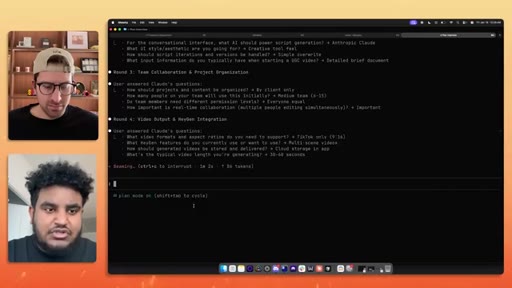
10:12notice how it says round one core workflow and technical foundation. Right? And some of the questions it might even ask you are things that you might not know about because you're not technical. So what do I do when I don't know something, Greg? I'm gonna copy this and I'm gonna go to the chatbot of my choice, whether it's Claude, Chad, GBT, whatever, and I'm gonna ask you questions.
10:28So if you remember earlier, it asked me generic questions about the app. Now it's saying what's your ideal workflow for generating UGC video from start to finish? Like, notice how the questions are even more specific now. So it says linear step by step, template based, batch processing, iterative,
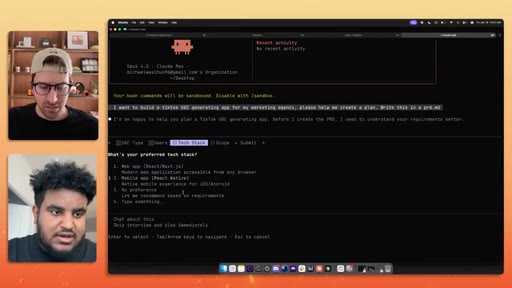
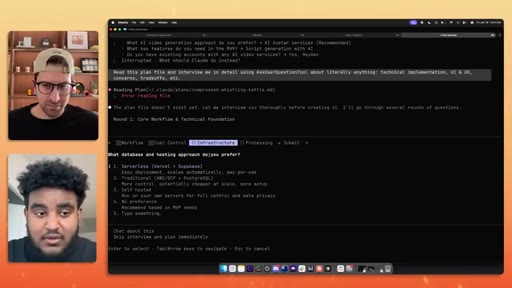
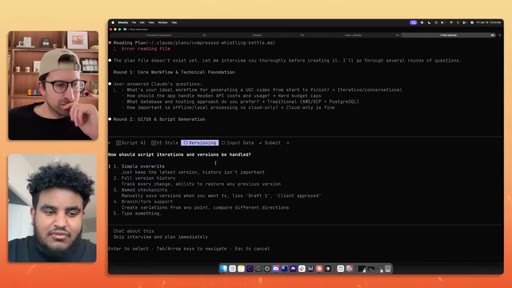
10:46conversational. So let's say I select that, and it says, how should the app handle agent API costs and usage? So now it's talking about costs. Right? Again, most of the times when you just have a basic plan, this is not included in the plan. Right? Let's say we wanna have a hard hard budget. What database and hosting approach do you wanna use? Most of you probably watching this have no idea. So I can copy this over, go to chat GBT, and ask what's the best decision. This is my current situation. And then you keep going, you keep going, and you submit answers. So when you use this ask user question tool,
11:20the questions become more granular. So it asked me about core workflow and technical foundation. Now it's going to ask me about UI, UX, and script generation. If you notice the first plan that it came up with, uh, the default plan for Claude code, it was pretty basic. Now it's asking me, okay. What AI do I wanna use for the script generation? I'll use Claude.
11:41Uh, what UI style aesthetic are you going for? Minimal clean, dashboard heavy, creative tool feel, chat first. Right? So, hopefully, Greg, I'm making sense with, like, how much more questions I'm being asked when I'm invoking this ask user question tool. Yeah. It makes complete sense. You're also you're also gonna use less tokens in the end. Right? Because you're right? Gonna
12:06Yeah. Because the thing is the better your plan, the better your input, the better the initial set of documents that you give the model, the the better the outcome. And if the better the outcome, there's no back and forth. Right? Most people will have a Ralph loop running. It'll be a basic plan, and it'll do what you told it to do, but you weren't specific. So now you're going back, and then maybe you're running another loop or you're going back and doing all these changes. But if you get it done right, if you invest the time in
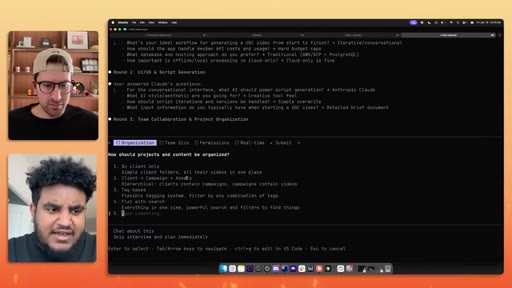
12:35the planning stage, I 100% believe you'll save a lot more money, and this will help you clear up a lot of ideas. So, like, for example, this idea that we just had, this TikTok UGC farm, how do we want it set up? Do we want it to be flat with search? Do we want it to be client campaign? As there's a lot of, like, these minute details that you're not thinking about. And because you're not thinking about it, you're allowing Cloud Code to make those assumptions for you. Right? Which at the end, after it's burned through a ton of tokens, now you're going back to change. Right? We can save so much headache if we do the proper planning from the beginning. And hopefully, um, people see value
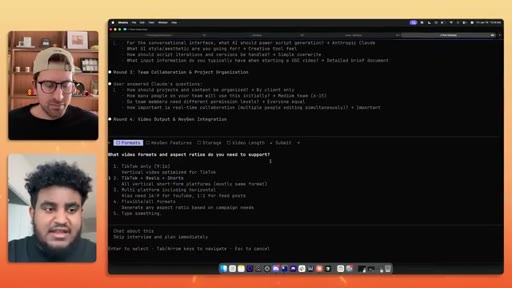
13:16in this, um, ask user question tool. Make sure you specify it in your prompt. And hopefully, Greg, that that made sense. It does. So I would say step number one for this Claude crash course is I would get good at planning. I would get really, really good at planning. I would get good at generating these. Right? Like, look, it it keeps on asking me questions. If you notice the very first plan that we generated with Claude, it was two sets of questions and it was ready to build. But with this, it's asking me, do I have basic avatars, custom avatars,
13:49multi scene videos? How do I wanna handle storage? Do I wanna download the videos instantly? Cloud storage, external storage. Like, there's so much to software engineering. And I I think in our last video, you, um, someone shared this on Twitter. I don't know if it was you or someone else. Like, software, uh, building personal software is easy, but building software others are going to use is very, very difficult. And if you don't have the audacity or the decency to to set up a little time, a little extra time to plan, then I guarantee whatever you generate is going to be AI slop. And you might blame the model, but really the problem is you. So invest in your plans. Spend time using planning. Um, don't use the generic plan,
14:30uh, mode that cursor or ClaudeCode has. I would use ClaudeCode, and then I would specify the ask user question tool. It's going to continue to annoy you with questions like it keeps asking. Right? Because until it knows exactly what it is you want, it won't start building. So I would say that's step number one to building with Cloud Code. Step number two, and everyone's talking about Ralph and it's exciting,
14:56um, but I wouldn't use it. I wouldn't use Ralph. And the reason I wouldn't use Ralph if I was just starting out, Greg, is because, um, how are you going to like, imagine this. Like,
15:10not knowing how to drive, but then buying a Tesla for, uh, like, the self driving stuff. Like, cool in theory, but maybe it's a great idea to know how to drive, how to steer, how to hit the corners, how to maybe yell at someone when they cut you off before you get the full automated version. I say this to say because when you get good at developing plans
15:33and then working with the AI to build each feature and testing each feature, you you start to develop the sense on product building on on like, you know, even, uh, I heard someone call vibe QA testing. You get this sense by going one on one yourself. And this is why a lot of people who were fighting with Claude Code all these months are really, really good at using it now because they spent the time building without using these crazy automation loops. So if you're using Cloud Code for the first time or you're just getting into it, good plan, number one. And number two, get your reps in by not using Ralph. So develop the features one by one. Now that you have your plan, you can literally tell Cloud Code, hey. Okay. Let's build the first feature.
16:18Um, you know, go ahead and do it. And then once the feature is done, you can test it or ask it, how can I test this? How can I run this app? I wouldn't jump into using Ralph right away. Build without Ralph. But let's say you've built these reps. Now and you're you're comfortable with Cloud Code. Now you hear about all these things, skills,
16:40m c p, prompt dot m d, agent dot m d. What else is there? Something dot m d. You you hear all these conventions, plug ins. You have Ralph, all these things. So what do I need to perfectly build something
16:58using Cloud Code or AnyAgent? I'll be honest with you. Most of these things are all the same. PromptMD and AgentMD are just markdown files. Plug ins
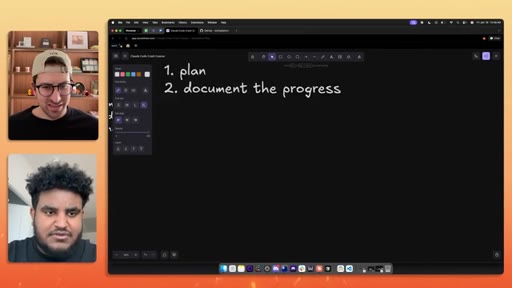
17:09are skills with, you know, a little bit extra. What you need to build successfully using these agents is, first of all, you need a good plan, right, which are documents, which is the PRD dot m d we just generated. And then you need, uh, to document,
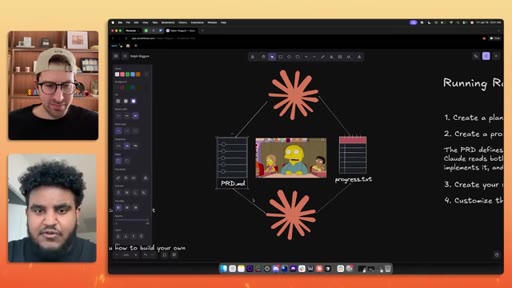
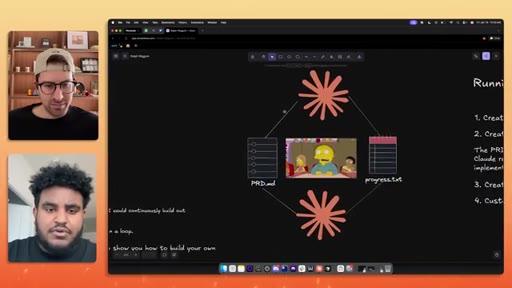
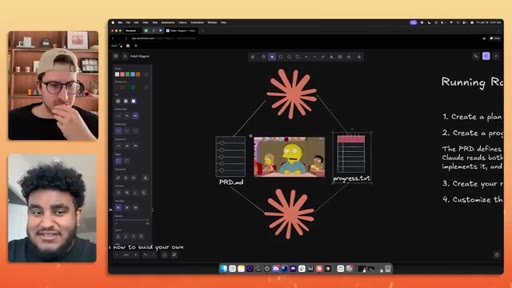
17:28um, the progress that's being made. Um, for anyone who's familiar with for with Ralph, you know what I'm talking about. For those who aren't, what's cool about a Ralph loop is as follows. A Ralph loop is basically you have a list of things that need to be get that need to get done. Uh, the, whatchamacallit,
17:47the p r d dot m d or the plan. You give it to the AI model. The model works on the first task. It finishes. It then documents it in another file, and then it it goes again. And it stops until it's completed the whole list. Now this isn't anything special,
18:05but the reason why it's now super powerful is because the models are getting so so good. But here is the issue. If you have a terrible plan, if you have a terrible PRD, this doesn't matter. You're just donating money to Anthropic, and I wish you the best of luck if that's what you want to do. But if you want to make sure that your tokens are not wasted, you're going to invest in a good PRD dot MD file or a good plan file.
18:31Greg, am I making sense so far? A 100%. Okay. You're driving the point home. Yes. So I'll talk a little bit about Ralph
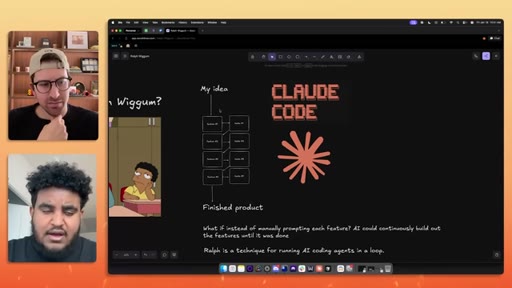
18:40now. So with mister Ralph Wiggum, how do we use this? Now there's a lot of different iterations, like people are coming with their own style. I'm gonna share with you my Ralph setup in a second.
18:53Greg. One thing I will say is Cloud Code has a plug in, a Ralph Wiggin plug in. I wouldn't use that. And the reason I wouldn't use that is even the person who invented the whole Ralph system is against it. It's not the best use of Ralph, but I just wanna share this concept of how Ralph works. It's essentially
19:12going to go through our plan, and it's going to build out each feature step by step, and it's not going to stop until it's done. This is cool when your plan rocks. If your plan sucks, then it's terrible. It doesn't matter. Now in terms of how to set up, um, Ralph Wiggum, I have my own setup, and I don't want anyone to think I'm shilling my own setup for any reason. But the reason why I built my own setup is there's a couple things my Ralph loop does.
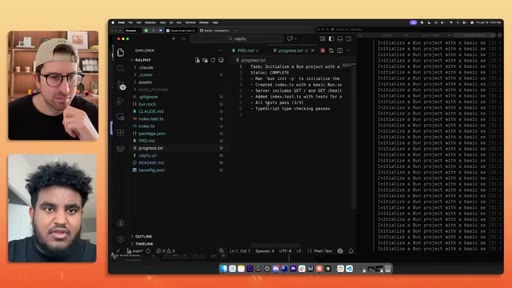
19:43The first thing is it makes sure that there's a plan, a PRD dot MD file, and there's a progress dot TXT file. But it also every feature it builds, it then writes a test, and it then lints.
19:57And, basically, what this does is it makes sure that every feature that's built actually works. Right? Because there's no point on working on feature two if feature one doesn't work. If feature one doesn't work, if the test fails, guess what the AI model is going to do? It's going to go back to working on feature one. And once the test passes, we work on feature two. And then once feature two test passes, we work on features three. Right? All this is awesome, but I'm gonna go back to the same point. If your plan sucks,
20:26then the Ralph loop won't matter. Now, in order to set up this loop, you can find the Git up here. How to set it up? You honestly, I'm not even going to explain it. Greg, people can literally copy the link, pass it to Claude, and then be like, I want to run this Ralph loop, and it will tell you exactly what to do. That's how good the models have become. But I'll show you an example of this running.
20:51So I have a simple PRD dot MD file. It's nothing crazy. It's just to show you the point. But, basically, there are a couple tasks here. I want to build a basic server that has some basic endpoints, and I just wanna show you how my Ralph loop works. So when I run this Ralph loop, and again, if you don't know how to run this, the you paste the GitHub URL
21:13in Cloud Code in your agent and ask it, and it will tell you how to do it. I have a few different configurations. I can use open code if I want. I can use codecs if I want, but I'm just gonna use Cloud Code. And I'm just gonna run the script. And, basically, what it's going to start doing is it's going to start running through each task as you can see, and it's going to update the PRD,
21:36and it's just gonna continue to work. Now I can go and leave. Right? I can go about my day, hang with, um, hang with, uh, Greg, and this loop will continue to work. And I'm going to see that at some point, whether it's five minutes, three minutes, ten minutes, however long this is, this is going to finish all the tasks. I'm going to have a working product built,
21:58and all this is cool, but it doesn't matter if I'm gonna go back to the original document if the plan isn't good. Now skills are great. MCP's are great. All these different markdown files are great. You would do yourself a serious service if
22:16your if your plan is good. So the key to successfully building with Cloud Code is you have an absolutely great plan, and if you use the ask user question tool, you will spend so much time on the plan where it starts to get annoying, it doesn't get fun, but those of us who focus on this will end up having better outputs. Um, let's continue. If you notice here,
22:42my Ralph loop is continuing to go and it took care of the first task. I can see some files already generated. If I go to the progress dot TXT file, you can see, Greg, it started to make some progress. It's documenting that, and this is just going to continue to work. This is just going to continue to run. So people have different iterations. I know the amp code people have their own iteration,
23:03and different people have their own iteration. It doesn't really matter. Right? Someone's Ralph is could be better. Someone's can be worse. Someone's can be all of that is cool, but don't get stuck in the weeds. The main sauce is how you can articulate perfectly in a beautiful presentation
23:21create the perfect input because if you create the perfect input, we have reached a point where the models will give you perfect output. So that's my main, uh, tip crash course for people. Use the ask user question tool. Build without using Ralph. And if you are going to use Ralph, understand if your plan sucks, you're just donating money to Anthropic, and I think Anthropic has enough money that they don't need your money being donated to them.
23:49Amen. Amen. Is there anything else people need to know, like little tips and tricks? I noticed, you know, you're not using the Mac terminal, you're using Ghosty. Yes. Yes. So, honestly, it's all preference. Right? So, like, the terminal you use and all this stuff is all preference. Here's what I would say. Like, let's have
24:11a tips and tricks list. Tips and tricks. So first, I would say is
24:18my goodness. Spelling today. First, I would say is use the ask what was the specific tool? I just wanna make sure I don't forget. Ask user questions tool. Slept on. I don't know why no one's not talking about it. It literally I saw the tweet from the Anthropic team. 100%, I would use that when planning.
24:37Uh, number two, don't over obsess
24:42obsess on, uh, MCP skills, etcetera, etcetera. I'm not saying don't get into these. I'm not saying don't read about them. I'm not saying don't use them, but I can almost guarantee you these things are not the reason why your product isn't working. Right?
24:59Most of the time, it's your plan sucks. Right? That's number two. Number three, I would use Ralph after I've built something without.
25:11And the reason being is, again, listen, if you are a baller shot caller and you have all the money to blow and you don't care and you wanna donate money to Anthropic, go ahead and use Ralph. But if we were to sit here eye to eye and you haven't built anything, deployed anything, there isn't a URL that I, myself, or Greg can click on that you've built, you have no business using Ralph. You literally have no business using Ralph. I would first get good at prompting
25:37and building something using a plan, whether it's whatever a g one, cloud code, open code, whatever. Once you have something deployed to Vercel or, like, there's a URL and we can use it, then you can use Ralph. Number four, um, this is a little in the weeds, but context is more important than ever.
25:58And a lot of times, ClaudeCode or even Cursor will tell you what percent of context has been used. I generally wouldn't go over 50%. Meaning, like, the Anthropic model, Opus 4.5 has a 200,000 token context limit. The moment, in my opinion, you've got over a 100,000 tokens, meaning you're using the same session,
26:19it starts to sort of deteriorate. That's when you have people, Greg, who say, oh, like, I started off good, but it started going bad. That's because you've filled it with so much context. And the best way to think about this is, like, yourself. Right? Like, let's say we went to some English class and or some, you know, whatever class, and the professor just kept dumping information, information, information.
26:41At some point, we're gonna feel overwhelmed, and we're gonna actually start forgetting stuff. And I'm not saying that's how the models work, but that's how the models act. Right? So context is very much important. The moment you see 50% or even 40%, I would start a new session. And last but not least, have Audacity.
27:00And what I mean by that is software development is starting to become easy, but software engineering is very, very hard. And what do I mean by that? Um, to architect software, to make sure things are usable, to create great UX UI, to have great taste, to make something that people actually use requires time. And in order to spend time, it requires audacity. I know the models are good, and you can clone a $6,000,000,000 software.
27:25But if all of us can do it, now what makes software different? I think thinking about those things and thinking about the art of building products and building something that's tasteful is very, important. And I think anyone who uses these five, uh, tips should kick cheeks in 2025 2026. Sorry. I
27:45agree on the Audacity thing. I think, like, it's for me, it's, like, about creating scroll stopping software. You know what I mean? Like, there's so many people, and there's a lot of tutorials about this, like cloning billion dollar software. You know, I cloned a $4,000,000,000 software. Look at me.
28:01But that's not the type of software that's going to work in 2026. Right? I saw this let me just share it real quick.
28:10I saw this guy who created a running app based on how you're feeling. So it's like, how are you feeling? Stressed? Angry? And it's an AI assisted running app that interprets current emotions to generate a personalized route. And I just thought it was interesting. You know what I mean? Like, I had never seen an app like this. And I think that, like, as, you know, you call it Audacity, I think this is an audacious app. Right? It's scroll stopping.
28:37You haven't seen it before. So I think push you wanna push Cloud Code to, like, get you to this, basically.
28:46And and and this is why I'm, like, so pro people not using Graph if they haven't built anything fully because, like, now where people are getting to a point where they they want the model to think for them. Right? Where, like, if you look at the app you just shared, the animations and how things were floating and, like, even the colors used for the different emotions, like, that required thought. Right? And that's what stops people now. Like, if building the AI chat interface is easy, what's going to make your app different? I think a little bit of audacity, a little bit of thought and care, and a little bit of taste goes a long way nowadays.
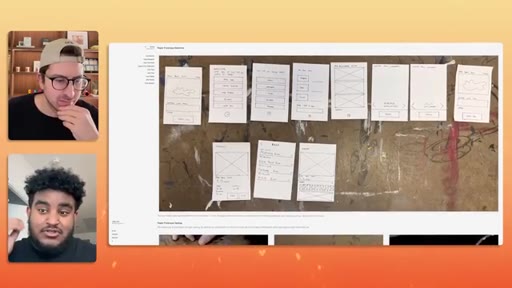
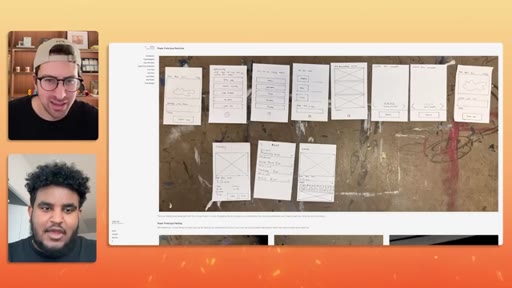
29:19And more than the models getting better, because it's going to get easier. It's going to get better. It's going to get faster. But, unfortunately, if you don't change, then it doesn't all matter. Yeah. And don't be afraid to use pen and paper. Like, this this person literally just, like, started sketching out the features.
29:36Yeah. Like, how did this thing work? Yeah. How should this feel? Like and I love it. I love it. Right? And and this is why the app if I don't know the metrics, but I'm willing to bet it's doing really, really well because all this stuff matters. Like, we could clone something like this feature wise, but I'm willing to bet, like, the feel, the animations,
29:53CTAthe colors, we would not be able to get it exactly like this. 100%. Alright, man. Thanks for coming on. You got me fired up. I actually I didn't know about that interview tool, so thanks for sharing that with me.
30:09CTAYeah. Just a heads up, it will ask a lot of questions. I shared it with a couple friends and a couple people got annoyed, but it's worth it. Right? Especially if you wanted to build something end to end or you're building a very, like like, very minute detailed feature, then it's really, really worth it. I wouldn't use the general plan personally.
30:28CTASo just a heads up, but it's really, really worth it, and I would love to hear people's feedback in the comments. Sounds good. We'll be in the comments. You gotta come back on in a few months or whenever people want you. It's always an absolute privilege to have you here. I'll include links where you can follow
30:46CTAand you should follow Monsieur Ras Mike. His YouTube channel is x. I'll include the link to Ralphie even though if you're a beginner, don't even click that link. I I wouldn't. Like, I know there's maybe some degenerates who do, but I'd highly suggest you don't because if you haven't even built without it, then no point some willpower
31:09CTAfolks. Come on, you know. Don't click the link. But I'm putting it in there because I wanna see who's tempted. And, yeah, thanks again for coming on. I'll see you I'm coming to Toronto in April, so let's hang out. Well, we'll see we'll see each other then. And again, as always, it's a pleasure. Thank you so much, know, for bringing me on. Of course. Later. Have a good one.
— full transcript
§ 05 · For Joe

Your plan is the product.

Claude Code operating system

The model is no longer the bottleneck - your ability to write a precise, feature-level plan is.

  • Add this to your planning prompt: 'Read this plan file and interview me in detail using AskUserQuestionTool about literally anything: technical implementation, UI & UX, concerns, tradeoffs.'
  • Think in features with tests, not product descriptions. A feature is done when its test passes, not when it compiles.
  • Build your first three features manually before touching any agentic loop. You need the reps.
  • Set a 50% context hard limit - start a new session when you hit it. Quality drops fast after that.
  • The PRD.md + progress.txt + test-gate loop is the cleanest Rolph pattern. Steal it from Ross's GitHub.
  • Audacity is now the moat: every clone is easy, but taste, animations, and feel are still hard. Build scroll-stopping, not feature-complete.
§ 05 · For You

Before you vibe-code your next idea.

For builders just getting started

The difference between AI slop and something people actually use is thirty minutes of planning you probably skipped.

  • Before writing a single line of code, spend time in Claude's planning mode - and ask it to interview you, not just generate a plan.
  • Describe what each feature does, not what the app does. 'Users can upload a video and get a script' beats 'a TikTok UGC tool.'
  • Don't automate until you understand what you're automating. Build one feature at a time first.
  • Keep your chat sessions short - start fresh when you sense quality slipping. Context fills up and the model forgets details.
  • The apps worth building in 2026 require taste, not just prompts. Sketch it on paper first.
§ 06 · Frame Gallery

Visual moments.