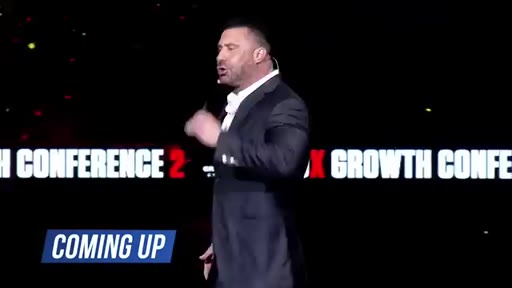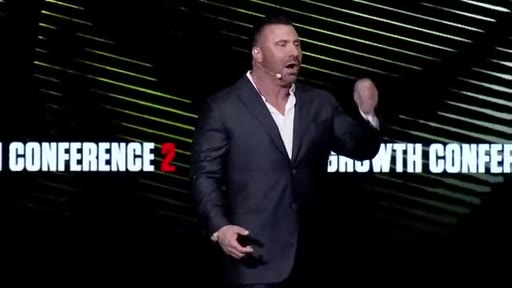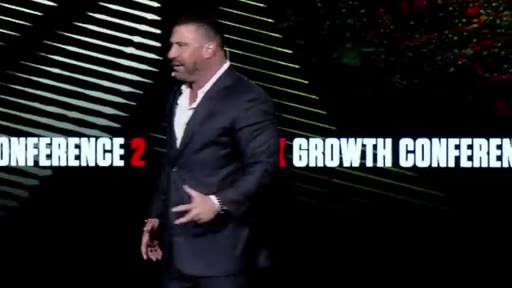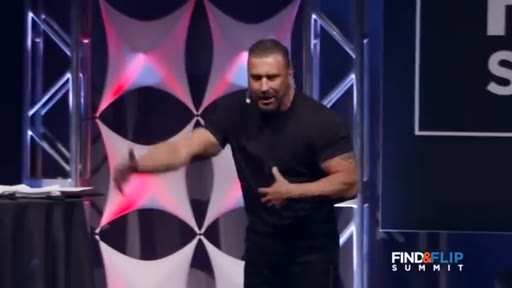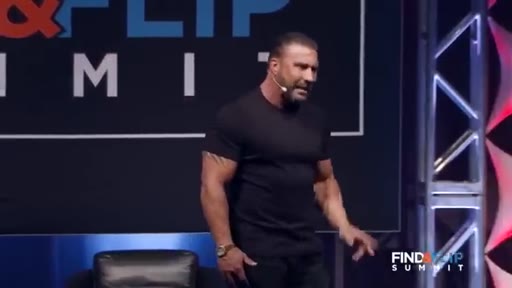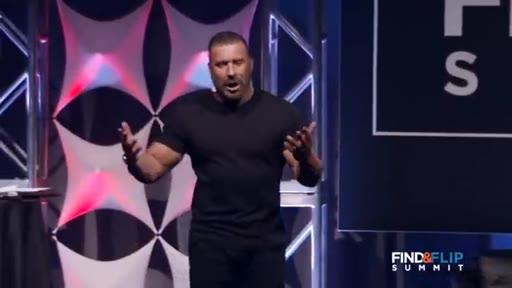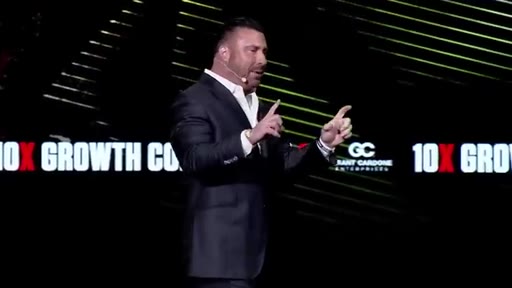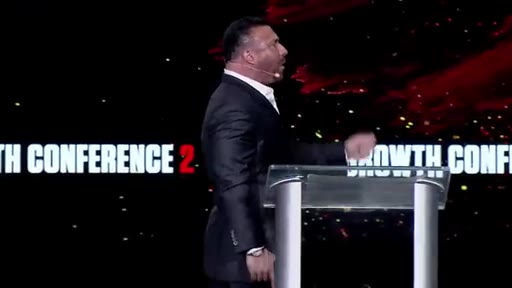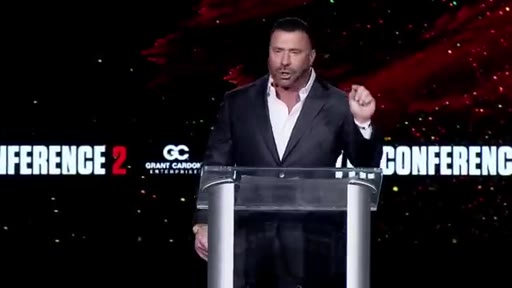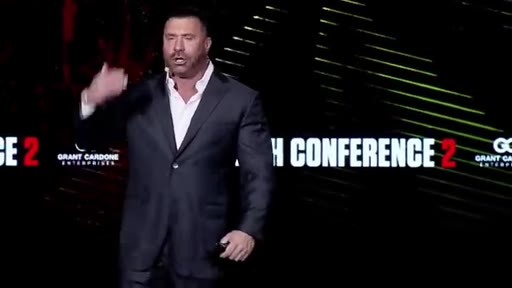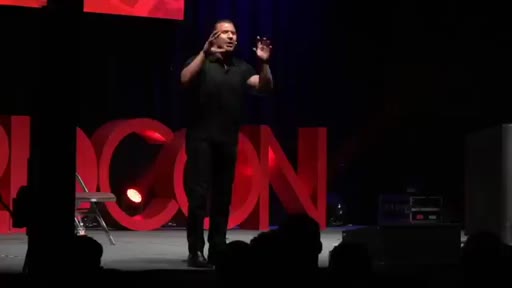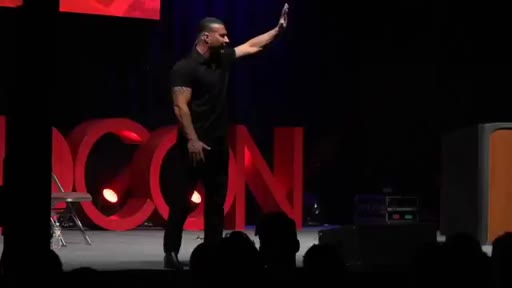
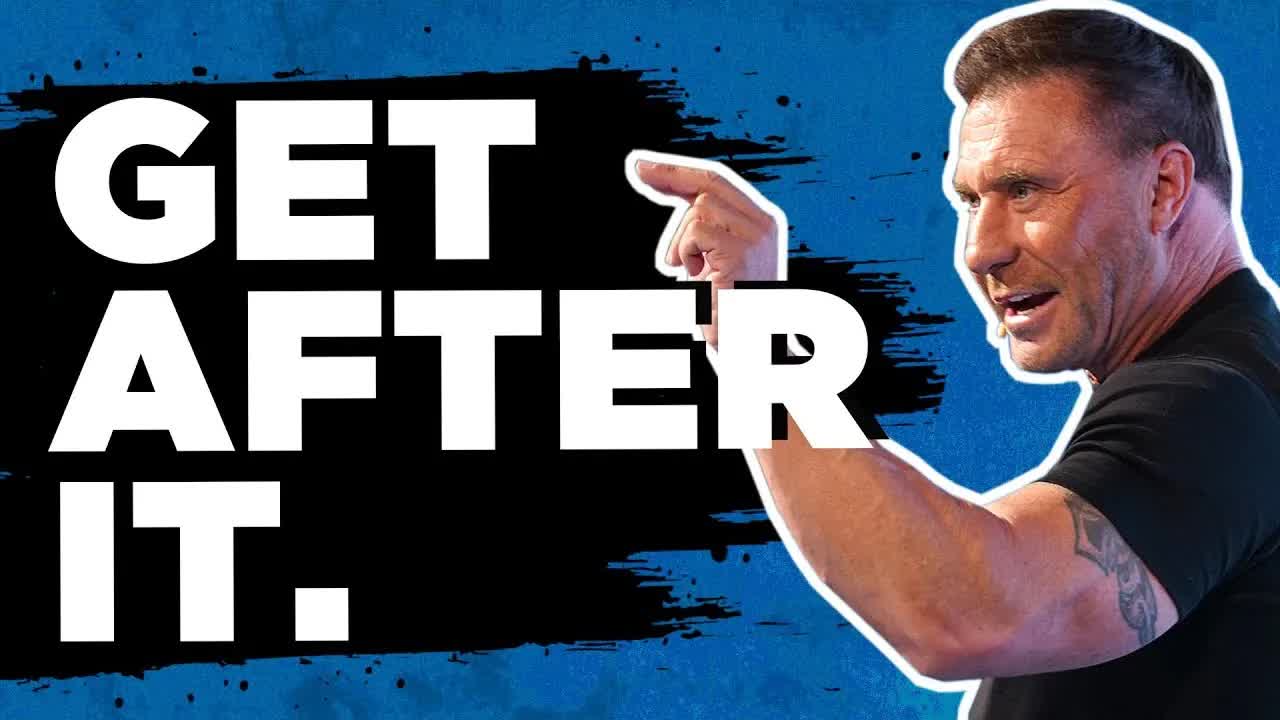
The bait, then the rug-pull.
The opening line arrives without setup: "Your past does not disqualify you." Four seconds in, with the crowd already buzzing, he is already inside the room — not walking toward it. What follows across 47 minutes and five different stages is a single sustained argument dressed in different rooms: the pain you survived is not a liability you carry but the skill you needed all along.
Where the time goes.

01 · Pain is the source code
Opens with the disqualification hook, builds through the Phil Heath pain-relationship story, then delivers the alcoholic father origin story — explaining how two core skills (presence and communication) were built at age five. Ends with the one-more philosophy from his father's sobriety.

02 · One decision away
Introduces the argument that you are always one decision from a different life. Reframes desperation as an asset using the missing-baby analogy. Lands the obsessions-become-possessions principle.

03 · The identity thermostat
The centerpiece framework. Identity functions like a thermostat set at 75 degrees — every external result that exceeds that setting gets regulated back down within 90 days. Winning is 75% psychology, 25% mechanics.

04 · Blissful dissatisfaction
Dismantles the belief that enjoying success kills drive. Neurological case for celebrating wins. Introduces the cost vs. worth distinction — poor thinkers negotiate price, wealthy thinkers negotiate worth.

05 · Stop bullshitting everyone
The confrontational segment. Direct call-out of people too comfortable to admit their real position. The 86,400-seconds framing. Destroys the need-to-know-more excuse with perfection as the lowest possible standard.
06 · Your will is not for sale
Introduces pre-negotiation: decide the price you will pay before adversity arrives, so failure and comfort cannot purchase your surrender. Most entrepreneurs sell their dream — decide yours is not purchasable.

07 · The lead character
The extras-vs-lead-characters framework. Cab driver number two does not appear in any important chapter of your life, yet holds enormous power over your decisions. Lead characters can rewrite their script at any moment.
08 · The destiny twin
The closing hallucination: at the end of your life you meet the person you were born to be. Heaven is when you are identical twins. Hell is when you are total strangers.
Visual structure at a glance.




Named ideas worth stealing.
The Identity Thermostat
Identity functions like a thermostat set to a fixed temperature. Any external result that exceeds your internal setting gets regulated back down within approximately 90 days. The only durable way to hold a higher result is to raise the thermostat setting — your self-concept.
The Destiny Twin
A visualization framework: at the end of your life you meet the person you were made to be. Heaven is when the two of you are identical twins. Hell is when you are total strangers.
Pre-negotiating the price
Decide the maximum price you are willing to pay for your goal before adversity arrives — not during it. Most people re-evaluate the price in the moment of pain and sell their dream. Pre-commitment eliminates the in-the-moment negotiation.
Lead Characters vs. Extras
In the story of your life, most people who consume your mental energy are extras — they do not appear in the important chapters. Stop giving power to people who are not in your book.
The One More Philosophy
Instead of committing to a permanent forever decision, commit to one more day, one more attempt, one more rep. The unit is small enough that it is always achievable, but it compounds.
Blissful Dissatisfaction
The sustainable performance state: genuinely happy in the present while remaining driven to improve. Rejects both delayed gratification and the belief that satisfaction kills ambition.
Lines you could clip.
"Perfection is the lowest possible standard. Quit trying to be perfect."
"You can't exceed your identity long term. It'll never happen."
"If you can survive the temporary, you'll meet another version of yourself."
"Heaven would be you catch him. Hell will be you meet that man you were capable of being and you're total strangers."
"Our obsessions become our possessions."
Things they pointed at.
How they asked for the click.
"If you're willing to fight, follow me on social and I'll help you with the fight."
Soft and earned — he has spent 47 minutes giving; the ask is positioned as a continuation of support, not a close. No product pitch, no link, just social follow.
Word for word.
The thermostat always wins.
Every result you achieve is secretly governed by an internal identity setting — and until you raise that setting, external wins will keep decaying back to baseline.
- Your most valuable skills are often built inside the experiences you least wanted — the pain you survived is not baggage but source code.
- Winning is 75% psychology and 25% mechanics: all the right actions run through a mismatched identity produce nothing that holds.
- Identity functions like a thermostat: results above your set point get regulated back down within 90 days, which is why most people yo-yo rather than compound.
- Desperation is a high-performance state, not a liability — the people who have slowed down are the ones who have allowed themselves to feel less desperate.
- Obsession determines outcome: because you are always obsessing about something, the question is only whether you are obsessing about what you want or what you fear.
- Celebrating wins is not a luxury — it is neurologically required; without it, the brain stops producing the dopamine that sustains the drive to perform.
- Pre-negotiate the price of your goal before adversity arrives, not during it — most people abandon their dreams mid-pain because they are still deciding whether the price is worth it.
- Perfection is the lowest possible standard because it guarantees you never execute; the best performers act without complete information, make a mess, and iterate.
- The difference between cost-thinkers and worth-thinkers is the question they ask when evaluating a sacrifice — one asks what it costs, the other asks whether it is worth it.
- The people whose judgment paralyzes you do not appear in the important chapters of your life; stop casting them as lead characters.